You’ll find Mississippi’s ghost towns steeped in dark histories, from Civil War devastation to natural disasters. Rodney’s abandoned churches stand sentinel after the Mississippi River’s westward shift, while Bankston’s lone store marks where Confederate textile mills once thrived. Rocky Springs harbors tales of Union occupation and yellow fever victims, with reported ghostly apparitions in its cemetery. Electric Mills’ empty streets and Plymouth’s flood-ravaged remains offer glimpses into these forgotten communities’ haunting legacies.
Key Takeaways
- Rocky Springs features ghostly apparitions in its cemetery, where yellow fever victims and Civil War casualties are buried.
- Rodney’s abandoned 19th-century churches and 200-grave cemetery are frequent sites of reported paranormal activity.
- Electric Mills stands eerily empty with abandoned theaters and businesses following its sudden 1941 closure and population exodus.
- Bankston’s solitary cemetery marks where Confederate factories once operated before Union forces destroyed the town in 1864.
- Grand Gulf preserves haunting Civil War-era ruins within its state park boundaries, showcasing remnants of its violent past.
The Confederate Legacy of Bankston
While many Civil War ghost towns dot Mississippi’s landscape, Bankston in Choctaw County stands out for its essential role in Confederate manufacturing.
You’ll find its Confederate legacy deeply rooted in textile production, as it operated the state’s first successful mechanically powered mill. The mill thrived before the war, with annual dividends reaching 37 percent. The town’s Bankston Textile Mill became fundamental to the Southern war effort, churning out clothing, shoes, and cloth for Confederate forces.
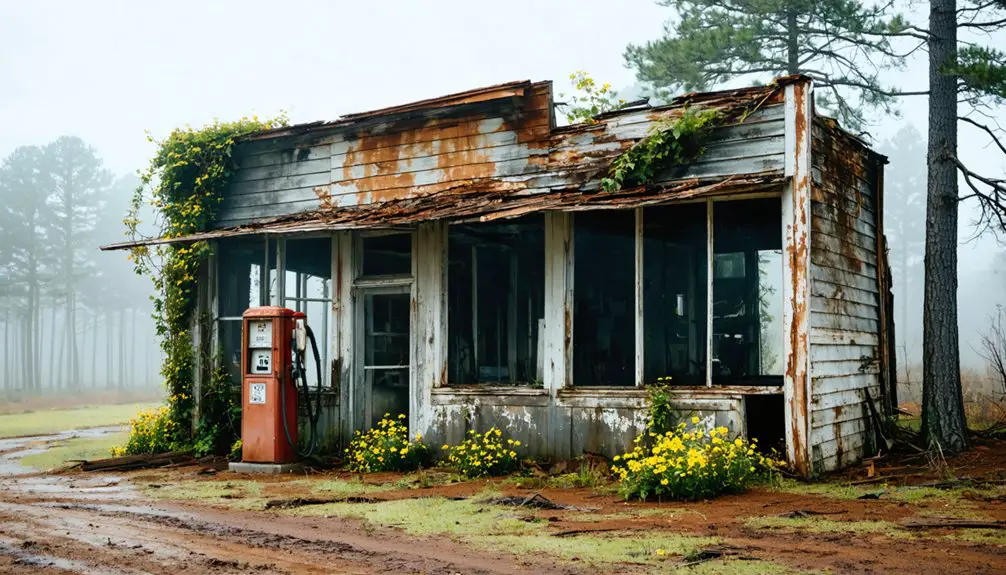
By early 1862, you could see thousands of yards of lindseys and jeans flowing from its production lines at $0.75 per yard. The mill’s significance made it a prime target, and Union forces finally destroyed Bankston’s factories in December 1864. Today, all that stands is one lone store amidst overgrown forests.
The mill’s $0.75 per yard textiles proved vital to Confederate forces until Union troops razed Bankston’s factories in 1864.
Today, you’re left with only ruins of this once-thriving industrial center that supplied essential materials to the Confederate cause.
Rodney’s Flooded Past and Silent Churches
After the Mississippi River dramatically shifted two miles westward in 1870 due to a massive sandbar formation, the once-prosperous port town of Rodney began its slow descent into abandonment.
The flood history that followed proved merciless, with devastating events in 1912, 1927, 1935, 2011, and 2016 gradually washing away residents and structures.
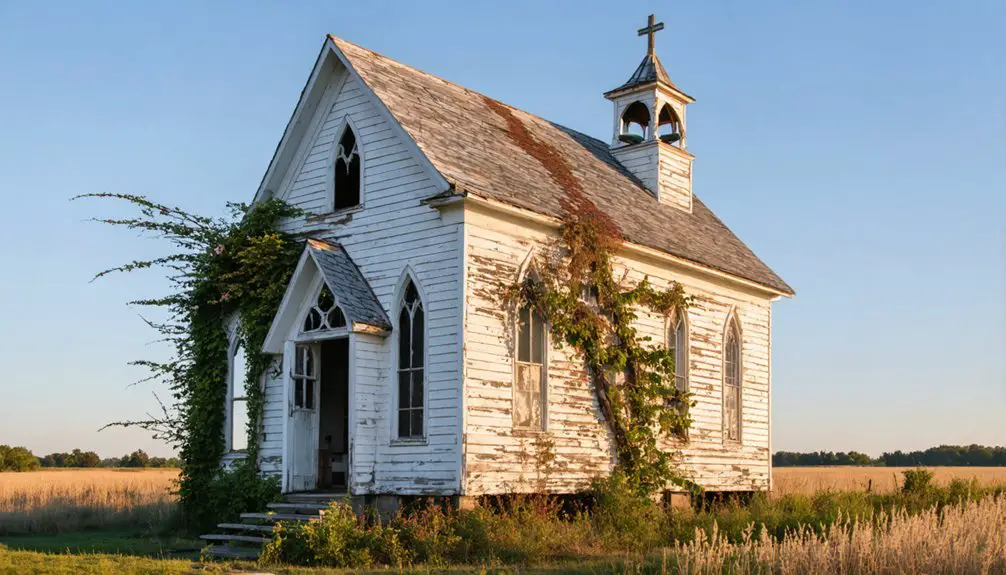
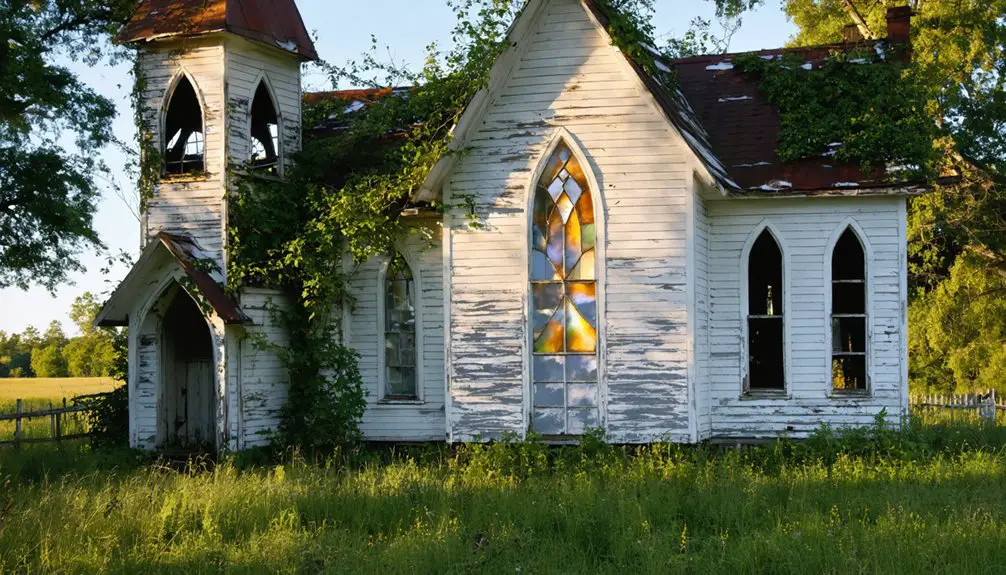
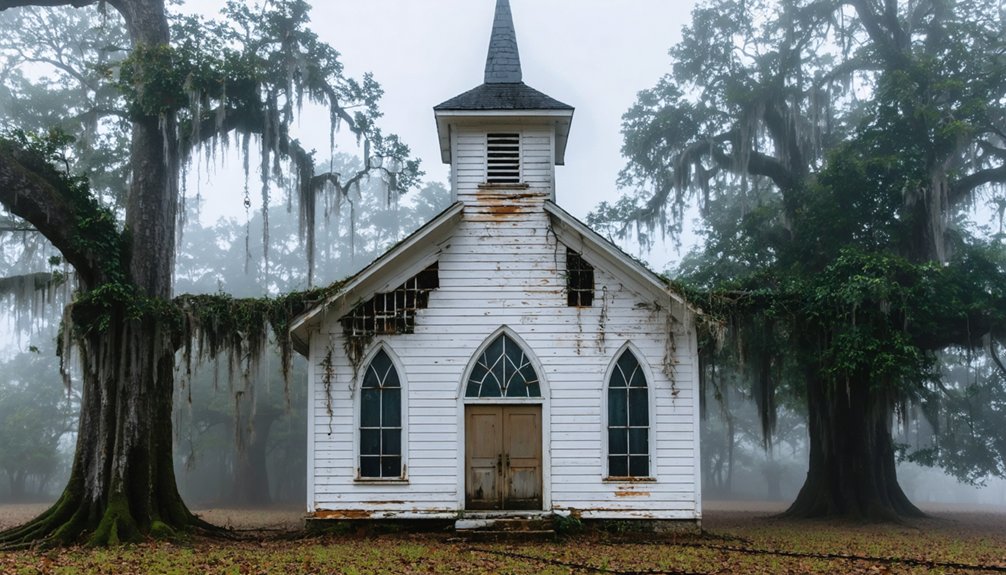
Today, you’ll find only two 19th-century churches standing as silent sentinels: the Federal-style Presbyterian Church and the Greek Gothic Revival Sacred Heart Catholic Church.
These remarkable examples of church preservation have endured multiple disasters, with the Presbyterian Church surviving three documented fires, while Sacred Heart narrowly escaped the devastating 1869 blaze.
Now surrounded by encroaching wilderness, these hollow structures rise from muddy waters during floods, marking what was once Commerce Street—now four miles from the shifted river. The town’s decline was further sealed when the Natchez, Jackson & Columbus Railroad bypassed Rodney, dealing another blow to its commercial prospects.
The Rodney History and Preservation Society has taken ownership of the Presbyterian Church and actively works to protect these historic landmarks from further deterioration.
Plymouth’s Native American Heritage
As you explore Plymouth’s ghostly remains, you’ll discover John Pitchlynn‘s vital role as a diplomatic liaison between the Choctaw Nation and U.S. government during the War of 1812.
The deerskin trade economy sustained early diplomatic relations between Native Americans and European settlers before Plymouth’s establishment.
Hernando DeSoto’s expedition first crossed through this historic area in 1540, marking the earliest European contact with local tribes.
Pitchlynn’s strategic fortification of Plymouth Bluff proved essential for defending allied Choctaw and Creek territories against hostile Red Stick forces.
While Pitchlynn founded Plymouth proper in 1832, recurring floods along with Columbus’s rapid growth led to the settlement’s swift abandonment within a decade.
Pitchlynn’s Diplomatic Legacy
Through his remarkable career spanning the mid-19th century, Peter Pitchlynn emerged as one of the most influential Native American diplomats in American history. His unique background as a bilingual leader with both Choctaw and European ancestry positioned him perfectly to advocate for his people’s rights.
After receiving education at institutions like Columbia Academy in Tennessee, he developed the intellectual foundation that would serve him throughout his diplomatic career. Pitchlynn’s contributions included serving as Principal Chief, leading critical negotiations with federal officials, and tirelessly defending Choctaw sovereignty in Washington, D.C. You’ll find his legacy most evident in his strategic approach to diplomacy – collecting documentary evidence, framing legal arguments in Euro-American terms, and testifying before Congress.
His unwavering dedication to his people led him to establish the Choctaw Academy near Georgetown, Kentucky, which was supported by tribal funds. At Plymouth Bluff, where his family once held land, you can still sense the impact of this skilled negotiator who fought to protect Choctaw interests during America’s tumultuous shift from antebellum to Reconstruction eras.
Early Settlement Flooding Impact
While Plymouth Bluff’s strategic location offered defensive advantages during the War of 1812, this same topography ultimately contributed to the settlement’s decline.
Similar to the harsh winter conditions that decimated early Plymouth Colony settlers in 1620, environmental challenges posed significant threats to survival.
You’ll find that flood dynamics played a significant role in Plymouth’s fate after its 1832 founding, as the settlement’s position near the Tombigbee River exposed it to recurring inundation risks.
Today, visitors can explore nearly five miles of nature trails that wind through the historic settlement area.
The settlement decline occurred rapidly, with Plymouth becoming virtually abandoned within a decade.
Despite the area’s rich Native American heritage, stretching back thousands of years through Choctaw settlement, the environmental pressures proved too challenging for sustained development.
Today, you can explore the 190-acre site, which stands as a monument to nature’s impact on human settlement patterns and the delicate balance between strategic positioning and environmental vulnerability.
The Rise and Fall of Electric Mills
- Free electricity illuminated every building, a revolutionary concept that attracted 2,500 residents.
- The self-contained community thrived with its own currency, hospital, and entertainment venues.
- Timber Depletion by 1940 marked the beginning of the end.
- Within months of the 1941 closure, the population plummeted to 100 as workers sought opportunities elsewhere.
- A general store that doubled as the Courthouse Post Office served as the town’s main commercial establishment
- Poor farming families, rather than wealthy planters, comprised the primary customer base
- No significant industrial enterprises or railroad-connected businesses ever developed
- The absence of substantial commercial growth beyond courthouse-related services sealed the town’s fate
- Union soldiers reportedly materialize near the church, where they once camped during their devastating occupation
- Echoes of Civil War devastation linger in two rusted safes and abandoned cisterns
- The dried-up springs whisper tales of the town’s gradual demise
- Spectral figures are said to roam the cemetery, where yellow fever victims rest alongside war casualties
- https://en.wikipedia.org/wiki/List_of_ghost_towns_in_Mississippi
- https://www.onlyinyourstate.com/experiences/mississippi/ms-ghost-towns
- https://mississippifolklife.org/articles/haunted-by-a-ghost-town-the-lure-of-rodney-mississippi
- https://freepages.rootsweb.com/~gtusa/history/usa/ms.htm
- https://kids.kiddle.co/List_of_ghost_towns_in_Mississippi
- https://www.geotab.com/ghost-towns/
- https://www.tripadvisor.com/Attraction_Review-g28945-d10045204-Reviews-Rodney_Ghost_Town-Mississippi.html
- https://www.youtube.com/watch?v=kkDWL9dpNII
- https://www.authentic-campaigner.com/forum/military-forums/authenticity-forums/14133-mississippi-manufacturing-company
- https://kids.kiddle.co/Bankston
Today, only scattered remnants and a historical marker remind you of this once-flourishing community.
Americus: A Lost Chapter in Jackson County
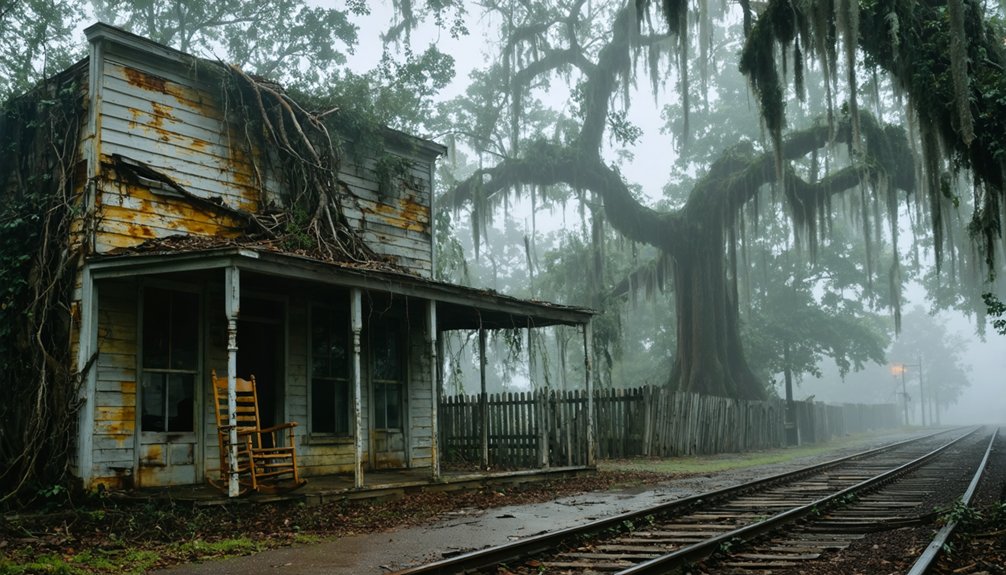
You’ll find scant business records from Americus’s brief period as Jackson County’s seat of government, with only a general store and post office documented alongside the courthouse complex.
When county officials relocated the courthouse in 1870, they effectively stripped Americus of its administrative core and primary economic engine.
The town’s rapid decline following the courthouse removal illustrates how deeply intertwined its existence was with its governmental function, as remaining residents soon abandoned their homes and businesses for more promising locations.
Historical Business Records
Despite the scarcity of surviving business records from Americus’s brief tenure as Jackson County’s seat, historical documents reveal a modest commercial infrastructure centered around its courthouse complex from 1826 to 1870.
You’ll find that Americus’s economic footprint remained strikingly small, with the courthouse serving as one of the few civic centers. The town’s business landscape revolved primarily around essential government services and basic commerce.
After the courthouse’s relocation to Brewer’s Bluff, business decline was swift and irreversible.
Courthouse Relocation Impact
The relocation of Jackson County’s courthouse from Americus to Scranton in 1871 marked the beginning of a swift and irreversible decline for this once-promising settlement.
You can trace Americus’s downfall through the devastating pattern of courthouse fires that plagued the town, including the destructive 1837 blaze that first destabilized its position as county seat.
When you look at the economic decline that followed the courthouse’s departure, you’ll find a familiar story of 19th-century ghost towns.
Local businesses that had thrived on courthouse traffic – from taverns to law offices – quickly shuttered their doors. Property values plummeted, while skilled workers and government employees fled to Scranton.
Today, only scattered cemetery plots and abandoned streets hint at Americus’s former status as a bustling administrative center.
Rocky Springs’ Civil War Ghosts
Perched along the historic Natchez Trace Parkway at Milepost 54.8, Rocky Springs‘ transformation into a ghost town began during the Civil War when General Ulysses S. Grant’s forces occupied the town for ten days in 1863.
As Union troops advanced toward Vicksburg, they stripped the community of its resources, destroying crops and carrying off livestock.
Today, ghostly apparitions are said to haunt the remnants of this once-thriving settlement.
Mysterious figures drift through the ruins of Rocky Springs, where echoes of its vibrant past linger in the Mississippi wilderness.
Mississippi’s Most Haunting Abandoned Places
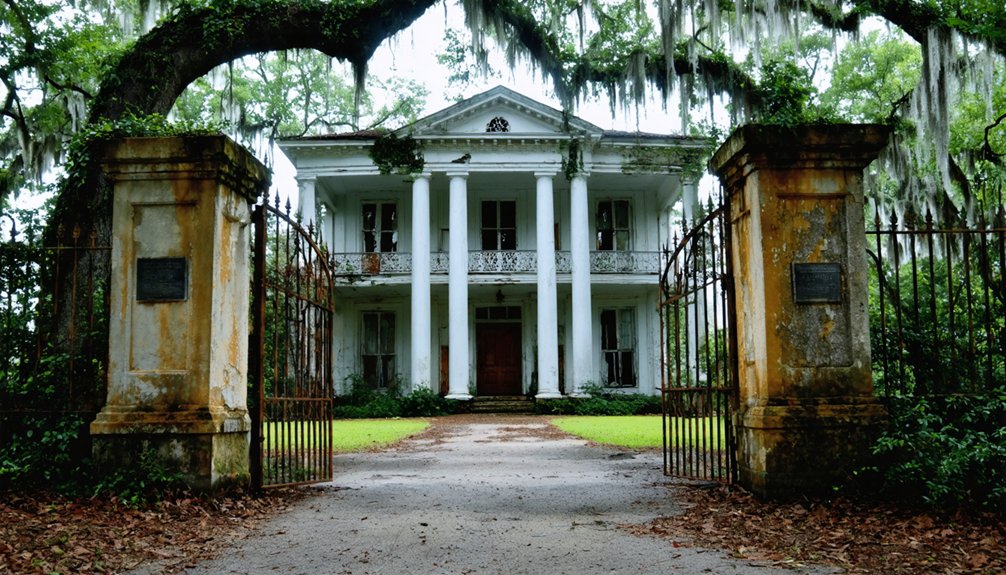
Scattered across Mississippi’s diverse landscape, five particularly haunting ghost towns stand as silent witnesses to the state’s tumultuous past.
Among these abandoned settlements in Mississippi, the crumbling buildings and overgrown streets tell stories of once-thriving communities. Each site echoes the laughter and struggles of the people who once called them home, now left to the mercy of time and nature. Exploring these forgotten places offers a glimpse into the lives that shaped the region long before modern developments took over.
You’ll find Rodney’s derelict churches and 200-grave cemetery, where toppled markers fuel local ghost stories.
At Grand Gulf, you can explore Civil War-era ruins protected within a state park, where the mighty Mississippi’s changing course sealed the town’s fate.
Electric Mills reveals the skeletal remains of a once-thriving company town, its abandoned theater and businesses evidence of industrial decline.
In Bankston, only a solitary cemetery marks where Confederate factories once stood before Union troops reduced them to ashes.
These haunted landscapes and forgotten stories paint a vivid picture of communities shaped by war, industry, and nature’s unstoppable force.
Frequently Asked Questions
Are There Any Reported Paranormal Activities in These Ghost Towns?
You’ll discover countless haunted legends in these towns, from bone-chilling footsteps at Rodney’s Presbyterian church to ghostly encounters at Grand Gulf’s battlefield and mysterious lights at Rocky Springs’ cemeteries.
What Modern-Day Security Measures Protect These Abandoned Historic Sites?
You’ll find robust security systems including remote cameras, motion sensors, and fenced barriers, while preservation efforts employ drone monitoring, access control gates, and routine inspections by historical societies.
Can Visitors Legally Explore and Photograph These Ghost Towns?
You’ll need to follow legal guidelines by staying on public roads and obtaining written permission from property owners. Photography permissions generally allow exterior shots from roads but restrict interior access.
Which Ghost Town Has the Best-Preserved Original Structures Today?
With four original 19th-century buildings still standing, Rodney offers you the best preservation of historic architecture, anchored by its 1832 Presbyterian Church that’s endured nearly 200 years of Mississippi River floods.
Do Any Descendants of Original Residents Still Maintain Connections There?
You’ll find descendant stories primarily in Rodney, where Angel Puckett maintains mail routes and Trent Lewis visits with Confederate veterans. The other towns lack documented historical connections to original families.