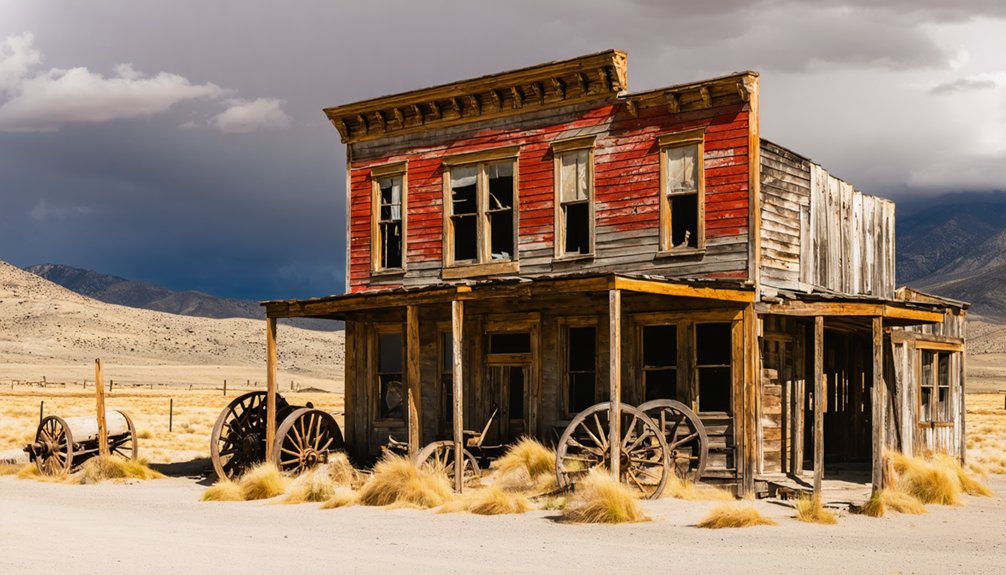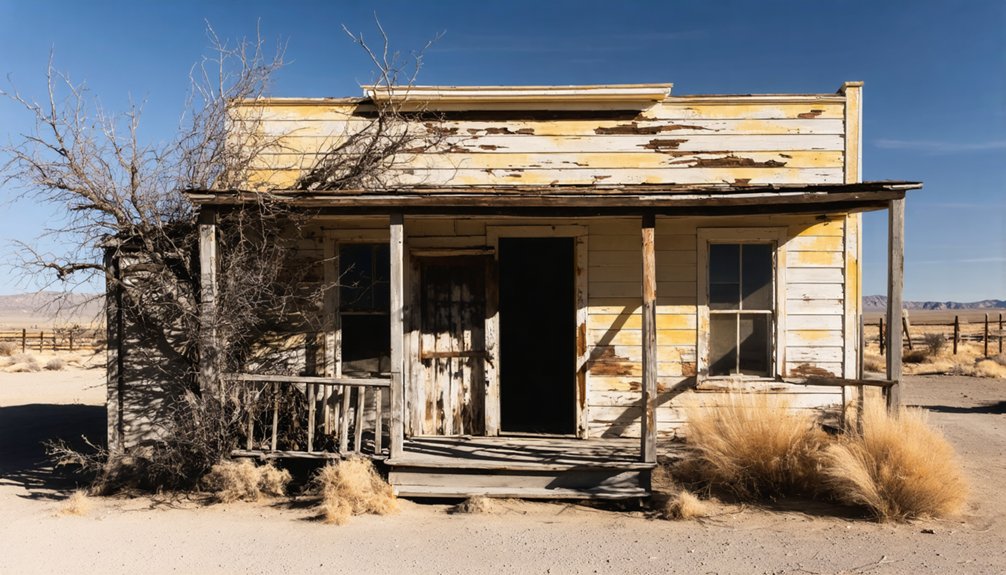
You’ll find dead bushes in ghost towns primarily due to severe drought stress and environmental changes that cause widespread plant mortality. When settlements are abandoned, vegetation faces prolonged hot and dry conditions, leading to dehydration rates that can kill over 90% of dominant plant species. These skeletal remains trigger ecological transformations as pioneer species gradually return, while wildlife populations adapt to shifting habitats. Understanding these ghost town ecosystems reveals nature’s complex response to abandonment.
Key Takeaways
- Ghost towns often experience widespread bush die-off due to prolonged drought stress, with mortality rates reaching up to 90%.
- Pioneer species like lichens and mosses initiate natural rewilding processes in abandoned settlements after bush die-off occurs.
- Decomposing vegetation in ghost towns releases CO2, while waterlogged soils can store carbon through anaerobic decomposition.
- Dead bushes create new habitats as ecosystems transform, forcing wildlife to adapt or relocate from traditional environments.
- Satellite imagery and ground surveys help track bush mortality patterns in ghost towns for effective management strategies.
Understanding the Root Causes of Bush Die-Off
While multiple factors contribute to bush die-off in abandoned settlements, drought stress emerges as the primary catalyst, triggering a cascade of physiological failures in plant systems.
You’ll find that prolonged hot, dry conditions deplete soil water, causing severe dehydration of leaf and branch tissue. When soil moisture drops critically low for extended periods, you’ll witness mortality rates exceeding 90% among dominant plant species. Quick checks with a shovel test method can reveal severely dry conditions at root depth.
Temperature extremes amplify this water stress, while soil imbalances from compaction or waterlogging compromise root systems. Research shows global-change-type drought increasingly drives these die-off patterns.
These weakened plants become prime targets for pest infestations, particularly bark beetles that can destroy 40-80% of drought-stressed vegetation. The combination of excessive heat, inadequate soil moisture, and secondary invaders creates a deadly cycle that’s particularly severe in ghost towns where regular maintenance has ceased.
The Ecological Transformation Process
The ecological transformation of ghost towns unfolds through a complex interplay of biological succession and environmental feedback loops.
The stories of abandoned sites along Route 66 reveal how nature reclaims spaces once bustling with life and activity. As flora and fauna establish themselves, visitors may uncover the remnants of the past in surprising ways. This transformation not only highlights the resilience of ecosystems but also invites a deeper reflection on human impact and the passage of time.
You’ll observe passive rewilding starting with pioneer species like lichens and mosses, gradually giving way to grasses and shrubs within decades. As vegetation returns, you’ll notice profound changes in the local environment: increased humidity, stabilized soil conditions, and new wildlife activity.
Watch how this ecological succession creates opportunities for diverse species. Local communities often lead conservation efforts to protect these emerging ecosystems. You’ll find predators following their prey into these recovering spaces, while pollinators expand their range as native flowers return. The installation of solar energy projects supports environmental restoration by repurposing contaminated sites and reducing regional air pollution.
As abandoned places heal, nature orchestrates an intricate dance of species returning to reclaim their former territories.
The transformation isn’t uniform – abandoned infrastructure creates unique microsites, while soil legacy effects from previous human activity shape which species can thrive. Through these dynamic processes, ghost towns evolve into increasingly complex ecosystems, often supporting greater biodiversity than actively managed alternatives.
Climate Impact and Greenhouse Gas Effects
Since dead bushes and vegetation in ghost towns decompose over time, they trigger complex greenhouse gas dynamics that merit careful examination.
You’ll notice carbon emissions increase as standing dead vegetation breaks down aerobically, releasing stored CO2 into the atmosphere.
However, when soils become waterlogged, slower anaerobic decomposition can actually enhance long-term carbon storage in sediments. Research shows that marsh transitions occur as saltwater intrusion increases, impacting these decomposition processes.
You’ll find the greenhouse gases released aren’t limited to CO2. Methane production varies based on saltwater presence, while nitrous oxide emissions fluctuate with changing nitrogen cycles.
While sulfate-rich seawater typically suppresses methane compared to freshwater conditions, the net climate impact depends on integrating all three gases – CO2, CH4, and N2O – across relevant timescales, considering their different atmospheric warming potencies.
The loss of these decomposing areas is especially concerning since wetland ecosystems store up to 30% of Earth’s terrestrial carbon.
Wildlife and Ecosystem Changes
Dramatic ecosystem transformations in ghost forests trigger cascading effects on wildlife populations and habitat distributions. You’ll witness forests converting into salt marshes as dying trees become stark snags, creating new spaces for salt-tolerant vegetation. This habitat transformation forces wildlife to adapt or relocate as their familiar forest environments vanish.
While you’re losing traditional forest habitats, nature’s adaptability emerges through wildlife adaptation patterns. Marsh birds find refuge in these altered landscapes, and saltmarsh grasses colonize the forest floor. Salt intolerant saplings die first as saltwater intrudes further inland through canals and ditches.
You’ll observe how 47,000 acres of forest have transformed into marsh or shrubland, fundamentally changing species composition. These shifts extend beyond immediate boundaries, impacting surrounding ecosystems while maintaining critical services like storm buffering that benefit both wildlife and coastal communities. Hurricane Irene’s surge in 2011 alone transformed over 11,000 acres into ghost forest.
Tracking and Managing Dead Bush Expansion
Mapping dead bush expansion requires sophisticated monitoring technologies and systematic field validation protocols.
You’ll need to employ high-resolution satellite imagery and multispectral indices to detect vegetation decline, while conducting ground-truth surveys to verify remote sensing data. Through automated change detection algorithms, you can track mortality patterns and assess potential risks. Early attempts showed that insufficient ground fuel made control difficult. Regular inspections have found that dead vegetation accumulates rapidly in summer months.
To implement effective management strategies, you’ll want to quantify fuel loads and fire risks around structures.
Measure fine-fuel density and calculate fuel continuity metrics to determine fire spread potential. When addressing expansion, select from various control techniques including mechanical removal, herbicide applications, or prescribed burning where permitted.
Monitor regrowth vigilantly and establish competitive groundcover to prevent reinvasion. This thorough approach guarantees you’re maintaining both safety and ecological balance in affected areas.
Frequently Asked Questions
Can Dead Bushes in Ghost Towns Be Used as Biofuel?
You’ll find limited biofuel potential from dead bushes, as their small biomass volume and scattered distribution create high collection costs. Their environmental impact as fuel isn’t significant enough to warrant harvesting.
How Long Does It Take for a Dead Bush to Completely Decompose?
You’ll find that a dead bush’s decomposition process typically takes 2-5 years, depending on environmental impact factors like moisture, temperature, and soil conditions that affect microbial activity.
Are There Any Medicinal Properties in Dead Bush Remains?
You’ll find amazing medicinal uses in dead bush remains – they’re packed with antioxidants, antimicrobial compounds, and natural remedies for respiratory issues, wounds, and inflammation when prepared as teas or smoke inhalation.
Do Ghost Towns With Dead Bushes Attract Paranormal Investigation Teams?
You’ll find paranormal investigation teams frequently explore ghost towns regardless of vegetation, focusing their investigation methods on reported paranormal activity within structures and surrounding areas rather than dead bushes specifically.
Can Dead Bushes Be Recycled Into Furniture or Building Materials?
You can transform dead bushes into sustainable materials for furniture design through milling, stabilization, and creative processing, though you’ll need to account for size limitations and structural integrity.
References
- https://www.pnas.org/doi/10.1073/pnas.2314607120
- https://www.whqr.org/local/2021-06-03/north-carolinas-shoreline-estuaries-are-transforming-into-ghost-forests-but-why
- https://carolinapublicpress.org/62712/ghost-forests-creeping-across-nc-coast-alarming-rate/
- https://dogwoodalliance.org/2021/10/ghost-forests-a-tangible-sign-of-the-climate-crisis/
- https://www.chesapeakebay.net/news/blog/the-chesapeake-is-haunted-by-the-ghosts-of-forests-past
- https://www.discovermagazine.com/as-ghost-forests-spread-researchers-ask-for-help-keeping-track-42681
- https://www.cbsnews.com/news/ghost-forests-what-they-are-why-theyre-becoming-more-common/
- https://www.pnas.org/doi/10.1073/pnas.0505734102
- https://extension.colostate.edu/resource/environmental-disorders-of-woody-plants/
- https://columbiainsight.org/pac-nws-trees-of-life-are-dying-now-we-know-why/