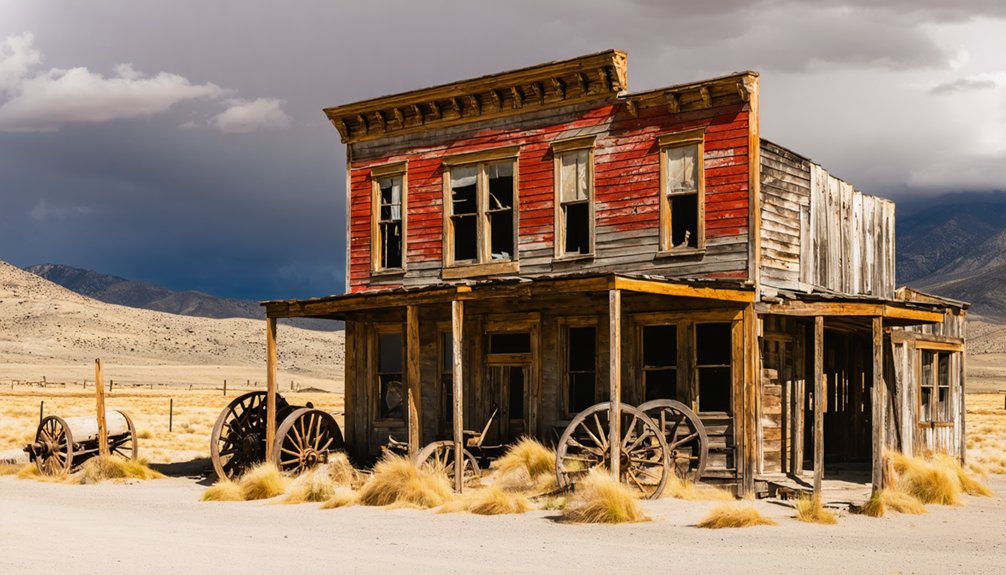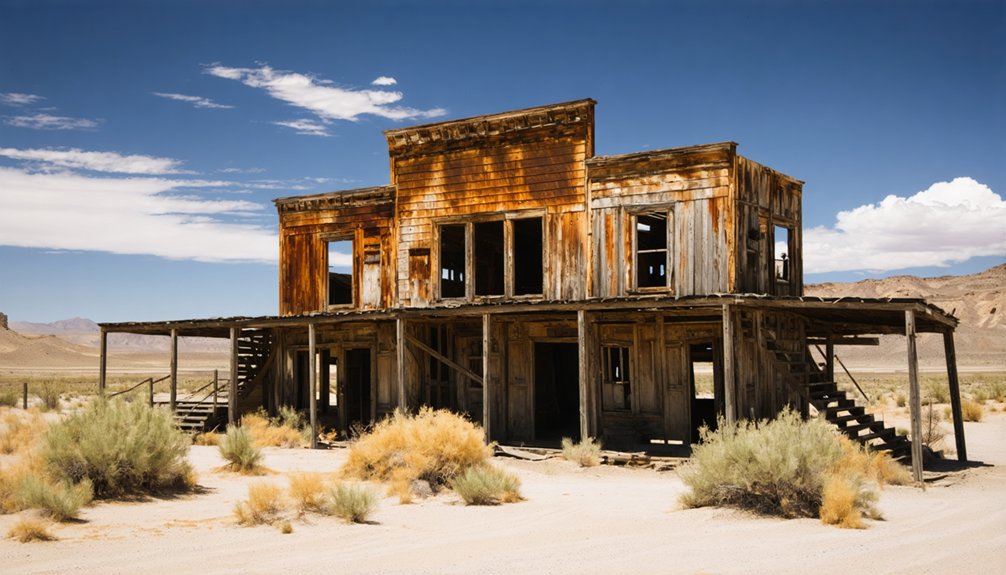
Ghost towns emerge when communities face devastating economic, environmental, and social pressures that force residents to abandon their homes. You’ll find that resource depletion, particularly in single-industry towns, often triggers rapid decline as businesses close and jobs disappear. Transportation changes, natural disasters, government policies, and military conflicts can also transform thriving settlements into abandoned shells. Understanding these complex factors reveals how once-vibrant communities become stark reminders of civilization’s fragile nature.
Key Takeaways
- Resource depletion in single-industry towns leads to mass unemployment and population exodus when extractive companies withdraw their operations.
- Changes in transportation networks, like highway bypasses and rail service elimination, isolate communities and destroy local business viability.
- Natural disasters and environmental hazards force permanent evacuations when rebuilding becomes unsustainable or areas become uninhabitable.
- Government policies trigger abandonment through forced relocations, urban renewal projects, and military training zone designations.
- Military base closures devastate local economies, causing systematic depopulation as businesses close and essential services withdraw.
The Impact of Resource Depletion on Town Abandonment
When natural resources that sustained single-industry towns became depleted, these communities often faced rapid and irreversible decline.
You’ll find that as mineral deposits or timber resources became economically exhausted, populations quickly dwindled within years or decades. The immediate aftermath of resource depletion triggered massive job losses, often representing the majority of local employment.
The impact of town abandonment became self-reinforcing as extractive companies withdrew their capital, dismantling housing and removing equipment. This left infrastructure unusable and deterred new investment. Today, an estimated 15,000 cities across America risk a similar fate of becoming abandoned. Cities like Detroit exemplify this pattern with vacant homes sitting empty for nearly 30% of properties.
You can see this pattern clearly in historic gold and silver rush towns, which peaked rapidly but emptied once ore grades declined or extraction costs became prohibitive.
The reduced tax base led to cuts in essential services like schools and utilities, accelerating the exodus of remaining residents.
Transportation Changes and Community Decline
As transportation networks evolved throughout the 20th century, changes in rail service and highway construction fundamentally reshaped the economic viability of many small towns. The transportation evolution brought dramatic shifts in how people and goods moved across the landscape, leading to widespread community decline through rail abandonment and highway bypasses. This transformation is evident in places like Gomez, which declined after the South Plains Railway arrived, shifting economic activity to nearby Brownfield. With current projections showing that population decline could affect nearly half of US cities by 2100, these transportation-driven changes may continue to reshape communities.
- You’ll find towns that once thrived due to railroad junctions now standing empty after routes changed or service ended.
- When interstates bypassed communities, local businesses lost crucial customer traffic and often couldn’t survive.
- The rise of centralized logistics hubs eliminated many small-town freight yards and warehouses.
- Communities without access to major transportation arteries faced increasing isolation as passenger services disappeared.
This transformation left many towns disconnected from essential economic lifelines, accelerating their decline as residents and businesses sought better-connected locations.
Natural Disasters and Environmental Forces
Natural disasters and environmental forces represent another major catalyst in the formation of ghost towns throughout history.
Explorations of haunted sites across the united states can often reveal the remnants of these once-thriving communities. Each location carries its own story, steeped in the eerie echoes of the past. Visitors are drawn to these places not only for their ghostly legends but also to gain insight into the lives that existed long before their decline.
You’ll find coastal communities abandoned due to erosion and rising seas, like Holland Island in Chesapeake Bay, while volcanic eruptions have entombed entire towns, as seen in Plymouth, Montserrat. Preservation efforts help document these sites before nature reclaims them completely.
Environmental forces gradually render areas uninhabitable through saltwater intrusion, soil degradation, and chronic flooding. The coastal village of Vunidogoloa demonstrates how rising sea levels can force entire communities to relocate inland.
When catastrophic events strike, communities face hard choices about rebuilding.
The Great Flood of 1993 forced Valmeyer, Illinois to relocate entirely, while recurring natural disasters can make insurance and reconstruction costs unsustainable.
Whether through sudden volcanic destruction, earthquake damage, or the slow march of coastal erosion, these environmental forces continue to transform thriving settlements into abandoned ghost towns.
Government Policy and Planned Relocations
Government policies have directly contributed to the creation of ghost towns through forced relocations and property seizures under eminent domain laws.
You’ll find numerous examples where military training zones displaced entire communities, such as when the U.S. government commandeered land for artillery ranges during World War II.
Urban renewal projects in the mid-20th century similarly reshaped communities, as federal initiatives cleared neighborhoods and relocated residents, often leaving abandoned districts in their wake. The Bureau of Indian Affairs relocation program moved thousands of Native Americans from reservations to cities, leading to the abandonment of tribal communities. The program operated for twenty years, targeting over 100,000 Native Americans for urban resettlement.
Eminent Domain Forced Moves
While legal frameworks permit eminent domain for public projects, this powerful government tool has transformed numerous thriving communities into ghost towns through forced relocations. The process often begins with government acquisition of private property for infrastructure, military installations, or disaster mitigation, leading to widespread community displacement and eventual abandonment. Managed retreat initiatives increasingly guide community relocations due to climate-driven flood risks. The World Bank projects that 216 million people will need to migrate within their countries by 2050 due to climate impacts, accelerating government-planned relocations.
- Historical cases like Tyneham, England show how military land seizures permanently erased entire villages.
- Reservoir and dam projects across America forced towns to relocate, leaving behind uninhabited landscapes.
- Post-disaster buyouts in floodplains have led to systematic depopulation of vulnerable areas.
- When communities scatter during relocation, the loss of social networks and economic bases often prevents recovery.
These government-mandated moves frequently trigger a cascade of decline as businesses close, services withdraw, and remaining residents eventually depart, creating ghost towns where vibrant communities once stood.
Military Training Zone Closures
Throughout the late 20th century, military base closures under the Base Realignment and Closure (BRAC) process transformed numerous thriving communities into ghost towns across America.
When military exercises and training facility closures occurred between 1988-2005, you’d witness entire communities unravel, particularly in rural areas where bases served as economic anchors. The impact was devastating – K.I. Sawyer Air Force Base’s closure in Michigan displaced over 3,000 military personnel, while Mare Island Naval Shipyard’s shutdown eliminated 45,000 Bay Area jobs.
You’ll find the aftermath still visible today in places like Fort Ord, California, where abandoned buildings stand as eerie monuments to once-vibrant military communities. Environmental contamination at many sites complicated redevelopment efforts, leaving some locations perpetually frozen in time as modern ghost towns.
Urban Renewal Project Impacts
In the name of progress and modernization, mid-century urban renewal policies devastated countless American neighborhoods, creating ghost towns within major cities. The consequences were particularly severe for Black communities, with places like Columbus’s Hanford Village and St. Louis’s urban core bearing the brunt of these destructive policies.
- Over 1 million Americans were forcibly relocated across 993 neighborhoods, most without compensation.
- Highway construction projects like I-70 demolished 87 homes in Hanford Village, including housing for Black WWII veterans.
- St. Louis lost 63% of its population since 1950 due to urban renewal consequences.
- Community displacement tore apart established neighborhoods while mega-development projects failed to deliver promised improvements.
You’ll find these ghost neighborhoods still haunt America’s urban landscape, from Buffalo’s empty blocks to Flint’s vacant buildings, serving as stark reminders of misguided government policies that prioritized demolition over community preservation.
Economic Shifts in the Global Marketplace
Economic shifts in the global marketplace have repeatedly transformed thriving communities into ghost towns through dramatic resource value fluctuations, emerging competition, and infrastructure changes.
You’ll find this pattern from California’s gold rush towns to China’s modern real estate developments, where boom-and-bust cycles leave empty settlements in their wake.
When resource values plummet or new competition emerges, you’re likely to see rapid abandonment of single-industry towns.
These economic shifts are particularly devastating when infrastructure bypasses once-thriving communities.
You can witness this in historical examples like Collingwood, Queensland, which collapsed after a railway favored its rival Winton, and in modern China, where overbuilding has created vacant cities as the global marketplace evolved beyond local demand.
Industrial Evolution and Rural Migration
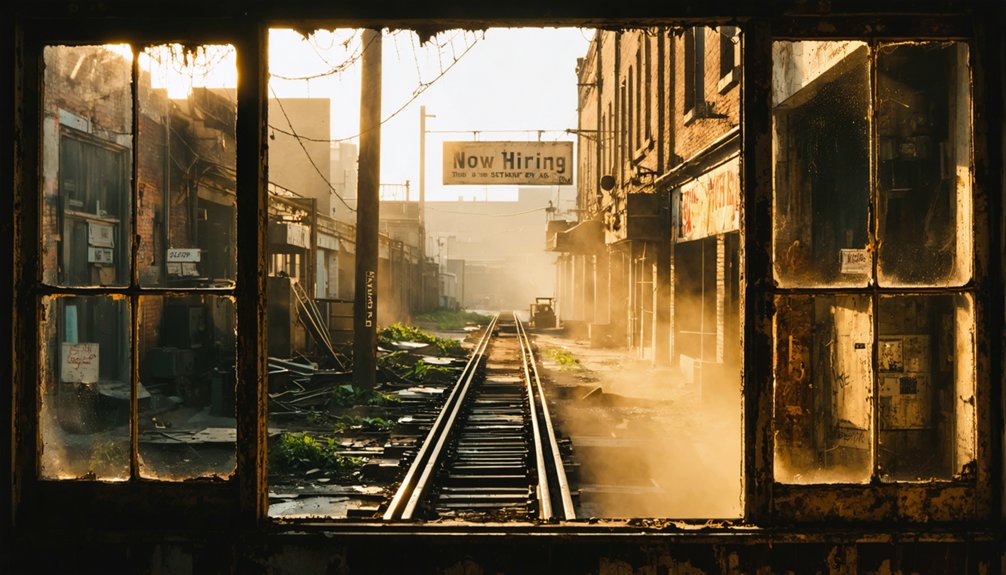
You’ll find that rapid industrialization in the late 19th and early 20th centuries triggered massive shifts in employment patterns as manufacturing jobs concentrated in urban centers, drawing rural workers away from agricultural regions.
While cities expanded with new factories and opportunities, single-industry towns often collapsed when their primary employer shuttered or relocated, leaving behind economically devastated communities.
The introduction of mechanized farming and improved transportation networks accelerated this rural exodus, as fewer workers were needed to maintain agricultural production and goods could bypass local markets entirely.
Manufacturing Jobs Vanish Fast
Over the past quarter-century, America’s manufacturing landscape has undergone a dramatic transformation, with more than 4.5 million jobs vanishing between 2000 and 2024.
You’ll find the impact of job automation and economic globalization has reshaped entire communities, particularly in the Industrial Northeast and Midwest regions.
While manufacturing output has grown 45%, the workforce has shrunk by 26%, revealing a stark disconnect between productivity and employment.
- Traditional manufacturing strongholds in the Rust Belt lost over 40% of their workforce
- Advanced technologies enabled factories to produce more with fewer workers
- Computer and electronics sector shed 750,000 jobs since 2000
- Despite adding 65,000 new manufacturing establishments, employment continues to decline
This seismic shift has left many once-thriving industrial towns struggling to maintain their economic significance, contributing to their gradual transformation into modern ghost towns.
Rural Workers Move Cityward
During the transformative period between 1880 and 1920, America’s workforce underwent a dramatic shift as agricultural workers, who once outnumbered industrial laborers three to one, reached parity with factory workers.
You’ll find that rural migration to cities accelerated as farming families faced mounting pressures from industrial farming, overproduction, and falling prices. While immigrant workers dominated urban employment growth, accounting for 53% of manufacturing jobs by 1920, rural Americans increasingly abandoned their farms for city opportunities.
The economic efficiency of modern farming meant fewer workers could produce more food, enabling agricultural exports to rise from 10% to 25% of income by 1900.
This productivity gain freed up rural labor, pushing young people toward urban centers where factories, despite their efficiency through mechanization, continued drawing workers with promises of steady employment.
Single Industry Towns Collapse
The collapse of single-industry towns marked a devastating chapter in America’s economic landscape, particularly from the 1950s onward. When you examine the impact of single industry reliance, you’ll find communities devastated by foreign competition and economic dependency.
- Manufacturing employment plummeted 30% in rural America, with 71% of U.S. counties experiencing significant job losses.
- Towns like Gary saw coal production drop 28% while workforce cuts reached 38% due to external pressures.
- Local economies crumbled as plant closures triggered ripple effects – from downtown decay to widespread business failures.
- Government capacity suffered severely, with coal-dominant counties collecting 10% less tax revenue and experiencing 11% lower government employment.
This pattern of decline transformed thriving industrial centers into struggling communities, as single-industry dependence left them vulnerable to market shifts and global competition.
War Zones and Conflict-Related Desertion

Armed conflicts have consistently proven to be one of the most devastating forces behind the creation of ghost towns, as military operations can rapidly transform vibrant communities into abandoned shells within days or weeks.
War devastation triggers mass civilian displacement through multiple mechanisms: strategic evacuations during offensives, deliberate destruction of infrastructure, and systematic targeting of economic assets.
Armed conflict drives populations from their homes through planned evacuations, infrastructure sabotage, and targeted attacks on economic foundations.
You’ll find that scorched-earth tactics often eliminate the basic foundations needed for communities to survive, from housing to agricultural resources.
Military exclusion zones, land contamination from unexploded ordnance, and forced population transfers can make abandonment permanent.
Even when active fighting ends, the lingering effects of ethnic cleansing, property seizures, and destroyed livelihoods prevent many communities from recovering, leaving once-thriving settlements permanently deserted.
Environmental Hazards and Safety Concerns
Environmental hazards represent one of the most intractable causes of community abandonment, as contamination from industrial activities, mining operations, and radiation incidents can render settlements permanently uninhabitable.
You’ll find that toxic exposure from these sources creates long-lasting health impacts that make areas unsafe for human habitation, often leading to permanent evacuation.
- Abandoned mines leave behind heavy metal contamination and acid drainage that poisons water supplies.
- Industrial accidents and chemical spills create persistent soil and groundwater contamination.
- Nuclear incidents produce radioactive zones that remain dangerous for decades or centuries.
- Climate-related hazards force communities to relocate due to flooding, erosion, or other environmental threats.
These environmental dangers often prove too costly or technically challenging to remediate, making abandonment the only viable option for affected populations.
Infrastructure Challenges and Service Loss
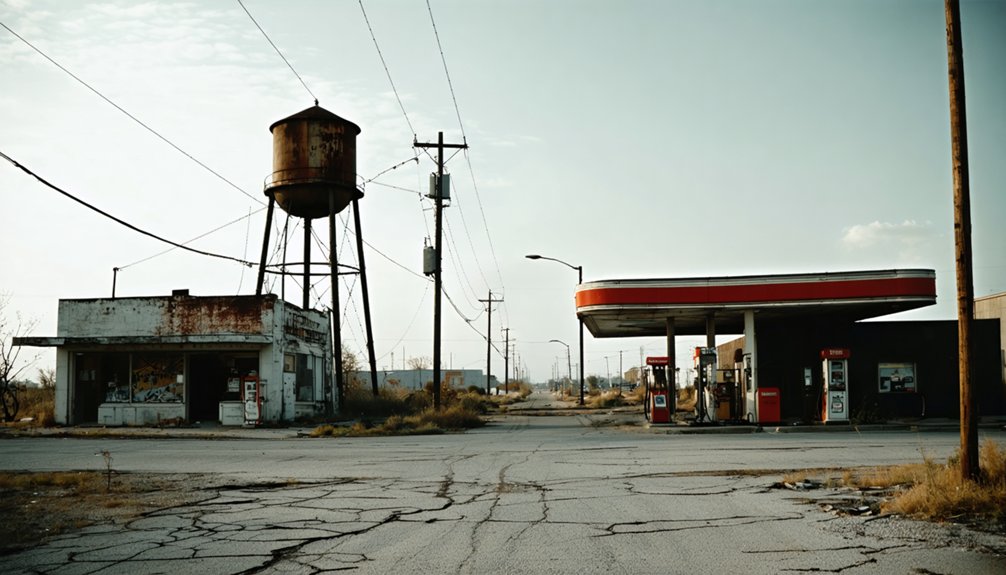
Infrastructure deterioration and service loss often follow closely behind environmental challenges, creating a compounding effect that accelerates community abandonment.
You’ll notice how infrastructure decay manifests through failing water systems, deteriorating roads, and unreliable power grids. When major transportation arteries are rerouted or closed, local businesses lose their customer base, triggering a downward economic spiral.
Service deprivation becomes evident as retailers, banks, and healthcare providers exit these struggling markets. You’re left with communities where basic necessities become increasingly difficult to access.
The fiscal impact of population decline creates a vicious cycle – reduced tax revenues force cuts to essential services, while aging infrastructure requires more maintenance than shrinking budgets can support.
Without reliable utilities, transportation, and public services, even the most determined residents eventually seek opportunities elsewhere.
Frequently Asked Questions
How Long Does It Typically Take for an Abandoned Town to Deteriorate Completely?
You’ll find abandonment timelines vary greatly based on environmental impact – from rapid 5-year deterioration in harsh conditions to centuries of gradual decay in arid climates like Bodie’s preserved state.
Can Ghost Towns Legally Be Purchased and Repopulated by Private Individuals?
Yes, you can purchase and repopulate ghost towns if you’ve secured clear property ownership, but you’ll face legal implications involving zoning permits, infrastructure requirements, building codes, and preservation regulations.
What Percentage of Ghost Towns Worldwide Have Been Successfully Revitalized?
You’ll find that exact worldwide statistics aren’t available, but successful revitalization strategies have transformed roughly 15-20% of documented ghost towns, with economic factors determining which locations prove viable for repopulation.
Are There International Laws Protecting Historical Artifacts Found in Ghost Towns?
You’ll find that international regulations like UNESCO and Hague Conventions protect historical artifacts in ghost towns through thorough preservation laws, requiring states to safeguard these cultural heritage sites.
How Do Insurance Companies Handle Properties in Areas Becoming Ghost Towns?
You’ll find insurance policies become increasingly restrictive as your area depopulates, with companies conducting strict risk assessments that often lead to nonrenewals or considerably higher premiums in declining communities.
References
- https://history.howstuffworks.com/history-vs-myth/ghost-towns.htm
- https://en.wikipedia.org/wiki/Ghost_town
- https://www.britannica.com/topic/ghost-town
- https://www.lovemoney.com/gallerylist/86648/americas-empty-ghost-towns-and-why-theyre-abandoned-today
- https://patch.com/us/across-america/thousands-u-s-cities-could-be-ghost-towns-2100-new-study
- https://themortgagepoint.com/2024/10/25/americas-new-ghost-towns/
- https://jamessiodla.com/wp-content/uploads/2024/03/ghost_towns_big_cities-1.pdf
- https://www.geotab.com/ghost-towns/
- https://storymaps.arcgis.com/stories/124e04142d3147078fb4519a6b9a5c64
- https://www.texastribune.org/2024/11/14/texas-population-changes-rural-urban/