You’ll find Devil’s Slide ghost town nestled in Weber Canyon, where a thriving cement company once employed 529 residents producing 24,000 sacks daily from rich limestone deposits. This company town peaked in the early 1900s before declining after the 1940s school closure, leaving behind quarry scars, cement plant foundations, and building remnants. The distinctive twin limestone fins create a natural landmark beside the abandoned industrial site, while archaeological fragments and rail pieces mark where workers from diverse backgrounds once built Utah’s most productive cement operation.
Key Takeaways
- Devil’s Slide was a bustling cement company town that peaked at 529 residents before declining after the 1940s.
- The town developed around limestone deposits discovered in 1904, with Union Portland Cement Company driving industrial growth.
- A tragic 1910 tunnel explosion killed 17 workers, highlighting dangerous conditions faced by the diverse immigrant workforce.
- Community featured two schoolhouses, company clubhouse, baseball diamond, and the Red Devil Store serving as social hub.
- Today only limestone geological landmarks and cement plant foundations remain, accessible via two main routes from Wasatch Front.
The Rise of a Company Town
After Aman Moore discovered limestone deposits in 1904, Devil’s Slide quickly transformed from untamed terrain into a bustling company town built around the Union Portland Cement Company.
Local business titans like Reed Smoot, M. S. Browning, and Joseph Scowcroft, along with the LDS Church, provided essential investment to launch the operation.
You’d find the company’s mark everywhere in town, from concrete houses and sidewalks to the Red Devil Store that served as both drugstore and post office.
Workers enjoyed modern amenities including electric lighting, a hotel with dining facilities, and even a baseball diamond.
The workforce reflected America’s immigrant story, with Japanese, Austrian, Italian, and Irish laborers working alongside locals.
At its peak, the town reached a population of two hundred fifty residents, supporting a vibrant community life.
The town experienced significant decline when the school closed in the 1940s.
Daily Life in Devil’s Slide
If you’d visited Devil’s Slide during its heyday, you’d have found workers laboring in the cement factory while their children attended one of two schoolhouses, where they could join the harmonica band.
You could have enjoyed recreation at the company clubhouse, watched games at the baseball diamond, or hiked to the top of the distinctive rock formation that gave the town its name.
Similar to Thistle’s landslide disaster in 1983, many Utah ghost towns faced natural challenges that led to their abandonment.
Among the remnants of these towns lie notable historic sites in Delle, Utah, which serve as a testament to the region’s rich history and its struggle against nature. Visitors often come to explore the eerie landscapes and learn about the lives of those who once called these areas home. As time passes, the stories of these once-thriving communities continue to captivate those who seek to uncover the past.
The community’s services centered around the Red Devil Store, which doubled as a post office, and the two-story hotel where workers gathered for meals in the dining room.
Before the Great Depression hit, Devil’s Slide was a bustling community with over 500 residents.
Work and Factory Life
Life in Devil’s Slide revolved around the demanding work at Union Portland Cement Company’s operations, which began in the early 1900s following Aman Moore’s 1904 limestone discovery.
The site’s unique limestone rock formation made it ideal for cement production in the early 20th century. The area’s hard limestone layers provided excellent raw materials for making cement.
You’d find workplace safety was a serious concern, highlighted by the tragic 1910 tunnel explosion that killed 17 workers when a black powder keg was dropped during transport.
The harsh labor conditions and dangerous environment didn’t deter workers, who came from diverse backgrounds:
- Foreign nationals made up the majority of the workforce
- Workers performed daily tunneling and quarrying in 100-foot deep excavations
- Shift work continued around the clock with cement processing
- Employees commuted from nearby towns like Henefer and Morgan as the company town declined
At its peak, Devil’s Slide supported 529 residents before the Great Depression triggered its gradual decline.
Social Activities and Recreation
Despite the demanding work environment, Devil’s Slide residents enjoyed several recreational outlets centered around the company clubhouse, which served as the town’s social hub.
You’d find workers gathering at the hotel dining room after shifts, sharing meals and conversation in this two-story structure.
Today, visitors can enjoy scenic trails while exploring the area’s natural beauty.
The baseball diamond hosted spirited games that brought the community together through team sports and physical activity.
Cultural entertainment flourished through the schoolhouses’ harmonica band, which performed at various recreational events throughout town.
One of the most spectacular social gatherings occurred in 1910 when thousands of Shriners descended upon Devil’s Slide for their ceremonies, which included the unusual activity of sliding down the namesake rock formation.
These diverse social activities fostered strong community bonding among the town’s residents beyond their work hours.
Today, visitors can view the site’s interesting geological features from designated pullouts along the road.
Community Services and Education
While the remote location of Devil’s Slide presented certain limitations, the town maintained essential community services centered around education and basic healthcare needs.
The cement company’s commitment to community support was evident in their education initiatives, which included two schoolhouses serving 250 residents. You’d find basic healthcare through the Red Devil Store, which doubled as both drugstore and post office. The store was part of the larger Union Portland Cement Company operations that supported the town’s development.
Key community services included:
- Two schoolhouses featuring a student harmonica band
- Combined post office and drugstore providing daily mail and medical supplies
- Company clubhouse fostering social connections
- Infrastructure improvements like cement sidewalks and 100 planted trees
The company’s investment in these services helped sustain the town’s population until its eventual decline in the 1980s, though most facilities had closed years earlier during the Great Depression.
Industrial Legacy and Limestone Production
The cement plant’s industrial legacy began with remarkable ambition, transforming from a 10-barrel-per-day operation into a facility producing 400 barrels daily at its peak.
You’ll find the plant’s technological progression marked by key acquisitions like Martha, a steam shovel from the Panama Canal project, and a 750-horsepower Corliss steam engine that brought electric lights to both the facility and town.
The limestone-rich geology of Weber Canyon proved essential to the region’s cement industry, though operations would eventually cease during the Great Depression, leaving only a gravel pit as evidence of the once-thriving industrial center. The abundant Twin Creek Limestone deposits in the area, stretching roughly 2,700 feet thick across northern Utah, made the location ideal for cement production.
Cement Plant Operations
Founded in 1904, Union Portland Cement Company established its operations near Devil’s Slide rock formation after Aman Moore’s essential limestone discovery in Weber Canyon, Utah.
The initial cement production facility featured small dry kilns that could produce 110,000 metric tons annually, with plant machinery operating around the clock to meet regional construction demands.
Key operational highlights included:
- First-generation plant utilized dry process kilns before changing to wet process
- Post-WWII expansion added two long wet kilns, increasing capacity to 320,000 metric tons
- Combined production reached 24,000 sacks daily after 1949 upgrades
- Raw materials came primarily from the adjacent Devil’s Slide mountain quarry
The plant’s efficiency and strategic location made it one of the finest cement facilities in the country, serving construction needs throughout the mountain states.
Mining Town Economics
Following Aman Moore’s discovery of rich limestone deposits in Weber Canyon, Devil’s Slide rapidly transformed from undeveloped land into a bustling industrial hub by 1904.
The Union Portland Cement Company’s mining profits drove significant infrastructure development, supporting a growing population that reached 250 residents.
You’ll find the town’s economic foundation was built on the abundant Twin Creek Formation limestone, formed 165-180 million years ago.
The labor dynamics initially relied heavily on foreign workers, including Japanese, Austrian, Italian, and Irish nationals.
However, the devastating 1910 tunnel explosion that killed 17 workers marked a turning point in the town’s prosperity.
This tragedy disrupted the workforce stability and led to an exodus of foreign laborers, fundamentally altering the economic landscape of this once-thriving mining community.
The Railroad’s Influence
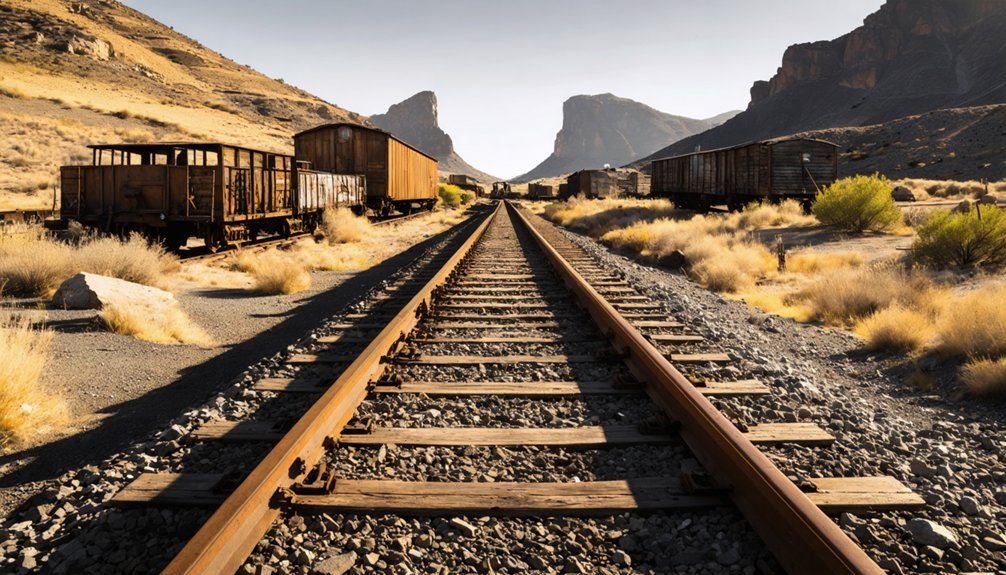
During initial surveys in 1864 and 1865, railroad engineers identified Weber Canyon as an ideal route for the Transcontinental Railroad, following the natural downward course along Echo Creek and Weber River.
This decision shaped regional settlement patterns, as workers and settlers collaborated on establishing tracks through the challenging terrain.
You’ll find the railroad’s expansion brought significant developments to the area:
- Construction crews tackled Devil’s Gate gorge with a swaying temporary trestle
- Two major tunnels (No. 3 and 4) were carved three miles west of Devil’s Slide
- Short runaround tracks with curved wooden trestles helped manage tunnel delays
- Double tracking was completed in 1926 from Riverdale to Wahsatch
The railroad’s completion in 1869 accelerated westward migration, transforming Devil’s Slide from a remote location into a bustling mining community.
Natural Landmark Formation
While the railroad shaped Devil’s Slide‘s human history, the natural landmark itself emerged through millions of years of geological processes.
You’ll find twin limestone walls rising 40 feet high, separated by 25 feet of eroded shaly limestone that created a distinctive chute formation through natural erosion.
The geological history of Devil’s Slide began 170-180 million years ago when these rocks formed in an ancient shallow sea.
The Sevier Orogeny, a massive mountain-building event 75 million years ago, tilted these once-horizontal layers nearly vertical.
Today, you can view this remarkable formation from Interstate 84 near Croydon, where differential weathering between hard and soft rock layers has sculpted this unique slide-like channel that extends hundreds of feet down the mountainside.
The 1910 Mining Disaster
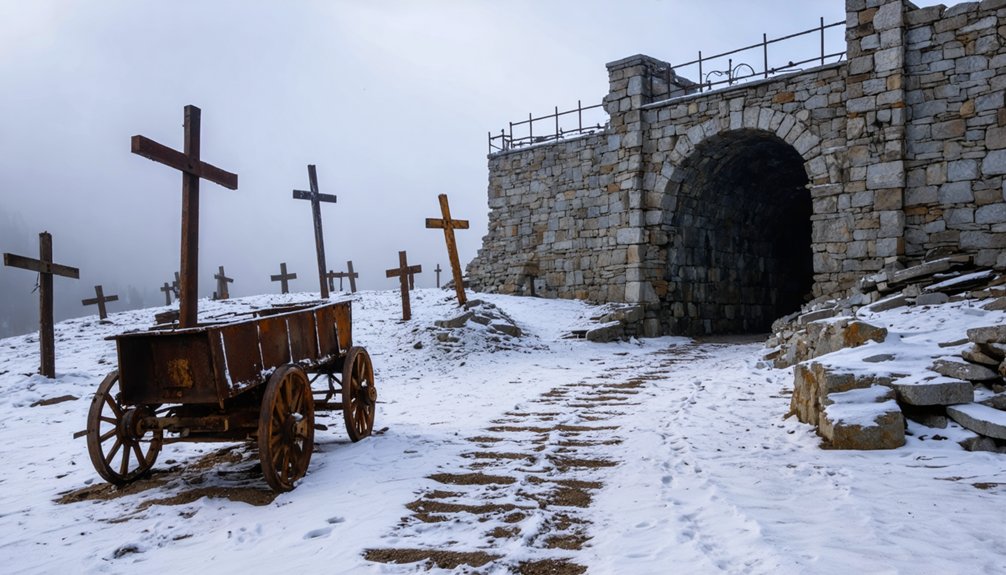
A devastating explosion rocked Devil’s Slide on June 1, 1910, when approximately 500 kegs of black powder detonated inside a 100-foot quarry tunnel at the Union Portland Cement Company.
You’ll find this disaster impact was catastrophic for the small mining community.
The explosion killed 17 workers from diverse backgrounds:
Seventeen men from four nations lost their lives in the catastrophic black powder explosion that forever changed Devil’s Slide.
- Seven Japanese immigrants seeking opportunity in Utah’s quarries
- Seven Austrian workers from the Austro-Hungarian Empire
- Two Italian laborers pursuing American dreams
- One Irish worker completing the international workforce
Survivor stories describe bodies scattered across hillsides like “shotgun pellets” from the confined blast.
A dropped keg during manual transfer likely triggered the tragedy. You can imagine the horror as townspeople recovered remains throughout the canyon.
This disaster decimated the workforce, fundamentally altering Devil’s Slide’s demographic composition forever.
Traces of the Past
What remains of Devil’s Slide today tells a layered story of geological forces, industrial ambition, and human tragedy.
You’ll find the twin limestone fins still towering forty feet above the valley, their Jurassic-age layers tilted nearly vertical by ancient mountain-building forces.
Across the highway, cement plant foundations and quarry scars mark where the Union Portland Cement Company once operated.
Archaeological findings include scattered building hardware, rail fragments, and foundation remnants from the company town that housed over 500 residents.
The cultural heritage survives in oral histories documenting immigrant workers who perished in the 1910 explosion and Shriner ceremonies held at the formation.
Gravel operations have buried much evidence, but you can still trace the railroad grade that connected this remote community to transcontinental commerce.
Getting There Today
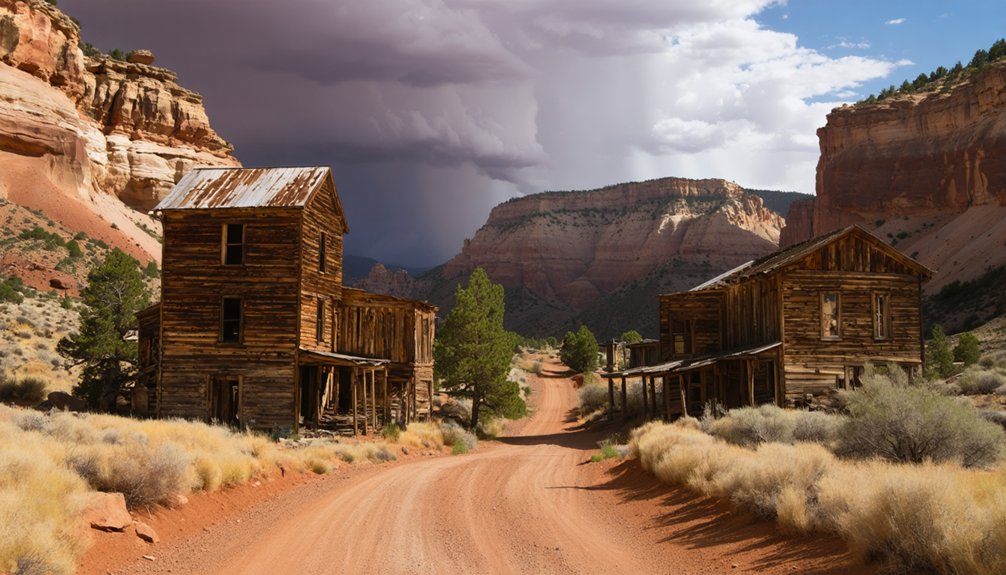
Two main routes provide convenient access to Devil’s Slide from the Wasatch Front, both converging on Interstate 84 near milepost 110-111.
These driving routes offer freedom to explore this geological marvel at your own pace.
From Farmington, take US-89 north 10.7 miles, then head east on I-84 approximately 23 miles to the scenic viewpoints.
Alternatively, from Salt Lake City via I-80, exit at Mountain Dell and follow UT-65 north through Henefer to reach I-84.
Key considerations for your visit:
- Park only in designated pullouts—RV access is limited
- GPS coordinates: 41.0636°N, 111.5481°W at 5,233 feet elevation
- No on-site facilities or services available
- Winter conditions affect shoulder safety and visibility
Plan 10-30 minutes for viewing and photography from the roadside scenic viewpoints.
Frequently Asked Questions
What Happened to the Original Buildings and Structures From the Company Town?
Like Atlantis vanishing beneath waves, you’ll find no original architecture remains from the company town. Historical significance lies buried under gravel pits where buildings once stood, leaving only geological formations as silent witnesses to industrial past.
Are There Any Preserved Artifacts or Relics Visitors Can See Today?
You’ll find minimal preserved artifacts from the company town today. Your best discovery opportunities involve historical photographs in museum collections and geological survey documents that capture the relics’ significance rather than physical remnants.
How Many People Lived in Devil’s Slide at Its Peak Population?
Peak population estimates vary between 250-500 residents, reflecting Devil’s Slide’s historical significance as a company town. You’ll find conflicting sources due to employment fluctuations and incomplete census records from the early 1900s.
Can You Legally Explore the Former Townsite on Foot?
No, you can’t legally explore on foot without landowner permission. The townsite sits on private property with posted no-trespassing signs. Legal access for foot traffic requires written consent from property owners beforehand.
What Other Ghost Towns Are Located Nearby in Weber Canyon?
You’ll find limited ghost town history directly within Weber Canyon itself. The canyon primarily served railroad and transportation purposes rather than permanent settlements. Nearby Morgan County contains historic mining remnants, but true ghost towns lie further from the immediate canyon corridor.
References
- http://ghosttowntour.blogspot.com/2014/07/devils-slide-morgan-county.html
- https://worldofurbanlegends.com/devils-slide/
- https://cowboystatedaily.com/2024/11/29/what-the-heck-is-that-demonic-looking-rock-formation-west-of-evanston/
- https://geology.utah.gov/map-pub/survey-notes/geosights/devils-slide/
- https://www.youtube.com/watch?v=IHKsMa9Dl58
- https://www.onlineutah.com/devils_slide_history.shtml
- https://mysteryofutahhistory.blogspot.com/2014/09/when-devils-slide-was-really-slide-and.html
- https://quod.lib.umich.edu/m/mqr/act2080.0045.110/–three-forks-portland-cement-company?g=mqrg;rgn=main;view=fulltext;xc=1
- https://archiveswest.orbiscascade.org/ark:80444/xv836837
- https://ilovehistory.utah.gov/morgan-county/