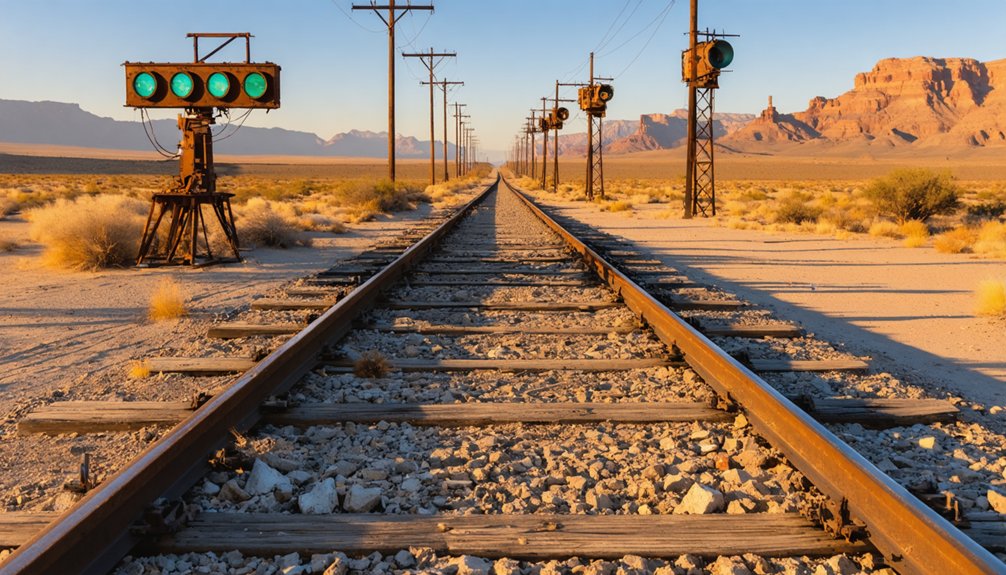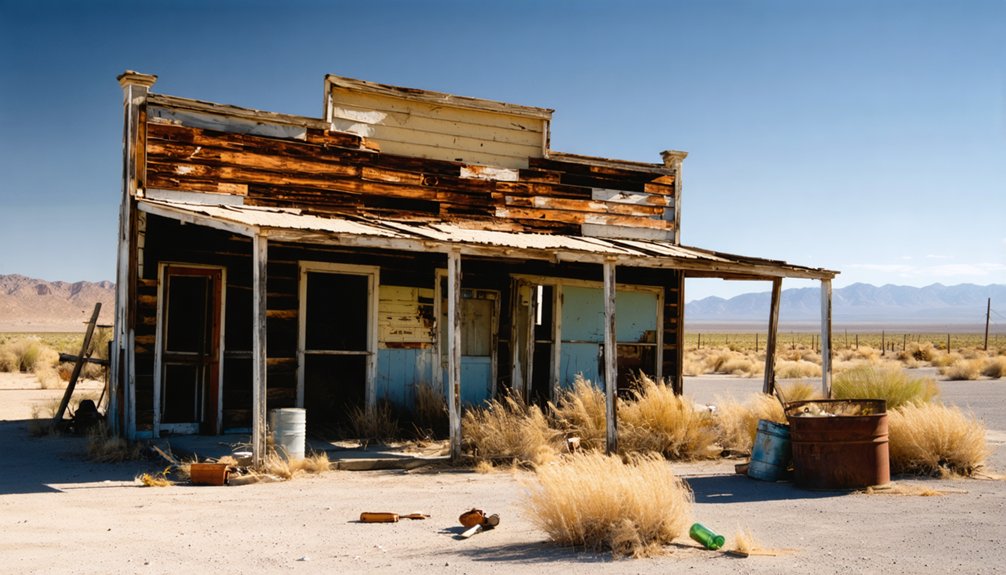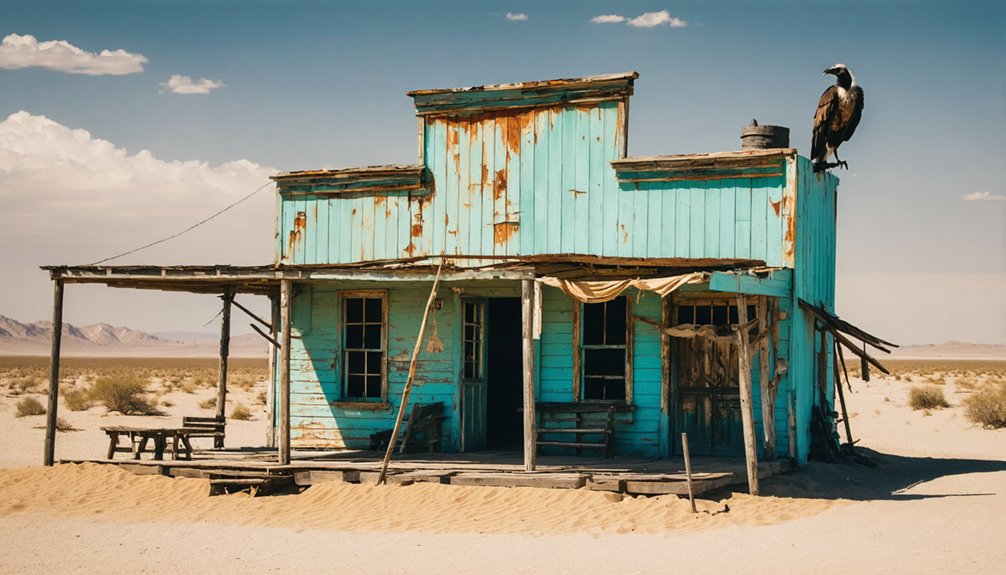
You’ll discover remarkable dilapidated ghost towns scattered across Arizona’s desert, including Courtland’s crumbling concrete jail from 1909, Gleeson’s fire-resistant structures built after the 1912 blaze, and Harshaw’s deteriorating brick foundations from the 1870s silver boom. Swansea preserves adobe buildings and smelter ruins from its copper mining era, while Ruby maintains two dozen original structures near the Mexican border. These abandoned settlements document Arizona’s mining heritage from 1870-1940, with connecting trails revealing additional historical insights.
Key Takeaways
- Courtland features collapsing stores, an old jail, and mining shafts after its 1917 closure when operations hit limestone.
- Harshaw displays brick foundations and mining remnants from its 1870s silver boom before the market’s decline ended operations.
- Swansea preserves deteriorating adobe structures and brick smelter ruins from its 1900-1937 copper mining period in La Paz County.
- Ruby maintains over two dozen crumbling adobe and concrete structures near the Mexico border from its 1877-1940 mining era.
- Gleeson showcases concrete jail ruins, hospital foundations, and fire-resistant rebuilds after a devastating 1912 fire destroyed twenty-eight buildings.
Courtland: Concrete Remnants and Mining Heritage
In the rugged Dragoon Mountains of southeastern Arizona, copper ore discoveries around 1908-1909 sparked the creation of Courtland, a boomtown named after Courtland Young, brother of Great Western Mining Company owner W.J. Young.
Unlike typical company towns, Courtland operated independently, attracting diverse businesses and 2,000 residents by 1910. Two railroads and newspapers served this thriving copper mining community, complete with hotels, theaters, and racing tracks. The post office opened in March 1909 to serve the growing population.
However, when mines hit limestone at 300 feet in 1917, operations ceased rapidly. Population plummeted to 414 by 1920, then 100 by 1930. The town was notorious for its unruly conditions, with several murders occurring on the roads leading to Courtland.
Today, you’ll find concrete remnants marking this ghost town: the old jail, collapsing stores, scattered foundations, and traceable railroad beds. Mining shafts still pockmark surrounding hills, evidence of Courtland’s brief but intense copper mining legacy.
Gleeson: Preserved Structures From the Early 1900S
After John Gleeson reopened the Turquoise camp and developed the Copper Belle mine around 1900, this southeastern Arizona settlement quickly established itself as a significant copper mining community.
You’ll find the concrete Gleeson jail stands as the town’s most recognizable surviving structure, now serving as an interpretive museum. The 1912 fire destroyed twenty-eight buildings, but residents rebuilt using adobe and concrete for fire resistance—materials that help these ruins endure today.
You can explore foundations from the hospital, saloon, school, and post office along Gleeson Road. Mining artifacts scatter the landscape near tailings heaps and abandoned shafts. Unlike many ghost towns that feature only foundations, Gleeson retains many buildings still standing throughout the area.
The railroad spur’s abandonment in the 1930s accelerated the town’s decline, with mines closing by 1940 and the post office shuttering in 1939. The town’s population peaked at 300 in 1920 before steadily declining through the following decades.
Fairbank: Abandoned Townsite Near Tombstone
You’ll find Fairbank’s well-preserved remnants situated along the San Pedro River in southern Arizona, approximately ten miles northwest of Tombstone.
The townsite contains several stabilized structures from its railroad depot era, including a 1920 gypsum block schoolhouse that now serves as a museum and a 1925 residence with modified porches. The oldest remaining structure is the Merkantile building, constructed in 1882 and last operating in 1973.
The Bureau of Land Management maintains public access to this ghost town, which represents one of Arizona’s best-preserved examples of an early territorial railroad community. The town was named after Nathaniel Kellog Fairbank when it was established as a railroad stop for Tombstone.
Exploring the historical sites in Arizona offers a glimpse into the rich tapestry of the state’s past. Visitors can wander through remnants of early settlements and learn about the cultural influences that shaped the region. Each location tells a unique story, enriching the experience for those interested in the heritage of the American West.
Historic Townsite Remnants
The site’s preserved remnants include:
- Mercantile building – Last operated in 1973 by the Heney family as post office and general store
- 1920 schoolhouse – Served the community during its peak population of 269 residents
- Water tower and pumphouse remnants – Essential infrastructure supporting railroad operations
- Fairbank Pioneer Cemetery – Contains graves reflecting 19th-20th century demographic shifts
The town originated in 1881 as Junction City along the New Mexico and Arizona Railroad before being renamed in 1883 after merchant Nathaniel K. Fairbank. Fairbank’s strategic location made it the closest railhead to the famous mining town of Tombstone during the 1880s.
Beneath these structures, excavations revealed Hohokam Colonial-period settlements (AD 750-850) with pit houses, plastered hearths, and storage facilities, demonstrating continuous human occupation spanning over a millennium.
Preservation and Access
Since federal acquisition in 1986, the Bureau of Land Management has overseen Fairbank’s preservation within the broader San Pedro Riparian Conservation Area, balancing historic structure maintenance with ecological protection.
You’ll find ongoing stabilization efforts focus on preventing collapse rather than full reconstruction of key buildings like the schoolhouse and depot. Preservation challenges include deteriorating adobe structures, seasonal flooding, and limited funding for thorough restoration.
When you visit, you’ll navigate self-guided tours using interpretive signs and designated pathways. Visitor safety concerns center on unstable buildings, exposed foundations, and uneven terrain.
You won’t find staffed facilities, restrooms, or potable water on-site. Federal protection under the National Historic Preservation Act guarantees archaeological compliance, while BLM permits regulate research activities and ground-disturbing work.
Southern Arizona Location
When railroad developers established Fairbank in 1881, they positioned the depot town strategically along the newly constructed rail line to serve as Tombstone’s primary freight and passenger gateway.
You’ll find this ghost town exploration site ten miles north of Tombstone, where the railroad met stagecoach routes in southeastern Arizona’s Cochise County.
Fairbank’s historical significance emerges through its perfectly preserved transportation infrastructure:
- Railroad depot footprint and wye turning area that connected multiple regional lines
- Adobe commercial building housing the general store, post office, and saloon operations
- Pioneer cemetery documenting late 19th-century frontier mortality patterns
- Schoolhouse constructed with local gypsum blocks, operating into the 1930s
The town’s prosperity ended abruptly when a devastating fire on May 26, 1886 destroyed the Grand Central mine’s pumping equipment, leading to mine flooding and the cessation of silver ore shipments that sustained Fairbank’s economy. The community had previously endured the destructive September 1890 flood of the San Pedro River, which caused significant property damage and forced residents to rebuild.
Today’s visitors can trace the town’s complete lifecycle from boom to abandonment, experiencing authentic Western railroad logistics frozen in time.
Harshaw: Brick Residences and Mining Operations
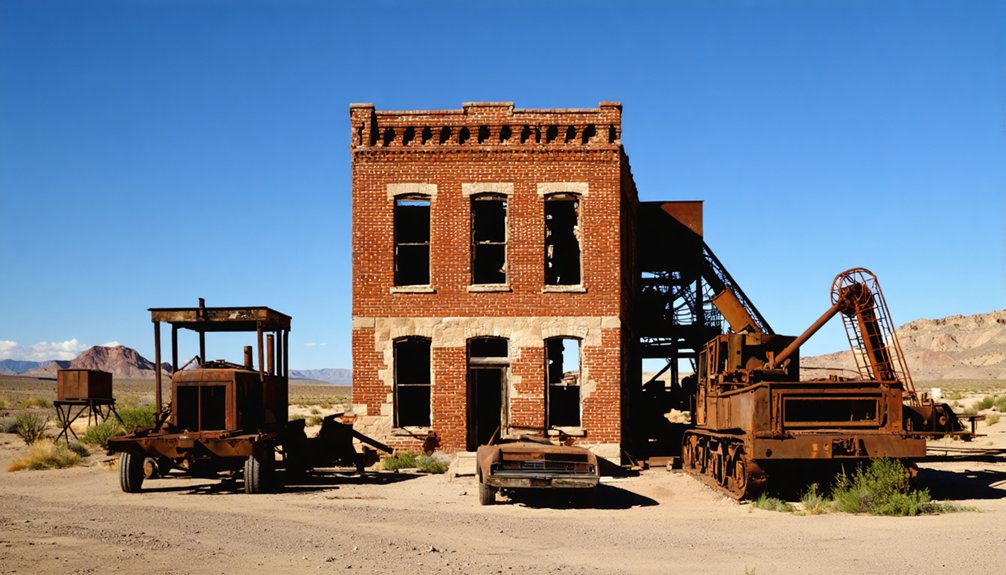
After David T. Harshaw’s silver discovery in the 1870s, you’ll find remnants of a once-thriving community that housed 2,000 residents.
The town’s brick foundations reveal sophisticated construction methods, with adobe cores and brick facings typical of Arizona mining camps. You can still trace masonry remains among collapsed walls where modest single-story dwellings once stood.
The Hermosa Mine anchored operations with its twenty-stamp mill opening in 1880, producing high-grade silver, lead, and gold.
ASARCO later operated local mines from 1937 to 1956, extending the mining legacy through multiple phases.
However, U.S. Forest Service demolition programs in the 1960s removed many structures lacking formal land title, leaving you with scattered ruins that document this boom-and-bust cycle.
Swansea: Well-Preserved Desert Ghost Town
You’ll discover Swansea’s remarkable mining legacy when you explore this remote La Paz County ghost town, where copper operations flourished from 1900 until the Great Depression forced closure in 1937.
The desert location has preserved dozens of adobe structures, brick smelter ruins, and mining infrastructure that showcase the town’s peak development when 500 residents supported extensive operations.
Today, you can examine the Bureau of Land Management’s careful restoration work, which has maintained authentic 1917 workers’ cottages and secured dangerous mine shafts while protecting this exceptionally well-preserved piece of Arizona’s industrial heritage.
Mining Heritage and History
Although silver-lead ore deposits had been identified in the harsh Sonoran Desert since the 1860s, serious mining efforts at what would become Swansea didn’t begin until prospectors Newton Evans and Thomas Jefferson Carrigan recognized the site’s potential in 1904.
The copper extraction operations that followed demonstrated remarkable historical significance in Arizona’s mining heritage.
You’ll discover Swansea’s mining legacy through these key developments:
- Production Scale: The Swansea Mine yielded 27 million pounds of copper between 1906-1949
- Infrastructure: Operations required 400,000 gallons of water daily and featured smelters processing 350-700 tons
- Corporate Evolution: Clara Gold and Copper Mining Company operated until 1911, followed by American Smelting and Refining Company from 1914
- Strategic Importance: Mining provided essential materials during World War I, sustaining production throughout the decade
Preserved Desert Structures
The remote location that once challenged Swansea’s miners now serves as the town’s greatest asset for preservation. You’ll find dozens of adobe structures scattered throughout this desert valley, their walls bearing handprints from 1910 that miners left behind.
The isolation that made life difficult for residents has protected these ruins from vandalism and urban development.
The Bureau of Land Management has carefully maintained the site’s historical significance, installing plaques that detail the town’s copper mining legacy. You can explore foundations of the massive 350-ton smelter, railroad depot remains, and two historic cemeteries.
Evidence of commercial buildings like saloons and theater remnants tells the story of a community that housed over 5,000 residents before abandonment in the 1930s.
BLM Conservation Efforts
Bureau of Land Management officials designated Swansea as a Special Management Area in 1990, establishing extensive protections that govern every aspect of visitor access and site preservation.
You’ll find thorough conservation strategies implemented throughout the 16,400-acre wilderness designation, where federal stewardship balances exploration freedom with cultural resource protection.
BLM’s visitor education initiatives include:
- Interpretive trails with educational signage documenting mining operations and community history
- Stabilization projects using arrested-decay techniques on adobe structures
- Designated primitive camping sites concentrating overnight use within town boundaries
- Safety hazard mitigation including fenced mine shafts and structural warnings
Federal regulations prohibit artifact removal while maintaining unrestricted daytime access.
You’re encouraged to explore responsibly using high-clearance vehicles on maintained unpaved routes.
Documentation efforts preserve historical records from Swansea’s 1909 founding through its peak population of 750 residents.
Ruby: Arizona’s Most Intact Mining Camp
Nestled in the rugged hills near Arizona’s border with Mexico, Ruby stands as the state’s most remarkably preserved mining camp, where over two dozen original adobe and concrete structures still dot the landscape more than eight decades after its abandonment.
Ruby’s Resilience stems from its remote 362-acre privately-owned location, protecting it from vandalism since the Forest Service expelled hippie squatters in 1976.
You’ll find this Mining Legacy began in 1877 with gold claims, evolved into Montana Camp, then transformed into Ruby during Arizona’s 1912 statehood. The lead-zinc boom swelled population to 2,000 residents before Eagle-Picher’s 1940 closure and shaft demolition.
Today’s caretaker maintains buildings housing 190,000 Mexican free-tailed bats, while three fish-stocked lakes serve researchers at this National Register site.
Exploring the Ghost Town Trail Experience
Winding through the Dragoon Mountains southeast of Tucson, Arizona’s Ghost Town Trail connects four abandoned mining settlements that flourished during the territory’s copper and turquoise boom between 1870 and 1920.
You’ll discover remarkable remnants of frontier life along this 34-mile route spanning Tombstone to Pearce, where Chiricahua Apache once extracted turquoise before Euro-American miners arrived.
The trail’s historical significance emerges through four distinct stops:
Four ghost towns along Arizona’s historic route reveal the rise and fall of the territorial mining era.
- Pearce – Cross streets, jail ruins, and residential foundations offer prime ghost town photography opportunities.
- Courtland – Mining tailings mark where 2,000 residents once lived before the 1942 post office closure.
- Gleeson – Bono Store, schoolhouse, and cemetery provide walking tours with interpretive displays.
- Tombstone – The surviving tourist center anchoring this boom-to-bust narrative.
You’ll need 2-4 hours exploring these desert ruins best visited during cooler fall-spring months.
Preservation Efforts and Modern Access
Although Arizona’s ghost towns face constant threats from weathering and vandalism, multiple preservation frameworks now protect these historic sites through coordinated federal, state, and private initiatives.
You’ll find Bureau of Land Management ownership enables stabilization projects at sites like Fairbank Historic Townsite, where formal management plans guarantee public access while protecting structures. Various preservation strategies include masonry consolidation, roof shoring, and collapse prevention for deteriorating adobe buildings.
Multiple funding mechanisms support these efforts. Federal Historic Preservation Fund grants provide capital for surveys and stabilization, while nonprofit organizations raise private donations for restoration projects.
You can visit privately restored sites like Vulture City, where entrance fees sustain ongoing maintenance. Volunteer labor reduces costs considerably, with local stewards contributing to interpretive signage and guided tours that preserve these authentic windows into Arizona’s mining heritage.
Frequently Asked Questions
What Safety Precautions Should Visitors Take When Exploring Abandoned Mining Shafts?
You shouldn’t enter abandoned shafts due to shaft stability concerns and cave in risks from rotting timbers. Stay back from openings, test ground ahead, carry gas detectors, and never explore alone underground.
Are Camping or Overnight Stays Permitted at Any Arizona Ghost Towns?
You can camp overnight at Goldfield Ghost Town’s designated campground for $30-50 nightly, while Fairbank Historic Townsite allows free dispersed camping. Check camping regulations and overnight permits before visiting other ghost town locations.
Which Ghost Towns Require Entrance Fees or Guided Tour Reservations?
Approximately fifteen Arizona ghost towns charge entrance fees ranging $7-$20. You’ll pay admission at Vulture City, Gold King Mine, and Ruby, while Goldfield offers free grounds access. Several require guided tour reservations for safety.
What Wildlife Dangers Might Visitors Encounter in Remote Ghost Town Locations?
You’ll face wildlife encounters including rattlesnakes, bark scorpions, and black widows in debris. Venomous creatures hide in abandoned structures while mountain lions, bears, and aggressive javelina roam nearby territories, demanding constant vigilance.
Can Visitors Legally Remove Artifacts or Souvenirs From Ghost Town Sites?
Don’t let temptation’s siren call lead you astray—removing artifacts triggers serious legal consequences including federal felony charges, hefty fines, and prison time. Artifact preservation laws protect these sites whether they’re on federal, state, or private land.
References
- https://www.arizonahighways.com/article/arizona-ghost-towns
- https://www.visittucson.org/blog/post/8-ghost-towns-of-southern-arizona/
- https://www.visitarizona.com/like-a-local/4-arizona-ghost-towns-you-may-have-never-heard-of
- https://www.atlasobscura.com/things-to-do/arizona/ghost-towns
- https://www.geotab.com/ghost-towns/
- https://www.tripadvisor.com/Attractions-g28924-Activities-c47-t14-Arizona.html
- https://state48a2z.wixsite.com/blog/post/copper-mines-a-shootout-and-a-murder-were-highlights-from-this-short-lived-ghost-town
- https://www.legendsofamerica.com/az-ghosttowntrail/
- https://azoffroad.net/courtland
- https://www.youtube.com/watch?v=IXuiUlJTDZI