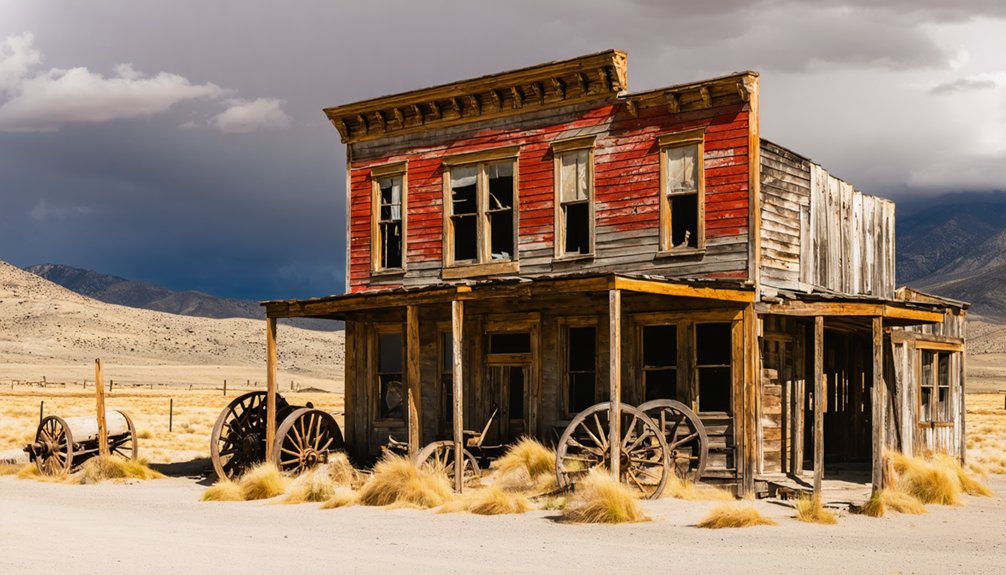
You’ll discover America’s 1,500+ ghost towns tell haunting stories of economic collapse, natural disasters, and supernatural encounters. Texas leads with 511 abandoned settlements, followed by California’s 346 sites, many stemming from mining booms and busts. Famous locations like Bodie, California and Centralia, Pennsylvania offer preserved buildings alongside reported paranormal activity, with Texas alone recording 7,641 spooky sightings. These deserted communities range from completely vanished settlements to semi-abandoned towns where visitors can explore authentic 1860s-1880s structures and experience the mysteries that continue to unfold.
Key Takeaways
- Texas leads with 7,641 spooky sightings and a 5.15% chance of ghostly encounters in abandoned settlements.
- Bodie, California features cursed treasure legends and ghostly whispers among 170 preserved buildings from the 1800s.
- Centralia, Pennsylvania has an eternal underground coal fire since 1962, creating deadly sinkholes and eerie evacuations.
- Common supernatural experiences include phantom footsteps, unexplained voices, crying sounds, and visual apparitions in decaying structures.
- Mining boom-bust cycles created volatile ghost towns where paranormal investigators report compelling spectral stories and mysterious encounters.
The Rise and Fall: What Creates America’s Abandoned Towns
While America’s ghost towns capture our imagination with their eerie silence and crumbling facades, their origins reveal predictable patterns of economic vulnerability and geographic isolation.
You’ll find that resource dependency created the most dramatic collapses—towns where 80-90% of residents worked single extractive industries like gold mining or oil drilling. When markets shifted or deposits depleted, entire communities vanished within months.
Urban decline followed different trajectories but similar vulnerabilities. Manufacturing towns lost populations through plant closures and offshoring, while transportation realignments left formerly prosperous communities stranded. In cities like Detroit, property owners abandoned homes when property taxes exceeded the actual value of their properties, creating entire neighborhoods of vacant lots.
You can still see the physical evidence: abandoned mills, derelict commercial blocks, and stranded infrastructure that once supported thriving populations. Natural disasters and environmental catastrophes also created instant ghost towns, forcing immediate evacuation of entire populations who could never return safely.
Whether sparked by exhausted silver mines or closed factories, America’s ghost towns demonstrate how quickly prosperity can turn to abandonment.
Leading States Where Ghost Towns Flourish
These patterns of abandonment concentrate most heavily in specific regions, with Texas claiming the undisputed crown for ghost town density.
You’ll find 511 abandoned settlements scattered across the Lone Star State’s vast territory, with interactive maps revealing dense clusters within 25-50 mile radii.
California follows with 346 ghost towns, where Kern County alone hosts 113 sites—the highest county total nationally.
Kansas rounds out the top three with 308 abandoned communities, reflecting rural transportation declines.
South Dakota’s 238 ghost towns concentrate heavily in Lawrence County’s mining regions, while Florida surprises with 257 sites. At the opposite end of the spectrum, Rhode Island and Connecticut maintain only one and four ghost towns respectively, making true ghost towns exceptionally rare in these northeastern states.
This ghost town geography reveals urban abandonment trends spanning military outposts, mining camps, and agricultural settlements across America’s diverse landscapes. Oklahoma’s extensive collection reflects the land run settlement patterns that created over 200 abandoned communities throughout the state.
Mining Booms That Turned to Busts
Mining camps transformed into thriving cities almost overnight, only to vanish just as quickly when precious metals ran dry.
You’ll discover that Nevada’s boom-bust cycle exemplifies the volatile nature of frontier capitalism, where fortunes appeared and disappeared within decades.
Economic fluctuations devastated these communities when external forces struck:
- Financial Panic of 1907 – Destroyed Rhyolite’s prosperity after the Montgomery-Shoshone Mine sold for millions just one year earlier.
- Great Depression – Slowed Tonopah’s silver production despite generating $121 million by 1921.
- Improved Mining Techniques – Briefly revived Belmont around 1915 with new extraction methods and higher prices.
These towns represent your ancestors’ relentless pursuit of independence through mineral wealth, where entire populations dismantled their homes and moved on when opportunities vanished. Berlin’s mine produced a total of $849,000 before its abandonment in 1911, demonstrating how even substantial earnings couldn’t sustain a community once the ore was exhausted.
Environmental challenges also contributed to mining town failures, as Greenwater’s population abandoned the settlement when severe snowstorms and water scarcity made living conditions unbearable.
Natural Disasters and Economic Collapse
Beyond the economic forces that emptied mining camps, nature itself dealt devastating blows that permanently erased entire communities from the American landscape.
You’ll find towns swallowed by floods when dam projects created reservoirs or catastrophic river overflows forced mass relocations. Hurricanes and coastal erosion claimed Gulf and Atlantic settlements, while wildfires consumed wooden structures in historic districts where rebuilding costs proved prohibitive. The Great Flood of 1993 devastated Midwestern communities like Valmeyer, Illinois, forcing nearly 900 residents to relocate to higher ground and leaving the original town virtually deserted.
The 1930s Dust Bowl exemplifies how natural disasters triggered economic collapse across the Great Plains. Prolonged droughts destroyed crops, eroded soil, and shattered tax bases in Kansas, Oklahoma, Nebraska, and the Dakotas. Environmental contamination from industrial activities also rendered some communities permanently uninhabitable, as toxic waste accumulation made entire neighborhoods too dangerous for human habitation.
Environmental catastrophe devastated Great Plains agriculture, transforming thriving farming communities into abandoned settlements across multiple states during the Depression era.
You’ll discover that when farming became unsustainable, entire rural communities lost schools, post offices, and businesses. Government mechanization accelerated farm consolidation, leaving small service towns without customers and creating today’s agricultural ghost towns.
Famous Ghost Towns and Their Dark Legends
You’ll find that America’s most notorious ghost towns carry legends as haunting as their abandoned streets.
Bodie, California’s gold rush boomtown harbors tales of cursed treasure that doom anyone who removes artifacts from its preserved buildings.
Meanwhile, Centralia, Pennsylvania burns eternally with an underground coal fire that’s raged since 1962, creating a literal hellscape beneath empty lots where homes once stood.
Virginia City, Nevada once thrived as the site of the Comstock Lode, America’s first major silver deposit that sparked a massive rush in the 1860s.
These abandoned settlements are among the 4,531 ghost towns scattered across the United States, each with their own dark history and mysterious past.
Bodie’s Cursed Gold Legacy
When William S. Bodey discovered gold near Bodie Bluff in 1859, he unknowingly set in motion a legacy of cursed treasures that would haunt this California mining town for generations.
After Bodey died in a blizzard and was buried in an unmarked grave, the town’s fortune turned dark despite producing $38 million in precious metals.
You’ll discover Bodie’s supernatural reputation stems from:
- The Killer’s Curse – A murderous husband’s spirit allegedly haunted the last residents in the 1940s
- Unnatural Deaths – All but one of the final six settlers died from mysterious circumstances
- Ghostly Whispers – Visitors report hearing voices among the 170 preserved buildings in arrested decay
This cursed gold legacy earned Bodie its official designation as California’s state ghost town.
Centralia’s Underground Fire Hell
While Bodie’s cursed gold created supernatural legends, Pennsylvania’s Centralia became a real-life hell when municipal workers ignited a landfill fire in May 1962 that breached abandoned coal mine workings beneath the town.
The Centralia fire spread through interconnected coal seam networks, reaching 300 feet deep and consuming 3,700 acres. Toxic emissions including carbon monoxide and sulfurous gases forced evacuations, while underground hazards created deadly sinkholes—including an 80-foot collapse in 1981.
Municipal neglect and failed suppression attempts allowed the blaze to spread at 75 feet annually. Health impacts and subsidence issues drove residents away as the government offered buyouts instead of extinguishing the fire.
Today’s ghostly remnants include abandoned streets and smoking ground, with projections showing the fire burning for another 250 years.
Frisco’s Violent Mining Past
Founded in 1874 following the discovery of high-grade silver deposits, Colorado’s Frisco exploded into one of the territory’s most notorious mining camps, where violence became as common as silver strikes.
With a peak population reaching 6,000 residents, this lawless settlement earned comparisons to Dodge City and Tombstone for its brutal reputation.
The town’s volatile atmosphere stemmed from multiple sources:
- Over two dozen Frisco saloons and gambling dens fueled constant brawls among transient miners and claim jumpers.
- Sheriff William Pearson’s lethal enforcement tactics reportedly resulted in multiple killings his first night establishing order.
- Mining disputes over claims and payroll robberies escalated into deadly confrontations between rival factions.
With limited formal justice infrastructure, frontier justice prevailed over due process, cementing Frisco’s legacy as one of Colorado’s wildest camps.
Categories of Abandonment: From Barren to Submerged
Ghost towns don’t simply vanish overnight—they undergo distinct stages of decay that archaeologists and historians have categorized into four primary classes based on their physical remains.
Class A represents complete disappearance—37 barren sites across America where only cemeteries or markers hint at former communities.
Class B features rubble and roofless ruins, showing intermediate decay from mining booms gone bust.
Class C encompasses classic ghost towns like Bodie, California, with standing buildings preserved as tourist destinations.
Class D includes semi-ghost towns where small populations live among abandoned structures.
Beyond these abandonment categories, you’ll find 46 submerged towns completely underwater from dam construction and flooding, representing the most dramatic form of abandonment where entire communities disappeared beneath reservoirs and lakes.
Supernatural Encounters in Deserted Places
Beyond the physical remnants that classify these abandoned settlements lies another dimension of ghost town exploration—the reported supernatural activity that draws paranormal investigators and curious visitors alike.
The abandonment stories of Santa Fe Trail often highlight the struggles and hardships faced by those who once called these towns home. Legends of lost treasures and mysterious disappearances continue to spark interest, prompting many to explore the rich history that lingers in the air. Each visit unveils new tales, leaving one to ponder what truly happened within the walls of these forsaken places.
Texas dominates with 7,641 total spooky sightings and a 5.15% probability of ghostly encounters across its 558 documented ghost towns. You’ll find compelling spectral stories throughout states shaped by gold rush history, where Montana’s 111 ghost towns and South Dakota’s 246 abandoned settlements continue generating paranormal reports.
Most Common Supernatural Experiences:
- Phantom sounds – footsteps approaching deserted buildings and voices from empty structures
- Unexplained crying – baby cries echoing through abandoned homes like those in Grafton, Utah
- Visual apparitions – ghostly figures witnessed among cemetery remnants and deteriorating foundations
These encounters transform ordinary historical sites into destinations where past and present mysteriously intersect.
Preservation Efforts Bringing Towns Back to Life
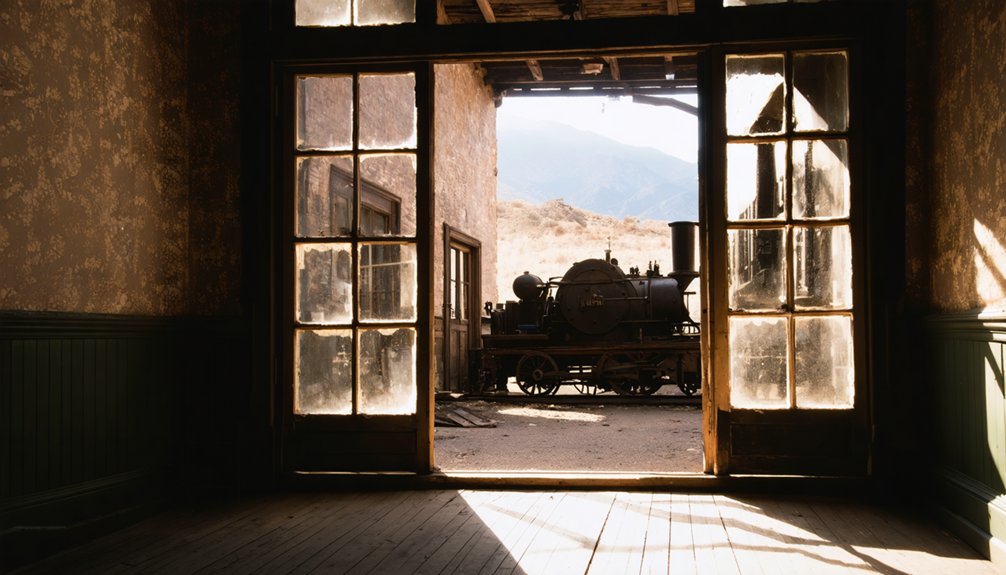
While abandoned settlements might seem destined for decay, determined preservation efforts across America have transformed countless ghost towns into thriving heritage destinations.
Through dedicated preservation initiatives and strategic funding, America’s forgotten settlements are experiencing remarkable revivals as celebrated cultural destinations.
You’ll discover that preservation funding from federal sources has exceeded $1.66 billion since 2001, channeling resources through State Historic Preservation Offices and competitive grant programs. These initiatives leverage nearly dollar-for-dollar matching funds from local communities, amplifying investment impact.
You can witness successful adaptive reuse projects where historic rehabilitation tax credits have converted former mining and industrial buildings into tourist attractions, museums, and lodging facilities.
National Register listings provide regulatory protection while enabling private investment through tax incentives. Sites like Eastern State Penitentiary now welcome over 220,000 visitors annually, proving that strategic preservation transforms forgotten places into vibrant cultural experiences that honor America’s authentic heritage.
Planning Your Visit to America’s Most Haunted Settlements
When you’re ready to explore America’s most haunted settlements, careful planning guarantees you’ll experience both historical significance and supernatural intrigue at these preserved ghost towns.
Essential Planning Steps:
- Book guided experiences – Bodie offers fifty-minute daily ranger tours, while summer ghost tours provide after-dark encounters with frontier spirits.
- Research accessibility – Cahaba’s privately owned tours require advance booking, and Garnet’s Bureau of Land Management status assures year-round visitor access.
- Time your visit strategically – St. Elmo’s picturesque summer appeal contrasts with Bannack’s spine-chilling atmosphere during off-peak seasons.
Historical preservation efforts have maintained authentic 1860s-1880s structures across these sites.
You’ll find 200 undisturbed buildings at Bodie and 60 remaining structures at Bannack.
These ghost tours connect you directly with America’s mining heritage while respecting archaeological integrity.
Frequently Asked Questions
Can You Legally Take Artifacts or Souvenirs From Ghost Town Sites?
No, you can’t legally take artifacts from most ghost town sites. You’ll face serious legal ramifications including fines and imprisonment. Artifact preservation laws protect these historical items on federal, state, and private lands.
What Safety Precautions Should Visitors Take When Exploring Abandoned Buildings?
Like armor protecting warriors, proper safety gear shields urban exploration enthusiasts from hazards. You’ll need sturdy boots, cut-resistant gloves, respiratory protection, eye gear, and hard hats when entering structurally compromised ghost town buildings.
Are Overnight Camping or Ghost Hunting Permitted in These Locations?
You’ll need landowner permission and must follow camping regulations on public lands, which typically allow 14-day stays. Ghost hunting etiquette requires respecting preservation laws and obtaining special permits for commercial activities.
How Do Property Ownership Laws Apply to Seemingly Abandoned Towns?
You’ll face complex property rights challenges since legal ownership typically remains with original owners, heirs, or lenders despite abandonment, creating potential ownership disputes requiring thorough title searches before any activities.
What Equipment Is Recommended for Photographing or Investigating Ghost Towns?
You’ll need essential camera gear including full-spectrum DSLRs, thermal cameras, and drones for documentation, plus ghost hunting equipment like EMF meters, digital recorders, and environmental sensors to capture potential paranormal activity safely.
References
- https://www.loveexploring.com/gallerylist/188219/the-us-state-with-the-most-ghost-towns-revealed
- https://www.geotab.com/ghost-towns/
- https://blog.batchgeo.com/ghost-towns/
- https://nightofthejack.com/2025/01/23/top-creepy-ghost-towns-in-america/
- https://storymaps.arcgis.com/stories/124e04142d3147078fb4519a6b9a5c64
- https://freepages.history.rootsweb.com/~gtusa/usa.htm
- https://kkyr.com/ghost-towns-of-america-texas-has-the-most/
- https://en.wikipedia.org/wiki/Lists_of_ghost_towns_in_the_United_States
- https://joybird.com/blog/top-ghost-towns-in-america/
- https://historycollection.com/ghost-town-boom-bust-instant-cities-that-vanished/