You’ll find modern ghost towns scattered across America today, from Detroit’s abandoned neighborhoods with 30% vacancy rates to entire developments in Missouri where McMansion subdivisions sit empty due to financial speculation and planning failures. Centralia, Pennsylvania has faced evacuation since 1962 due to an underground coal fire, while Valmeyer, Illinois relocated entirely after 1993 flooding. These contemporary examples mirror historic patterns but stem from different causes than their Wild West predecessors.
Key Takeaways
- Yes, modern ghost towns exist across America, created by suburban sprawl, financial speculation, and failed development projects.
- Detroit exemplifies urban ghost towns with 30% residential vacancy and population declining from 1.8 million to 640,000 residents.
- Commercial districts become ghost towns as office vacancy rates exceed 30% in cities like San Francisco.
- Single-industry towns rapidly become ghost towns when major employers close, creating predictable patterns of mass abandonment.
- Global ghost cities exist from speculative development, including China’s empty cities and Turkey’s unfinished Burj Al Babas.
Modern Ghost Towns vs. Historic Western Settlements
While historic Western settlements became ghost towns through resource depletion and economic shifts, today’s abandoned communities emerge from entirely different forces.
You’ll find modern ghost towns like Missouri’s McMansion developments, where suburban sprawl created empty neighborhoods when buyers never materialized. Unlike mining camps that died with their ore veins, contemporary abandonments stem from financial speculation, climate change, and urban decay.
Centralia, Pennsylvania exemplifies this shift—an underground coal fire since 1962 forced evacuation, while Valmeyer, Illinois relocated entirely after 1993 flooding. Ground temperatures in Centralia have reached over 900 degrees in some locations, with the coal fire expected to burn for another 250 years. Cities like Augusta, Georgia show rental vacancy rates of 8.9%, indicating the gradual transformation of once-thriving communities.
These aren’t frontier failures but products of modern planning mistakes. From Turkey’s castle-themed Burj Al Babas to China’s replica Thames Town, today’s ghost towns reflect overambitious development rather than resource exhaustion, creating eerie monuments to contemporary miscalculation.
Residential Vacancy Crisis in American Cities
You’ll find Detroit exemplifies America’s most severe urban vacancy crisis, with residential vacancy rates reaching approximately 30% across the city by 2025, far exceeding the national average of 7.1%.
Property values have collapsed so dramatically that you can purchase entire homes for under $100,000 in many neighborhoods, with some selling for as little as $1,000-$5,000 according to Wayne County tax auction records. The rental vacancy rate serves as a key indicator of housing market health, measuring the proportion of rental inventory available for rent across different markets. In contrast, the national housing market shows remarkable stability with vacancy rates holding steady at 1.3% for over three consecutive years.
This extreme devaluation reflects decades of population decline from 1.8 million residents in 1950 to fewer than 640,000 today, creating vast swaths of abandoned residential districts that mirror historic ghost towns.
Detroit’s Extreme Vacancy Rates
Detroit’s residential vacancy crisis exemplifies how post-industrial cities can develop extreme housing market imbalances, with the Detroit–Warren–Dearborn MSA reporting an 8.7% residential vacancy rate that reflects substantial rental market slack compared to most metropolitan areas.
You’ll find that post-2020 population decline of approximately 6% created excess housing units throughout neighborhoods, while long-term outmigration reduced household demand relative to existing housing stock.
Geographic concentration reveals stark disparities across Detroit’s landscape:
- Central neighborhoods with stabilized multifamily assets maintain 94.8% occupancy rates
- Suburban office corridors like Southfield show extreme vacancy exceeding 30%
- Transit-poor areas experience chronic residential emptiness and abandonment
- Peripheral post-industrial zones concentrate vacant structures and blighted properties
- Economic disinvestment creates mismatches between aging housing stock and modern rental demand
However, the metro area’s workforce housing segment has shown resilience with occupancy rising by 90 basis points to 93.2% as essential workers seek affordable housing options.
Despite vacancy challenges, Detroit’s rental market demonstrated modest growth momentum with year-over-year rent increases of 2.9%, significantly outpacing the national average of 0.9%.
Property Values Under $100K
Across America’s struggling metropolitan areas, residential properties valued under $100,000 concentrate in neighborhoods where long-term disinvestment has created persistent vacancy cycles that compound local housing market distress.
You’ll find these low income housing markets primarily in Rust Belt metros experiencing population loss, small nonmetro counties with aging housing stocks, and legacy industrial cities where foreclosure inventories periodically flood weak-price ZIP codes.
These affordable housing units often require substantial capital expenditures for roofs, HVAC systems, and foundations, raising total ownership costs well above market prices.
Investor buy-and-hold strategies frequently convert these properties to rentals, removing them from for-sale inventory while creating appearance of reduced vacancy.
Meanwhile, high property-tax delinquencies and code-enforcement cases cluster around these low-priced parcels, perpetuating cycles of neighborhood disinvestment and reduced marketability. Current data shows rental vacancy rates reaching 11.83% in certain states, indicating significant housing market challenges across different regions. This contrasts sharply with competitive markets where national occupancy rates stand at 93.3% and renters face intense competition for available units.
Commercial Real Estate Collapse and Office Ghost Towns
You’re witnessing the most severe commercial real estate crisis in decades, with office vacancy rates hitting record highs across major U.S. markets through mid-2025.
The pandemic’s permanent shift to hybrid work models has fundamentally reduced office space demand per worker, leaving property owners facing a devastating refinancing cliff as approximately $1.8 trillion in commercial loans mature by 2026. Office absorption has remained negative since early 2025, further accelerating the decline in occupied commercial space.
Regional banks and traditional lenders have sharply reduced office exposure, creating a perfect storm of distressed sales and forced dispositions that’s transforming once-bustling business districts into modern ghost towns. Urban cores like New York and San Francisco are experiencing the most severe impacts as declining property values compound the challenges facing office sector owners.
Post-Pandemic Office Vacancies
While the pandemic’s initial shockwaves sent office vacancy rates skyrocketing to unprecedented levels, the commercial real estate market has begun showing tentative signs of recovery by late 2025.
You’re witnessing the first quarterly decline in national vacancy rates, dropping to 18.3% in Q3 2025 after peaking at 19.6% earlier that year. Office occupancy has steadily improved, reaching 80% of pre-pandemic levels by July 2025 as companies implement return-to-office mandates.
Vacancy trends reveal significant regional disparities in recovery:
- San Francisco and West Coast cities maintain troubling 30%+ vacancy rates
- Manhattan CBD availability sits at 18% with positive absorption momentum
- Texas markets stabilize in mid-20% range after dramatic increases
- Suburban offices outperform CBD locations with 17.8% vacancy
- Class A properties show stronger performance, particularly post-2000 construction
1.5 Trillion Debt Crisis
Despite modest recovery signals in office occupancy, the commercial real estate sector faces an unprecedented debt crisis that threatens to trigger widespread defaults and institutional failures.
You’re witnessing $950 billion in commercial mortgages maturing within twelve months, with $1.8 trillion due in 2026. Over 50% of property owners face loan maturities this year, confronting refinancing challenges as rates jump from sub-4% origins to 75%-100% higher payments.
Banks engage in extend-and-pretend strategies to delay inevitable losses, but regulators will eventually force recognition. Default rates are projected to surge as borrowers can’t service elevated debt costs.
The Federal Reserve’s benchmark rate, forecasted at 3.5%-3.75% by 2025’s end, continues pressuring margins. This tsunami of debt defaults could reshape America’s commercial landscape permanently.
Population Decline Patterns Across Major Metropolitan Areas
Although the pandemic initially triggered widespread metropolitan population losses, recent demographic data reveals a stark reversal across America’s urban landscape between 2023 and 2024.
You’re witnessing 88-90% of metro areas gaining residents, driven by international migration contributing 2.7 million new arrivals.
However, this recovery isn’t uniform across regions.
Population migration patterns show clear winners and losers:
- Sun Belt metros with moderate affordability lead growth rates
- Large pandemic-hit metros like New York and San Francisco rebound unevenly
- Industrial Midwest metros continue underperforming despite national trends
- Prime working-age populations concentrate in metropolitan areas
- Housing supply constraints limit urban gentrification in high-cost regions
You’ll find the fastest growth concentrated in moderately-priced metros offering employment opportunities, while lowest-cost areas struggle with structural economic weaknesses that prevent meaningful population recovery.
Failed Tourist Destinations and Economic Abandonment
America’s tourism economy creates its own casualties when destinations fail to sustain visitor interest or adapt to changing market conditions.
You’ll witness tourism dependency’s devastating effects when single-attraction towns lose their novelty. Branson, Missouri’s entertainment district saw declining visitor numbers after theme preferences shifted, while Atlantic City’s boardwalk deteriorated as gambling moved online and to other states.
Economic downturns accelerate abandonment patterns you can observe today. Retail storefronts close first, followed by reduced transportation links and hospitality closures.
Rising operating costs outpace declining visitor spending, forcing business owners to abandon assets. Former resort towns like Salton Sea, California, now display empty hotels and deteriorating infrastructure.
High seasonality concentrates income into brief periods, creating unsustainable cash-flow cycles that ultimately destroy local economies dependent on tourist dollars.
The Economics Behind Contemporary Ghost Towns
You can trace modern ghost towns to specific economic collapse patterns that unfold predictably over 1-2 decades.
Many cities have been impacted by significant shifts in industry and population, with urban decline in Detroit serving as a notable example. As job opportunities dwindled, residents left in search of better prospects elsewhere, leading to a dramatic decrease in the city’s vibrancy. This trend has not only affected the local economy but has also altered the social fabric of the community.
When single-industry towns lose their primary employer through resource depletion or plant closures, population decline accelerates rapidly—some U.S. cities experienced -6% population loss between 2020-2023 alone.
Property markets signal this decline early, with rental vacancy rates climbing to 8.9% in high-risk areas and building permits dropping by 22% year-over-year as investment confidence evaporates.
Economic Collapse Triggers Abandonment
The collapse follows a predictable pattern:
- Major employer closure triggers immediate mass unemployment and income loss
- Small businesses fail as local purchasing power disappears overnight
- Property values plummet, creating negative equity and foreclosures
- Municipal tax revenue drops, forcing cuts to essential services
- Infrastructure deteriorates while maintenance budgets shrink
This economic death spiral accelerates abandonment as remaining residents flee deteriorating conditions, leaving behind the skeletal remains of once-thriving communities.
Property Values Signal Decline
When property values begin their downward spiral, they create the most reliable early warning system for identifying communities at risk of becoming modern ghost towns.
You’ll notice median home values declining 20-30% faster than regional averages, with some neighborhoods reaching just 14% of statewide medians.
These property market trends trigger cascading effects: developers halt construction, buyers retreat, and months of supply increase from two to over six.
Vacancy rates climb to 15-20% as “zombie” properties multiply during foreclosure processes.
These economic indicators compound rapidly—depressed values slash municipal tax bases, reducing services and increasing blight.
Commercial vacancy rates spike 30-35% above normal levels, eliminating local jobs.
This feedback loop accelerates decline, making recovery increasingly difficult once property values signal distress.
Retirement Communities Facing Reversal and Decline
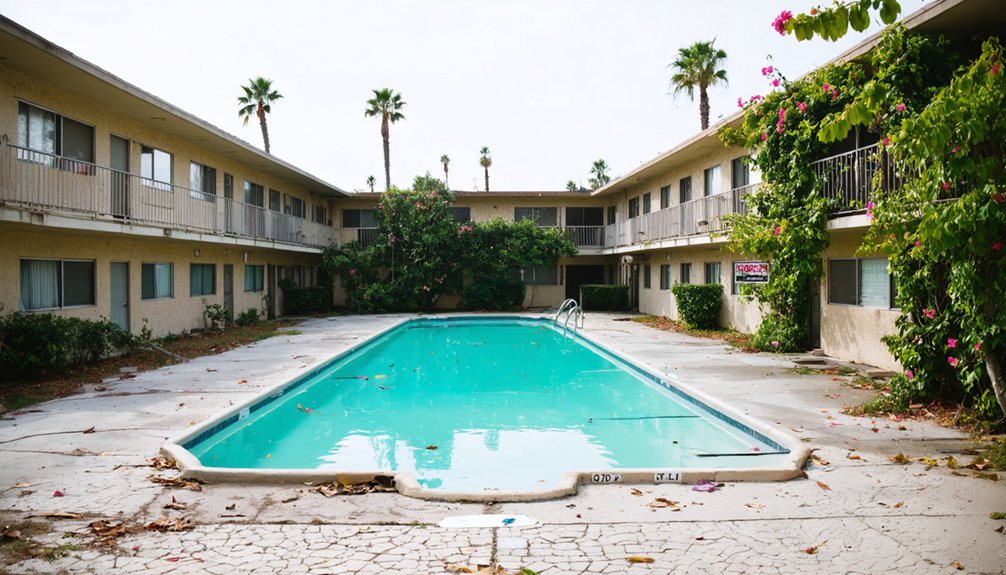
Although Baby Boomers are driving unprecedented demand for senior housing nationwide, you’ll find that many retirement communities are paradoxically facing closure, conversion, or decline due to financial pressures and market imbalances.
Despite overall occupancy reaching near-record levels at 89% for independent living in Q1 2025, inventory is actually shrinking in markets like San Antonio, Pittsburgh, and Sacramento where closures outpace new construction.
Rising construction costs have pushed starts to historic lows in secondary markets, while providers face margin compression that forces them to abandon lower-quality properties rather than invest in costly renovations.
- Construction starts near historic lows limit replacement of aging senior housing stock
- Localized unit losses reach 4% over three years in affected metropolitan areas
- Secondary market assets struggle with capital access, increasing distress likelihood
- Memory care segments show investor caution through rising cap rates
- Geographic demand imbalances create regional oversupply despite national shortfalls
This community decline concentrates in smaller, outdated facilities lacking modern amenities that today’s affluent seniors demand.
Crime and Infrastructure Decay in Vacant Neighborhoods
As neighborhoods empty and properties fall vacant, you’ll find that crime rates spike dramatically in these deteriorating areas.
These vacant dangers create hyperlocal crime hotspots where violent crimes increase by 19% within 250 feet of foreclosed homes. In Austin, blocks with unsecured vacant buildings experienced 3.2 times more drug calls and twice the violent incidents compared to occupied areas.
Vacant properties transform neighborhoods into crime magnets, with violent incidents surging 19% within a 250-foot radius of foreclosed homes.
You’ll notice property crimes flourish as abandoned structures provide cover for vandalism and drug dealing.
Detroit’s fire department responded to over 9,000 structural fires in 2011, with 85% occurring in vacant buildings. Cleveland studies confirm higher rates of homicide and weapons violations around empty properties.
However, remediation works. Crime risk subsides when you reoccupy vacant properties, as demonstrated in Flint and Binghamton’s successful intervention programs.
Predicting Future Ghost Towns Based on Current Trends
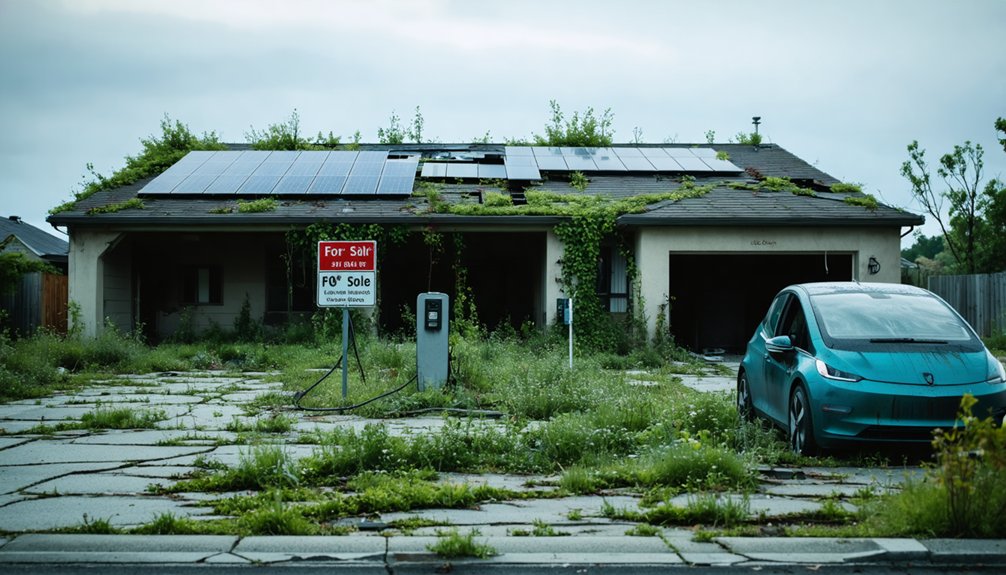
While nearly half of America’s 30,000 cities will lose 12-23% of their population by 2100, current data reveals you’re already witnessing the early stages of this dramatic urban contraction.
Population migration patterns show 43% of cities currently losing residents, escalating to 64% under climate scenarios.
You’ll see urban decay accelerating beyond traditional Rust Belt regions—even growth states like Texas and Utah face projected decline.
- Northeast and Midwest cities lead depopulation trends, with economic collapse driving mass exodus
- Florida’s 2025 housing crash threatens 10 cities with ghost town status from market implosion
- Climate disasters force permanent abandonment, from California wildfires to Alaska’s thawing permafrost
- Industrial decline creates hollowed-out communities with shrinking tax bases unable to maintain services
- Smaller cities face greater extinction risks than major metropolitan areas in demographic projections
Global Examples of Modern Settlement Abandonment
Beyond America’s projected urban contraction, you can observe settlement abandonment accelerating across every continent today.
China’s speculative developments created vast “ghost cities” like Nova Cidade de Kilamba in Angola, where entire districts remain vacant years after completion.
Turkey’s Burj Al Babas stands frozen following developer bankruptcy, leaving hundreds of castle-like homes empty.
Environmental disasters drive systematic relocations—Vunidogoloa, Fiji relocated due to rising seas, while Pripyat remains abandoned since Chernobyl’s contamination.
Economic collapse triggers rapid population migration from former mining centers across Australia and Canada.
Armed conflicts empty entire settlements throughout Africa and the Middle East.
This global pattern of urban decay reflects climate change, economic volatility, and political instability creating unprecedented settlement abandonment worldwide.
Frequently Asked Questions
Can Ghost Towns Be Legally Purchased by Individuals or Private Companies?
You can purchase ghost towns like striking gold in real estate markets. Property rights vary considerably, with ownership restrictions including historic preservation laws, environmental assessments, and zoning limitations affecting your acquisition plans.
What Happens to Utilities and Internet Services in Abandoned Ghost Towns?
You’ll find utility maintenance stops when populations drop, leaving dangerous live wires and contaminated water systems. Internet access disappears first since providers can’t justify rural infrastructure costs without paying customers.
Are There Tax Benefits for Living in High-Vacancy Ghost Town Areas?
You’ll find tax incentives for rural development in ghost towns through Opportunity Zones offering capital gains deferral, Iowa’s 10-20% housing credits, and reduced improvement thresholds making revival investments more financially viable.
How Do Emergency Services Operate in Sparsely Populated Ghost Town Regions?
You’ll find emergency response relies on volunteer crews, mutual-aid agreements, and extended travel times due to rural challenges. First-responder programs provide immediate care while regional coordination compensates for limited local resources.
What Environmental Cleanup Responsibilities Exist for Contaminated Abandoned Ghost Town Sites?
You’re facing monumentally complex responsibilities: you’ll need contamination assessment under CERCLA, then secure cleanup funding through Superfund, state programs, or Good Samaritan provisions depending on your liability status and site characteristics.
References
- https://themortgagepoint.com/2024/10/25/americas-new-ghost-towns/
- https://www.resourcefulfinancepro.com/news/the-top-15-ghost-towns-for-businesses-will-return-to-work-mandates-help/
- https://www.youtube.com/watch?v=9Q3IEfnUqyM
- https://www.youtube.com/watch?v=aTbMdOZRZO4&vl=en
- https://www.youtube.com/watch?v=hS27BhfMojc
- https://247wallst.com/special-report/2023/07/11/americas-modern-ghost-towns/
- https://joybird.com/blog/top-ghost-towns-in-america/
- https://worldpopulationreview.com/world-city-rankings/abandoned-cities
- https://www.loveproperty.com/gallerylist/83211/modern-ghost-towns-where-noone-lives
- https://www.ube.ac.uk/whats-happening/articles/ghost-cities/