You won’t find actual ghosts in ghost towns, but you’ll discover fascinating psychological and environmental factors that create compelling supernatural experiences. Scientific research shows that isolation, deteriorating structures, infrasound, and electromagnetic anomalies can trigger hallucinations and sensations of otherworldly presence. While documented histories reveal gradual economic abandonment rather than tragic mass departures, these locations have become profitable paranormal tourism destinations where entertainment often trumps historical accuracy. Understanding the complex interplay between neuroscience, folklore, and commerce reveals the true mysteries behind America’s most haunted settlements.
Key Takeaways
- No scientific evidence supports actual ghosts in ghost towns, with paranormal claims typically having natural explanations.
- Environmental factors like infrasound, electromagnetic fields, and deteriorating structures can create eerie sensations mistaken for supernatural activity.
- Psychological conditions including stress, fatigue, and pareidolia cause visitors to perceive ghostly figures in shadows and decay.
- Many ghost stories are fabricated by tourism operators to attract visitors and generate revenue for struggling communities.
- Historical records show most ghost towns experienced gradual population decline rather than sudden tragic events that folklore suggests.
The Historical Foundation of Ghost Town Legends
When you examine the economic forces behind ghost town formation, a clear pattern emerges: these settlements didn’t vanish mysteriously—they collapsed under predictable market pressures and resource depletion cycles.
Mining booms created rapid population spikes, but when gold and silver deposits depleted, towns emptied just as quickly. Railroad route changes severed market access, while single-industry communities died when employers relocated or closed.
Yet contemporary ghost stories rarely mention these mundane realities. Instead, historical narratives emphasize dramatic folklore—lawlessness, colorful characters, and supernatural mysteries. The Dust Bowl devastation of the 1930s particularly affected Great Plains farming communities, forcing widespread abandonment across Kansas, Oklahoma, and the Dakotas.
This mythmaking process transforms economic failures into romantic frontier tales. Many of these communities experienced boom and bust cycles that created the economic instability underlying their eventual abandonment. You’ll find that 19th and early 20th-century media accounts amplified these dramatic stories, creating the ghost town legends that persist today while obscuring the actual market forces that destroyed these communities.
Common Paranormal Phenomena Reported in Abandoned Settlements
Despite these rational explanations for ghost towns’ origins, visitors consistently report similar paranormal experiences across abandoned settlements worldwide.
Worldwide reports of paranormal encounters in ghost towns show remarkably consistent patterns, defying geographical and cultural boundaries across abandoned settlements.
You’ll find documented cases spanning visual apparitions, auditory phenomena, physical interactions, unexplained sensations, and environmental anomalies.
Paranormal sightings include shadowy figures in Cerra Gordo’s American Hotel and full-body apparitions at various locations.
You’ll encounter reports of disembodied voices, children singing, and unexplained footsteps echoing through empty buildings.
Physical manifestations range from objects moving independently to direct contact like scratches or shoulder tapping.
Ghostly encounters often involve temperature fluctuations, overwhelming presence sensations, and electromagnetic disturbances affecting lighting systems. EVP sessions have captured unexplained voices and sounds that weren’t audible during the actual recording time.
At Grafton near Zion Red Rock, visitors report strange noises and ghostly apparitions throughout the weathered structures.
These consistent patterns across geographically diverse locations suggest either genuine supernatural activity or shared psychological responses to abandoned environments.
The data remains compelling regardless of interpretation.
Scientific Explanations for Supernatural Encounters
While paranormal reports from ghost towns share striking similarities, neuroscience and psychology offer compelling explanations for these encounters. Your brain misfires during stress or fatigue in isolated environments, creating hallucinations of figures that aren’t there.
Sleep paralysis compounds this by mixing waking and dream states while you’re immobile, manifesting terrifying presences.
Environmental factors trigger additional psychological responses. Pareidolia makes you perceive faces in random shadows or rust stains, while higher dopamine levels increase pattern-finding where none exist. Ghost towns often become focal points for unexplained phenomena during nighttime hours when darkness amplifies psychological uncertainty. Social influence from group members asserting supernatural experiences can dramatically increase your belief in witnessing paranormal activity.
Infrasound around 19 Hz from silent fans creates “fear frequency” sensations and optical illusions. Weak electromagnetic fields stimulate presence sensations, and carbon monoxide leaks cause auditory hallucinations resembling footsteps or voices.
These psychological triggers transform ordinary decay into supernatural experiences.
How Investigators Document and Analyze Evidence
Although scientific explanations account for most supernatural experiences, paranormal investigators employ systematic methods to document and analyze potential evidence from ghost towns.
You’ll find serious researchers establishing baseline readings with EMF detectors and thermometers before investigating reported hotspots. Their evidence documentation includes multiple recording devices capturing audio, video, and environmental data simultaneously.
Teams conduct controlled EVP sessions while infrared cameras monitor for visual anomalies. Investigators often use trigger objects strategically placed throughout locations to potentially encourage spirit interaction during their systematic documentation process.
During analysis techniques, investigators apply rigorous protocols to eliminate false positives. You’ll see them cross-reference multiple data sources, seeking corroborating evidence across different instruments.
They actively work to debunk their own findings first, testing natural explanations before considering paranormal ones. Investigators also recognize that cultural conditioning may influence their interpretation of ambiguous data during the analysis phase. This scientific approach separates legitimate researchers from thrill-seekers, ensuring any unexplained phenomena receives proper scrutiny rather than sensationalized interpretation.
The Tourism Economy of Haunted Heritage Sites
The systematic investigation methods used by paranormal researchers have created an unexpected economic byproduct: a thriving tourism industry built around haunted heritage sites.
You’ll find ghost tours generating substantial revenue streams for struggling communities, with paranormal tourism contributing measurably to local economies. In New Orleans, businesses report significant income from supernatural-themed activities, while trails like Ghost Town Trail attract 75,557 annual visitors spending $1.7 million on accommodations and goods.
This niche market serves dual purposes: funding heritage preservation while providing authentic historical experiences. Research demonstrates that paranormal tourism creates opportunities for businesses to capitalize on growing supernatural interests while accommodating community development needs. With tourism contributing approximately 2.5% to GDP, even specialized sectors like paranormal tourism play measurable roles in economic stability.
You’re witnessing communities leverage their spectral reputations strategically, transforming abandoned locations into economic assets. The data shows paranormal tourism’s rising popularity creates jobs, supports local businesses, and maintains historical sites that might otherwise deteriorate—proving ghost stories can generate very real financial benefits.
Geographic Patterns in Ghostly Hotspots
You’ll notice that ghost towns aren’t randomly scattered across the landscape—they cluster in specific geographic zones with distinct geological and climatic characteristics.
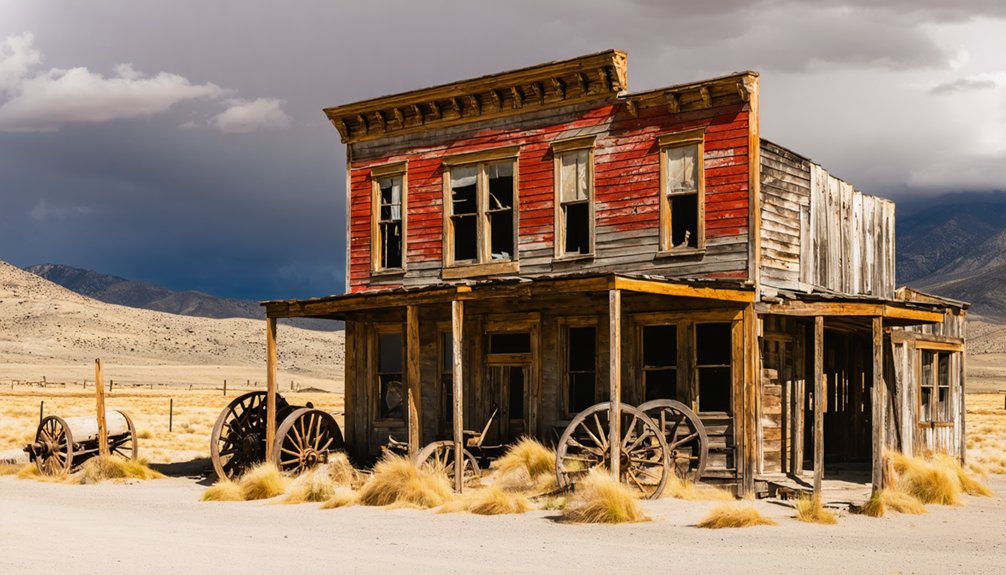
One such area is the southeastern region, where abandoned buildings in California’s deserts tell stories of past lives and lost opportunities. These structures, often weather-beaten and half-buried in sand, serve as haunting reminders of the challenges that once faced their inhabitants. Exploring these ghostly remnants can reveal insights into the boom-and-bust cycles that characterized the development of these remote locations.
Western mining settlements concentrate heavily along the Rocky Mountain and Sierra Nevada ranges, where ore deposits created boom-bust cycles that left entire communities abandoned when resources depleted.
The correlation between catastrophic events and ghost town formation becomes particularly evident in the Dust Bowl regions of the Great Plains, where environmental disasters accelerated the abandonment of already struggling agricultural communities.
Western Mining Town Concentrations
When you examine the distribution of ghost towns across North America, clear geographic patterns emerge that directly correlate with historical mining activity and geological formations.
The Western United States dominates ghost town geography, with Nevada, California, and Arizona containing the highest concentrations. You’ll find these abandoned settlements clustered along specific geological features—the Great Basin and Sierra Nevada mountains host dense pockets where 19th-century gold rushes created numerous short-lived camps.
Mining town dynamics reveal themselves through spatial clustering around major ore deposits. Historical districts like Nevada’s Comstock Lode and Colorado’s Cripple Creek contain multiple abandoned settlements within miles of each other.
You can trace these patterns directly to underlying geology: gold-silver vein systems generated tight clusters of high-turnover camps, while porphyry copper provinces produced fewer but longer-lived towns.
Catastrophic Event Correlation
Beyond mining booms and busts, catastrophic natural disasters create distinct geographic patterns of abandonment that correlate with specific hazard zones and geological vulnerabilities.
You’ll find ghost town correlations along earthquake fault lines, volcanic zones, and flood-prone valleys where catastrophic events repeatedly devastate communities.
Examine the evidence: San Francisco’s 1906 earthquake demolished entire districts, while Mount Tarawera buried New Zealand’s Te Wairoa under volcanic debris.
Tornado Alley produces abandoned settlements like Greensburg, Kansas, where 95% destruction forced mass exodus. Flood-prone regions show recurring patterns—Pattonsburg, Missouri endured thirty floods before relocating entirely.
These aren’t random occurrences. Geological instability, seismic activity zones, and extreme weather corridors create predictable abandonment clusters.
You’re witnessing natural selection applied to human settlements, where geography determines survival.
Why Some Ghost Towns Attract More Paranormal Reports Than Others
Although all ghost towns share the common thread of abandonment, certain locations generate markedly more paranormal reports than others—a disparity that researchers attribute to measurable factors rather than supernatural activity levels.
You’ll find paranormal hotspots typically feature documented violent histories, mass casualties, or unresolved tragedies that create compelling ghostly narratives. Accessibility plays an essential role—towns near population centers with established tourism infrastructure report considerably more sightings than remote locations.
Media coverage amplifies this effect through feedback loops where featured locations attract more visitors, who then submit additional reports to crowd-sourced databases. Environmental factors like deteriorating architecture, low lighting, and acoustic anomalies increase misperception rates.
Marketing that emphasizes “haunted” branding transforms uncertain history into reproducible attractions, systematically inflating report frequencies through suggestion and expectation.
Separating Folklore From Fact in America’s Most Famous Haunted Towns
When you examine America’s most notorious “haunted” ghost towns, you’ll find that documented historical tragedies often provide rational foundations for supernatural legends that developed decades later.
Scientific analysis of alleged paranormal evidence—from EMF readings to photographic “orbs”—typically reveals environmental factors like infrasound, structural settling, or simple camera artifacts rather than ghostly activity.
Tourism’s commercial influence has amplified and embellished these stories, creating feedback loops where visitor expectations shape reported experiences and guide operators emphasize dramatic narratives over historical accuracy.
Historical Facts Vs Legend
While ghost towns across America carry compelling supernatural reputations, examining their documented histories reveals how economic collapse, natural disasters, and human tragedy create fertile ground for paranormal folklore.
You’ll find that Bodie’s “abrupt abandonment” legend contradicts historical records showing gradual population decline after gold depletion.
Similarly, Bannack’s “bandit victim ghosts” stem from documented Civil War violence and dangerous stagecoach routes rather than supernatural evidence.
St. Elmo’s haunting claims trace to documented isolation—only two residents remaining by the 1940s creates psychological conditions ripe for ghost stories.
These towns’ real histories—mining booms, economic busts, fires, floods—provide rational explanations for abandonment.
Urban legends flourish where documentation ends, transforming economic reality into supernatural narrative.
You’re witnessing how human psychology processes collective trauma through paranormal interpretation.
Scientific Evidence Analysis
Understanding how historical trauma transforms into paranormal folklore naturally leads to examining what happens when researchers apply scientific methodologies to these supernatural claims.
You’ll find that rigorous investigations use controlled environmental monitoring, measuring temperature, humidity, electromagnetic fields, and infrasound during ghost-town expeditions. Researchers employ time-synced video equipment and multi-channel audio to capture potential anomalies while implementing blinded witness protocols to reduce confirmation bias.
However, evidence interpretation consistently points toward natural explanations. You’re likely experiencing pareidolia—your brain’s pattern-recognition creating faces in shadows or voices in wind.
Deteriorating buildings produce thermal drafts and acoustic anomalies that mimic supernatural activity. Sleep deprivation during overnight investigations triggers hypnagogic hallucinations. Even toxic exposures from mold or decaying materials induce feelings of dread and visual disturbances that investigators mistake for ghostly encounters.
Tourism’s Influence on Tales
How considerably does commercial tourism reshape ghost town narratives?
You’ll find tourist narratives consistently amplify supernatural elements beyond historical records. Tombstone’s OK Corral shootout transforms from documented gunfight into ghost-laden spectacle through 400,000 annual visitors seeking paranormal thrills.
Goldfield’s staged gunfights blend authentic mining history with fabricated Wild West folklore, creating hybrid tales that prioritize entertainment over accuracy.
Folklore evolution accelerates when towns like Bodie market their “frozen in time” mystique—the preserved decay becomes a backdrop for ghost stories that never existed during the town’s operational years.
Rhyolite’s atmospheric Death Valley ruins inspire supernatural narratives despite lacking documented paranormal activity.
You’re witnessing commercial transformation where economic survival depends on manufacturing mystery rather than preserving factual heritage.
Frequently Asked Questions
Are There Specific Times of Day When Ghost Sightings Occur Most Frequently?
You’ll find ghost sightings cluster during nighttime encounters, particularly 3-4 AM. This correlates with sleep deprivation, reduced lighting, and infrasound exposure rather than historical events driving paranormal activity timing patterns.
Do Electromagnetic Fields From Old Mining Equipment Contribute to Paranormal Experiences?
While you might dismiss electromagnetic explanations as boring science, old mining equipment’s electromagnetic radiation actually creates measurable field anomalies that correlate with reported paranormal experiences, though causation remains unproven in controlled studies.
Can Weather Conditions Influence the Intensity of Reported Supernatural Activity?
You’ll find weather patterns correlate with paranormal reports—atmospheric pressure drops, humidity spikes, and electromagnetic storms create conditions that amplify misperception. However, you’re seeing environmental effects on human senses, not actual supernatural activity.
Are Children More Likely to Experience Paranormal Phenomena Than Adults?
You’ll find children report “unusual experiences” more frequently due to developing neural pathways affecting childhood imagination and fear perception. Their immature prefrontal cortex creates weaker reality-testing abilities, making ambiguous stimuli seem more mysteriously significant than adults experience.
Do Ghost Towns With Preserved Cemeteries Have Higher Rates of Hauntings?
You’ll find cemetery legends cluster around preserved burial sites, but there’s no controlled evidence showing higher historical hauntings rates. Tourism, cultural narratives, and environmental factors likely inflate reports rather than actual paranormal activity.
References
- https://aceraft.com/2020/06/22/thurmond-paranormal-evidence/
- https://www.youtube.com/watch?v=gw1BdabksPE
- https://www.newmexico.org/haunted/
- https://en.wikipedia.org/wiki/List_of_reportedly_haunted_locations_in_the_United_States
- https://www.losethemap.com/scariest-ghost-towns-in-the-world/
- https://www.gothichorrorstories.com/real-ghost-stories/
- https://i95rock.com/mystery-of-dudleytown-ct/
- https://www.geotab.com/ghost-towns/
- https://www.mentalfloss.com/geography/american-ghost-towns-can-still-walk-through
- https://www.christywanders.com/2024/08/top-ghost-towns-for-history-buffs.html