You’ll find incredible adventures exploring New Mexico’s dog-friendly ghost towns like historic Cerrillos, where your pup can walk five-mile trail networks through abandoned mine shafts along the scenic Turquoise Trail. Shakespeare near Lordsburg welcomes leashed dogs on guided tours of authentic Butterfield Stage Station ruins, while Kelly’s mining ruins offer rockhounding opportunities beneath towering headframes. Remember to pack extra water and check leash regulations, as desert conditions can be challenging but rewarding for prepared explorers seeking these hidden treasures.
Key Takeaways
- Cerrillos offers dog-friendly trails through Cerrillos Hills State Park and welcomes leashed pets at the Turquoise Mining Museum petting zoo.
- Ghost Ranch provides nine pet-friendly trails across 21,000 acres with designated camping areas and stunning photography opportunities.
- Shakespeare near Lordsburg features authentic Butterfield Stage Station tours where dogs can explore dusty trails once traveled by outlaws.
- Kelly’s Mining Ruins allows dogs to explore scattered ore carts and foundation ruins while offering rockhounding opportunities in mineral-rich terrain.
- All locations require leashes, ample water (one gallon per dog daily), and adherence to Leave No Trace principles for safety.
Cerrillos: Mining History Meets Modern Trails
When you and your four-legged companion arrive in Cerrillos, you’ll discover a town where ancient turquoise mines once glittered with Native American treasures and Spanish conquistadors sought their fortunes in the rolling hills.
Historic mining operations date back to 1695, when Governor Vargas established Real de Los Cerrillos as New Mexico’s oldest official European community.
Real de Los Cerrillos stands as New Mexico’s oldest official European settlement, founded in 1695 during the era of Spanish colonial expansion.
Your dog will love exploring Cerrillos trails throughout the five-mile network in Cerrillos Hills State Park, where dirt paths wind past abandoned mine shafts and weathered foundations.
The town’s peak population once supported 21 saloons before becoming a semi-ghost town by 1900. This community was officially established in 1880 and sits along the scenic Turquoise Trail, just 25 miles southwest of Santa Fe. The big strike of 1879 transformed Cerrillos from a hardscrabble gold mining operation into a thriving mining center.
Today, you’ll find dog-friendly attractions like the Turquoise Mining Museum‘s petting zoo and Brown’s Casa Grande Trading Post, where leashed pets can accompany you through this authentic Old West experience.
Shakespeare Near Lordsburg: Stage Station Adventures
You’ll discover Shakespeare’s authentic Butterfield Stage Station where your dog can walk the same dusty trails once traveled by Billy the Kid and notorious outlaws.
The remote location two miles south of Lordsburg requires careful planning since tours operate only one weekend monthly, so you’ll want to call ahead and pack extra water for both you and your furry companion. This historic mining town once boasted a population of 3,000 during its silver boom heyday before economic decline set in. The town’s fascinating history dates back to the mining era that began in 1882.
Your dog will love exploring the preserved adobe buildings and cemetery while you soak up tales of this lawless town where killers had to dig their own victims’ graves.
Butterfield Stage Station Tours
As you step through the weathered adobe walls of Shakespeare’s Grant House, you’re walking into what remains of a genuine Butterfield Overland Mail station that once buzzed with dusty stagecoaches, weary travelers, and Army personnel relaying messages across the territorial Southwest.
Your dog can explore alongside you during guided walks that reveal fascinating stagecoach logistics—how teams were changed, mail sorted, and passengers fed during their grueling desert journey.
The volunteer-run ghost town offers seasonal tours ranging from quick 30-minute visits to immersive experiences.
You’ll discover original adobe masonry, period furnishings, and relocated mining buildings that paint a vivid picture of frontier life. The town reached its peak when rich silver ore was discovered in the surrounding hills in 1870, drawing thousands of fortune-seekers to this remote desert location.
Historical preservation here relies on passionate local stewards rather than big budgets, creating an authentic, accessible adventure where your four-legged companion can roam freely through genuine Western history. The nearby town of Lordsburg, established in 1880, grew alongside the Southern Pacific Railroad and became a vital transportation hub that connected this historic region to the expanding American West.
Remote Location Planning Tips
Planning your Shakespeare ghost town adventure requires desert savvy and flexible timing, since this authentic slice of frontier history sits on private ranch land miles from the nearest services.
You’ll need to call 575-542-9034 before making the trek to confirm tour scheduling and guide availability—there’s nothing worse than driving through remote desert terrain only to find locked gates.
Pack water and sun protection for your 90-minute walking tour through rugged terrain. The remote access via NM Highway 494 means you’re truly off the beaten path, so fuel up in Lordsburg first.
Your timing flexibility pays off when you’re exploring eight authentic buildings with passionate guides who’ve preserved this place since 1935. The $10 adult admission supports their dedication to keeping history alive.
While you’re in the area, consider dining at one of the five restaurants within 3 miles of the ghost town for a meal after your tour.
The town’s name honors the world’s most famous playwright, whose works were translated into every major language and continue to influence culture centuries after his death in 1616.
Kelly’s Mining Ruins and Rockhounding Paradise
You’ll discover Kelly’s towering 121-foot mine headframe rising from the high desert like a steel monument to New Mexico’s silver boom, while your dog explores the scattered ore carts and foundation ruins that tell stories of a once-thriving community of thousands.
The surrounding tailings piles and mineral-rich terrain offer excellent rockhounding opportunities for collectors seeking remnants of the district’s famous silver, lead, and zinc deposits. Near the restored St. John the Baptist church, you can park conveniently and begin your exploration of this historic site that once housed over 3,000 residents during its mining heyday.
Before you start filling your pack with specimens though, you’ll need to check current access permissions and understand which areas remain open to collecting, since mining claims and private property boundaries can shift over time. The impressive headframe was designed by Alexander G. Eiffel, bringing state-of-the-art European engineering to this remote New Mexico mining camp in the early 1900s.
Historic Mining Infrastructure Remains
Towering above Kelly’s weathered landscape, the 121-foot steel headframe stands as a monument to the town’s mining legacy—and it’s the first thing that’ll catch your eye as you and your dog explore this fascinating ghost town.
This Carnegie Steel Works structure from 1906 marks the Tri-Bullion shaft, which once plunged nearly 1,000 feet into extensive underground networks.
You’ll discover scattered mining artifacts throughout the site—rusted mine carts, tramway remnants, and processing equipment that paint vivid pictures of bustling operations.
Historic preservation efforts focus on maintaining these remnants safely, though you’ll need to watch for unstable timber and corroded metal.
Keep your pup close around fenced areas and enjoy photographing these incredible industrial relics.
Rockhounding Access and Permits
Beyond the thrill of exploring Kelly’s historic structures, the surrounding area offers exceptional rockhounding opportunities that’ll have you and your canine companion discovering everything from vibrant turquoise specimens to unique galena crystals scattered across ancient mine dumps.
Understanding rockhounding regulations becomes essential since you’ll encounter a patchwork of private lands, state territories, and federal areas around Kelly. Most productive collecting spots require landowner permission, and permit requirements vary dramatically depending on your chosen location.
- Contact Magdalena town offices or local rock shops for current access information and permit requirements
- Purchase access passes from Tony’s rock shop or other local vendors for premium collecting areas
- Confirm pet policies before visiting, as many private owners restrict dogs on their property
- Stick to surface collecting from mine dumps rather than dangerous underground workings
Old Town Albuquerque’s Urban Ghost Walking Tours
When night falls over Albuquerque’s historic plaza, something magical happens—lanterns flicker to life and professional storytellers begin weaving tales that blur the line between documented history and supernatural legend.
You’ll discover Old Town’s 300-year legacy through ghostly encounters tied to Confederate burials beneath the plaza and Civil War phantom sightings that still haunt these adobe walls.
These 90-minute walking tours combine historical narratives with eyewitness accounts of disembodied voices and moving objects.
You’ll explore narrow alleys where hangings and duels once occurred, visiting spots like High Noon Restaurant Saloon that anchor these spine-tingling stories.
Multiple operators offer nightly tours starting around 8 PM, with family-friendly options and private group experiences.
Reserve ahead—freedom-seekers shouldn’t miss this authentic blend of education and supernatural entertainment.
Ghost Ranch and Abiquiú’s Expansive Desert Landscapes

You’ll discover nine pet-friendly trails winding through Ghost Ranch‘s 21,000-acre desert landscape where Georgia O’Keeffe once painted those iconic multicolored cliffs with your four-legged companion by your side.
Your camera will capture the same sweeping vistas that inspired O’Keeffe’s masterpieces—Chimney Rock, Cerro Pedernal, and those stunning red-and-gold mesas stretching toward the horizon.
Before you set out with your dog on these high-desert trails, you’ll need plenty of water, shade protection, and paw covers since the exposed terrain can reach scorching temperatures even in cooler months.
Nine Pet-Friendly Trails
Stretching across 21,000 acres of New Mexico’s high desert, Ghost Ranch offers nine officially designated trails where you and your leashed companion can explore the same dramatic red-rock landscapes that inspired Georgia O’Keeffe’s most famous paintings.
Trail features range from short walks through white hoodoos to challenging mesa climbs with panoramic views. The Kitchen Mesa Trail rewards your effort with sweeping vistas after a 741-foot ascent, while the Echo Amphitheatre Trail provides an easy introduction to the area’s natural acoustics.
- Matrimonial Point Trail offers stunning red-rock views on a moderate 2.3-mile loop
- Chimney Rock Trail leads to a prominent spire with 629 feet of elevation gain
- Georgia O’Keeffe’s Hoodoo Trail showcases unique white rock formations in under a mile
- Echo Amphitheatre provides photogenic sandstone walls with minimal hiking effort
Dog friendly amenities include welcome center trail maps and designated camping areas for RVs.
O’Keeffe Landscape Photography
Four decades after Georgia O’Keeffe first set up her easel among Ghost Ranch‘s crimson cliffs, photographers and their four-legged companions continue pilgrimage to these same transcendent landscapes that transformed American art.
You’ll discover O’Keeffe’s Inspiration while hiking the sweeping plains where she captured New Mexico’s soul through her woodie station wagon window.
The evanescent light shifts dramatically across red cliffs, offering endless opportunities for stunning Landscape Composition.
Your dog can explore freely across these 21,000 acres while you frame shots of Cerro Pedernal and Abiquiú Dam.
Professional workshops teach darkroom techniques using these sacred backdrops, following Ansel Adams’ 1937 footsteps.
Remember to secure permits for formal sessions, though casual photography remains unrestricted throughout most ranch areas.
Desert Safety Essentials
While your camera captures those same ethereal moments O’Keeffe immortalized on canvas, the high desert demands respect and preparation that goes far beyond artistic vision.
You’ll need rock-solid desert navigation skills and bulletproof hydration strategies when exploring Ghost Ranch’s vast wilderness with your canine companion.
- Pack 1 gallon of water per person daily – your dog needs constant access too
- Carry map, compass, and GPS with spare batteries for when cell towers vanish
- Schedule hikes before dawn or after 4 PM to avoid scorching midday heat
- File detailed trip plans with reliable contacts including your exact route and return time
The unforgiving landscape rewards preparation.
Those dramatic temperature swings that create O’Keeffe’s mystical lighting can shift from 120°F blazing sun to near-freezing nights, demanding layers and emergency shelter for both you and your four-legged explorer.
Essential Safety Preparations for Desert Exploration
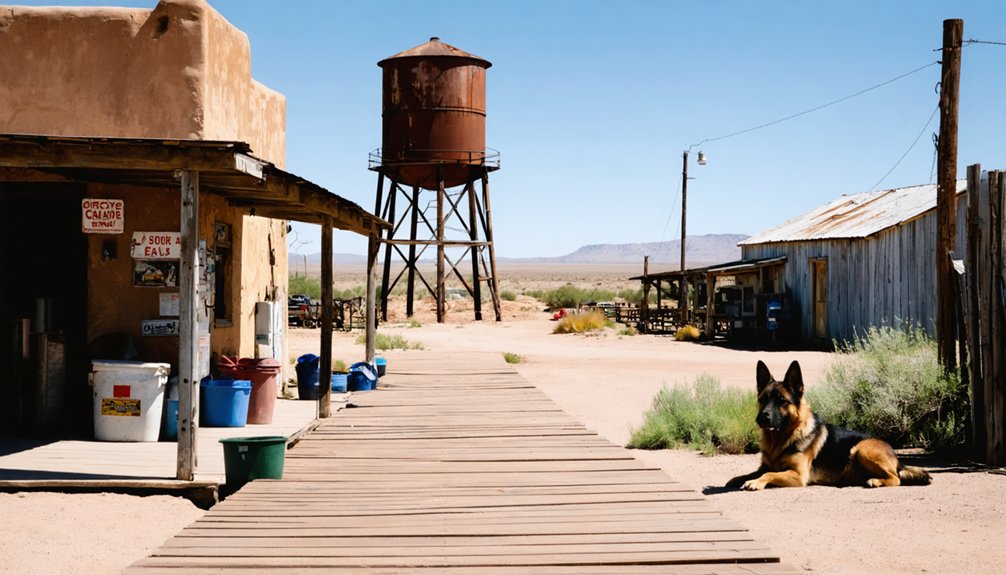
Before you and your four-legged companion venture into New Mexico’s sun-baked ghost towns, proper preparation can mean the difference between an unforgettable adventure and a dangerous ordeal.
Pack one gallon of water per person for day trips, plus extra for your dog. Your hydration strategies should include drinking before entering the desert and monitoring urine clarity.
Layer clothing for temperature swings and bring a fine-tooth comb for cactus spine removal.
Inform others of your route and carry backup navigation tools since cell service fails frequently.
Stay alert for desert wildlife like rattlesnakes and scorpions by making noise and using hiking poles to rustle brush.
Pack extensive first aid supplies and research weather conditions beforehand.
Leash Laws and Local Regulations Across Sites
Beyond water bottles and first aid kits, you’ll need to understand the legal landscape governing where your dog can roam freely and where they must stay leashed. New Mexico’s ghost towns exist within a patchwork of jurisdictions—state parks, federal lands, and municipal territories—each with distinct rules.
While that abandoned mining town might feel lawless, modern leash laws and local regulations still apply. State parks typically require six-foot maximum leashes, but federal ghost town sites often have stricter controls. Municipal codes vary dramatically; some rural counties embrace “under control” language while others demand specific leash lengths. Tourist-heavy locations enforce rules more aggressively than remote sites.
- Check park-specific regulations before arriving—they supersede local municipal rules
- Carry proper leash length for strictest potential jurisdiction
- Research dangerous dog penalties that escalate with repeat violations
- Document service animal status if applicable for broader access rights
Water, Shade, and Heat Management Strategies
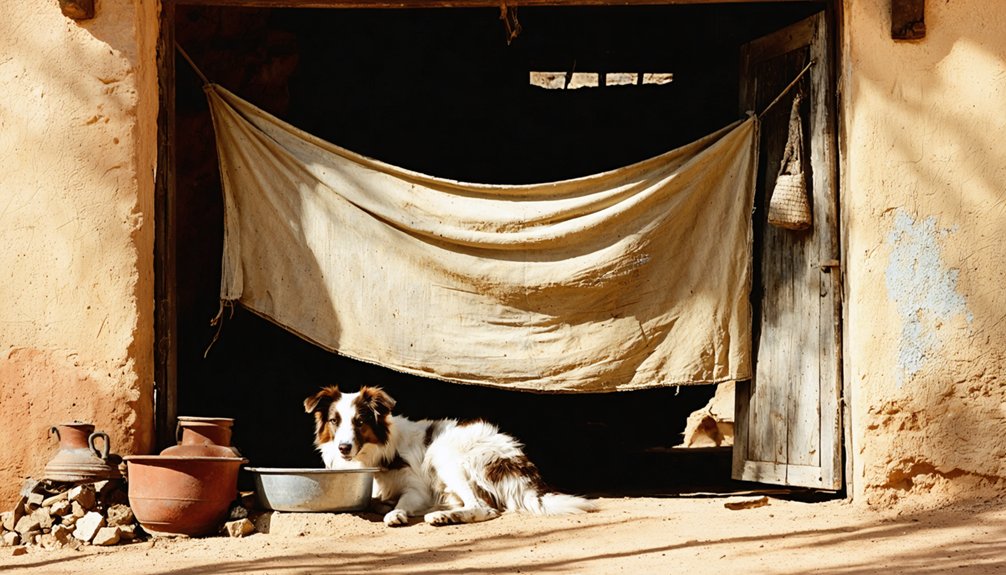
When temperatures soar above 90°F and your Border Collie starts panting heavily beside crumbling adobe walls, you’ll quickly realize that New Mexico’s ghost towns present unique hydration and heat challenges that can turn a fun adventure into a dangerous situation.
Water safety becomes critical since these abandoned settlements lack municipal systems. Carry one gallon per dog daily and test any natural sources with field strips—uranium mining contaminated many western New Mexico aquifers. Standard filters won’t remove heavy metals, so bring bottled backup.
Abandoned settlements offer no water infrastructure—pack one gallon per dog daily and avoid contaminated natural sources from historic mining operations.
Your shade strategies need creativity in these exposed locations. Scout rock overhangs and building shadows, then pack portable canopies for open areas. Wet towels create cooling microclimates in desert humidity.
Check ground temperature before letting paws touch hot surfaces that retain heat well past sunset.
Vehicle Requirements and Road Conditions
As your sedan’s undercarriage scrapes against yet another hidden rock outcropping on the approach to Madrid’s abandoned coal tipple, you’ll understand why ghost town exploration demands more than just weekend grocery-getter capabilities.
Vehicle suitability becomes critical when maneuvering washboard dirt roads, arroyo crossings, and seasonal clay sections that transform into slick traps after summer storms.
- High clearance (8+ inches) prevents costly undercarriage damage from rocks and mining debris scattered across access routes
- 4WD or AWD handles steep grades leading to elevated mining camps and mesa-top settlements
- All-terrain tires with reinforced sidewalls resist punctures from sharp metal fragments and jagged stones
- Full recovery kit with straps and shovel guarantees self-extraction when road hazards create unexpected situations
You’re seeking freedom, not expensive towing bills from remote locations.
Leave No Trace Principles for Historic Preservation
While your dog sniffs around the weathered foundation stones of Elizabethtown’s 1870s hotel, resist the urge to pocket that intriguing piece of blue-and-white china peeking from beneath decades of pine needles.
Historic preservation means leaving artifacts exactly where you find them—photograph that rusty horseshoe or pottery shard, but don’t touch. Removing anything violates the Archaeological Resources Protection Act and robs future adventurers of their own discoveries.
Practice environmental stewardship by keeping boots and paws on designated paths. Don’t let Rover dig near historic structures or disturb rock cairns marking old mining claims.
Those weathered timbers you’re admiring? They’re fragile—leaning against them could cause irreversible damage.
Pack out everything you brought in, leaving these ghost towns pristine for the next freedom-seeking explorer.
Frequently Asked Questions
Are There Dog-Friendly Accommodations Near These Ghost Town Locations?
You’ll discover countless pet friendly hotels scattered around New Mexico’s ghost towns like treasure! From Magdalena Hall’s canine amenities to Apache Inn’s cozy cabins, your four-legged adventure buddy won’t be left behind.
You might also want to explore the history of Cuervo, New Mexico, where remnants of old buildings tell tales of the past. In this small town, you’ll find unique stories intertwined with the vibrant landscape, making it an interesting stop on your journey. Be sure to capture the essence of Cuervo as you roam through its historic sites and enjoy the natural beauty surrounding it.
What Veterinary Services Are Available in Remote Ghost Town Areas?
You’ll find veterinary clinics scattered 50-75 miles away in regional hubs like Silver City and Deming. Emergency services require longer drives to Albuquerque or Las Cruces, so plan ahead for your adventurous pup’s health needs.
Can Dogs Enter Historic Buildings at These Ghost Town Sites?
Want freedom to explore with your furry companion? Most historic buildings prohibit dogs inside due to preservation concerns, but dog policies vary—always check leash requirements and contact sites beforehand for outdoor access.
Are There Entrance Fees for Dogs at State Parks Near Ghost Towns?
No, you won’t pay separate entrance fees for dogs at state parks near ghost towns. Standard vehicle fees cover your furry companion on hiking trails, but dog park regulations require leashes everywhere for everyone’s freedom and safety.
What Time of Year Offers the Best Weather for Visiting With Dogs?
You’ll find the best seasons are late spring and fall when ideal temperatures hover in the 70s-80s. Mid-May through June offers perfect ghost town exploration weather before desert heat becomes dangerous for your adventurous pup.
References
- https://www.newmexico.org/places-to-visit/ghost-towns/cerrillos/
- https://www.newmexicoriveradventures.com/dog-friendly-new-mexico/
- https://lafondoftheroad.com/2023/04/03/shakespeare-ghost-town-lordsburg-nm/
- https://www.bringfido.com/attraction/10735
- https://www.gopetfriendly.com/blog/dog-friendly-day-trips-in-northern-new-mexico/
- https://www.tripadvisor.com/Attraction_Review-g47102-d8446559-Reviews-Ghost_Town_of_Kelly-Magdalena_New_Mexico.html
- https://www.abqtours.fun
- https://www.newmexicoghosttowns.net/cerrillos-nm
- https://www.cerrillosnewmexico.com/cerrillos-historical-society
- https://www.cerrilloshills.org/history/a-cultural-historical-overview/history-of-the-cerrillos-mining-district/history-of-the-cerrillos-mining-district-homer-milford