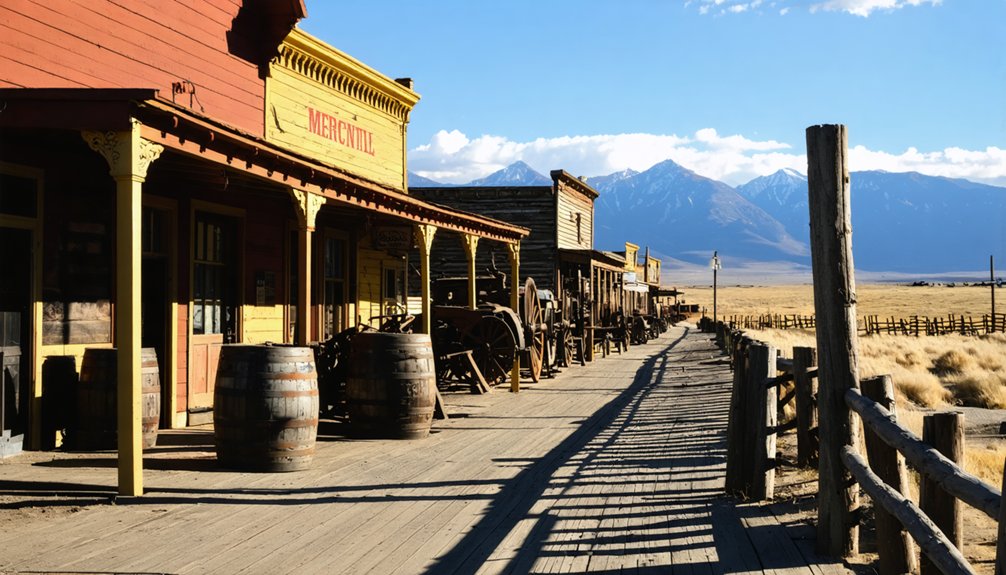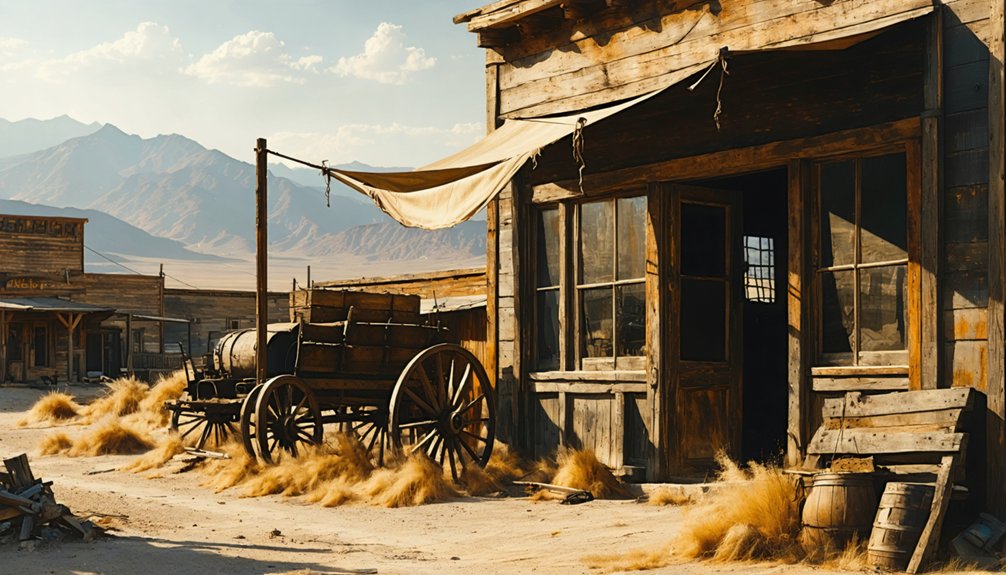
Dog Town, California’s first major placer mining camp, was established around 1857 when Carl Norst discovered gold along Dogtown Creek in the Eastern Sierra. You’ll find this California Historical Landmark No. 792 located six miles south-southeast of Bridgeport at coordinates 38°10′13″N 119°11′51″W. The camp peaked at roughly 100 miners before the 1859 Independence Day Gold Strike triggered mass relocation to Monoville. Today, you can explore dugout house remnants, rock foundations, and Peter Johann Anderson’s marble-marked grave to uncover the compelling stories behind this boom-and-bust mining community.
Key Takeaways
- Dog Town was established in 1857 as California’s first major placer mining camp along Dogtown Creek.
- The ghost town is marked as California Historical Landmark No. 792, located 6 miles south-southeast of Bridgeport.
- Remnants include dugout houses, rock foundations, gravel fields, and scattered mining artifacts overgrown with sagebrush.
- The camp peaked at 100 miners before mass exodus to Monoville following the 1859 Independence Day Gold Strike.
- Visitors can explore Peter Johann Anderson’s fenced grave and experience reported ghostly sightings at this historic site.
Origins of the Mining Camp
When gold seekers first arrived at Dogtown Creek around 1857, they established California’s first major placer mining camp on the eastern slope of the Sierra Nevada.
You’ll find this historic site marked as California Registered Historical Landmark No. 792, acknowledging its significance in regional mining history.
The initial settlement drew prospectors who built dugout shelters and makeshift huts typical of pioneer diggings.
Within a few years, you’d have witnessed a bustling community of roughly 100 miners during peak activity.
The placer mining camp attracted rapid in-migration as word spread about gold discoveries along the creek. The settlement was established by German prospector Cord Norst and his wife Mary, who founded this remote mining community.
The camp earned its name from the miners’ term for settlements characterized by makeshift dwellings and rough living conditions.
This mining camp’s establishment sparked additional prospecting throughout the region, ultimately leading to richer discoveries at Monoville, Bodie, and Aurora that would reshape eastern Sierra Nevada mining.
Carl Norst and the German Prospectors
You’ll find Carl Norst (also recorded as Cord Norst) credited as Dog Town‘s founding prospector, a German-born miner who established the area’s first placer camp around 1857.
He built the settlement’s initial dugout and rock-walled dwelling while beginning panning operations that would attract other German prospectors to the eastern Sierra slope.
Norst’s discovery sparked the early gold rush that brought diverse miners to the region, though he and several German families remained even after larger strikes drew crowds to Bodie and Monoville. The settlement’s name created potential confusion with other similarly named locations, requiring disambiguation pages to help visitors distinguish between different mining camps throughout California’s gold country.
The camp endured harsh winters with temperatures plummeting below zero and significant snowfall that often trapped miners for months at a time.
Carl Norst’s Mining Discovery
Around 1851, Carl Norst and his fellow German prospectors made a significant quartz vein discovery in the hills surrounding Dog Town, California.
You’ll find their discovery resembled the rich veins found at Grass Valley, containing gold-bearing rocks that required crushing and mercury amalgamation for extraction.
The prospectors focused their quartz mining efforts on elevated bars and ancient riverbeds in the Dog Town vicinity.
Their prospecting techniques included rudimentary tests like biting nuggets and hammer strikes to verify authenticity.
You’d see them establish claims measuring approximately 30 by 40 feet, following standard miner resolutions.
These deposits necessitated water delivery systems since they were located in dry areas.
The Germans applied their European mining knowledge, evolving from simple placer methods to more sophisticated hard-rock extraction techniques that would define the region’s mining future. They utilized stamp mills to crush the gold-bearing quartz, transitioning from soft iron to more efficient cast iron designs. The extraction process involved mercury contamination, which emerged as a growing environmental concern throughout California’s mining operations.
German Settlement Patterns
After Carl Norst established the Dogtown diggings as a placer mining camp around 1857, a determined group of German prospectors followed him to this remote site on the eastern Sierra Nevada slope.
You’ll find their arrival greatly bolstered the early camp population, creating one of the first major eastern Sierra gold rushes. These hardy immigrants targeted nearby Bodie, Aurora, and Masonic districts while establishing settlements along Dogtown Creek.
The German settlers demonstrated remarkable cultural integration within multi-ethnic prospector groups, their immigrant influence shaping the camp’s development patterns.
They constructed makeshift huts and hovels typical of “dog towns,” enduring harsh conditions including deep snowfalls and sub-zero temperatures. The area’s name originated from Mrs. Bassett’s dogs, who settled in the region and maintained a high population of canines that she sold to other residents.
Despite the transient nature of mining camps and difficult living conditions, these German prospectors persisted in working the placer deposits, contributing to Dogtown’s legacy. Their efforts represent California’s mining heritage and the enduring impact of gold rush communities on local economies.
Early Camp Establishment
When German prospector Carl Norst staked his claim along Dogtown Creek around 1857, he carved the first dugout dwelling into the hillside and established what would become the eastern Sierra Nevada’s initial major gold rush camp.
You’ll find that early settlers like Norst relied on simple placer mining techniques, panning creek gravels and using rocker boxes to extract visible gold flakes from the sediment.
His wife Mary, described as Native American in historical accounts, shared the rough dugout residence that served both as home and mining headquarters.
The camp’s success with manual recovery methods produced enough gold to signal richer deposits nearby, drawing word-of-mouth attention that would soon bring Mormon prospectors and other miners flooding into the area by 1859. The diverse population would eventually include Chinese, Chilean, Cornish, French, Indian, Mexican, black, and Yankee miners all seeking their fortunes. By 1858, over 100 miners had established themselves in this remote mountain settlement, creating the first substantial mining community in the Eastern Sierra region.
Location and Getting There
Seven miles south of Bridgeport, California, Dog Town sits on the eastern slope of the Sierra Nevada in Mono County at milepost 69.5 on State Highway 395.
You’ll find the commemorative plaque marking California Historical Landmark No. 792 directly along the highway, with scenic views of the surrounding Sierra Nevada landscape.
The ghost town ruins lie below the highway near Dog Town Creek. To reach the actual town site, you’ll need to loop around the backside of the hill and cross the creek.
As you explore the area, keep an eye out for historic sites in El Dorado that tell the story of the region’s past. Each site offers a glimpse into the lives of those who once lived here, making your visit both educational and fascinating. Don’t forget to bring your camera; the scenery surrounding these sites can be truly breathtaking.
Park at the information markers above the ruins for the best vantage point. Multiple access routes are available depending on conditions, though a creek crossing is required from the highway side.
The site remains easily accessible for exploration.
Physical Remains and What You’ll See
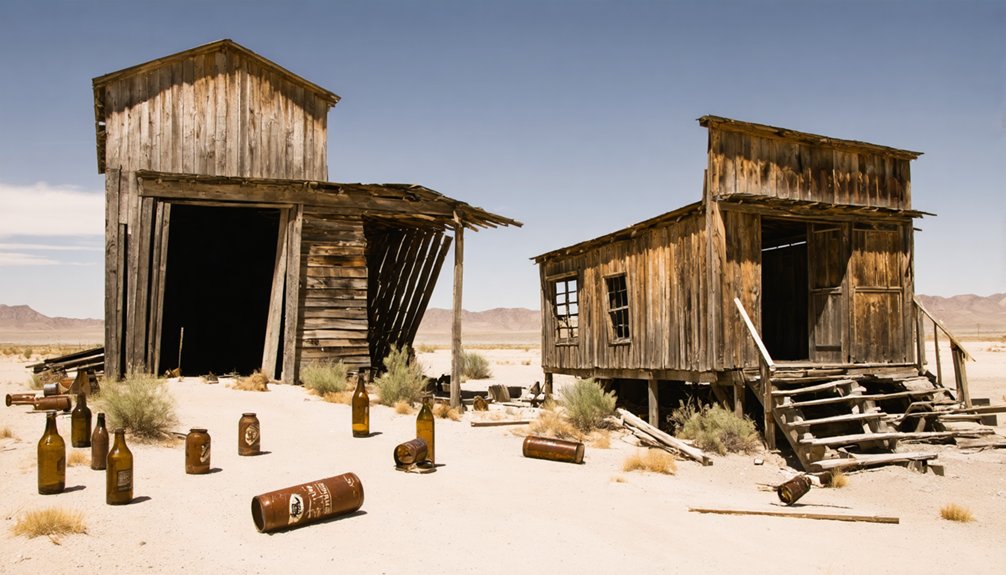
Scattered stone foundations and weathered ruins mark what remains of Dog Town‘s brief but significant place in California’s gold rush history.
You’ll discover four stone structures total – two dugout houses with partial rock walls near the cliff bordering Dog Town Creek, plus two additional foundations visible across the water. These physical features showcase volcanic rock construction typical of 1857-era mining camps.
The site’s most prominent historical artifacts include gravel fields from placer mining operations and distinctive rock pilings that reveal extensive hydraulic mining activity.
A single fenced grave with marble marker sits among the ruins, marking pioneer Peter Johann Anderson’s final resting place.
Scattered makeshift dwelling foundations fade into the desert landscape, overgrown with sagebrush yet still providing tangible evidence of this forgotten mining community.
The Short-Lived Gold Rush
You’ll discover that Dog Town’s gold rush began in 1857 when Carl Norst first panned for gold on Dog Creek, making this the eastern Sierra’s inaugural major gold strike.
The camp quickly grew to roughly 100 miners who built dugouts and rock shelters along the creek, but this boom wouldn’t last long.
Early Strike Discovery
When Cord Norst, a German prospector, discovered gold at the confluence of Virginia and Dog Creeks in 1857, he sparked the first major gold rush to the eastern Sierra Nevada slope.
You’ll find California Historical Landmark 792 marking this significant founding moment that preceded the later rushes in Bodie and Aurora.
Norst built a dugout house with rock walls above the creek, where he and his Native American wife Mary developed their prospecting techniques.
They panned for gold specs in the creek gravels, targeting precious metal washed down from Dunderberg Mountain.
While some credit Leroy Vining as an alternative discoverer, Norst’s family remained after the main exodus, homesteading the land they’d claimed during this pivotal gold rush period.
Rapid Population Exodus
Within months of Norst’s 1857 discovery, several hundred prospectors flooded into Dog Town, establishing the typical boom-and-bust pattern that characterized mid-19th-century Sierra Nevada mining camps.
You’d witness mostly single males erecting temporary tents and crude cabins, with merchants following to supply camp necessities. The population dynamics shifted dramatically when richer strikes opened at Monoville, Bodie, and Aurora within 1-3 years.
Economic shifts proved devastating as miners abandoned Dog Town’s lower-yielding placer operations for more profitable ventures. High operational costs, primitive conditions, and seasonal Sierra constraints accelerated the exodus.
Capital and equipment relocated to emerging districts, leaving behind vacant plots and derelict structures. The rapid departure created classic ghost-town features while forcing remaining inhabitants into subsistence living or migration elsewhere.
Notable Residents and Events

After Cord Norst established his mining camp in 1857, Dog Town attracted a diverse array of residents whose discoveries and tragedies shaped the settlement’s brief but notable history.
You’ll find three remarkable events that defined this frontier community:
- Independence Day Gold Strike (1859) – A resident discovered gold in the eastern hills during July 4th festivities, triggering mass relocation to Monoville.
- Pioneer’s Tragic End – Peter Johann Anderson was found severely decomposed on his porch by a passerby, buried near stone cabins with a marble marker.
- Record-Breaking Discovery – Miners produced the largest gold nugget found on the Sierra’s eastern slope.
These significant deaths and notable artifacts remind you that Dog Town’s residents lived dangerously but dreamed big, leaving behind tangible proof of their determination to strike it rich.
Dog Town Cemetery
Among Dog Town‘s lasting remnants, Peter Johann Anderson’s grave stands as the settlement’s most somber landmark.
You’ll find this fenced enclosure near the confluence of Virginia and Dog Creeks, where the pioneer miner met his end during the 1857 gold rush era. A passing Native American discovered Anderson’s severely decomposed body on his dugout house porch before July 1859.
The Bridgeport Chronicle Union documented how Coroner Welch couldn’t transport the remains due to their condition. Eight to ten men assembled to dig Anderson’s grave directly at Dog Town, burying him beside the stone cabins where he’d lived.
Today, ghostly sightings and cemetery legends surround this isolated marble marker, adding supernatural intrigue to your exploration of this abandoned settlement at 7,057 feet elevation.
Historical Significance in Eastern Sierra Mining
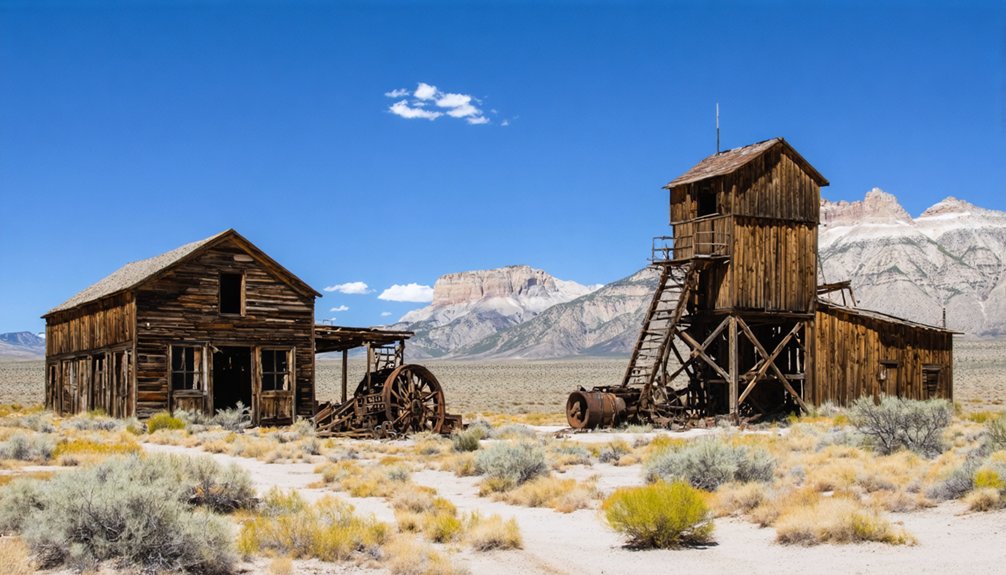
Although Dog Town‘s physical remains appear modest today, this remote settlement earned recognition as the first major gold rush site on the eastern slope of the Sierra Nevada. Founded around 1857 by prospector Cord Norst, this placer-mining camp established the template for eastern Sierra mining development.
Dog Town’s historical significance extends beyond its initial discovery:
- Pioneer mining techniques – Early hydraulic and placer methods created extensive tailings that Chinese miners later reworked during the 1860s.
- Regional catalyst – The camp’s success sparked prospector traffic leading to Monoville (1859) and eventually Bodie discoveries.
- Demographic shifts – Population included Mormon prospectors, Chinese laborers, and roughly 100 miners at peak occupation.
You’ll find Dog Town officially recognized through California’s historical landmark registration, cementing its role as the eastern Sierra’s mining frontier genesis.
Visiting Today
Modern visitors can explore Dog Town’s remnants at coordinates 38°10′13″N 119°11′51″W, located 6 miles south-southeast of Bridgeport in Mono County.
You’ll find California Historical Landmark No. 792‘s commemorative plaque at Highway 395’s post mile 69.5, marking this ghost town’s location.
From the trio of historic markers overlooking the site, you can access the ruins via a gravel road leading through marshy willowland.
Stone hut walls and scattered foundations remain from the original settlement, though wooden structures teeter on collapse’s edge.
The site’s mildly vandalized but retains its historical exploration value.
Don’t miss the fenced gravesite with its marble marker commemorating pioneer Peter Johann Anderson.
You can combine your visit with nearby attractions like Bodie State Historic Park for thorough Eastern Sierra mining history.
Frequently Asked Questions
Is Metal Detecting or Prospecting Allowed at the Dog Town Site?
You’ll need landowner permission and proper prospecting permits since metal detecting regulations vary by parcel ownership. Federal lands require compliance with BLM/USFS rules, while the historic landmark designation creates additional restrictions.
What Caused the Camp to Be Completely Abandoned?
You’ll find economic decline and population shift caused complete abandonment after Monoville’s richer 1859 gold strike drew miners away, while Dog Town’s limited deposits, primitive infrastructure, and harsh conditions couldn’t compete with booming nearby camps.
Are There Any Ghost Stories or Paranormal Activities Reported at Dog Town?
Like whispers lost in time, you won’t find documented ghost sightings or haunted locations reports here. The historical records focus on Peter Anderson’s lonely death and mining activities, leaving paranormal tales uncharted territory for freedom-seeking explorers.
How Much Gold Was Actually Extracted From Dog Town During Its Peak?
You’ll find Dog Town’s gold extraction wasn’t extensively documented, but overall production remained limited despite famous nugget discoveries. Placer and hydraulic mining techniques operated from 1857 through century’s turn before miners abandoned for richer strikes.
Can You Camp Overnight Near the Dog Town Ruins?
You’ll hit a roadblock with camping regulations since overnight stays aren’t permitted directly at the ruins, but you can find nearby campgrounds on surrounding public lands with proper permits.
References
- https://nvtami.com/2023/09/28/dog-town-california/
- https://www.ghosttowns.com/states/ca/dogtown.html
- https://ohp.parks.ca.gov/listedresources/Detail/792
- https://kids.kiddle.co/Dog_Town
- https://www.youtube.com/watch?v=0iNmSpfEKJM
- https://sierranevadageotourism.org/entries/dog-town-no-792-california-historical-landmark/8e9174f3-7591-4711-9aa7-1df65dbe0a15
- https://noehill.com/mono/cal0792.asp
- https://www.recordcourier.com/news/2005/sep/21/dogtown-a-mining-camp-hardly-fit-for-dogs/
- https://en.wikipedia.org/wiki/Dog_Town
- https://thebillbeaverproject.com/2016/07/10/dogtown-nugget-discovery-site/