Dripping Springs isn’t a traditional ghost town, but rather a haunted mountain site in New Mexico’s Organ Mountains with 7,000 years of human occupation. You’ll find ruins from Major Eugene Van Patten’s 1870s resort and Dr. Nathan Boyd’s tuberculosis sanatorium from 1917. The area’s dark history includes Giovanni Maria Agostini, “El Ermitano,” who was mysteriously murdered in 1869 at nearby La Cueva. Archaeological excavations have uncovered over 100,000 artifacts from ancient Jornada Mogollon cultures, while visitors today report unexplained phenomena among the crumbling foundations and abandoned structures that reveal deeper mysteries.
Key Takeaways
- Dripping Springs was a luxury mountain resort in the 1870s that became abandoned after financial ruin around 1915.
- The site later housed Dr. Boyd’s tuberculosis sanatorium from 1917 until closure, with patient ruins still visible today.
- Giovanni Maria Agostini, “El Ermitano,” was murdered here in 1869, creating the area’s first ghost legend.
- Visitors report unexplained voices, cold spots, and eerie sensations around the abandoned resort and sanatorium foundations.
- The location has over 7,000 years of human occupation, from ancient Mogollon cultures to modern ghost stories.
Ancient Roots in the Organ Mountains
Long before European explorers set foot in the American Southwest, the dramatic landscape around Dripping Springs hosted continuous human occupation spanning millennia.
You’ll discover evidence of the Jornada Mogollon culture, who first settled La Cueva rock shelter around 5,000 B.C. Their prehistoric art still adorns canyon walls, while grinding holes carved into stone reveal daily life patterns.
Archaeological excavations have uncovered hundreds of thousands of artifacts near Dripping Springs, including ceramic sherds, stone scrapers, and projectile points.
Dr. Donald Lehmer’s 1940s excavations and later University of Texas work in the mid-1970s recovered over 100,000 artifacts from La Cueva alone.
These discoveries confirm that indigenous peoples found sanctuary and resources in the Organ Mountains’ protected canyons for over 7,000 years. The area’s year-round springs provided the reliable water source that sustained these ancient communities through changing seasons and climate variations. Even earlier, fossilized mastodons roamed this region approximately 50,000 years ago, when the landscape supported megafauna in a dramatically different climate.
The Hermit’s Tragic End at La Cueva
You’ll find one of Las Cruces’ most enduring mysteries in the story of Giovanni Maria Agostini, the Italian hermit who made La Cueva his home from 1866 until his brutal murder in 1869.
The cave dwelling became both sanctuary and crime scene when the beloved healer was discovered with fatal wounds to his head and lungs, his body clutching a crucifix outside his mountain refuge. When found, he was wearing iron belt spikes and a hair shirt beneath his cloak, evidence of his lifelong devotion to penance. The hermit was known for his herbal cures that helped heal the sick throughout the region.
His weekly fire signals had warned residents of danger, but couldn’t prevent the violent end that created the region’s oldest unsolved case and spawned decades of local legends.
Giovanni’s Cave Dwelling Years
When Giovanni Maria Agostini retreated to La Cueva in August 1863, he’d chosen one of the most inaccessible refuges in the Organ Mountains—a cramped rock shelter perched 100 feet below Hermit’s Peak’s summit, reachable only by scaling sheer cliffs from above.
The cave’s roof forced him to crouch, and its narrow ledge entrance offered little comfort, yet Giovanni transformed this harsh dwelling into a base for his unconventional life.
Known locally as “El Ermitano,” Giovanni’s practices as a folk healer drew patients from surrounding communities who’d brave the treacherous climb seeking his remedies.
His community interactions included a weekly Friday evening signal fire ritual, reassuring valley friends of his wellbeing while marking his presence for visitors needing his services during his three-year residence. The hermit’s mysterious death in 1869 came when he was discovered with a knife in his back, leaving behind an unsolved murder that haunts the Organ Mountains to this day.
Today, archaeological artifacts discovered throughout the cave reveal the layers of human habitation that preceded and followed Giovanni’s residence in this remote mountain refuge.
Murder Mystery Details
The silence that greeted valley residents on the night of April 30, 1869, marked the beginning of one of southern New Mexico’s most enduring mysteries.
When Giovanni’s weekly signal fire failed to appear at La Cueva, concerned friends rode to investigate. They discovered the hermit’s body face-down, clutching a crucifix, with valuable silver items untouched—ruling out robbery.
Conflicting Evidence in the Unsolved Homicide:
- Multiple weapon accounts – Reports varied from knife in the back to lance through chest to blunt-force head trauma.
- Suspected perpetrators – El Indio Chacón and an unnamed Mesilla priest faced allegations but no convictions.
- Murder theories – Ranged from anti-clerical vendetta to indigenous conflict to personal disputes.
- Official outcome – Despite community posses and a $5 reward, the case remains officially unsolved.
Legacy and Local Legends
Although Giovanni’s brutal murder shocked the local community in 1869, his death only amplified the mystical reputation that would transform him from a living hermit into an enduring southwestern legend.
You’ll find his hermit legacy preserved at Mesilla Cemetery, where his inscription commemorates his years as El Ermitano. The local legends surrounding Giovanni inspire the annual Hermit of La Cueva Festival, featuring musical presentations celebrating his memory.
You can experience his story through BLM presentations exploring the history and mystery of La Cueva. Guided hikes to his cave site continue drawing visitors fascinated by his tale. Prehistoric rock art adorns the cave walls, adding layers of ancient history that span over 5,000 years to Giovanni’s already compelling story. The cave’s distinctive blackened ceiling bears witness to countless fires lit by inhabitants throughout the millennia.
The Sociedad del Ermitano society persists today, maintaining connections to the Penitente admiration that originally brought Giovanni recognition throughout New Mexico’s spiritual communities.
Van Patten’s Mountain Resort Era
You’ll discover Van Patten’s ambitious transformation of Dripping Springs began in the 1870s when he constructed a two-story, 14-room hotel from native rock near the natural springs.
His vision attracted notable figures like Kit Carson and Pat Garrett, drawing guests seeking the area’s therapeutic altitude and pristine air quality until the resort’s 1906 expansion added eighteen additional rooms.
However, prolonged legal disputes with Dr. Nathan Boyd over land and water rights devastated Van Patten’s finances, forcing the resort’s closure around 1915 and leading to his bankruptcy by 1917. Van Patten’s military background as a Confederate Army soldier shaped his leadership approach in establishing the resort. The resort was constructed using native rock and mud-mixing plaster, materials that helped the structures blend seamlessly with the surrounding canyon environment.
Resort’s Early Development
When Colonel Eugene Van Patten established his mountain resort in the 1870s, he constructed a two-story stone hotel from native canyon rock, creating what would become one of New Mexico’s most distinctive recreational retreats.
This early architecture featured mud-mixed plaster walls and tightly stretched muslin ceilings, housing 14-16 guest rooms alongside a dining hall and concert venue.
Van Patten’s vision transformed the remote canyon into an elite escape:
- Landscaped grounds included gardens, gazebo, and essential outbuildings like livery stables
- Natural spring provided fresh water for drinking, irrigation, and livestock
- Stage line connections linked Las Cruces visitors to mountain refuge via coach service
- On-site food production supplied fresh dairy, poultry, and vegetables for guest experiences
The resort attracted regional elite seeking cooler mountain air and refined social gatherings.
Van Patten’s Vision
By 1870, Major Eugene Van Patten had transformed his rugged mountain acquisition into New Mexico’s most ambitious high-altitude resort venture.
You’ll discover that Van Patten’s ambitions extended far beyond simple hospitality—he envisioned creating a complete mountain retreat that’d serve the territory’s growing population seeking respite from desert heat.
Van Patten constructed his two-story granite hotel around the natural springs, incorporating fourteen rooms with dining facilities and recreational spaces.
He understood that community impact required more than accommodation, so he built extensive support infrastructure including livery services, landscaped grounds, and entertainment venues like the gazebo bandstand.
His strategic location choice capitalized on the 6,000-foot elevation’s cooler temperatures while the perennial water source enabled lush gardens that contrasted dramatically with surrounding desert landscapes, establishing unprecedented luxury in territorial New Mexico.
Financial Decline Bankruptcy
Although Van Patten’s resort had flourished for decades, a devastating legal dispute with Dr. Nathan Boyd would ultimately destroy everything he’d built.
What began as a simple land rental agreement spiraled into thirteen years of bitter legal battles that drained Van Patten’s resources and crushed his entrepreneurial spirit.
The key factors in Van Patten’s downfall included:
- Prolonged litigation costs – Thirteen years of court battles over land and water rights
- Escalating legal expenses – Mounting fees that bankrupted the once-thriving operation
- Boyd’s refusal to compromise – Driving up costs through relentless legal warfare
- Remote location expenses – High operational costs combined with legal financial strain
Dr. Boyd’s Tuberculosis Sanatorium
Dr. Nathan Boyd transformed Van Patten’s failed resort into one of America’s first federally funded tuberculosis clinics in 1917.
A Stanford-educated physician created a groundbreaking federal tuberculosis treatment facility from the ruins of a defunct desert resort.
You’ll discover that Boyd, a Stanford medicine graduate, pursued this venture after his wife’s tuberculosis diagnosis motivated him to establish proper treatment facilities.
The sanatorium history reveals how physicians believed high desert air could cure the “White Plague” that devastated early 1900s populations.
Boyd constructed patient cabins, a kitchen, dining hall, and his residence approximately 100 feet from the original Van Patten Camp.
Tuberculosis treatment involved patients staying in cabins or tents, breathing the dry mountain air. Health seekers traveled to this remote location specifically for respiratory remedies.
Today, you can explore the remaining foundations and Boyd’s intact caretaker’s house.
Archaeological Treasures and Cultural Heritage
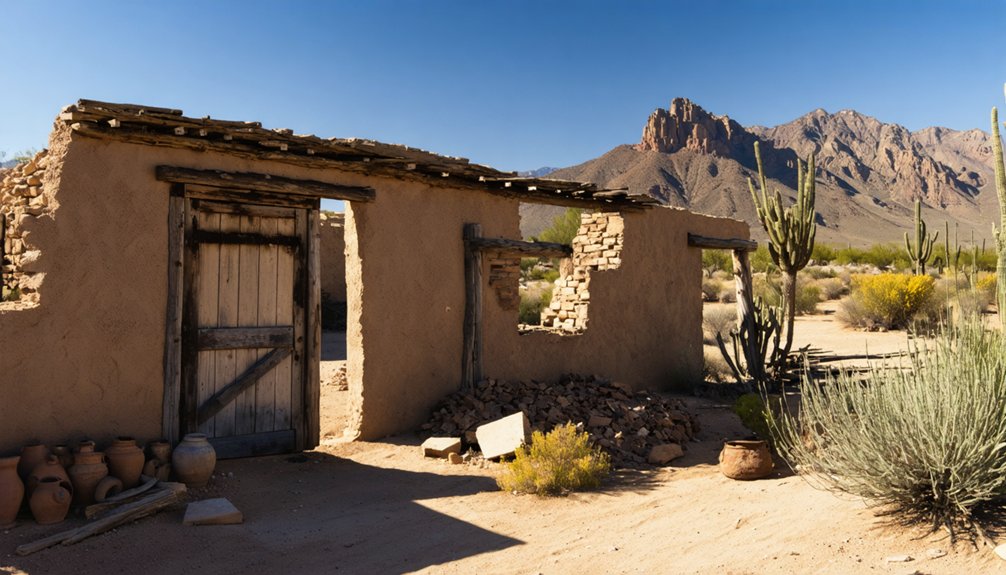
Long before Dr. Boyd established his sanatorium, you’ll discover La Cueva’s archaeological significance spans over 7,000 years of continuous human occupation.
University of Texas at El Paso archaeologists recovered approximately 100,000 artifacts in the mid-1970s, revealing this rock shelter’s extraordinary cultural preservation.
Archaeological Timeline:
- 5,000 B.C. – Prehistoric Archaic peoples first inhabited the cave
- Jornada Mogollon cultures utilized the shelter with perennial spring access
- Manso and Mescalero Apache groups occupied the site historically
- 1860s – Giovanni Maria Agostini lived as hermit until his 1869 murder
You’ll find prehistoric rock art visible on guided hikes, while diverse Chihuahuan Desert flora supported these ancient inhabitants.
The reliable water source and strategic location made La Cueva invaluable for survival across millennia.
Exploring the Ruins Today
When you venture into Dripping Springs today, you’ll find a moderate 3-mile roundtrip hike that rewards visitors with remarkably preserved ruins and breathtaking desert vistas.
The trail follows the original road from Cox Ranch visitor center, climbing 1,500 feet through rocky canyon terrain to reach the historic settlement.
Your ruins exploration reveals Van Patten’s resort foundations, Boyd’s sanatorium remains, and surviving structures including the caretaker’s house and outbuildings.
The dramatic Weeping Wall provides the natural spring that sustained this remote community. Site preservation efforts by BLM and volunteers have stabilized key structures while maintaining archaeological integrity.
You’ll need proper footwear for steep, rocky sections and adequate water for desert conditions.
The panoramic views over Mesilla Valley from 6,000 feet elevation make this challenging hike worthwhile for adventurous explorers.
Legends of Restless Spirits
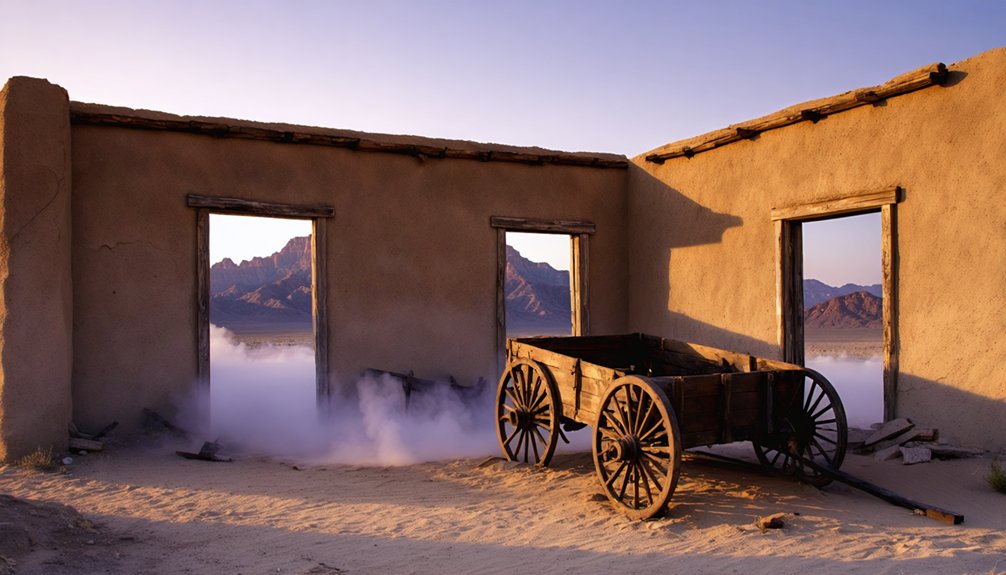
Beyond the crumbling foundations and weathered stone walls, Dripping Springs carries darker stories that have captivated visitors for over a century. The haunted folklore surrounding this remote site stems from documented tragedies and mysterious deaths that occurred here.
Beyond crumbling stone and weathered ruins, Dripping Springs harbors century-old tales of tragedy and restless spirits that continue haunting visitors today.
Four Key Elements of Dripping Springs’ Ghostly Encounters:
- The Hermit’s Murder (1869) – Giovanni Maria Agostini’s brutal killing in La Cueva cave created the area’s first restless spirit legend.
- Sanatorium Deaths (1910s-1920s) – Tuberculosis patients who died seeking mountain cures allegedly linger near patient housing foundations.
- Paranormal Reports – Visitors consistently report unexplained voices, cold spots, and eerie sensations around the ruins.
- Cultural Memory – Local oral histories preserve multiple ghost story versions, creating layered legends that blend documented history with supernatural speculation.
These accounts transform your exploration into something beyond mere historical curiosity.
Planning Your Visit to Dripping Springs
How do you reach this haunted remnant of New Mexico’s past? Drive twelve miles northeast of Las Cruces to 15000 Dripping Springs Road in the Organ Mountains.
You’ll pay a $5 day-use fee at the trailhead, where the visitor center operates 8 AM–5 PM with maps and current conditions.
The moderate three-mile round-trip hike gains 1,500 feet to Van Patten’s ruins and Boyd’s sanitarium remains.
Essential hiking tips include sturdy boots, ample water, and early morning starts during scorching summers. Winter snow can create slippery conditions.
Practice proper visitor etiquette by staying on marked trails—these archaeological sites are fragile and potentially dangerous with loose rocks and rusted metal.
Leashed pets are permitted in designated areas. Spring and fall offer ideal weather for exploring these mountain spirits’ domain.
Frequently Asked Questions
How Much Does It Cost to Visit Dripping Springs Natural Area?
You’ll pay a $5 entry fee for parking access, though America the Beautiful Pass holders enter free. No additional charges exist for guided tours or trail usage beyond this standard parking requirement.
What Are the Operating Hours for the Visitor Center?
Like clockwork, the visitor center operates daily from 8:00 a.m. to 5:00 p.m., giving you freedom to explore interpretive displays and gather maps, except on Thanksgiving, Christmas, and New Year’s Day.
Are Pets Allowed on the Trail to the Ruins?
No, you can’t bring pets on trails to the ruins. Pet policies prohibit dogs on both Dripping Springs and La Cueva trails due to protected wildlife. Follow trail etiquette by respecting these restrictions.
Is Camping Permitted at Dripping Springs?
No, you can’t camp there—even ghosts respect camping regulations! The BLM prohibits overnight stays within Dripping Springs Natural Area. However, you’ll find dispersed camping on nearby BLM lands outside the ghost town history boundaries.
If you’re looking for a thrilling way to explore the remnants of the past, consider visiting the ghost towns of Oregon by ATV. The rugged terrain and scenic vistas make for an unforgettable adventure, allowing you to uncover the history hidden in these abandoned places. Make sure to pack plenty of water and snacks, as some of these routes can lead deep into remote areas.
As you traverse the landscapes, you’ll encounter the rich history of Antelope, Oregon ghost town, where stories of pioneers and lost dreams linger in the air. Each step reveals remnants of once-thriving buildings and the echoes of a bygone era. It’s a chance to connect with the past while experiencing the thrill of adventure in Oregon’s ghostly corners.
How Long Does It Take to Hike the Complete Trail?
You’ll need 1-2 hours round-trip depending on your pace and stops. The 3-mile trail gains 1,500 feet elevation with moderate trail difficulty. Here’s hiking tips: bring water and allow extra time for interpretation.
References
- https://www.desertusa.com/desert-new-mexico/ruins-dripping-springs.html
- https://epcc.libguides.com/c.php?g=754275&p=5406054
- https://batteredsuitcase.net/dripping-springs-discovering-stories-of-the-past/
- https://www.blm.gov/sites/default/files/docs/2021-08/NM_DrippingSpringsHistory_2020(508).pdf
- https://newmexiconomad.com/dripping-springs-trail/
- https://kfoxtv.com/news/special-assignments/legend-of-dripping-springs
- https://www.blm.gov/blog/2025-07-22/history-and-heritage-among-ruins-dripping-springs-natural-area
- https://cityofdust.blogspot.com/2013/05/cool-water-dripping-springs-new-mexico.html
- https://www.youtube.com/watch?v=pyivwYxNZEI
- https://www.newmexicoghosttowns.net/dripping-springs-nm