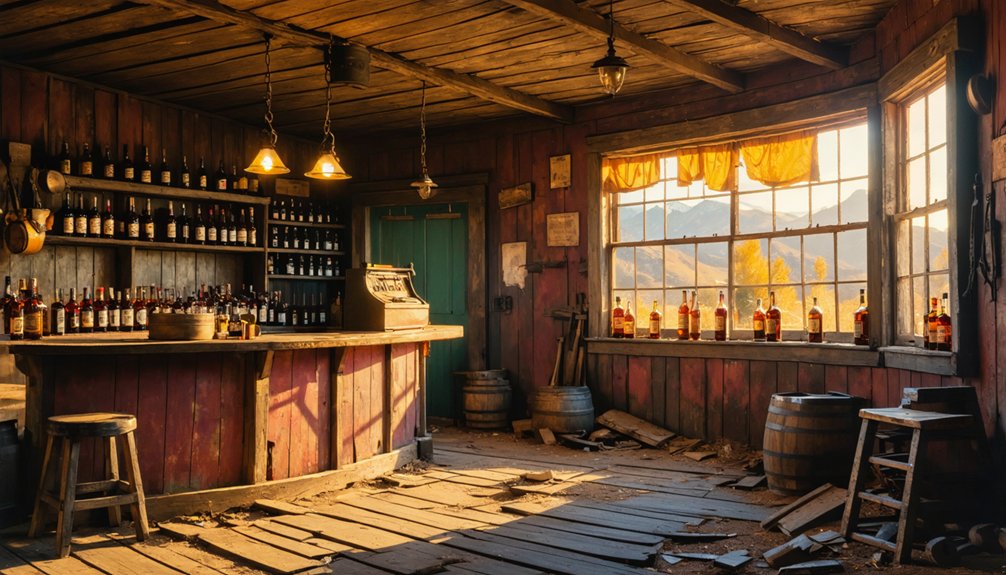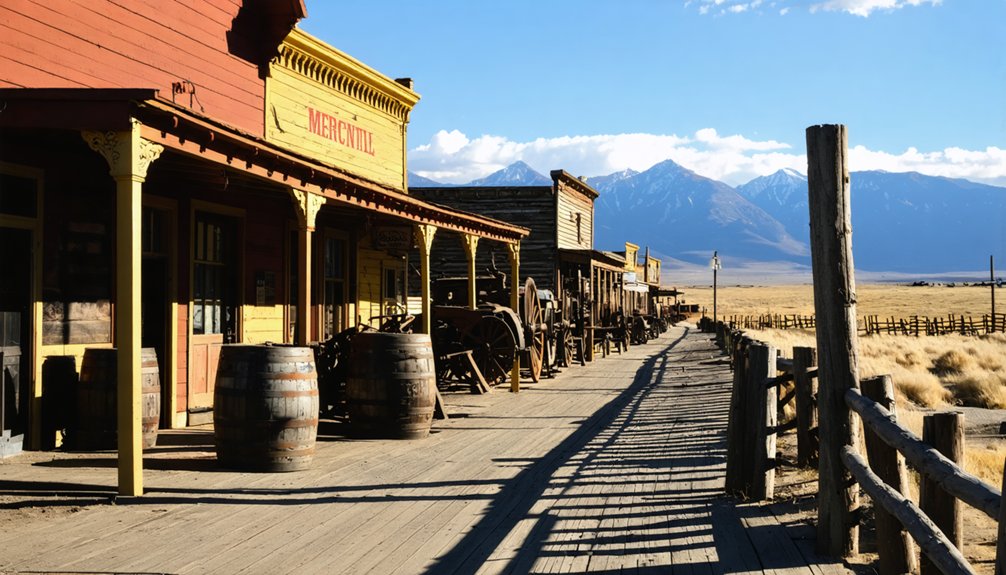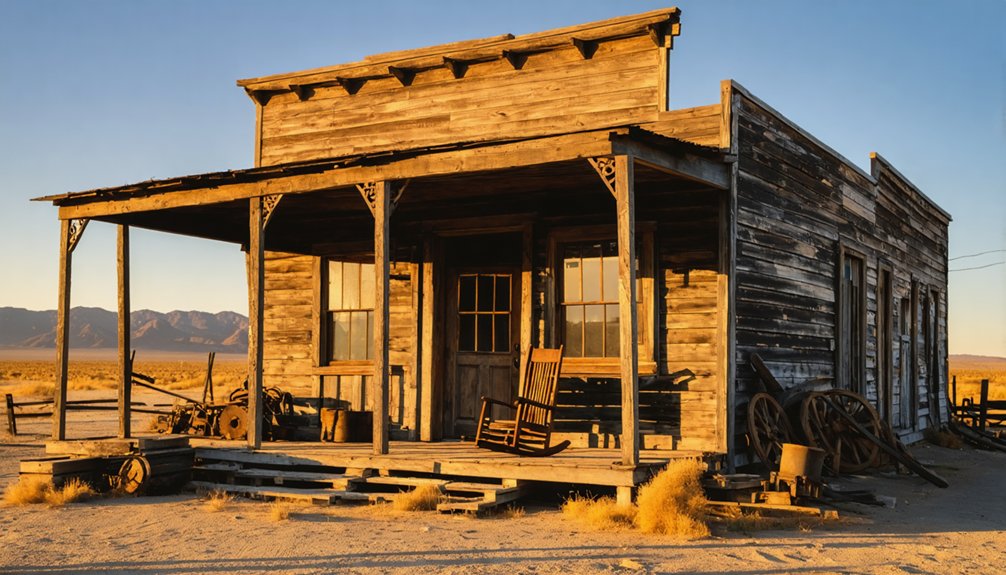
You’ll find Drum Barracks in Wilmington, California—a Civil War ghost town established in 1862 as a Union military outpost. Originally housing 500 soldiers across 19 buildings, only two structures remain today after its 1873 deactivation. The site gained fame for reported apparitions of Civil War soldiers and mysterious phenomena since the 1960s. Now preserved as a museum since 1987, this historic landmark offers more than just Civil War history.
Key Takeaways
- Drum Barracks, established in 1862 as a Union outpost, evolved into a ghost town after its military deactivation in 1873.
- The 19-building military complex housed 500 soldiers during the Civil War but was abandoned when it lost strategic importance.
- Only junior officers’ quarters and powder magazine survived by the 1960s from the original 60-acre military installation.
- The site gained national attention for paranormal activity, with reported apparitions of figures in Civil War uniforms and unexplained phenomena.
- Community preservation efforts saved Drum Barracks from demolition, establishing it as Southern California’s major Civil War landmark and museum in 1987.
The Birth of Drum Barracks as a Civil War Outpost
While most people associate Civil War military installations with the eastern United States, Drum Barracks emerged in 1862 as a critical Union outpost in Wilmington, California, just 25 miles south of Los Angeles.
Originally named Camp Drum after Adjutant General Richard Coulter Drum, the base addressed urgent military strategy concerns. Confederate sympathizers threatened Southern California’s stability, and Union officials worried about potential seizures of gold shipments and raids on Pacific shipping.
The western theater of Civil War strategy extended far beyond battlefields, with Union forces establishing outposts to secure Pacific territories from Confederate threats.
The withdrawal of regular troops to eastern battlefields had left the region vulnerable.
Union loyalists Phineas Banning and B.D. Wilson donated the land, selling parcels to the Army for $1 each. In 1873, when the barracks were deactivated, the government returned the land to these original donors, with Banning purchasing five buildings for $2,917 and Wilson buying one for $200.
Construction eventually cost $1 million, reflecting the installation’s strategic importance as headquarters for military operations throughout Southern California, Arizona, and New Mexico during the Civil War. The facility occupied sixty acres of land with additional thirty-seven acres near the harbor to support its extensive military operations.
Historic Architecture and Military Significance
You’ll notice that Drum Barracks’ architecture represents adaptive military construction techniques common to Union outposts in 1860s California, with buildings designed for both defense and comfort in the region’s climate.
Of the original 19 structures spread across 60 acres, only the junior officers’ quarters and powder magazine survived by the 1960s when preservation efforts began.
The preservation challenges faced by these remaining structures highlight the tension between historical conservation and urban development pressures near the growing Port of Los Angeles. The junior officers’ quarters, where Lt. Col. James Curtis and his wife Maria once lived, has become an important focal point for both historical education and ghostly encounters reported at the site. The facility was formally decommissioned in 1871, after serving as a crucial supply base for military operations throughout the Southwest during and after the Civil War.
Adaptive Military Construction
As Union commanders sought to establish a permanent military presence in Southern California during the Civil War, construction at Drum Barracks evolved rapidly from temporary shelters to substantial military facilities.
The military adaptation began with tents and lean-tos before advancing to elaborate wooden and masonry structures across the 60-acre compound at a cost exceeding $1 million by 1863.
The architectural evolution produced specialized buildings designed to address both military functions and environmental challenges of the coastal region, particularly heavy winds and blowing sand.
The sprawling complex included officers’ quarters, powder magazines, hospitals, and supply depots strategically positioned throughout the site.
Of the original 19-22 structures, only the junior officers’ quarters survives today, with dismantled chimneys repurposed into walkways—a reflection of the pragmatic reuse of materials even in preservation.
The camp was renamed Drum Barracks in March 1864, reflecting its growing importance as a permanent military installation.
The entire property was distinctively enclosed by a white picket fence, creating a formal military appearance that contrasted with the rugged surrounding landscape.
Barracks Preservation Challenges
The preservation of Drum Barracks presents significant challenges that have evolved since the military’s departure in 1866. The wooden structures face relentless threats from coastal climate, rot, and insect damage, compromising structural integrity throughout the surviving officers’ quarters.
You’ll find preservation techniques caught in a delicate balance—modern materials can stabilize deteriorating elements but diminish the site’s historical authenticity. The barracks’ history as a terminus for camels until 1863 adds another unique element requiring specialized preservation knowledge. The site’s phone number (310) 548-7509 provides a direct line for inquiries about ongoing preservation efforts. Iron fixtures continue to rust while fire safety concerns complicate restoration efforts.
The barracks’ significance as Union Army headquarters for Southern California makes preservation essential for interpreting California’s Civil War role. However, urban encroachment has reduced the original 60-acre military complex drastically, fragmenting the historic landscape.
Since 1987, nonprofit management has struggled with limited funding and visitation, making long-term preservation dependent on public engagement and educational programming.
Drum’s Connection to California’s Gold Rush Era
Located near the heart of California’s Gold Rush region, Drum emerged during the unprecedented population explosion that followed James Marshall’s 1848 gold discovery at Sutter’s Mill.
As California’s population soared from 400 to 90,000 in just one year, Drum likely served as a critical supply hub or residential outpost supporting nearby mining operations.
The town reflected the era’s cultural diversity, with indigenous peoples, Californios, European and Asian immigrants all converging in search of fortune.
You’d have found residents primarily engaged in placer mining techniques, using simple tools to extract gold from nearby streams and riverbeds.
While some struck it rich, most earned modest returns from mining or by providing services to the transient population. Like successful merchant Levi Strauss, many business owners in Drum may have profited more consistently than the miners themselves.
Many Chinese migrants formed a significant presence in the mining community, eventually comprising 25% of workers in California’s mining districts by the late 1850s.
Like many Gold Rush settlements, Drum ultimately fell victim to the boom-and-bust cycle as accessible gold deposits dwindled.
From Military Base to Ghost Town: The Decline of Drum
When the Civil War ended in 1865, Drum Barracks quickly lost its strategic importance, leading to the military’s departure in 1866.
You’ll find this once-bustling $1 million complex was effectively abandoned, with only minimal operations continuing until its official closure as headquarters in 1871.
The sudden exodus of 500 soldiers and support staff left the 19-building compound largely vacant, creating the conditions for its transformation into a ghost town as structures fell into disrepair without military maintenance.
Wartime Operations Cease
As the Civil War drew to a close, Drum Barracks experienced a gradual but inevitable decline in its military significance.
No formal closure process existed then, unlike today’s Base Realignment and Closure Commission established in 1988. Instead, you’d have witnessed a slow military shift as troops redeployed and operations diminished.
By the late 1860s, the base’s strategic importance had waned considerably.
Buildings fell into disrepair, with only a few structures maintained for minimal functions. The economic ramifications rippled through the surrounding community as federal spending decreased and military personnel departed.
The powder magazine remained fenced but inactive, while other structures were abandoned or sold as private property.
This incremental withdrawal represented an early example of military base closure, occurring long before formalized decommissioning procedures existed.
Military Exodus Effects
The rapid transformation of Drum Barracks from a thriving military hub to a ghost town began immediately after its official abandonment in 1866.
When federal troops withdrew, they took with them the economic lifeblood that had sustained Wilmington’s growth during the Civil War years.
The military relocation created a cascading effect of decline:
- Over 500 soldiers and staff departed, eliminating jobs and military payroll
- Local businesses lost valuable contracts and customer base
- Property values stagnated as development prospects diminished
- Wilmington’s population contracted notably
This economic downturn was exacerbated by the lack of alternative development.
The land returned to Banning and Wilson remained largely underutilized, while the abandoned military structures stood as hollow reminders of the area’s brief strategic importance.
Paranormal Legacy: Hauntings at the Drum Barracks

Since the preservation of Drum Barracks in the 1960s, numerous accounts of paranormal activity have transformed this historic Civil War site into one of California’s most notorious haunted locations.
You’ll find the Model Room hosts the most frequent ghostly apparitions, with visitors reporting shadowy figures in Civil War uniforms.
Staff and guests regularly document unexplained phenomena—chains dragging, footsteps echoing through empty halls, and the unmistakable scent of pipe smoke with no source.
The site gained national attention after features on “Unsolved Mysteries” (1990s) and “Most Haunted” (2005).
Perhaps most compelling are the paranormal encounters involving Colonel Curtis, whose spirit reportedly complains about his improperly tied boot—a detail later verified through historical records confirming his amputation.
These experiences continue to draw investigators and curious visitors alike.
The Tale of Maria and Other Resident Spirits
Among the spectral residents of Drum Barracks, two distinct personalities stand out in documented paranormal encounters.
Maria’s influence pervades the historic site, appearing in her signature hoop skirt and announcing her presence with lavender and violet perfume scents.
The ethereal Maria announces herself through floral whispers, her Victorian silhouette materializing amidst waves of lavender and violet.
Alongside her, Colonel Curtis makes his presence known through pipe smoke and complaints about his left boot—a detail historians confirmed relates to his foot amputation from frostbite.
When you visit the Model Room, you’ll encounter the epicenter of their activity, where:
- Unexplained footsteps echo when nobody’s present
- Objects move on their own during off-hours
- Distinctive scents materialize without source
- Lights activate independently after closing
These documented phenomena connect you directly to the barracks’ Civil War past, where these spirits continue their eternal residence.
Preservation Efforts and Museum Establishment
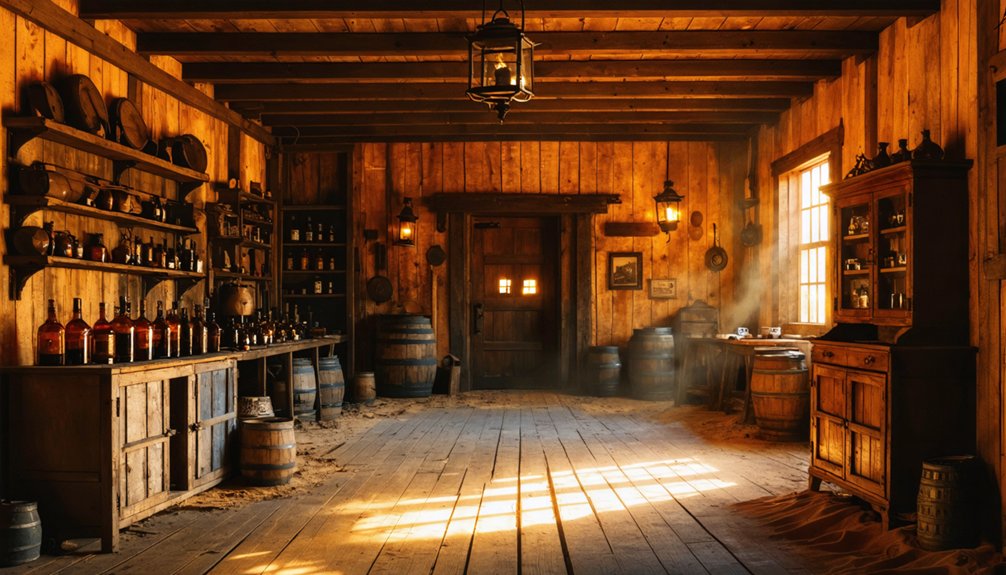
Nearly forgotten by the turn of the 20th century, Drum Barracks faced imminent destruction in the 1960s when bulldozers threatened to erase this significant Civil War landmark from California’s landscape.
You can thank dedicated community involvement for saving this historical treasure. In 1962, local groups halted demolition plans, launching restoration efforts focused on the junior officers’ quarters—the last significant structure remaining from the original 19 buildings.
After decades of grassroots preservation work, the site opened as Drum Barracks Civil War Museum in 1987.
Today, the museum stands as Southern California’s only major Civil War landmark, offering historical education through exhibits, reenactments, and educational programs.
Despite ongoing preservation challenges, the museum continues to commemorate California’s Civil War role while depending on community support and visitor engagement for its survival.
Drum Barracks vs. Bodie: Comparing California Ghost Towns
While Drum Barracks stands as a preserved Civil War site, it represents just one type of California ghost town. Unlike Bodie—California’s official gold rush ghost town—Drum’s historical significance stems from military rather than mining origins.
When comparing these two distinctive abandoned settlements, several contrasts emerge:
- Origin and purpose: Drum began as Camp San Pedro in 1862 for military security; Bodie formed after an 1859 gold discovery by William Bodey.
- Social atmosphere: Drum maintained military discipline while Bodie gained notoriety with 65 saloons and daily violence.
- Current preservation: Drum features restored buildings as a museum; Bodie’s 170 structures remain in “arrested decay.”
- Ghost stories: Both sites claim paranormal activity—Drum with apparitions like “Maria” and phantom tobacco smells; Bodie with legends tied to its violent mining deaths.
Visiting the Past: What Remains of Drum Today
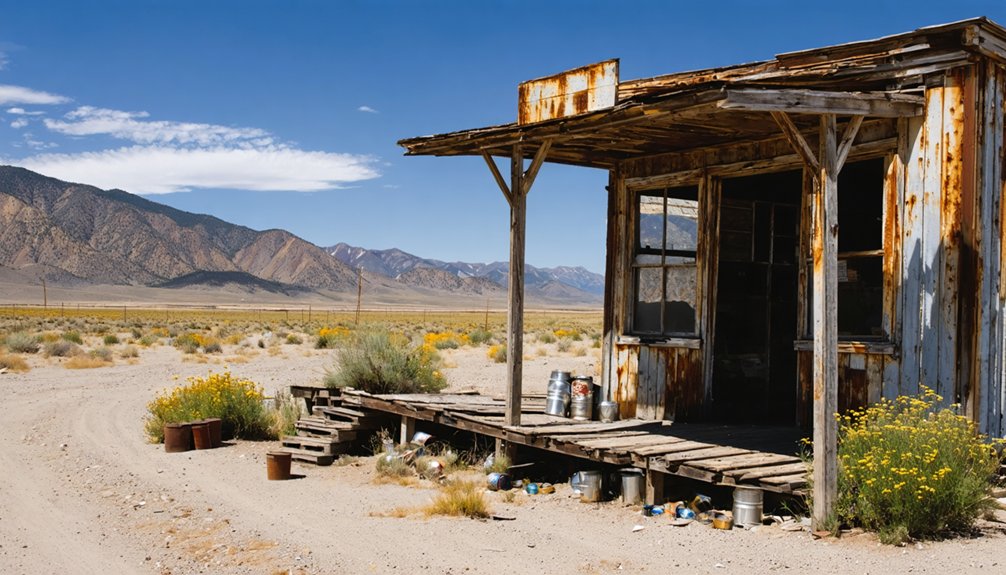
Today’s visitors to Drum encounter a stark contrast to the site’s former liveliness, with few physical remnants left to tell its story.
Urban exploration here reveals only deteriorated ruins and scattered foundations, with vegetation reclaiming much of the landscape. Unlike preserved ghost towns such as Bodie, you’ll find no intact structures or interpretative materials.
The site’s remote location offers no visitor amenities, requiring self-sufficiency when exploring.
Pack accordingly—there’s nothing waiting for you at Drum but memories and wilderness.
Historical archaeology enthusiasts might discover rusted mining equipment and structural fragments, but these artifacts continue disappearing due to harsh environmental conditions and lack of preservation efforts.
Your visit requires traversing rough terrain without official guidance or facilities.
While Drum’s physical presence fades, its legacy persists primarily through historical records and regional mining chronicles rather than tangible remains.
Frequently Asked Questions
What Was the Average Soldier’s Salary at Drum Barracks?
You’d find that the average soldier pay at Drum Barracks varied by rank—privates earned $13-16 monthly while officers received substantially more, reflecting the military hierarchy in barracks history.
Did Any Famous Historical Figures Visit Drum Barracks?
Like historical shadows fading with time, you won’t find Civil War luminaries such as Grant or Lee at Drum Barracks. Historical records mention only local figures like Phineas Banning and Lt. Col. James Curtis.
Were There Any Documented Native American Conflicts With Drum?
No, you won’t find documented Native American conflicts with Drum Barracks. Records show the post was ostensibly built for Indian fighting, but no actual Drum conflicts materialized in Southern California.
How Did Local Civilians Interact With Drum Barracks Personnel?
Like bees to a hive, you’d find local civilians trading with soldiers, attending community events, and joining social gatherings. You’d see entrepreneurs establishing businesses while laborers worked at the barracks during its million-dollar construction.
What Happened to Military Equipment When Drum Was Abandoned?
When Drum was abandoned, you’d find most valuable items were subject to military salvage. Some abandoned equipment stayed onsite, later preserved in the museum, while other items were transferred or sold off.
References
- https://www.pacificadventureclub.com/blog/the-infamous-bad-man-of-bodie-california-ghost-town-a-haunting-history
- https://vocal.media/horror/bodie-california-the-wild-west-ghost-town-where-the-past-never-dies
- https://www.legendsofamerica.com/ca-drumbarracks/
- https://statesymbolsusa.org/symbol-official-item/california/attraction-recreation-city-town-museum/bodie
- https://en.wikipedia.org/wiki/Bodie
- https://www.youtube.com/watch?v=2Foz-2R_mH8
- https://capitolmuseum.ca.gov/state-symbols/gold-rush-ghost-town-bodie/
- https://www.nps.gov/deva/learn/historyculture/death-valley-ghost-towns.htm
- https://www.youtube.com/watch?v=nWsPJA-KZ3g
- https://en.wikipedia.org/wiki/Drum_Barracks