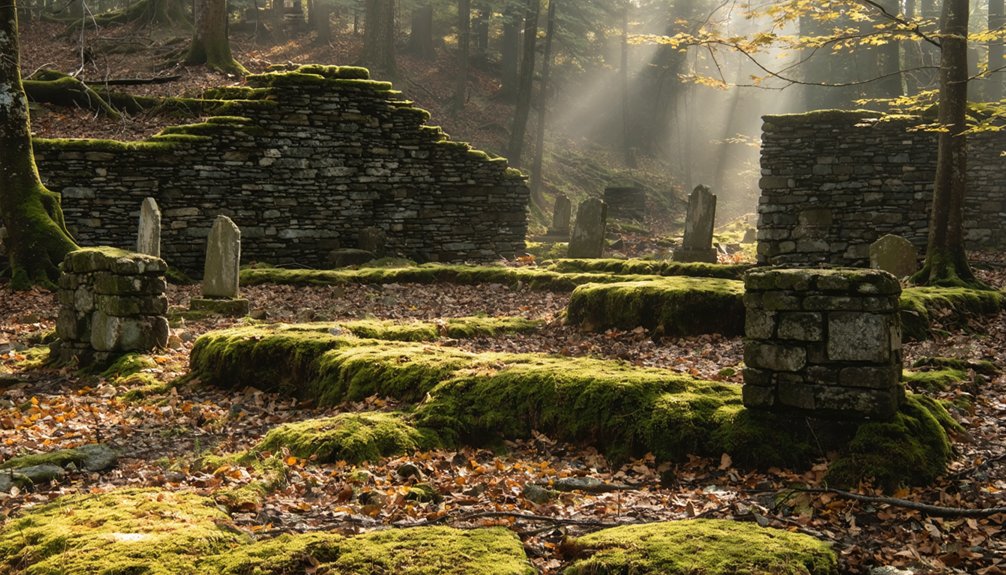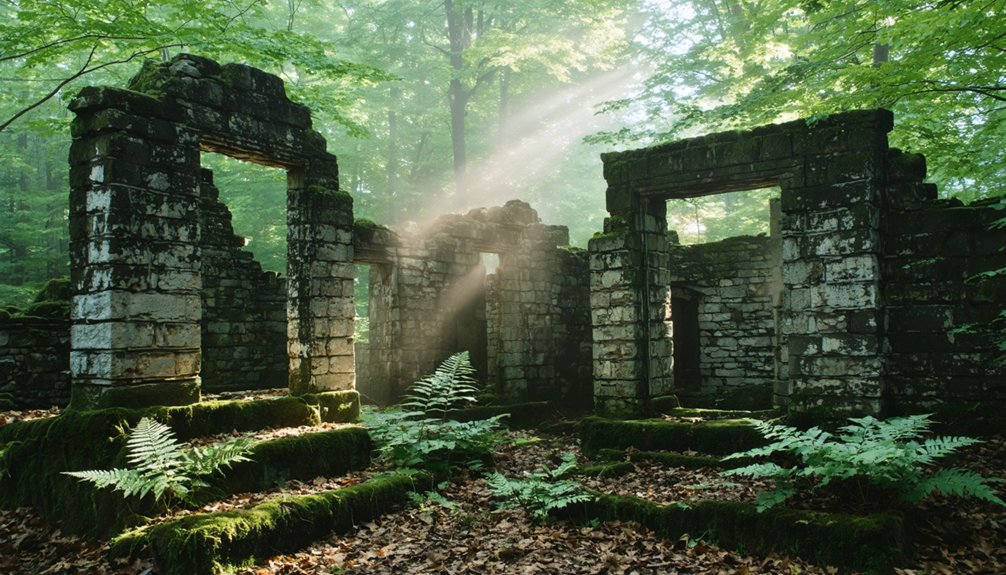
You’ll find Dudley Town in Cornwall, Connecticut’s remote hills, where colonial settlers established farms in the 1740s despite challenging terrain and poor soil. The Dudley family and other residents abandoned their homesteads by the early 1900s due to economic hardship and agricultural failure. While paranormal investigators have claimed supernatural activity since the 1970s, historians attribute the abandonment to practical factors like infertile land and limited transportation. The site remains privately owned with restricted access, though its legend continues growing.
Key Takeaways
- Dudleytown was a colonial settlement founded in the 1740s that was abandoned due to poor soil and economic decline.
- The site gained supernatural reputation through alleged curse legends linking back to Edmund Dudley’s 1510 execution in England.
- Paranormal investigators report shadowy figures, demonic creatures, and unexplained phenomena throughout the Dark Entry Forest area.
- Edward Starr’s 1926 historical account transformed local folklore into permanent “Village of the Damned” supernatural narratives.
- The abandoned settlement is now private property with strict no-trespassing enforcement, though ghost hunters continue visiting illegally.
Early Settlement and the Dudley Family Legacy
While ghost stories would later shroud its history in supernatural claims, Dudleytown’s origins trace back to ordinary colonial settlement patterns of the 1740s.
Despite its later reputation for paranormal activity, Dudleytown began as a typical 1740s colonial settlement in the Connecticut wilderness.
You’ll find that Thomas Griffis first settled the area, followed by Gideon Dudley who gave the location its eventual nickname. By 1753, Barzillai and Abiel Dudley had joined Gideon, establishing what became a cluster of related landholders rather than an incorporated town.
The Dudley heritage shaped this remote Connecticut hillside through multiple generations.
Family dynamics created adjacent parcels owned by various Dudley relatives, including Martin Dudley who arrived during the mid-to-late 18th century. These interconnected family holdings transformed steep, forested terrain into small-scale farms, though challenging topography and short growing seasons limited agricultural success compared to more favorable valley locations. The area was not ideal for farming due to steep terrain that made cultivation difficult. The settlement’s isolated location in Cornwall Township meant residents had no access to essential community services like shops, schools, or churches.
Life in the Remote Valley Community
The Dudley families and their neighbors faced formidable geographic obstacles that shaped every aspect of their daily existence. You’d find yourself farming on a steep hill between three larger peaks, where darkness fell at noon and rocky, infertile soil resisted cultivation.
These farming challenges forced residents to convert dense forest into marginal farmland, tilling the stubborn earth for generations despite poor yields.
Your community struggles intensified during brutal winters that shortened growing seasons considerably. You’d rely primarily on timber harvesting for income, cutting trees from Mast Swamp and floating them down the Housatonic River for ship construction. The Dark Entry Forest that surrounded your settlement had previously served as a Native American burial site, adding an ominous atmosphere to the already challenging location. The community also benefited from the iron industry that initially drove economic growth in the region.
Economic Decline and Population Exodus
As the mid-19th century approached, Dudleytown’s economic foundation began crumbling beneath the weight of multiple converging pressures.
You’d witness the community’s agricultural base failing as rocky, infertile soil couldn’t sustain profitable farming. The local iron industry that once anchored the settlement declined regionally, eliminating vital employment.
Economic factors worsened when limited transportation infrastructure prevented access to expanding markets, making nearby connected towns more attractive.
Population trends shifted dramatically as younger residents migrated west seeking better opportunities.
You’d see families gradually abandoning their homesteads rather than facing a catastrophic exodus. Competition from fertile western farmlands drew away both labor and investment.
Without economic diversification to replace lost agricultural and industrial activity, the valley couldn’t retain its residents. The combination of untimely deaths and economic hardship created an atmosphere of despair that accelerated the community’s decline. The scattered farms that made up the settlement were never formally recognized as a town on colonial maps, reflecting the community’s lack of cohesive organization.
The Curse Legend and Supernatural Claims
You’ll encounter claims that Edmund Dudley’s 1510 execution created a hereditary curse that followed his descendants to Dudleytown, though historians trace this narrative to Edward C. Starr’s 1926 local history that mixed fiction with fact.
The curse legend gained momentum in the 1970s when paranormal investigators Ed and Lorraine Warren promoted Dudleytown as “demonically possessed” through Halloween videotapes and public appearances.
You’ll find modern paranormal accounts describing mass insanity, unexplained deaths, spectral figures, and strange phenomena, but these reports lack consistent primary documentation and often recycle earlier embellished claims. Contemporary visitors report encounters with large black shadows and glowing creatures wandering through the abandoned forest areas. The area’s reputation persisted despite historical investigations revealing no connection between Dudleytown residents and the beheaded English noblemen.
Edmund Dudley’s Alleged Curse
While Edmund Dudley’s execution in 1510 preceded Dudleytown’s settlement by over two centuries, legend claims his beheading for treason created a supernatural curse that would follow his descendants across the Atlantic.
You’ll find the curse origins rooted in familial betrayal against King Henry VIII, who allegedly uttered a doom upon the Dudley line condemning them to horror and death.
The curse supposedly manifested through multiple sixteenth-century beheadings. John Dudley faced execution in 1553 during Lady Jane Grey‘s failed reign. His son Guildford Dudley also lost his head after the nine-day queen episode.
Robert Dudley became suspect in his wife Amy Robsart’s mysterious 1560 death. This pattern of tragedy allegedly followed English Dudleys to America, where Connecticut settlers bearing the name would face supernatural persecution.
Joseph Dudley, born in Saybrook, Connecticut, eventually settled in what became known as the cursed village.
However, most legends about the curse actually originated in the 1920s during the Spiritualism movement, long after the town’s actual abandonment.
Reported Paranormal Phenomena
Beyond the historical tragedies that allegedly spawned Edmund Dudley’s curse, modern visitors and paranormal investigators have documented extensive supernatural activity throughout Dudleytown’s abandoned settlement.
You’ll encounter reports of shadowy figures moving through trees and demonic creatures emerging from the forest depths. Investigators Nicholas Robert Grossmann and Peter Cerow have toured the site multiple times, claiming it functions as a portal to the spirit world.
Ed Warren declared the area demonically possessed during a 1970s Halloween special. Visitors describe ghostly encounters including disembodied voices calling them toward the woods, mysterious lights within the treeline, and physical sensations of being touched by unseen hands.
These eerie phenomena contribute to overwhelming feelings of dread and terror that permeate the location.
Media Popularization and Modern Folklore
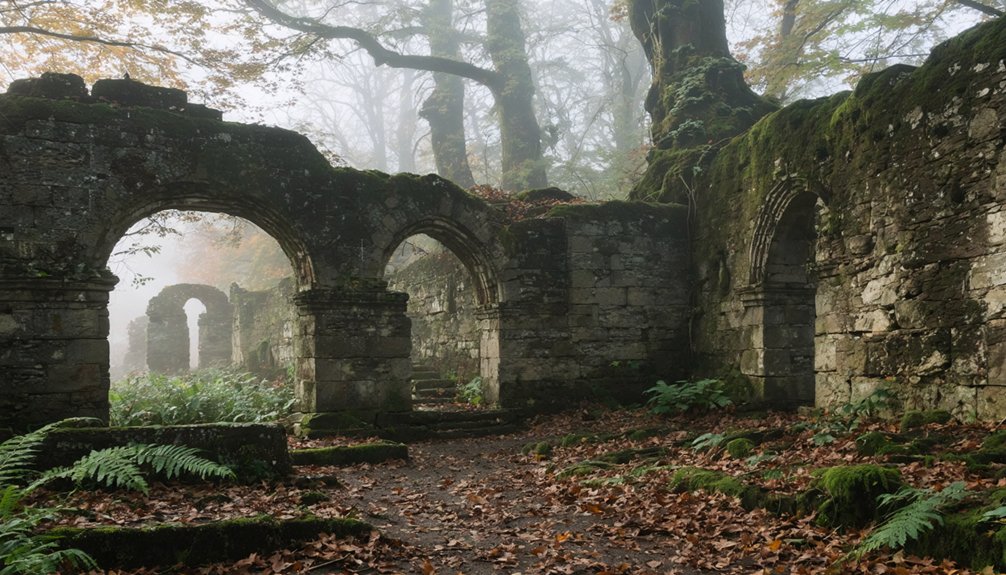
You’ll find that Edward C. Starr’s 1926 “History of Cornwall” launched Dudley Town’s transformation from forgotten settlement into supernatural legend.
The digital age has amplified these ghost stories through podcasts, YouTube videos, and paranormal websites that draw modern legend trippers to the restricted ruins.
While media outlets continue promoting the “Village of the Damned” narrative, historical records reveal the town’s abandonment resulted from poor soil and harsh winters rather than ancient curses.
Early 20th Century Documentation
The Cornwall Historical Society recognizes Starr’s narrative as the foundation for all subsequent supernatural stories.
His written account shifted oral traditions into permanent folklore origins, linking 16th-century English executions to Connecticut’s wilderness settlement.
This documentation transformed scattered local tales into a cohesive curse narrative, establishing the framework that would fuel decades of ghost stories and paranormal claims about the abandoned village.
Digital Age Ghost Hunting
While Starr’s early documentation established Dudley Town’s curse narrative through written folklore, reality television transformed these local legends into global entertainment commodities starting in the 2000s.
You’ll find paranormal investigation shows featured Connecticut’s abandoned settlement repeatedly, using dramatic editing and suggestive narration to amplify perceived supernatural evidence. These productions drove dark tourism to the site, encouraging amateur investigators armed with smartphones and consumer-grade equipment.
Digital tools democratized ghost hunting, enabling hobbyists to collect thermal images, EVP recordings, and electromagnetic readings with affordable devices.
Social media platforms accelerated viral distribution of alleged paranormal footage from Dudley Town, creating crowd-sourced validation through likes, shares, and comments.
Online communities now reinforce supernatural claims through collective interpretation, converting Starr’s local curse stories into modern folklore backed by digital “evidence” and social validation.
Folklore Versus Historical Reality
Although Edward Starr’s 1926 *History of Cornwall* contains only two pages about Dudleytown, this brief account became the foundation for an entire supernatural mythology that bears little resemblance to documented historical reality.
You’ll find that Cornwall Historical Society records contain no mentions of curses or hauntings before Starr’s sensational retelling.
The Dudleytown mythology traces supernatural events to a 16th-century English execution, yet this connection appears nowhere in contemporaneous documents.
When you examine tax records, petitions, and census data, you’ll discover ordinary agricultural struggles—poor soil, economic isolation, and market decline—not mass insanity or ritual murders.
Historical inaccuracies multiplied as paranormal writers cited each other, creating an echo chamber that transformed economic hardship into supernatural terror through repeated retelling.
Current Site Status and Access Restrictions
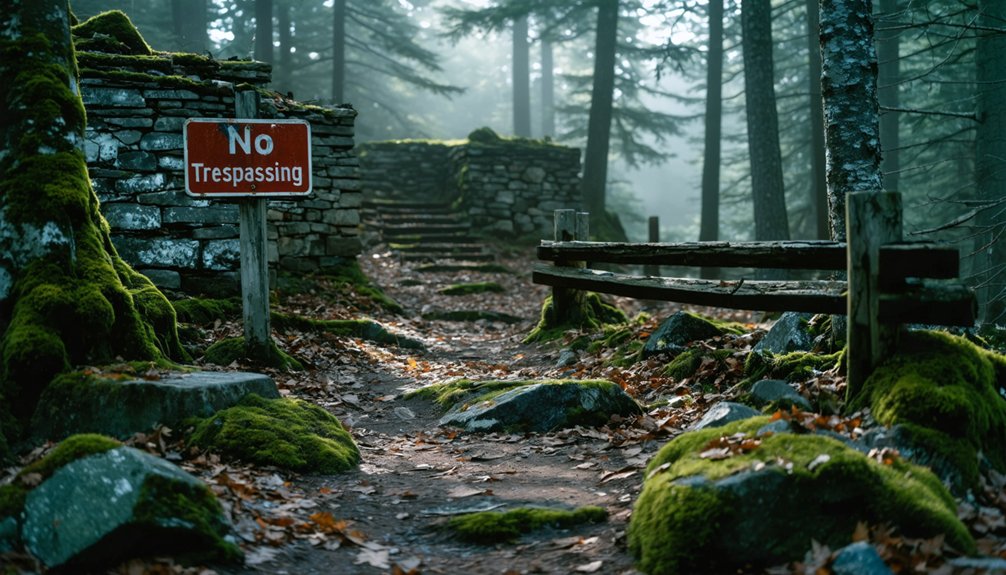
Since 1990, Dark Entry Forest, Incorporated has maintained strict control over the former Dudleytown site through private ownership and aggressive access restrictions.
Dark Entry Forest, Incorporated has enforced stringent access controls and private ownership restrictions at the former Dudleytown location since 1990.
You’ll find the current site designated as a private nature preserve, not public parkland, making unauthorized entry illegal trespassing under Connecticut law.
The access restrictions you’ll encounter include:
- Posted no-trespassing signs and physical barriers along forest trails
- Active enforcement by local and state police who arrest violators
- Legal prosecution of guide operators and repeat offenders
You’ll face significant hazards if you attempt entry, including unstable stone foundations, hidden cellar holes, and heavily wooded terrain without maintained pathways.
The remote location lacks cell reception, delaying emergency response if injuries occur.
Permission requires explicit landowner consent, typically granted only to approved researchers.
Separating Historical Facts From Fiction
The restricted access to Dudleytown stems partly from decades of sensationalized ghost stories that bear little resemblance to documented history.
When you examine actual Dudley history, you’ll find economic hardship, not supernatural forces, drove residents away. The curse origins trace to Edmund Dudley’s 1510 execution, but no historical records support this family curse mythology.
Edward C. Starr’s 1926 publication launched widespread supernatural narratives, yet primary sources reveal ordinary explanations.
Abiel Dudley suffered normal senility, not demonic possession. Poor soil, harsh winters, and economic migration westward caused abandonment by 1900.
The 1854 census shows 26 families struggling with practical challenges.
You can verify these facts through town records, census data, and contemporary documents that contradict ghost tales promoted by modern media and paranormal enthusiasts seeking sensational content.
Exploring unique ghost towns in New Hampshire can reveal intriguing insights about the state’s history and the people who once lived there. Many of these towns have been abandoned for decades, yet they still hold stories waiting to be uncovered. As you wander through their remnants, you’ll find that the truth often diverges from the myths surrounding them.
Frequently Asked Questions
What Specific Buildings or Structures Remain Visible in Dudleytown Today?
You’ll find crumbling stone foundations, empty cellar holes, and deteriorating stone walls scattered throughout the overgrown forest. These architectural remnants hold significant historical significance as markers of the abandoned settlement’s former boundaries and homesteads.
Are There Any Guided Tours or Legal Ways to Visit the Site?
Since the 1980s, no guided exploration exists due to private ownership and trespassing restrictions. You can’t legally visit without written landowner permission, though Cornwall Historical Society offers research into its historical significance through archives instead.
Who Currently Owns the Land Where Dudleytown Once Stood?
The Dark Entry Forest Association owns the land where Dudleytown once stood. You’ll find current regulations strictly prohibit public access, with the private association vigorously patrolling and prosecuting trespassers since the 1920s.
What Evidence Exists for the Reported Paranormal Activity and Supernatural Encounters?
Seeing isn’t always believing—you’ll find ghostly sightings rely on anecdotal testimonies, amateur investigations, and EMF readings rather than verified historical accounts or peer-reviewed documentation establishing supernatural phenomena at this location.
How Does Dudleytown Compare to Other Abandoned Settlements in Connecticut?
You’ll find Dudleytown stands out among Connecticut’s abandoned settlements because it’s generated more ghost stories than typical economic failures like Johnsonville or Bara-Hack, though all share similar agricultural and industrial decline patterns.
The history of dudleytown in connecticut weaves an intriguing tale of mystery and the unexplained. Many visitors claim to experience eerie sensations as they wander through the overgrown pathways where homes once stood, hinting at the lives and stories that were lost to time. This haunting aura has turned dudleytown into a popular spot for paranormal enthusiasts seeking to uncover the secrets hidden within its quiet woods.
As you continue exploring Bloomfield’s abandoned neighborhoods, you’ll witness a contrast between the vibrant history of the area and the current state of decay. These locations, once bustling with life, now serve as poignant reminders of the passage of time and the stories that linger in the shadows. Each corner reveals remnants of the past, inviting those brave enough to uncover the tales hidden within the crumbling facades.
References
- https://newenglandhistoricalsociety.com/the-dudleytown-curse-connecticuts-village-of-the-damned/
- https://www.youtube.com/watch?v=PKr-5HrudiI
- https://www.americanhauntingsink.com/dudleytown
- https://usghostadventures.com/haunted-stories/americas-most-haunted-east/the-curse-of-dudleytown/
- http://www.onlyinyourstate.com/experiences/connecticut/dudleytown-ct
- https://www.youtube.com/watch?v=t7SHpW0dc38
- https://en.wikipedia.org/wiki/Dudleytown
- https://vocal.media/horror/the-untold-story-of-dudleytown-ct
- http://cornwallhistoricalsociety.blogspot.com/2014/09/the-truth-about-dudleytown.html
- https://podcasts.apple.com/us/podcast/dudleytown-connecticuts-cursed-ghost-town/id1379959217?i=1000637103479