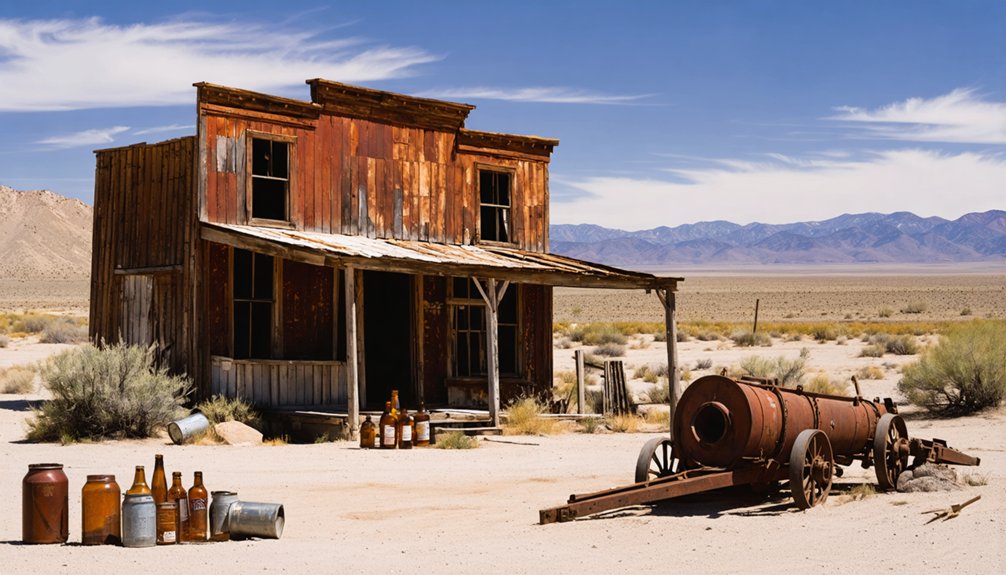
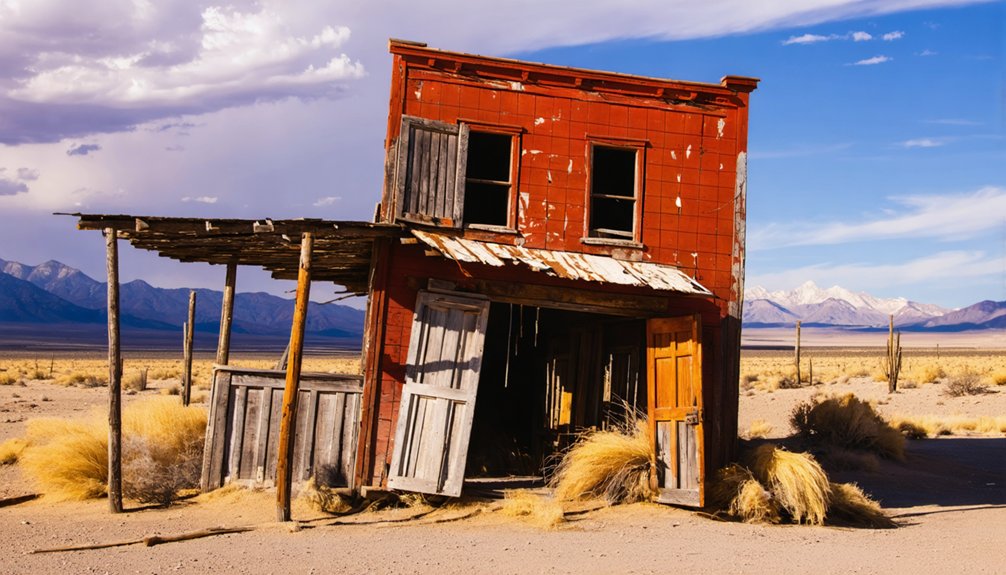
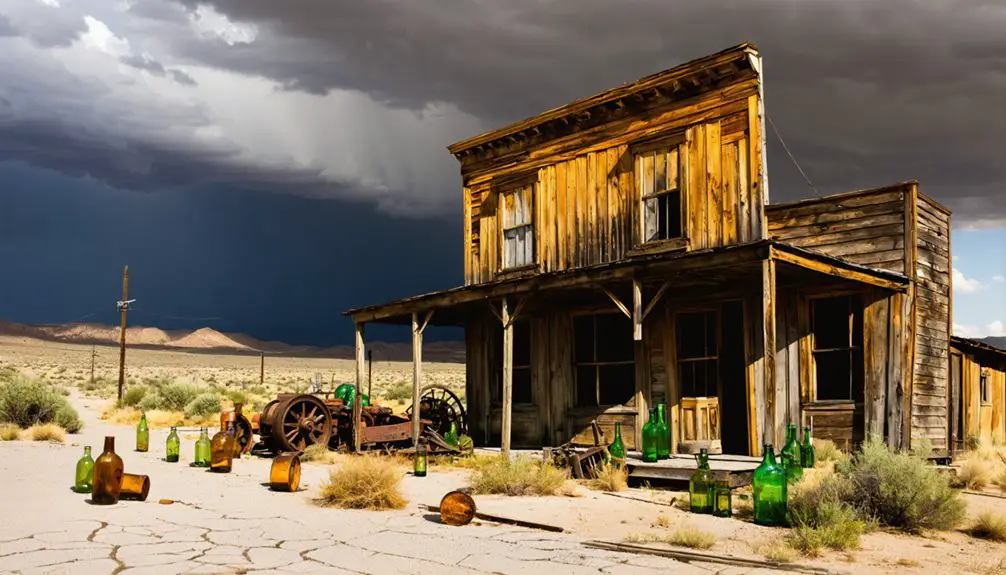
You’ll find Eagleville’s weathered remains scattered across Mineral County’s high desert at coordinates 39°01’34″N, 118°15’10″W, where Albert Woodruff’s 1882 gold discovery sparked a mining boom that lasted until 1915. This remote ghost town once housed 200-500 residents but now offers only collapsed foundations, mining adits, and cemetery remnants accessible via primitive BLM roads requiring GPS navigation and four-wheel-drive capability for rougher terrain sections. The complete story reveals fascinating details about Nevada’s ambitious mining frontier.
Key Takeaways
- Eagleville is located at 39°01’34″N, 118°15’10″W in Mineral County, Nevada, requiring GPS navigation and four-wheel-drive access.
- Founded in 1882 after Albert Woodruff’s gold discovery, the town peaked at 200-500 residents before declining by 1915.
- Mining operations focused on low-grade gold and silver deposits, with episodic production that proved economically challenging throughout.
- Current remains include collapsed foundations, stone bases, cemetery features, and mining infrastructure like shallow adits and tailings.
- Visitors face serious safety hazards including hidden mine shafts, structural collapse risks, and remote desert conditions.
Location and Access Information
Eagleville sits at coordinates 39°01’34″N, 118°15’10″W according to the USGS Big Kasock Mountain Quadrangle, placing this Nevada ghost town within the historically significant Mineral County mining region near Clark Fork.
Nevada’s remote Eagleville ghost town lies precisely at 39°01’34″N, 118°15’10″W within Mineral County’s historic mining territory near Clark Fork.
You’ll find the site’s geological features shaped by mining activity from the Eagleville Mining District, including the notable Yankee Girl Mine operations.
Reaching Eagleville presents significant access challenges through primitive BLM and county roads shown on topographic maps.
You’ll need GPS coordinates for navigation since desert tracks remain unnamed and unmarked. While two-wheel-drive vehicles can handle graded dirt sections during dry conditions, four-wheel-drive becomes essential for rough, washed, or sandy terrain.
Creek crossings typically stay dry year-round but become impassable after storms, requiring current road condition checks before departure. The area contains wooden buildings that showcase remarkable preservation from the mining era. Visitors should watch for vertical mine shafts in the area, as these dangerous openings from historical mining operations pose serious safety risks to explorers.
Historical Timeline and Settlement
You’ll find Eagleville’s story began in 1882 when Albert A. Woodruff discovered gold deposits that sparked the establishment of the Eagleville Mining Company.
The settlement developed rapidly through the 1880s, gaining enough residents to warrant a post office by 1889 and maintaining active mining operations into the early 1900s. At its height, the town supported a population between 200 to 500 residents who worked the mines and supported the local economy.
Your understanding of this ghost town’s timeline reveals a classic boom-and-bust cycle that concluded around 1915 when the more promising Rawhide strike drew away population and investment. The post office served as the town’s communication hub until its closure in March 1913, marking the beginning of Eagleville’s final decline.
Early Discovery and Settlement
When Albert A. Woodruff discovered gold in Mineral County, Nevada in 1882, you’re witnessing the birth of another Western mining venture.
Woodruff didn’t waste time establishing the Eagleville Mining Company that same year, though actual mining operations wouldn’t begin until 1884.
You’ll find this pattern typical of frontier gold mining—discovery followed by careful planning and capital formation. The remote location of Eagleville’s ore deposits made the settlement challenging to sustain over the long term. Like many Nevada mining towns of this era, Eagleville’s peak population would reach approximately 2,000 residents during its most prosperous years.
Peak Years to Abandonment
Following the establishment of organized mining operations in 1884, Eagleville’s transformation from discovery site to functioning mining camp accelerated rapidly through the late 1880s.
You’ll find evidence of this boom in the wood frame buildings, ore bins, and stamp mills constructed during peak investment years. The post office’s 1889 establishment reflects robust community dynamics supporting year-round residents and federal services.
However, you’d witness decline beginning in the mid-1890s as ore yields disappointed investors.
Mining technologies couldn’t overcome low-grade veins and infrastructure deficits that plagued remote operations. Competition from richer Rawhide strikes drew away capital and labor, accelerating Eagleville’s economic collapse. Eventually, ore depletion forced the remaining miners to abandon their claims and seek opportunities elsewhere.
Mining Operations and Economic Activity
The gold discovery that sparked Eagleville’s brief mining boom came in 1882 when Albert A. Woodruff struck ore, leading to the Eagleville Mining Company’s formation.
Albert Woodruff’s 1882 ore strike triggered Eagleville’s mining rush and prompted the swift establishment of the Eagleville Mining Company.
You’ll find this wasn’t your typical large-scale operation—miners employed basic mining techniques including surface prospecting, shallow underground workings, and rudimentary stamp mills for ore processing.
The district’s economic struggles stemmed from patchy, low-grade gold and silver deposits scattered across multiple small claims rather than substantial veins. The camp was part of the broader Eagleville district that also produced tungsten and barite alongside the precious metals.
Production remained episodic and artisanal throughout the camp’s existence. The Monte Cristo mill was constructed for ore treatment but proved unsuccessful in its operations during 1874.
Key characteristics of Eagleville’s mining operations included:
- Small crews working surface and shallow underground claims
- Basic on-site ore treatment with simple crushing equipment
- Minimal recorded shipments reflecting constrained economic output
Infrastructure and Surviving Structures
Unlike many Nevada mining camps that developed extensive street grids, Eagleville’s physical layout remained compact and clustered around a small central core near the present-day Mineral County–Pershing County border.
You’ll find infrastructure remnants scattered throughout the modest townsite, including collapsed wood-frame building remains with visible timbers and wall fragments. The surviving features consist primarily of scattered foundations, low masonry footings, and a possible powder house depression that once stored explosives.
Mining-related infrastructure surrounds the camp, featuring shallow adits, prospect pits, and small tailings piles documenting the area’s sporadic extraction activities.
Unfortunately, scrappers removed most metal infrastructure including rails and machinery, considerably altering the original footprint. Today’s degraded condition reflects decades of abandonment, though cemetery features remain among the most identifiable cultural elements you can still access. The site’s deterioration follows a familiar pattern seen throughout Nevada’s mining booms and subsequent declines that left numerous settlements in various states of decay.
Community Life and Demographics
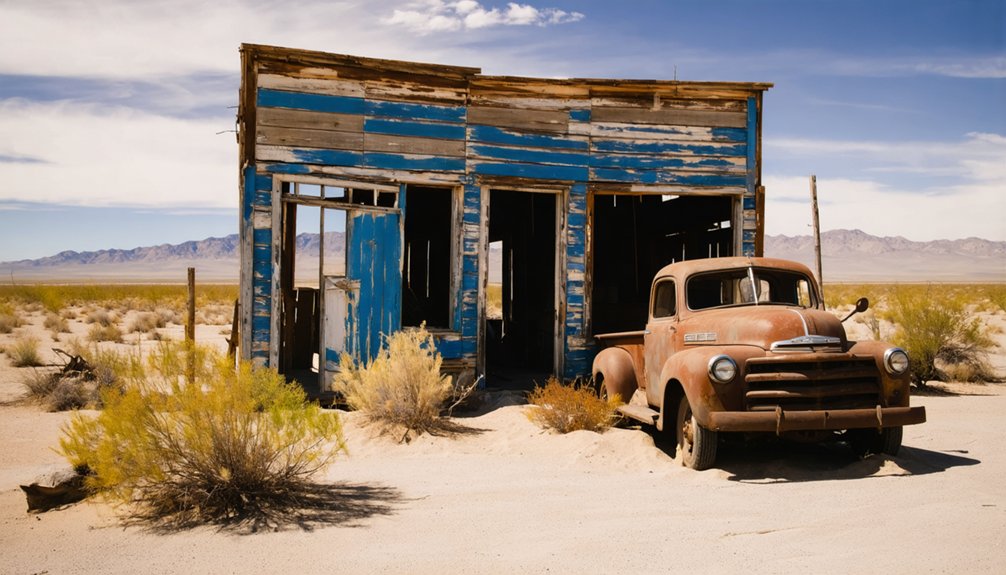
Although Eagleville never achieved the bustling population densities of Nevada’s major mining districts, the camp sustained a modest community for roughly three decades between the 1880s and 1920s.
You’d find the settlement warranted federal postal services from 1889 to 1913, indicating sufficient residents to justify this essential lifeline. The community dynamics revolved around gold extraction efforts, with settlers arriving after early 1880s discoveries and developing basic camp functions through the 1910s.
Demographic challenges defined Eagleville’s existence:
- Limited population growth despite three-decade persistence
- Sporadic mining activity that couldn’t sustain steady growth
- Gradual decline following 1913 post office closure
The Eagleville Mining Company anchored this Mineral County settlement, but you’ll discover the camp dissolved quietly without documented mass exodus, typical of Nevada’s smaller mining ventures.
The Rise and Fall of a Mining Camp
Albert A. Woodruff’s 1882 gold discovery sparked Eagleville’s transformation from barren Nevada landscape into a bustling mining camp.
You’ll find that the Eagleville Mining Company established operations in 1884, employing underground mining techniques that reached 400 feet above the No. 2 northwest vein and extended 200 feet below the main tunnel level.
The camp flourished through the 1880s, earning a post office by 1889 and generating approximately $50,000 in production value.
However, you’d witness its decline as operations limped along for years, hampered by small deposit sizes and irregular intervals.
The nearby Rawhide strike delivered the final blow, closing the post office in 1913 and cementing Eagleville’s ghost town legend by 1915.
Current Condition and Preservation Status

When you visit Eagleville today, you’ll find a site where structural decay has claimed most remnants from its early 20th-century mining era, with ore rock values below twenty-five dollars per ton making any restoration economically unfeasible.
The town’s remote desert location in Mineral County has actually protected it from the vandalism and artifact theft that plague more accessible ghost towns, though natural erosion continues to deteriorate what little remains.
You won’t encounter formal access restrictions since no preservation efforts or historical society involvement currently exist, but the isolated terrain itself presents safety challenges for modern explorers attempting to reach this unrestored ruin.
Structural Decay and Collapse
Since Eagleville’s abandonment after 1915, structural decay has consumed nearly every building that once comprised this remote Nevada mining camp.
You’ll find no intact superstructures above foundation level, only scattered stone bases marking where the 1880s settlement once thrived. The structural integrity of mine-related buildings has completely failed, leaving decay patterns that tell the story of Nevada’s boom-and-bust cycles.
When you explore the site, you’ll encounter these remnants of structural collapse:
- Collapsed wooden buildings reduced to rotting timber piles near active mine shafts
- Foundation stones scattered around tailing piles where structures once stood above mining operations
- Powder house ruins transformed into cavern-like formations from complete structural failure
The proximity to unstable mine workings accelerated this widespread deterioration, creating today’s landscape of rubble and memories.
Vandalism and Artifact Loss
Beyond natural decay, Eagleville faces ongoing threats from vandalism and systematic artifact removal that have accelerated the site’s deterioration since its 1915 abandonment.
You’ll find graffiti marking structures throughout Nevada’s ghost towns, with human-shaped markings appearing on remaining buildings. Vandalism prevention efforts include fencing around vulnerable sites, though many areas remain unprotected.
The destruction extends beyond simple graffiti—visitors have demolished structures and stolen valuable remnants. Artifact preservation challenges mirror those at other Nevada mining camps, where scrappers removed rail lines and valuable materials post-abandonment.
Historical sites receive protection under state and federal law, but enforcement remains difficult in remote locations. Without active preservation measures, many Nevada ghost towns have been lost forever to ongoing vandalism and neglect.
exploring the history of simonsville can provide valuable insights into the challenges faced by similar sites across the country. The stories of these once-thriving communities highlight the need for ongoing support and greater public awareness to ensure their survival. By uncovering the past, we can inspire future generations to take action in preserving our historical heritage.
Access Restrictions and Safety
Although Eagleville’s ruins attract history enthusiasts and explorers, access to the ghost town involves traversing complex land ownership patterns and significant safety hazards.
You’ll need to determine whether ruins sit on private parcels requiring owner permission or BLM public lands with potential closure orders. Access permissions depend on current administrative status, which can change seasonally.
The site presents serious safety hazards requiring careful preparation:
- Structural collapse risks from unstable mining-era buildings with deteriorating roofs and walls
- Hidden mine shafts and adits lacking barriers, creating life-threatening fall hazards
- Desert environmental dangers including extreme heat, limited water, and poor cellular coverage
You’ll face long emergency response times in this remote location. Travel with companions, carry adequate water, and avoid entering any structures or mine openings to minimize risk.
Photography and Documentation Efforts
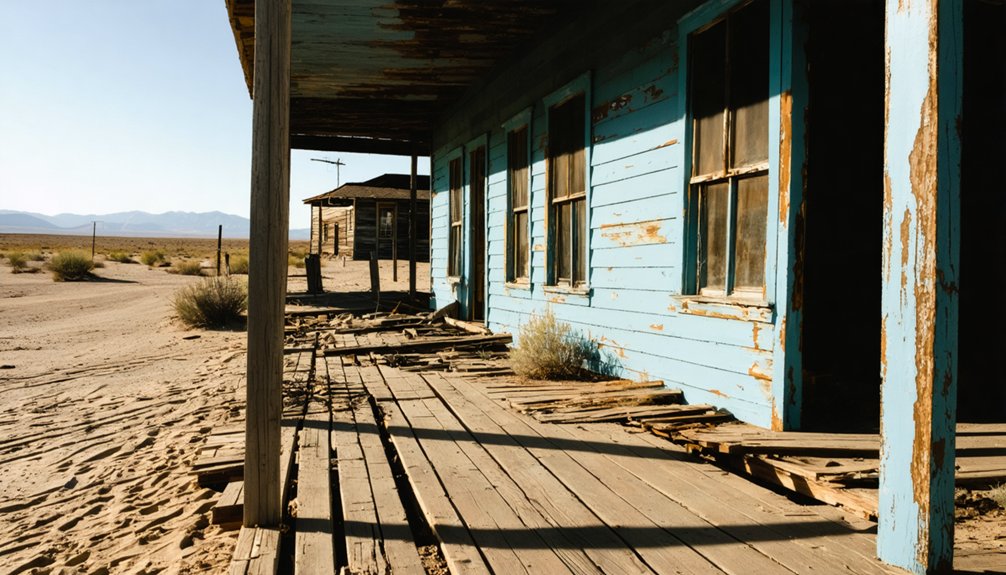
The documentation of Eagleville’s remnants has attracted photographers and researchers who’ve captured its deteriorating structures through various media formats.
You’ll find extensive photographic techniques employed throughout Nevada’s ghost town exploration community, with high-resolution color photography documenting schoolhouses, cemeteries, and mining structures.
Video documentation methods include detailed recordings of mine interiors, capturing workings like stopes, drifts, and underground passages before access becomes permanently restricted.
Interactive online maps now link photographs to historical information for hundreds of ghost towns, providing visual planning resources for your exploration.
Black-and-white archival prints preserve Eagleville’s earlier appearance, while modern documentation efforts combine tear-resistant maps with photographic content.
These thorough documentation methods guarantee you’ll have access to both historical context and current conditions when planning your visit to this remote Nevada location.
Visiting Today: What to Expect
What should you expect when visiting Eagleville today? This ghost town exploration requires serious preparation for remote site safety. You’ll find minimal remains of a once-active mining camp that quietly died after the Rawhide boom ended.
Your visit will reveal:
- Tumbled ore bin – Scattered down the hillside, representing the camp’s modest mining operations
- Powder house ruins – A dynamite storage cavern, likely the most substantial surviving structure
- Barren landscape – Few visible remnants of the community that operated from the 1880s to 1915
You’re venturing far beyond cellphone range, where emergency help faces significant delays. Access restrictions change yearly, and you must respect private property boundaries.
The site’s neglected condition reflects decades of abandonment since mining ceased permanently.
Frequently Asked Questions
Are There Any Reported Ghost Sightings or Paranormal Activity at Eagleville?
You’ll find occasional ghost encounters mentioned in local lore and YouTube videos, but no verified paranormal investigations or documented evidence exists. Most claims remain anecdotal without credible primary sources or systematic research.
What Wildlife or Dangerous Animals Might Visitors Encounter in the Area?
You’ll encounter mountain lions, rattlesnakes, and scorpions requiring serious caution. Wildlife encounters include coyotes, bobcats, and golden eagles. Watch for caution signs, but remember most dangerous animals avoid humans if you’re alert.
Are There Any Hidden Treasures or Valuable Artifacts Still Buried There?
Like prospectors chasing fool’s gold, you’ll find treasure hunting here disappointing. Historical records show no documented buried valuables or significant artifact exploration opportunities—small production levels and complete site abandonment left little behind worth discovering.
What Is the Best Time of Year to Visit Eagleville?
Spring and fall offer the best season for visiting, with comfortable 60-80°F temperatures and stable road conditions. You’ll avoid summer’s dangerous heat and winter’s limited daylight while enjoying ideal weather conditions for exploration.
Are Camping or Overnight Stays Allowed Near the Ghost Town?
Yes, you can camp near the area following BLM dispersed camping regulations. You’ll need to stay within 14-day limits, camp responsibly, and check local restrictions, though specific overnight permits aren’t typically required.
References
- https://www.youtube.com/watch?v=8j6nXrmWk9I
- https://en.wikipedia.org/wiki/Eagleville
- https://nvtami.com/2025/06/25/lincoln-county-ghost-town-trip/
- https://www.wikiwand.com/en/articles/Eagleville
- https://www.youtube.com/watch?v=KshnYk_fDs0
- http://www.raydunakin.com/ghost_towns_and_mines.html
- https://forgottennevada.org/sites/eagleville.html
- https://kellycodetectors.com/content/pdf/site_locator_books/NV.pdf
- https://www.rachel-nevada.com/places/reveille.html
- https://dot.ca.gov/-/media/dot-media/programs/research-innovation-system-information/documents/place-names/2020-place-names-in-california-a11y.pdf