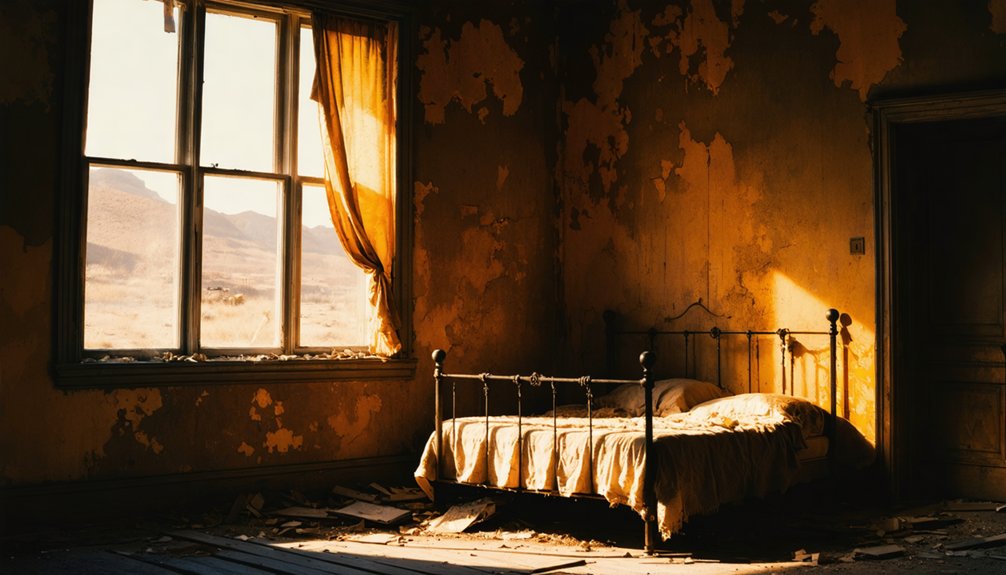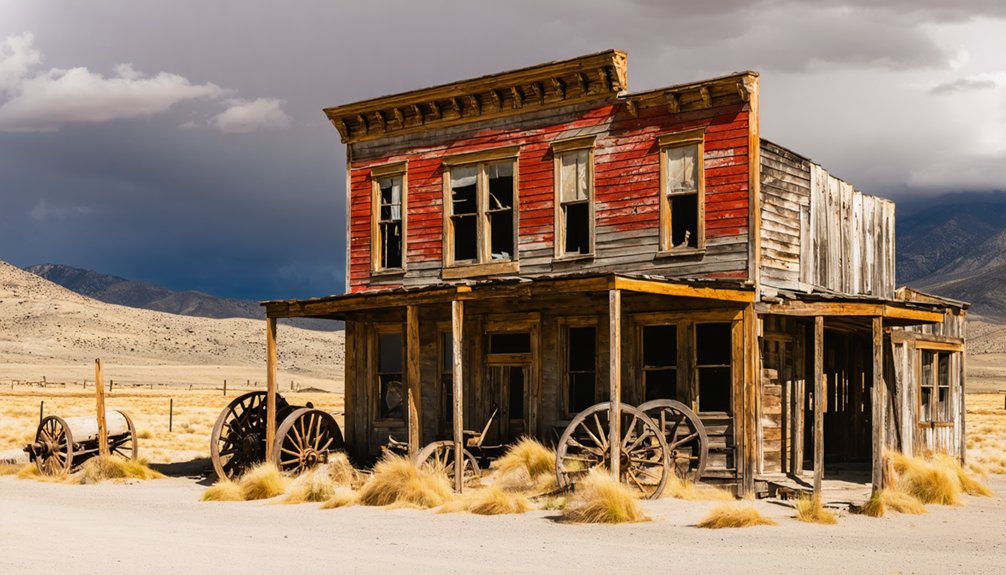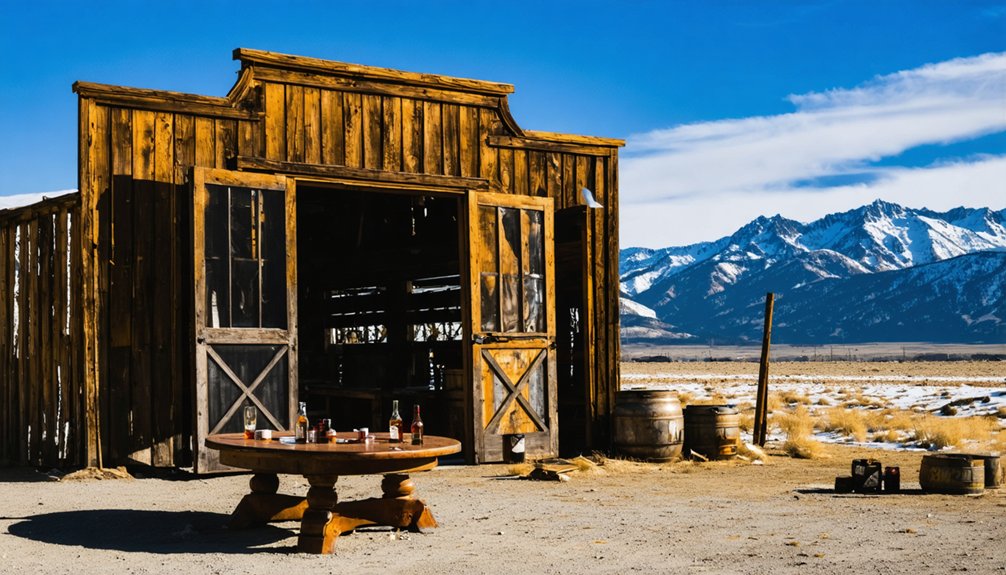
You’ll find six legendary Eastern Sierra ghost towns that chronicle California’s most dramatic mining era, from Bodie’s notorious 1880s boomtown with 65 saloons to Cerro Gordo’s massive silver operations producing 4.5 million ounces. Darwin peaked at 3,500 residents before disease and violence drove exodus, while Ballarat crumbled when ore played out in 1903. Randsburg remains a “living ghost town” with operational businesses, and remote Lundy showcases high-altitude mining heritage. These weathered remnants reveal the complete boom-bust story that shaped the region’s wild frontier legacy.
Key Takeaways
- Bodie became California’s most famous ghost town after an 1876 mine cave-in revealed rich gold veins, attracting 10,000 residents.
- Cerro Gordo produced over 4.5 million ounces of silver and became California’s largest silver producer by 1869.
- Darwin peaked at 3,500 residents by 1877 before declining due to smallpox epidemics and economic downturns.
- Lundy’s high-elevation mining operations began in 1879 around Lundy Lake in the Sierra Nevada mountains.
- Modern preservation efforts include Cerro Gordo’s $1.4 million purchase in 2018 with ongoing restoration and guided tours.
Bodie: California’s Most Famous Ghost Town
Four prospectors discovered gold in the eastern Sierra foothills in 1859, launching what would become California’s most notorious mining boomtown.
You’ll find Bodie’s history rooted in tragedy—W.S. Bodey died in a blizzard seeking supplies, yet the town bears his misspelled name.
The 1876 mine cave-in changed everything, exposing rich veins that attracted 10,000 residents by 1880.
You’d have encountered 65 saloons, brothels, and constant violence earning the phrase “bad man from Bodie.”
The town produced $70 million in precious metals before decline set in post-1880s. The community included hundreds of Chinese residents who contributed significantly to Bodie’s economy through various trades including laundry services and logging operations.
Today, you can explore preserved Bodie architecture in this state historic park, where 200 structures remain in “arrested decay,” maintaining their authentic Wild West atmosphere. The name Bodie appears in multiple contexts across different places and people, making it a subject worthy of disambiguation in historical records.
Cerro Gordo: The Silver Mining Giant Above Lone Pine
You’ll find Cerro Gordo perched high above Lone Pine produced over 4.5 million ounces of silver during the 1860s-1880s, making it one of California’s most profitable mining operations.
The camp’s boomtown atmosphere bred a culture of violence and heavy drinking among its diverse population of Anglo, Mexican, and Chinese miners who worked the dangerous shafts.
Today, you can explore the site’s deteriorating adobe structures and mine tunnels, now preserved under private ownership after decades of revival attempts and ownership changes. Access requires navigating a challenging 7-mile dirt road with significant elevation gain from the nearest town. The charcoal kilns located 12 miles south of Lone Pine stand as weathered reminders of the smelting operations that once processed the mountain’s precious metals.
California’s Most Profitable Mine
While most California mining ventures struggled to turn substantial profits, Cerro Gordo emerged as the state’s most lucrative silver operation after Pablo Flores discovered rich ore deposits near the summit of Buena Vista Peak in 1865.
You’ll find that by 1869, this remote mountain mine had become California’s largest silver producer, shipping over 340 tons of bullion to Los Angeles.
The mine’s economic impact transformed Southern California. Trade with Cerro Gordo directly spurred Los Angeles’s prosperity, while innovative mining technology enabled extraction of nearly $500 million worth of minerals over nine decades. By 1912, Cerro Gordo became the largest U.S. producer of zinc carbonates, with 11,800 short tons produced.
Between 1865-1949, you’d witness the removal of 4.4 million troy ounces of silver and 35,000 tons of lead through over 30 miles of underground tunnels carved into the Inyo Mountains. The mining operations continued until 1957, when the last commercial extraction ended after nearly a century of continuous production.
Violence and Whiskey Culture
The camp’s brutal reality included:
- Miners sleeping with sandbags in their bunks to stop stray bullets from nightly gunfights.
- Justice Hughes wielding a shotgun to prevent mob lynchings during heated inquests.
- Bill Crapo’s final gunfight on December 29, 1892, killing two men over election disputes.
Remote location meant no quick law enforcement, creating a wide-open town where whiskey-lubricated miners settled disputes with pistols. The town earned its deadly reputation with an estimated murder a week during its violent peak years. At its height, the lawless settlement housed over 1,500 residents who lived with constant danger and disorder.
Modern Preservation Efforts
After decades of abandonment, Cerro Gordo found new life when entrepreneur Brent Underwood and his partners purchased the historic mining town for $1.4 million in 2018.
You’ll find Underwood transformed the site from deteriorating ruins into a functioning tourist destination through dedicated historical restoration efforts. Since COVID’s onset, he’s lived on-site, rebuilding structures to modern safety codes while preserving authentic character.
Community involvement drives the project’s success. The Friends of Cerro Gordo nonprofit raised over $17,000 for hotel reconstruction after fire destroyed the American Hotel in 2020. The historic hotel had operated for 149 years before flames consumed it on the anniversary of its original 1871 opening date.
Volunteers drawn through Underwood’s YouTube channel assist with restoration and maintenance. You can now visit this work-in-progress via guided tours, experiencing gourmet meals, mine shaft hikes, and overnight stays while supporting ongoing preservation of California’s richest silver mining history. Located at approximately 5000 feet elevation between Death Valley and Lone Pine, the ghost town offers visitors a unique high-altitude desert experience.
Darwin: Weather-Beaten Remnants of Failed Dreams
Perched on the harsh eastern slopes of the Sierra Nevada, Darwin stands as one of California’s most enduring reminders that boom can quickly turn to bust. Named after Dr. E. Darwin French’s 1860 prospecting expedition, this settlement exploded from nothing to Inyo County’s largest town by 1877, housing 3,500 residents around twenty active mines.
Darwin’s history reveals how quickly fortune vanishes. Mining decline began with devastating blows:
Mining fortunes collapsed under relentless devastation: disease, violence, and mysterious fires transformed California’s boom town into desolate remnant.
- The 1878 smallpox epidemic that decimated the population while economic slowdown strangled production
- Eighty unsolved murders between 1874-1877 as wage cuts sparked violent desperation
- The suspicious 1879 fire that destroyed the Darwin Hotel and fourteen businesses in one night
Today, thirty-five hardy souls call this semi-ghost town home, living seventy miles from the nearest market.
Ballarat: From Mining Hub to Cult History
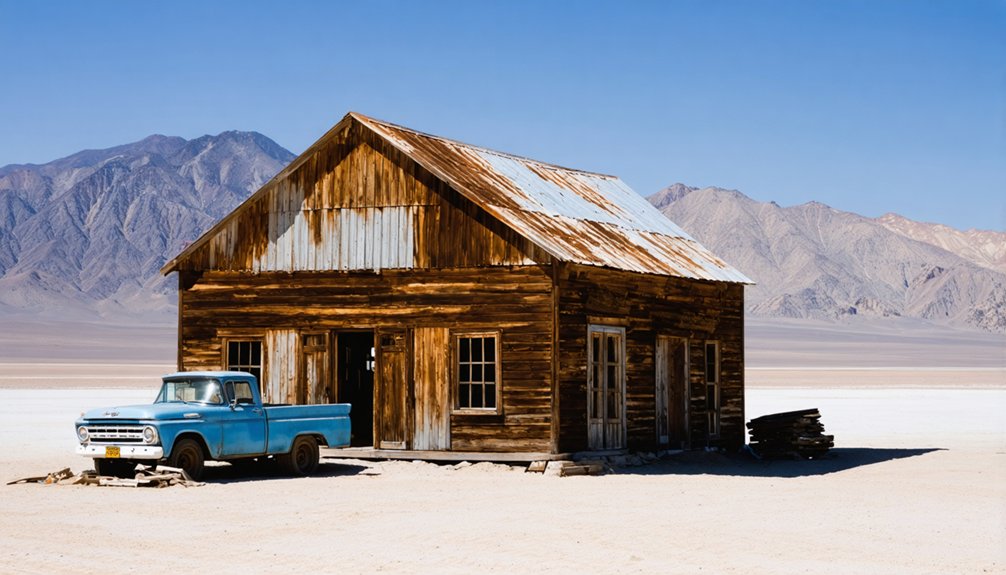
Unlike Darwin’s chaotic mining origins, Ballarat emerged in 1896 as a calculated business venture—a supply station strategically positioned at Post Office Springs to serve the scattered mining camps of the Panamint Range.
George Riggins, an Australian immigrant, proposed naming it after Victoria’s famous goldfields. You’ll find remnants of what once housed 400-500 residents during its 1897-1905 boom, when seven saloons and three hotels serviced miners working the profitable Radcliffe Mine.
The town’s mining heritage crumbled when ore played out by 1903, leading to the post office’s closure in 1917. Legendary figures like Shorty Harris lingered into the 1930s, creating enduring ghost town legends.
Today, Ballarat’s connection to the Manson Family’s nearby Barker Ranch adds dark intrigue to its desert ruins.
Randsburg: The Living Ghost Town of Kern County
Three determined prospectors—Charles Burcham, Frederick Mooers, and John Singleton—struck gold on Rand Mountain’s slopes in 1895, launching what would become Southern California’s largest gold-producing operation.
Three determined prospectors struck gold on Rand Mountain’s slopes in 1895, launching Southern California’s largest gold-producing operation.
Their Yellow Aster Mining and Milling Company produced over $25 million in gold, transforming Rand Camp into a bustling town of 3,500 residents by 1899.
Today’s Randsburg preserves authentic mining history while maintaining its frontier spirit:
- You’ll discover operational businesses like the General Store with its original 1904 soda fountain, keeping Old West traditions alive.
- You can still prospect for gold in surrounding areas, continuing the legacy of freedom-seeking miners.
- You’ll explore genuine mining equipment and structures that witnessed America’s greatest gold rush.
Despite devastating fires and boom-bust cycles, this living ghost town survives with 60-69 resilient residents celebrating gold prospecting heritage.
The allure of these living ghost towns of the American West draws both historians and adventurers eager to uncover the stories lost to time. Each town holds a unique narrative, revealing the challenges and triumphs of those who once thrived amidst the harsh landscape. As visitors wander through the remnants, they can sense the echoes of a vibrant past still lingering in the air.
Lundy: High Sierra Mining Legacy
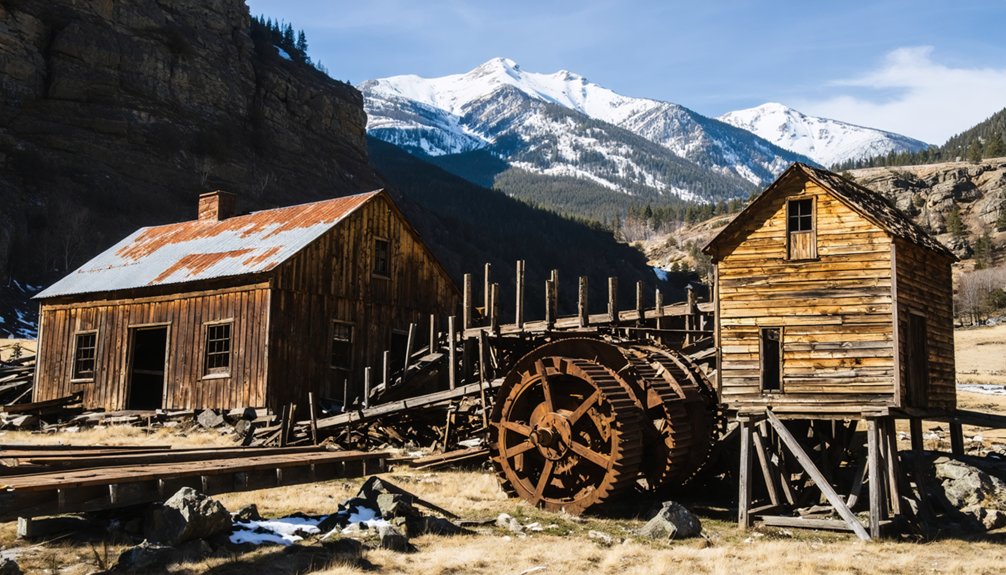
While Randsburg thrived in Southern California’s desert, miners in the Eastern Sierra pursued different fortunes at elevations exceeding 7,000 feet.
You’ll discover Lundy’s mining heritage began in 1879 when prospectors established camp around what’s now Lundy Lake, originally called Wasson Lake.
The town quickly expanded from Emigrant Flat to the pine-covered lakeshore, where William Lundy’s sawmill cleared timber for construction.
Frequently Asked Questions
What Should Visitors Bring When Exploring Remote Eastern Sierra Ghost Towns?
You’ll need essential gear including sturdy shoes, water, sunscreen, and maps. Safety tips: pack first aid supplies, make certain full gas tank, bring flashlight, and carry offline navigation since cell service remains unreliable.
Are There Guided Tours Available for Multiple Ghost Towns in One Trip?
Yes, you’ll find guided tour options spanning multiple sites, from day trips combining preserved settlements to multi-day expeditions exploring their historical significance across California’s mining districts, typically operating late spring through fall.
Which Ghost Towns Require Four-Wheel Drive Vehicles to Access Safely?
Bodie requires 4WD for winter access and spring mud conditions. Remote Bodie Hills mining sites need high-clearance vehicles year-round. Cottonwood Canyon’s unpaved sections demand 4WD after storms, while isolated camps require expedition-capable rigs.
What Are the Best Months to Visit Eastern Sierra Ghost Towns?
Like golden threads through history’s tapestry, June through September offer you the best weather and seasonal events. You’ll find warm days, long daylight hours, guided tours, photography workshops, and reliable road access to explore these preserved mining settlements.
Are Camping Facilities Available Near Any of These Ghost Town Locations?
You’ll find camping available at Benton Hot Springs with reservations required. Bodie’s camping regulations prohibit overnight stays, but Willow Springs Resort offers campground amenities five miles south near Bridgeport for your exploration freedom.
References
- https://en.wikipedia.org/wiki/List_of_ghost_towns_in_California
- https://whimsysoul.com/must-see-california-ghost-towns-explore-forgotten-histories/
- https://sayawe.com/ghost-towns-of-the-eastern-sierra-where-the-west-refuses-to-die/
- https://californialocal.com/localnews/statewide/ca/article/show/51711-10-california-ghost-towns-to-see/
- https://www.californist.com/articles/interesting-california-ghost-towns
- https://californiahighsierra.com/trips/explore-ghost-towns-of-the-high-sierra/
- https://www.tripadvisor.com/Attractions-g28926-Activities-c47-t14-California.html
- https://nvtami.com/2022/10/11/lessor-known-mono-inyo-ghost-towns/
- https://thelittlehouseofhorrors.com/bodie-the-cursed-ghost-town/
- https://en.wikipedia.org/wiki/Bodie