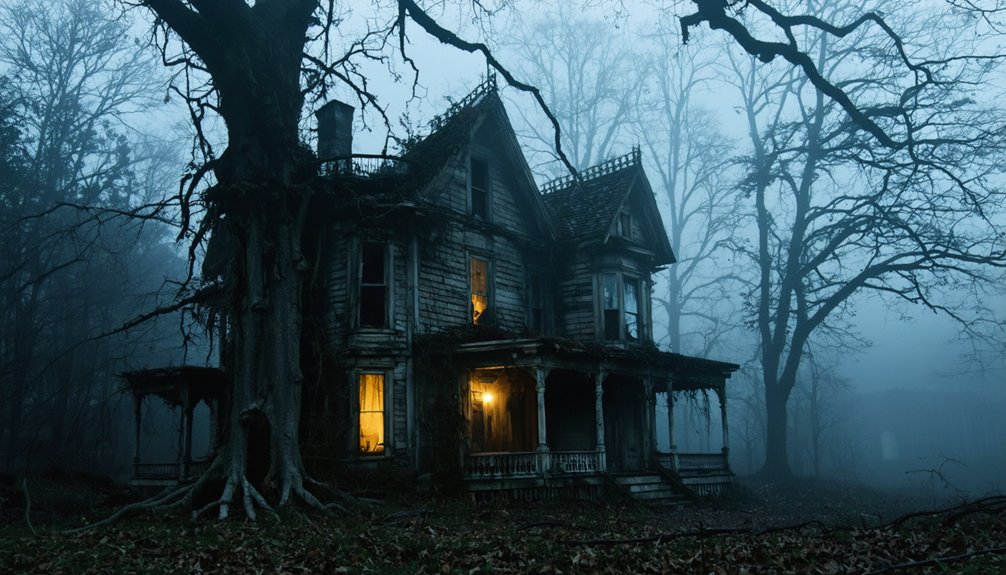
You’ll find Eastern USA’s ghost towns haunting because they combine tragic historical events with dramatic industrial decline. These abandoned places tell stories of catastrophic mine explosions, devastating epidemics, and sudden evacuations that transformed bustling communities into silent ruins. Nature’s steady reclamation adds an ethereal quality, with thick vines and wildlife now inhabiting forgotten factories and empty streets. Behind each crumbling facade lies a deeper tale of America’s rise, fall, and transformation.
Key Takeaways
- Tragic historical events like mine explosions and epidemics created sudden mass evacuations, leaving towns frozen in time.
- Nature’s dramatic reclamation of abandoned structures creates haunting landscapes where wildlife thrives amid industrial ruins.
- Rich folklore and supernatural tales stem from forced evacuations and disasters, making locations mysteriously compelling.
- Preserved landmarks and museums offer authentic glimpses into America’s industrial past and immigrant communities.
- Interactive ghost tours blend historical storytelling with spooky experiences, creating memorable connections to America’s cultural heritage.
The Dark Origins of Eastern Ghost Towns
While Eastern ghost towns share many common origins, their initial descents into abandonment often stemmed from devastating historical events that struck suddenly and irreversibly.
You’ll discover ghostly origins rooted in catastrophic mine explosions, deadly epidemics, and devastating fires that wiped out entire communities. These tragic legacies live on in places where residents fled so quickly they left their belongings behind, creating time capsules of sudden desertion.
Abandoned homes frozen in time reveal the sudden tragedies that forced entire communities to flee, leaving their lives behind forever.
In many cases, you’re walking through towns where violence, disease outbreaks, and natural disasters forced rapid evacuations. The most extreme example is Pennsylvania’s Centralia, where an unstoppable underground coal fire has been burning since 1962.
Similar to the violent history of Eastern State Penitentiary, many towns experienced rampant brutality that drove residents away permanently.
Cramped mining communities fell victim to cholera and typhoid epidemics, while others succumbed to destructive floods that crippled crucial infrastructure.
The haunting remnants of these catastrophes tell stories of communities that vanished almost overnight, leaving only silent buildings as witnesses to their dramatic ends.
Tales of Industrial Glory and Decay
As you explore the industrial ruins of Eastern ghost towns, you’ll encounter the skeletal remains of America’s manufacturing might – from abandoned steel mills and silent coal mines to vacant factory floors that once teemed with workers.
Similar to how mining towns declined in the West, these industrial settlements flourished in the late 1800s and early 1900s, when company towns sprouted around resource extraction sites and manufacturing centers, providing both employment and complete community infrastructure for thousands of workers.
You can still witness the stark evidence of this industrial era in places like Pennsylvania’s coal country, where rows of identical worker houses stand empty and massive coke ovens rust quietly in the shadows of former steel towns. When these key industries collapsed, many thriving towns transformed into haunting shadows of their former glory, with populations dwindling from tens of thousands to mere hundreds.
Rusted Steel Empire Remains
Towering ruins of America’s industrial might still haunt the landscapes of the Eastern United States, marking the remnants of what was once known as the Steel Empire. From Pittsburgh to Buffalo, you’ll find these industrial whispers echoing through massive stone mills and rusted steel frameworks that once powered the nation’s economic engine.
During the late 19th and early 20th centuries, you would’ve witnessed a landscape alive with smoking stacks and bustling workers. Now, nature’s slow reclamation wraps these architectural giants in vines and shadows, creating an eerie reflection of progress’s relentless march. The region’s decline accelerated dramatically as manufacturing employment fell 32.9% between 1969 and 1996. One haunting example includes an isolated New England mill where granite walls still stand against time since 1850.
The rusted nostalgia of these abandoned complexes tells a deeper story – of communities built around steel, of technological innovation, and of the eventual exodus that left these magnificent structures to decay in silent dignity.
Mining Towns Gone Silent
Deep within the remote valleys and mountainsides of America’s East, abandoned mining towns stand frozen in time, their empty streets and weathered structures telling stories of industrial ambition and eventual decline.
You’ll discover how these once-thriving communities, built by mining companies in the late 19th and early 20th centuries, supported thousands with advanced infrastructure and social services.
As you explore these silent streets, ghostly echoes of European immigrants and African American miners who forged distinct cultural communities still linger.
When precious minerals like coal, copper, and gold ran dry, these company towns couldn’t survive.
Today, their mining heritage lives on through preserved landmarks and museums, where you can walk through remnants of company stores, hospitals, and workers’ homes.
Despite their isolation and industrial scars, these towns’ haunting beauty now draws visitors seeking connection to America’s resource-driven past.
Concentration mills once powered these communities, with some towns operating up to six of these massive processing facilities.
Places like Eckley Miners Village showcase authentic mining life through immersive living history exhibits.
Abandoned Factory Floor Stories
Behind crumbling brick walls and shattered windows, Eastern America’s abandoned factories tell haunting stories of industrial might and decline.
You’ll find these mammoth structures scattered across cities like Philadelphia and Baltimore, where industrial whispers echo through empty halls that once housed thousands of workers.
As you explore these ruins, you’ll encounter the raw evidence of post-WWII deindustrialization – rusting machinery, toxic remnants, and structural decay that speaks to decades of abandonment.
Factory hauntings aren’t just about ghostly encounters; they’re embedded in the asbestos-laden walls and chemical-soaked floors. The decay draws vandals who leave behind graffiti and damage, further deteriorating these historic structures.
Yet these spaces have found new life through urban explorers, artists, and community activists who’ve transformed them into canvases for cultural expression.
While many sit awaiting costly cleanup and redevelopment, they remain powerful monuments to America’s industrial heritage. Environmental scientists must conduct thorough site assessments to identify contamination before any revitalization can begin.
Architectural Remnants That Tell Haunting Stories
Throughout the eastern United States, abandoned architectural masterpieces stand as silent witnesses to America’s evolving social history, from the grand Beaux Arts federal buildings of the 1890s to the imposing Methodist churches of the early 1900s.
These architectural storytelling elements reveal themselves in places like the 1925 Colonial Revival “Science” building in Chicopee and the Old Cincinnati Library’s ornate cast iron shelving and marble floors.
You’ll find haunting legacies in institutional structures that chronicle society’s changing values, from the Trans-Allegheny Lunatic Asylum to Eastern State Penitentiary.
Each crumbling wall and weathered facade tells a distinct story – tuberculosis sanatoriums designed for healing through fresh air, railway stations marking the golden age of rail travel, and reform schools reflecting evolving approaches to corrections.
These remnants stand as powerful symbols of American innovation, social reform, and architectural ambition.
Nature’s Eerie Reclamation of Abandoned Places
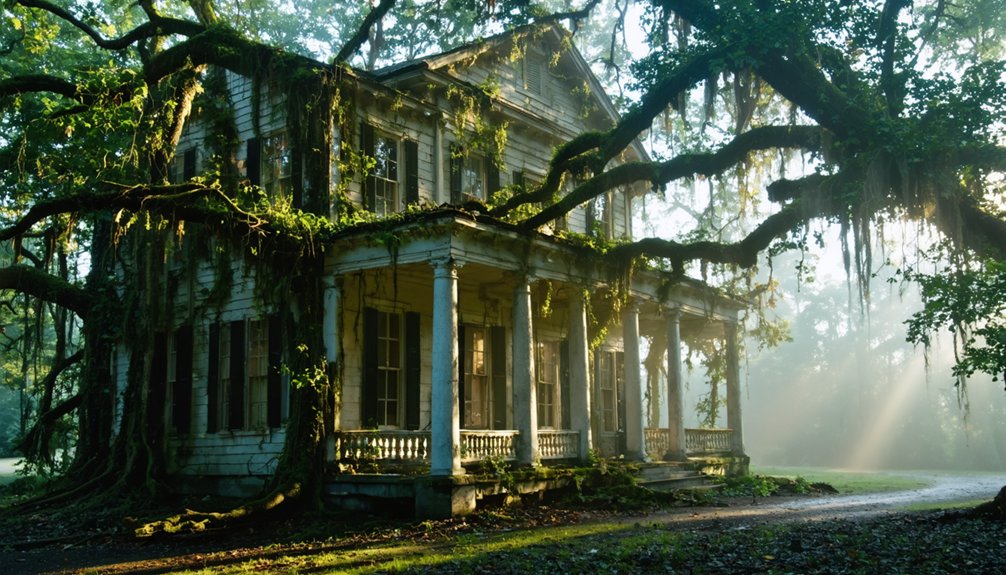
As you explore these haunting Eastern USA sites, you’ll witness nature’s systematic takeover, where thick vines embrace crumbling walls and moss carpets forgotten streets.
In these ghostly settings, diverse wildlife has established new domains, with birds nesting in deteriorating windowsills and deer wandering through overgrown thoroughfares that once bustled with human activity.
What began as quiet towns has transformed into dense forests, where towering trees burst through foundations and native plants reclaim every available space, leaving only hints of human presence beneath the verdant canopy.
Vines Swallow Historic Walls
When abandoned buildings surrender to time’s endless march, nature’s most persistent invaders begin their quiet conquest. You’ll witness kudzu and wisteria muscling through mortar, while ivy and Virginia creeper transform weathered walls into living tapestries.
This vine coverage creates an eerie atmosphere that beckons urban explorers and photographers alike. As seasons shift, these botanical invaders reshape wall aesthetics, painting haunting scenes that tell stories of human departure and nature’s return.
You’re not just seeing green overtaking gray – you’re watching a complex ecological drama unfold. While these vines provide vital habitats for wildlife and help stabilize surrounding soil, they’re simultaneously hastening the structure’s decay through moisture retention and root invasion.
It’s nature’s paradox: creating life while destroying the very walls that support it.
Wildlife Reclaims Empty Streets
Once bustling city streets fall silent, nature’s most opportunistic residents emerge to reclaim their ancestral territories.
You’ll witness deer and wild boars boldly traversing abandoned roadways that have transformed into wildlife corridors, while rats adapt and thrive in the urban void. As streets empty, movement rates for small mammals, butterflies, and pollinators surge by 68% through these newly connected habitats.
You’re observing an unprecedented shift in urban coexistence as nature repairs itself.
Empty streets become living laboratories where ecological succession unfolds before your eyes. Native species return, finding refuge in restored wetlands and vacant lots turned pocket prairies.
This isn’t just abandonment – it’s nature’s renaissance, where wildlife carves new paths through our forgotten spaces, proving that wilderness always waits beneath the pavement.
Forests Consume Lost Towns
Deep within the Eastern United States, abandoned towns surrender to nature’s patient siege as forests methodically devour human settlements.
You’ll witness forest encroachment at every turn, as tree roots penetrate foundations and moss blankets crumbling walls. The process of urban decay accelerates as vines snake through windows and ferns sprout between floorboards.
In places like Appalachia’s former mining communities and logging camps, you’ll find industrial ruins dissolving into recovering woodlands.
The transformation is particularly striking in national parks, where sites like Elkmont, Tennessee showcase nature’s reclamation work. As seasons change, mist weaves through partially hidden structures, creating an otherworldly atmosphere where time stands still.
Through this natural succession, you’re observing yesterday’s bustling communities becoming tomorrow’s mysterious forest ruins.
Legends and Folklore Behind the Emptiness
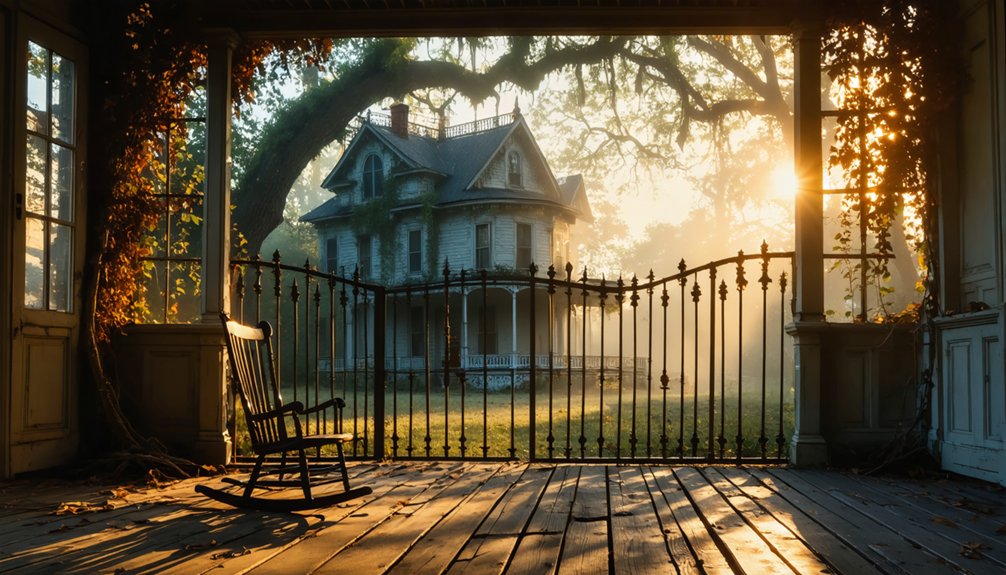
Behind the haunting emptiness of Eastern America’s ghost towns lies a rich tapestry of folklore that interweaves historical tragedy with supernatural legend.
You’ll find notorious cursed locations like Dudleytown, Connecticut, where mysterious deaths and insanity drove residents away in the 1740s, and Pine Hill Cemetery in New Hampshire, where unexplained disappearances fuel tales of ancient Native American curses.
These supernatural hauntings often stem from real historical events – forced evacuations, economic collapse, or mining disasters that left communities abandoned.
Behind every ghostly legend lies the stark reality of human tragedy, loss, and communities torn apart by circumstance.
In places like Salem, Massachusetts, the infamous witch trials of 1692 have embedded lasting folklore into the region’s identity.
The physical emptiness of these locations, marked by crumbling cellars and overgrown foundations, serves as a canvas for generations of storytellers who’ve transformed historical suffering into enduring supernatural narratives.
Tourism’s Revival of Forgotten Communities
While many Eastern ghost towns languished in obscurity throughout the 20th century, a surge in heritage tourism has breathed new life into these forgotten communities since the 1990s.
exploring the past of ghost towns can reveal fascinating stories of resilience and abandonment. As travelers venture into these unique locations, they uncover remnants of history that spark curiosity and appreciation for the lives once lived there. This revival not only honors the heritage of these towns but also invites a new generation to connect with their forgotten histories.
You’ll now find restored downtown districts drawing visitors from surrounding regions, with local businesses thriving on the influx of curious explorers. Market days and renovated historic theaters serve as anchors for economic revitalization, while adaptive reuse of vintage buildings preserves the authentic character that tourists seek.
You can experience this transformation firsthand through well-preserved historical sites, mining heritage trails, and railway attractions that tell compelling stories of America’s industrial past.
Smart communities have balanced preservation with progress, implementing sustainable tourism models that protect their town’s character while creating new economic opportunities through lodging, guided tours, and cultural events.
The Economic Forces That Created Modern Ruins

As resource-based economies exploded across the Eastern United States in the late 19th century, countless towns sprouted up overnight around mining operations and agricultural ventures.
You’ll find these boom towns followed predictable economic cycles – swift growth followed by devastating decline once resources depleted or market prices crashed.
The 1930s marked a turning point, as the Dust Bowl and Great Depression triggered massive demographic shifts away from rural areas.
Towns that relied on single industries, like coal mining or farming, couldn’t adapt when transportation patterns changed and larger urban centers drew commerce away.
Without rail access or highway connections, many communities became isolated.
The lack of economic diversification and investment in sustainable infrastructure sealed their fate, transforming once-thriving settlements into the haunting ruins you see today.
Preserving History Through Ghostly Remains
The preservation of ghostly remains across the Eastern United States has evolved into a sophisticated network of historical societies, community organizations, and preservation plans working in tandem to protect these haunting time capsules.
You’ll find this ghostly preservation most evident in places like Easton, where 36 historic cemeteries serve as silent witnesses to centuries of local history. The town’s all-encompassing approach combines cemetery restoration with broader historical conservation efforts, including the protection of stone walls and industrial ruins.
Historical societies have transformed these sites into powerful educational tools, where you can explore preserved structures like Hill View Manor or participate in ghost tours that blend historical significance with spine-tingling experiences.
Through these efforts, you’re connecting with both the physical and spectral remnants of America’s past.
Frequently Asked Questions
Are Ghost Towns in the Eastern USA Safe to Explore Alone?
You’ll need to take serious safety precautions if attempting solo exploration, as Eastern USA ghost towns present significant risks from crime, structural hazards, and legal issues. It’s safer exploring with others.
What Survival Gear Should Visitors Bring When Exploring Eastern Ghost Towns?
You’ll need survival essentials like water purification tools, first aid supplies, navigation gear, and emergency shelter. Don’t forget your ghost town gear: flashlights, repair tools, and protective clothing for abandoned structures.
How Can Photographers Capture the Best Paranormal Activity in Ghost Towns?
Like a moth to flame, you’ll capture ethereal spirits by using long exposures during golden hour, setting up full-spectrum cameras on tripods, and shooting in burst mode while exploring ghost town’s darkest corners.
Which Eastern Ghost Towns Allow Overnight Camping or Accommodation Nearby?
You’ll find camping near Thurmond and Fayetteville in West Virginia’s ghost towns, with regulated sites at New River Gorge. Centralia offers nearby accommodations, while Rodney lets you camp in Mississippi Delta campgrounds.
Do Any Eastern Ghost Towns Have Year-Round Resident Caretakers?
You’ll find that most Eastern ghost towns don’t have year-round resident caretakers. Instead, preservation efforts are managed by historical societies and state agencies, with caretaker roles typically filled by seasonal staff or rangers.
References
- https://themortgagepoint.com/2024/10/25/americas-new-ghost-towns/
- https://www.loveexploring.com/gallerylist/188219/the-us-state-with-the-most-ghost-towns-revealed
- https://devblog.batchgeo.com/ghost-towns/
- https://247wallst.com/special-report/2021/05/19/30-american-ghost-towns-7/
- https://www.geotab.com/ghost-towns/
- https://freepages.history.rootsweb.com/~gtusa/usa.htm
- https://en.wikipedia.org/wiki/Lists_of_ghost_towns_in_the_United_States
- https://joybird.com/blog/top-ghost-towns-in-america/
- https://nightofthejack.com/2025/01/23/top-creepy-ghost-towns-in-america/
- https://usghostadventures.com/haunted-stories/americas-most-haunted-east/eastern-americas-most-haunted/