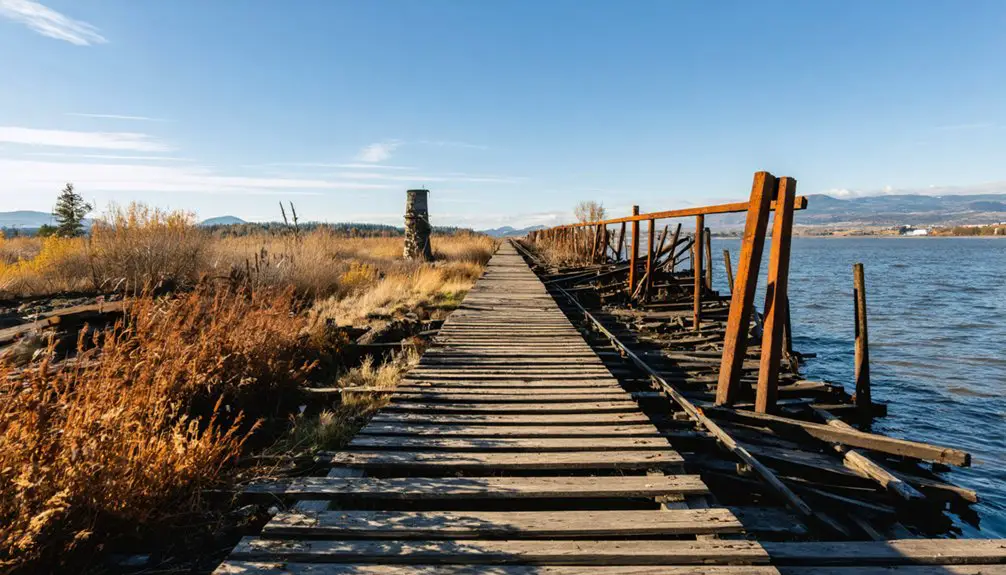
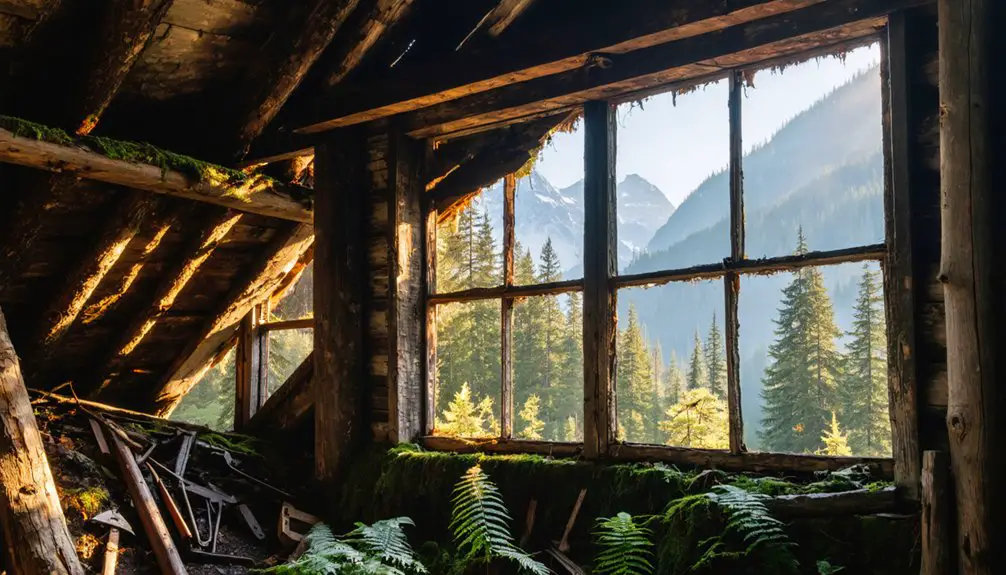
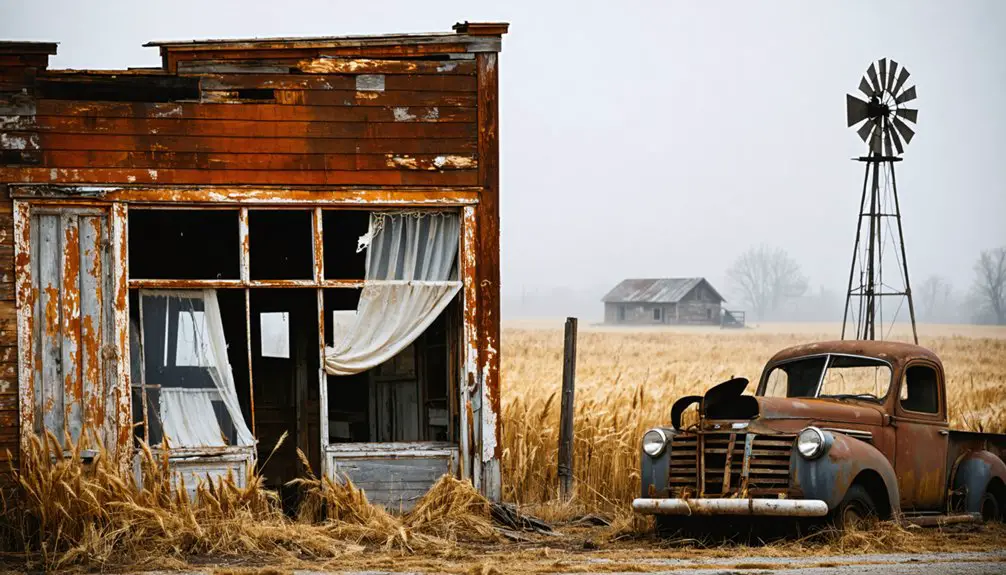
You’ll find over a dozen authentic ghost towns scattered across Eastern Washington‘s semi-arid landscape, preserving remnants of America’s westward expansion from the 1860s-1900s. Notable destinations include Govan, a former railway town with unsolved murders; Liberty, Washington’s oldest continuously operating mining settlement from 1868; and Old Molson, the state’s most authentic pioneer settlement. These abandoned communities tell stories of failed homesteads, exhausted mines, and railway dreams, offering photographers and history enthusiasts glimpses into forgotten chapters that shaped the region.
Key Takeaways
- Six notable ghost towns include Govan, Sherman, Liberty, Bodie, Nighthawk, and Old Molson, each with unique histories and preserved structures.
- Most towns emerged from 1860s-1900s mining booms and homesteading, declining due to economic shifts, fires, and agricultural consolidation.
- Liberty remains Washington’s oldest continuously operating mining settlement, while Old Molson is considered the state’s most authentic pioneer settlement.
- Preservation efforts by volunteers maintain historical structures, with Liberty listed on the National Register of Historic Places since 1974.
- Visitors should prioritize safety with proper equipment and structural assessments while exploring these historically significant abandoned settlements.
Govan: Railway Town With a Dark Past
Weathered wooden buildings stand scattered across the wheat fields of Lincoln County, marking what remains of Govan, a town whose violent past earned it a reputation as one of Eastern Washington’s most notorious settlements.
You’ll find this former railway depot, established in 1889 on the Central Washington Railway, once thrived as a construction headquarters before becoming an agricultural shipping point. The town peaked around 1909 with 115 residents, two general stores, a bank, and grain elevators. The town was named after a Northern Pacific civil engineer, reflecting its deep railroad connections.
However, Govan’s darker legacy stems from unsolved murders, including the 1903 saloon shooting and the 1941 Lillie Lesneww case. A devastating 1927 fire caused $100,000 in losses and prompted many businesses to abandon rebuilding efforts entirely.
Two brutal unsolved murders forever stained Govan’s reputation, transforming the railway town into Eastern Washington’s most feared settlement.
Today, these Govan legends attract dark tourism enthusiasts who explore the ghost town seeking remnants of its violent history.
Sherman: Homesteading Dreams on Creepy Terrain
You’ll find Sherman perched on rolling hills where homesteaders first staked claims during the 1880s land rush, drawn by promises of fertile wheat country and free territorial acreage.
The settlement’s church, built in 1888, and its weathered cemetery now stand as the primary survivors of what once housed dozens of farming families before agricultural consolidation emptied the townsite. The cemetery contains graves of Civil War veterans who settled in Washington Territory after their military service.
Today’s visitors encounter an unsettling landscape where collapsed schoolhouse ruins and scattered building remnants create the “creepy terrain” that gives this Lincoln County ghost town its haunting reputation. The town’s population declined as new roads attracted residents to larger towns like Spokane.
Nearby, ghost towns near Ellensburg Washington also share a similar eerie charm, drawing explorers eager to discover remnants of the past. Each abandoned building tells a story of prosperity and decline, inviting visitors to imagine life before the bustling highways pulled inhabitants away. As nature slowly reclaims these forgotten places, their history becomes a whispered echo in the wind.
Homesteading Boom Origins
When Congress passed the Homestead Act in 1862, it released a wave of settlement dreams that would transform Eastern Washington’s semi-arid landscape into a patchwork of ambitious claims and eventual ghost towns.
You’d have witnessed thousands rushing to claim their 160 acres for minimal fees, driven by railroad connections that finally reached the territory in the 1880s. Washington’s population exploded over 120% between 1900-1910—the nation’s highest growth rate.
These homestead challenges weren’t insurmountable if you’d chosen wisely. Smart settlers developed settlement strategies around fertile river valleys like the Palouse, where wheat thrived in loess soils. The Cascade Mountains created a stark climate divide, leaving eastern settlers to contend with desert-like conditions while western immigrants enjoyed abundant rainfall.
But venture beyond reliable water sources, and you’d likely join the thousands who abandoned claims when semi-arid conditions proved too harsh for sustainable farming. Many homesteaders discovered that land speculators had exploited loopholes in the legislation, making prime parcels unavailable to legitimate settlers.
Eerie Abandoned Structures
Something haunting emerges from the wheat fields of Sherman County, where a 136-year-old church stands as the sole sentinel over dreams that died with the homesteading era.
You’ll discover architectural decay in every weathered board and collapsed beam of the ruined schoolhouse, where wind whistles through broken timbers that once echoed with children’s voices.
The false-front commercial façade tells stories of economic hope turned to dust, its delaminating boards creating a ghostly atmosphere that draws photographers seeking decay’s stark beauty.
You can trace former town lots through landscape features and scattered foundations, while the cemetery’s weathered gravestones mark settlers who couldn’t outlast the brutal 1890s blizzards.
Each Memorial Day, visitors gather among these remnants, preserving memories of a community that time abandoned.
Liberty: Washington’s Oldest Mining Settlement
You’ll discover Liberty’s remarkable distinction as Washington’s oldest continuously operating mining settlement, with gold discoveries dating back to 1868 and organized mining district formation in 1873.
The town’s single main street preserves an authentic collection of original log cabins, wooden storefronts, and period mining equipment that survived nearly a century of intermittent gold extraction. Among these historical structures stands the Assay Office, originally constructed prior to 1895 and later converted into a residence by local miners.
Walking through this living ghost town, you’ll encounter surviving dredge remnants, historic excavation equipment, and a reconstructed Virden arrastra that showcase the evolution from hand panning to large-scale mechanized operations. Liberty was particularly renowned for producing large gold nuggets, with miners typically recovering coarse gold rather than fine dust throughout the district’s active decades.
Historic Gold Rush Legacy
Five years after the first gold discoveries in Swauk Creek, Liberty emerged as Washington’s oldest mining settlement and the heart of the state’s first organized mining district.
You’ll find this gold rush legacy produced over three and a quarter tons of placer gold across more than a century of mining operations. The Swauk Mining District, organized in 1873, remains the state’s oldest existing mining district today.
Liberty’s mining legacy demonstrates remarkable persistence through changing technologies—from early placer mining to hydraulic operations in the 1900s, gold dredging in the 1920s, and later dragline methods.
Unlike typical boom-and-bust camps, you’ll discover Liberty fostered multi-generational mining families who maintained community stability. By 1912, the thriving community boasted essential infrastructure including a hotel, school, and barbershop that served the mining families.
This enduring gold rush settlement contributed hundreds of thousands of dollars to Washington territory’s economy throughout the 1880s. The town’s name reflects the broader American ideal of individual freedom that drove westward expansion and the pursuit of prosperity through mining ventures.
Mining Equipment and Buildings
Weathered wooden structures and rusted mining machinery scattered throughout Liberty tell the story of over a century of gold extraction in Washington’s oldest mining settlement.
You’ll discover authentic log cabins lining the main street, including Gus Nelson’s 1891 schoolhouse-post office that’s been repurposed over decades.
The town’s historic machinery includes a 1974 replica arrastra featuring a horizontal undershot water wheel design, built after vandals destroyed the original.
You can examine the largest surviving operational equipment—an extant shovel excavator maintained by local caretakers.
Mining relics from placer operations include rockers, pans, and sluice riffles displayed throughout the site.
These preserved structures earned Liberty its National Register recognition, transforming from Meaghersville in 1912 into today’s interpretive mining camp where volunteers maintain this remarkable heritage.
Bodie: Okanogan County’s Mining Heritage
Deep in the Toroda Creek drainage of far northeastern Okanogan County, the ghost town of Bodie stands as a tribute to Washington’s gold rush era.
You’ll find this remnant of Bodie history positioned at Bodie Creek’s mouth, accessible via well-maintained Toroda Creek Road twelve miles north of Wauconda.
Gold mining began when Henry DeWitz established his log cabin around 1896, striking an $80,000 ore pocket one mile north.
The original Toroda settlement relocated four miles north in 1897, becoming Bodie.
You can explore where the Bodie Mining Company’s ten-stamp mill once processed ore, generating an estimated $1,250,000 in gold before permanent closure in 1944.
Though fire destroyed much infrastructure in 1962, you’ll discover this well-preserved ghost town remains a compelling destination for mining enthusiasts and historians.
Nighthawk: Supply Center of the Northern Mines
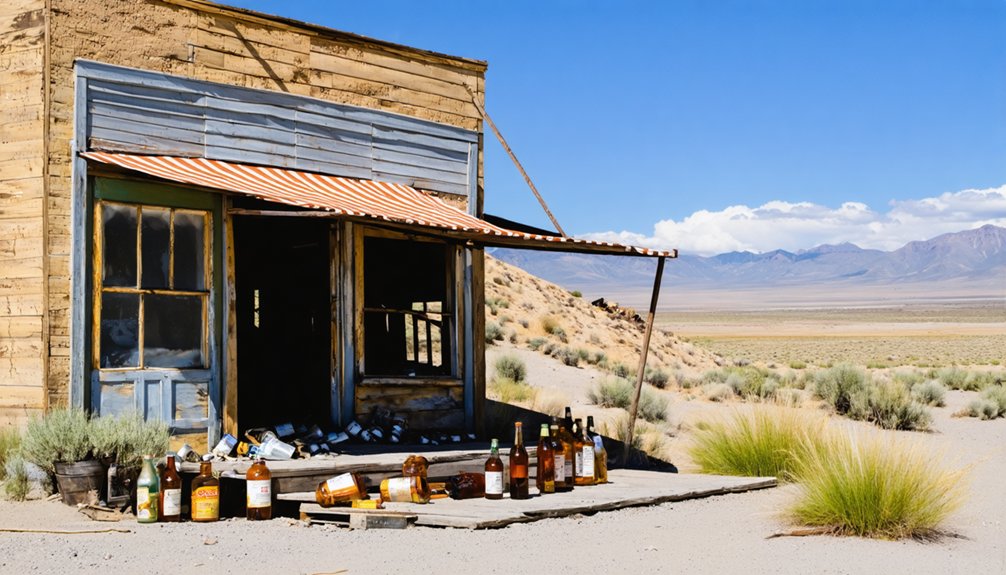
Moving northeast from Bodie’s isolated creek drainage, Nighthawk emerged as the bustling commercial heart that supplied the northern Okanogan County mining district.
You’ll find this mining settlement history began with 1860s tent camps before formal platting in 1903. The town’s strategic location created essential regional supply infrastructure serving six concentration mills throughout the area’s boom years.
Nighthawk’s railway connection around 1905 linked remote mines to broader markets, while its general store handled freight distribution for surrounding claims.
You can still explore surviving structures including the rebuilt 1903 hotel, the circa-1915 schoolhouse, and mining office ruins along original Prospect Avenue.
Economic decline followed typical patterns—falling metal prices, transport shifts, and ore exhaustion gradually emptied this once-vital supply center by mid-century.
Old Molson: Living Museum of Pioneer Life
Fifteen miles northeast of Oroville, Old Molson stands as Washington’s most authentic pioneer settlement, where original buildings and artifacts create an outdoor museum frozen in early 1900s frontier life.
Founded in 1900 after gold discoveries swelled the population to 300, the town thrived until a devastating land feud forced residents to relocate.
When founder George Meacham failed to register the town’s land title, homesteader J.H. McDonald claimed the site in 1905. A two-decade legal battle culminated in an April 1909 evacuation notice, forcing businesses to literally move buildings on skids to New Molson.
Today’s outdoor museum, established by Harry Sherling in 1960, preserves this pioneer lifestyle through restored cabins, mining equipment, and daily life artifacts.
Free admission supports ongoing historical preservation efforts.
Planning Your Ghost Town Adventure
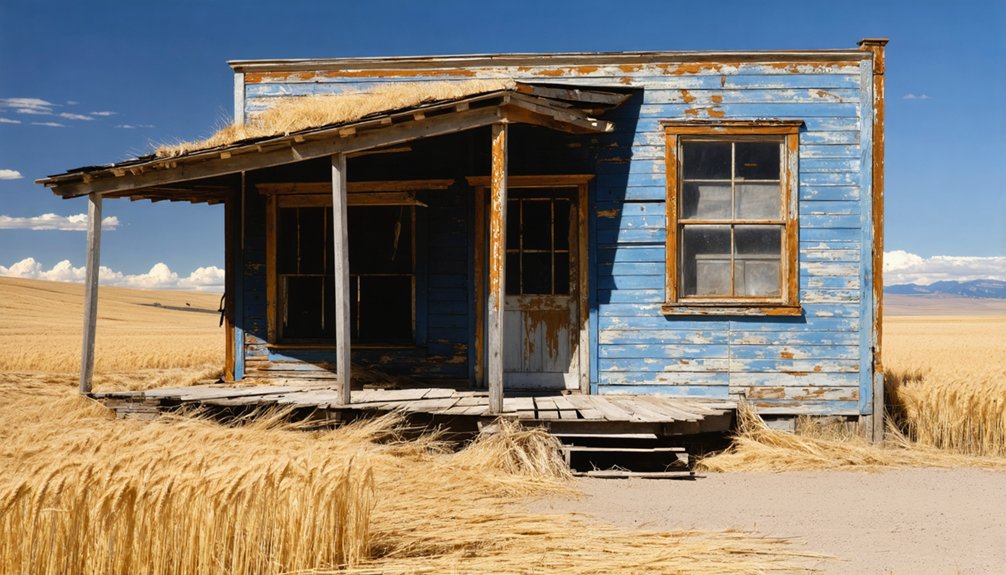
Before you set out on your ghost town expedition across eastern Washington, you’ll need proper maps and route planning to navigate these remote historical sites.
Several specialized navigation tools will enhance your exploration of these forgotten places.
Essential planning resources include:
- Metsker Maps – overlay historical maps from 1883, 1889, and 1907 on contemporary roads for precise Eastern Washington ghost town locations
- Proxi interactive map – displays Washington ghost towns with exact coordinates for GPS navigation
- Local historical societies – provide area-specific information about access routes and current conditions
- Wikipedia databases – list extensive Eastern Washington sites like Alpine and Alto
Remember hiking safety when exploring ghost town legends at places like Govan’s alleged murder site or Franklin’s sealed mine shafts.
Check abandoned buildings and railroad infrastructure for hazards before entering.
What to Expect When Visiting Abandoned Towns
When you arrive at an abandoned town site, you’ll encounter a landscape where nature has begun reclaiming human settlement, creating unique hazards that require careful assessment before exploration.
Test structural integrity by tossing rocks onto floors before entering buildings. Inspect exteriors first for collapsed ceilings and identify clear exit routes. Watch for holes, broken windows, and sharp debris throughout interiors.
Before stepping inside any abandoned structure, always test floor stability with thrown rocks and survey all visible damage from the outside.
Exploration safety demands proper gear: N95 respirators protect against mold and asbestos, while steel-toed boots and long sleeves shield you from cuts.
Legal considerations include confirming true abandonment by checking for recent activity like mowed lawns or parked vehicles. Respect private property boundaries and federal artifact protection laws. Some preserved sites charge minimal entrance fees, while others require permission to avoid trespassing charges.
Photography Tips for Historic Ruins
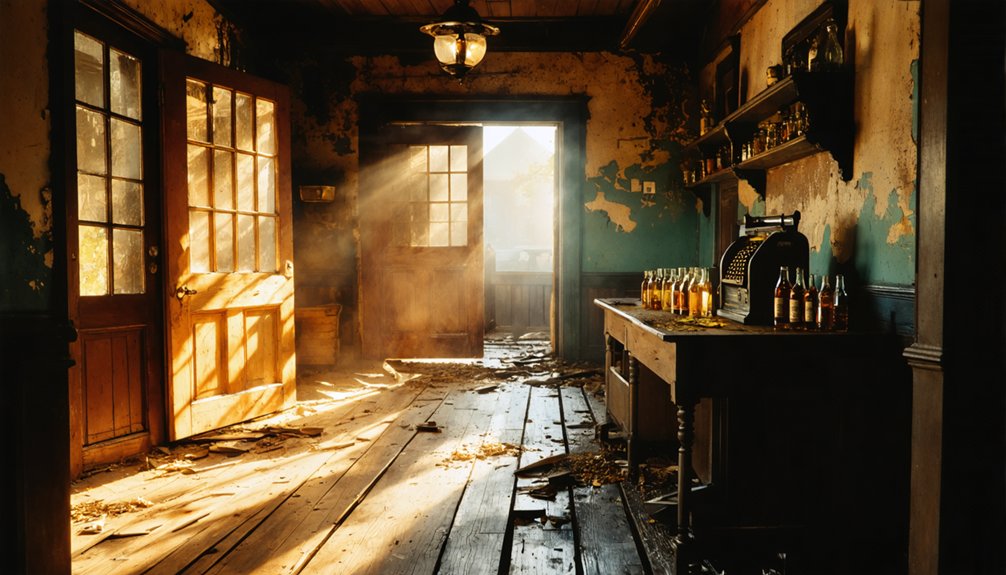
You’ll capture Eastern Washington’s ghost towns most effectively by timing your shoots during golden hour when warm, directional light reveals weathered textures and creates dramatic shadows across abandoned structures.
Your composition should balance wide-angle establishing shots of entire streetscapes with intimate mid-range details like rusted door hardware and faded signage that tell the human story.
Protecting your camera equipment from the region’s dust, temperature extremes, and unpredictable weather requires proper gear selection and strategic planning before you enter these remote locations.
Golden Hour Lighting Techniques
As the sun approaches the horizon during golden hour, photographers gain access to the most dramatic lighting conditions for capturing Eastern Washington’s abandoned settlements.
These lighting techniques transform weathered structures into compelling visual narratives.
Position yourself strategically to harness directional light across crumbling facades. Set your camera between f/1.6-f/2.2 with 1/250-1/500 second shutter speeds to capture ideal exposure without blown highlights.
Essential golden hour approaches include:
- Backlight positioning – Place the sun behind ruins to create glowing rim effects on deteriorating edges
- Side lighting angles – Emphasize texture and depth in weathered wood and stone surfaces
- Exposure for highlights – Protect sky details while recovering shadows in post-processing
- Multiple shot sequences – Capture changing light conditions as the sun descends
These methods guarantee you’ll document ghost towns with authentic atmospheric drama.
Composition and Framing Methods
While golden hour provides the dramatic lighting foundation, your composition techniques determine whether ghost town photographs merely document decay or transform abandoned structures into powerful visual stories.
Position boulders in corners as anchors, letting grass and building edges create leading lines that guide viewers through your frame. Apply the rule of thirds by placing pillars one-third into your image for balanced eye flow.
Use equidistant framing strategies—place rusting metal frames equally between wall edges and window corners to maintain visual harmony. Shoot low angles upward to emphasize room vastness and create disorientation in abandoned interiors.
Frame discarded items like chairs or electronics against architecture for historical storytelling, making single objects powerful centerpieces amid chaotic environments.
Equipment Protection Strategies
Though Eastern Washington’s ghost towns offer compelling photographic opportunities, these deteriorating environments pose significant threats to your camera equipment that require proactive protection strategies.
Environmental challenges like windblown dust, extreme temperature swings, and structural debris demand gear durability measures that’ll preserve your investment while capturing these vanishing pieces of history.
Essential protection strategies include:
- Weather-sealed camera bodies and lenses to resist moisture infiltration during unexpected precipitation or high humidity conditions
- Comprehensive cleaning kits with microfiber cloths and blower tools for immediate dust and particle removal after each shoot
- Padded camera bags with secure compartments that cushion against impacts from unstable flooring and falling debris
- Protective filters and lens shields that safeguard front elements from scratches caused by airborne sand and particles
Preserving Eastern Washington’s Forgotten History
Because Eastern Washington’s ghost towns face constant threats from weather, vandalism, and neglect, dedicated preservationists work tirelessly to maintain these historical treasures for future generations.
The stories of abandoned towns in eastern Washington echo the resilience of those who once called them home. Each structure tells a tale of ambition and community, now slowly fading into the landscape. These towns hold a unique charm, attracting explorers and historians eager to uncover their secrets and preserve their legacies.
You’ll find ghost town preservation efforts most successful in Molson, where local volunteers have transformed the site into one of Washington’s best-preserved mining communities since 1960. Liberty’s historical significance earned National Register of Historic Places recognition in 1974 as the state’s oldest mining town.
Tim Nyhus documents these disappearing sites through photography and exploration, beginning his statewide mission after hiking Melmont in 2009.
When you visit these locations, you’re experiencing living history maintained through donations, volunteer guides, and careful restoration work. Local communities counter destruction by rebuilding damaged structures like Liberty’s 1976 arrastra reconstruction, ensuring authentic Gold Rush experiences remain accessible.
Frequently Asked Questions
Are There Any Entrance Fees Required to Visit These Ghost Towns?
Most ghost towns don’t require entrance fees, though you’ll encounter specific fee structures like Franklin’s $5 parking cost. Check entrance regulations beforehand since some locations charge for parking or trail access.
What Are the Best Months to Visit Eastern Washington Ghost Towns?
Like autumn leaves embracing decay, October offers the best seasons for your ghost town adventures. You’ll enjoy perfect weather considerations with 50-60°F temperatures, crisp air, and snow-free trails enhancing those eerie atmospheres you’re seeking.
Can You Camp Overnight Near Any of These Abandoned Settlements?
You can camp near some abandoned settlements if you follow camping regulations and obtain overnight permits from the controlling land manager—whether that’s USFS, BLM, DNR, or private owners.
Are Guided Tours Available for Any of These Historic Sites?
You’ll find guided exploration through commercial operators offering Old West experiences, relic-hunting excursions, and Manhattan Project tours. These organized visits provide expert interpretation of each site’s historical significance while ensuring proper access permissions.
Which Ghost Towns Are Accessible by Regular Passenger Vehicles?
You can reach all four ghost towns by regular passenger vehicle. Sherman’s accessible via Highway 2, Govan sits directly off the main highway, while Corfu and Cloverland connect through standard roads, preserving their historical significance.
References
- https://en.wikipedia.org/wiki/List_of_ghost_towns_in_Washington
- https://stateofwatourism.com/ghost-towns-of-washington-state/
- https://okanogancountry.com/ghost-towns
- https://www.emeraldpalate.com/abandoned-places-in-washington/
- https://www.atlasobscura.com/things-to-do/washington/ghost-towns
- https://www.wta.org/go-outside/seasonal-hikes/fall-destinations/hidden-history-ghost-town-hikes
- https://www.cascadeloop.com/ghost-towns-and-haunted-places-in-the-washington-cascades
- http://www.bigbendrailroadhistory.com/2008/12/history-of-govan.html
- https://www.sunset-hwy.com/govan.htm
- https://thewaywardjournal.substack.com/p/ghosts-of-govan