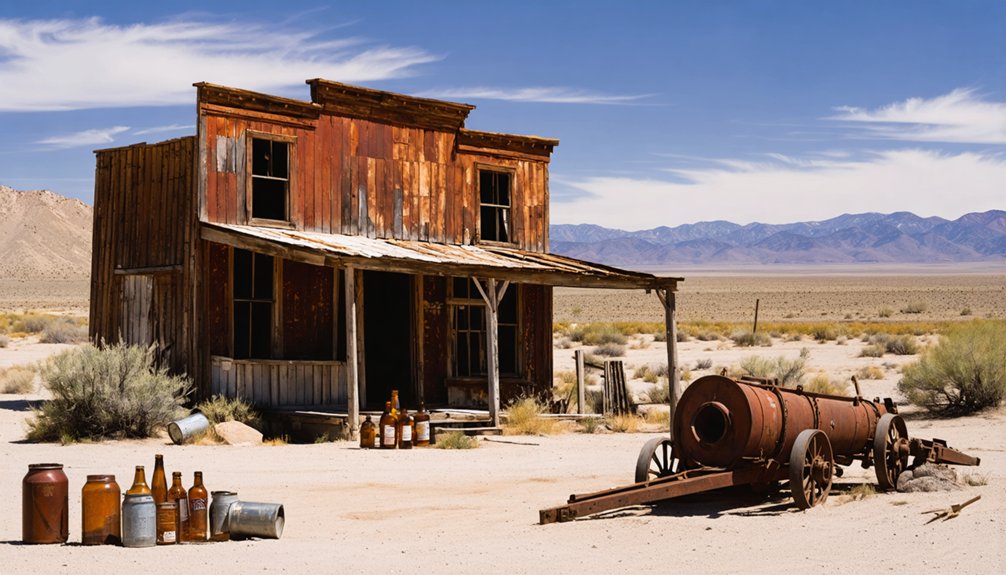
You’ll find Eberhardt’s crumbling stone ruins scattered across Treasure Hill’s southeast slope at 7,215 feet, where T.E. Eberhardt’s December 1867 silver discovery created one of Nevada’s most legendary mining camps. The Eberhardt Mine produced $1.5 million from just 750 tons of ore, featuring chambers with walls of pure silver that drew thousands during the White Pine rush. British investors controlled operations from 1871 until withdrawing in 1885, leaving behind mill foundations, tunnel portals, and remnants that reveal the full story of this remarkable boom-and-bust cycle.
Key Takeaways
- Eberhardt was a silver mining boomtown established in 1868 after T.E. Eberhardt discovered rich silver deposits on Treasure Hill.
- The Eberhardt Mine produced $1.5 million from 750 tons of ore, making it the richest mine in White Pine District.
- The town experienced rapid growth from 1868-1886 with multiple mills, businesses, and infrastructure supporting thousands of miners and residents.
- Economic decline began in the 1870s due to diminishing ore quality, mill fires, and British investor withdrawal in 1885.
- Today Eberhardt exists as scattered stone ruins including the tunnel portal, mill foundations, abandoned tools, and a historic graveyard.
Discovery and Early Settlement
When T.E. Eberhardt discovered rich silver deposits in December 1867, he sparked what would become one of Nevada’s notable Eberhardt origins stories.
You’ll find this discovery occurred on Treasure Hill’s southeast flank at 7,215 feet elevation in White Pine County.
The shift from prospect to thriving mining community happened with remarkable speed—formal development accelerated through 1868-1869 as regional attention drew prospectors seeking their fortunes. The mine featured an aerial tram that connected directly to the mill for efficient ore transportation.
British interests took control of the operations in 1871, establishing international investment in the promising silver venture.
The Eberhardt Mine and Silver Riches
You’ll find that T.E. Eberhardt’s December 1867 discovery revealed one of the richest silver deposits ever found in the district, with ore so pure it could be hammered into sheets without milling.
The mine’s walls and ceilings glittered with silver at 8,720 feet elevation, producing exceptionally fine ore that established the foundation for what would become a major mining operation. Located in White Pine County, the Eberhardt mine was situated on National Forest land, distinguishing it from many other mining operations in the region. The Post Office operated from June 19, 1871, to July 11, 1893, serving the growing community that developed around the profitable mining activities.
Discovery and Rich Ore
Within 250 feet of the surface, 750 tons of ore yielded $1.5 million, most extracted from just 140 feet down.
These discoveries triggered mining techniques that focused on surface-level extraction rather than deep shafts.
The exceptional quality meant you’d witness silver so concentrated that traditional milling processes weren’t necessary for the finest specimens. The Eberhardt Mine became the richest in the district, cementing the area’s reputation as a premier silver-producing region.
The mine’s legendary rich ore chamber featured walls and ceiling completely composed of silver, creating an underground treasure vault that became the stuff of mining folklore.
Million Dollar Yields
Although precise figures remain elusive in modern databases, historical records document that Eberhardt Mine generated extraordinary silver wealth during its peak years from the late 1860s through the 1880s.
Contemporary press accounts and company ledgers cite millions in gross returns from the Treasure Hill district operations. You’ll find evidence of this prosperity in the massive infrastructure investments: the International Mill‘s construction cost reached $257,000, with an additional $137,000 for the aerial tramway system.
These industrial-scale facilities wouldn’t have been justified without exceptional ore values. The Eberhardt & Aurora Mining Company’s archival records from 1869–1877 contain financial ledgers documenting substantial receipts and ore shipments.
This silver mining boom created significant economic impact throughout Nevada’s mining territory. Similar to other Nevada mining operations, the Eberhardt district featured epithermal veins within volcanic host rocks that concentrated precious metals in high-grade zones. Modern exploration continues in the region, with recent aerial magnetic-radiometric surveys identifying new potential drill targets and extensions to existing mineralization zones.
Boom Years and Population Growth
When the White Pine rush erupted in the late 1860s following discoveries at Treasure Hill, Eberhardt’s transformation from empty desert to bustling mining town began almost immediately.
The population dynamics shifted dramatically as thousands flooded the White Pine District, with Eberhardt emerging as an essential support center for the mining influx.
You can trace Eberhardt’s explosive growth through three distinct phases:
- Initial boom (1868-1870): District filed 13,000 claims in two years, drawing massive population surge
- Commercial expansion (1871-1873): Post office established, stores and saloons opened amid steady growth
- Revival period (1876-1886): Town experienced rebirth after brief decline, remaining busy for nearly ten years
The mining operations required substantial infrastructure, including charcoal kilns that supplied fuel for the smelting processes throughout the district. Like many Nevada mining communities, Eberhardt’s streets bustled with various professionals including lawyers, doctors, and merchants who served the growing population.
Mills and Industrial Development
You’ll find that Eberhardt’s industrial backbone emerged through two major milling operations that transformed raw silver ore into profitable metal.
The Stanford Mill‘s construction in early 1869 established the camp’s first thirty-stamp processing facility, while the International Mill‘s development in 1871 created the district’s most ambitious industrial project.
These mills didn’t just process ore—they supported extensive infrastructure including massive tramways and pipeline systems that connected the remote mining camp to essential water sources.
International Mill Operations
By June 1870, construction crews had broken ground on the International Mill at Eberhardt, though the ambitious scope of the project would delay operations for nearly a year. The mill technology centered on a thirty-stamp crushing system designed to pulverize high-grade silver ore into powder for chemical recovery.
You’ll find the mill faced significant operational challenges throughout its existence:
- Infrastructure delays – Construction of one of the nation’s largest tramway systems pushed startup from 1870 to May 1871.
- Catastrophic fire – A devastating 1872 blaze destroyed primary buildings and equipment, shuttering operations until November 1873.
- Capital withdrawal – British investors pulled funding in the mid-1880s, forcing permanent closure in 1885.
The Eberhardt & Aurora Mining Company‘s substantial investments included long-distance water pipelines from Applegarth Springs and extensive masonry foundations that remain visible today.
Stanford Mill Construction
While the International Mill represented the district’s most ambitious undertaking, the Stanford Mill preceded it as Eberhardt’s first major processing facility.
You’ll find that construction began in early 1869, utilizing masonry construction techniques that required local stone sourcing and heavy material transport. The builders completed this large stone structure by fall 1869, demonstrating remarkable efficiency given the remote location.
The labor force during peak construction exceeded several hundred workers, enabling rapid mill erection and supporting infrastructure development.
You can see how they incorporated stamp-milling technology to process silver-bearing ore from the Eberhardt Mine. The mill included ancillary structures like retort-houses and carpenter shops, creating an extensive processing complex that operated until approximately 1874.
Industrial Infrastructure Development
As the Stanford Mill neared completion in fall 1869, the British-controlled Eberhardt & Aurora Company launched construction of the even more ambitious International Mill in June of that same year. This thirty-stamp facility represented unprecedented industrial investment in Nevada’s remote mining frontier, though infrastructure challenges would greatly delay its completion.
The company tackled three critical development priorities:
- Massive tramway construction – the largest system in the nation at that time
- Water supply pipelines to Applegarth Springs, located 1.5 miles away
- Comprehensive mill infrastructure supporting both industrial operations and town services
British capital funded these extensive improvements, transforming Eberhardt from a basic mining camp into a sophisticated industrial operation.
Despite construction delays, the International Mill finally commenced operations in May 1871, establishing the town’s dominance in regional ore processing.
Infrastructure and Daily Life
Two major mills anchored Eberhardt’s industrial infrastructure and shaped the community’s daily rhythms.
You’d have witnessed the Stanford Mill’s rapid construction in 1869, followed by the International Mill’s thirty-stamp operation in 1871. Essential water infrastructure connected the camp to Applegarth Springs through pipelines laid by Eberhardt & Aurora Company, supplying both milling operations and the growing town of over 200 residents.
Daily life revolved around mill schedules and mining activities.
You’d have patronized thriving saloons and mercantile stores while receiving mail from Hamilton three times weekly through the post office operating from 1871-1893. Community services included an established church providing religious services during peak years.
This infrastructure supported a self-sufficient population until mining declined in the 1880s, gradually reducing Eberhardt to scattered building ruins.
British Operations Era
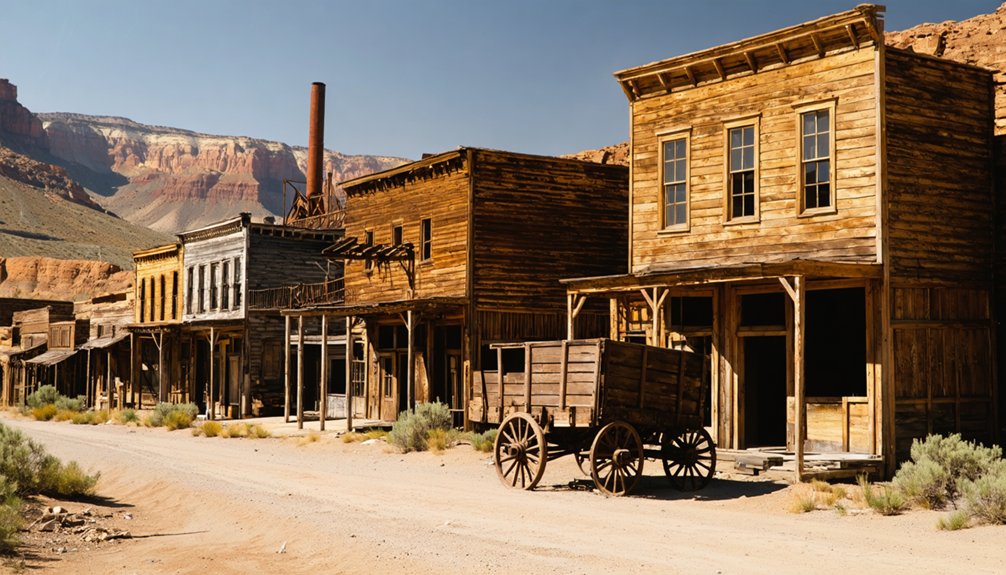
Following the initial mining boom’s decline, an English firm established from London acquired the Eberhardt operations in 1870, purchasing the interests of Captain Frank Drake’s mining group to exploit residual silver ores in the old Hidden Treasure diggings on White Pine Mountain.
These British investments transformed the struggling camp into one of the few profitable British mining enterprises in the United States.
The company’s mining strategies focused on three key developments:
- Infrastructure expansion – constructing the nation’s largest tramway and a thirty-stamp International Mill
- Water supply systems – laying pipelines one and a half miles to Applegarth Springs
- Professional management – hiring Frank Drake as superintendent, Thomas Phillpotts as surveyor, and F.H. Bousfield as assayer
Operations began in 1871, sustaining the camp until withdrawal in 1885.
Economic Decline and Abandonment
Despite the British company’s initial success in revitalizing Eberhardt’s mining operations, the venture couldn’t withstand the fundamental challenges plaguing the White Pine District. The 1870s brought declining silver ore quality and diminishing returns on capital investments.
Mill disasters compounded these problems—fire destroyed the International Mill in 1872, and though rebuilt in 1873, it closed permanently in 1885. The Stanford Mill shuttered even earlier in 1876.
This economic downturn triggered severe population decline. From Eberhardt’s peak of 200 residents, only 170 remained by the 1880s. After British investors withdrew in 1885 following massive losses, abandonment accelerated dramatically.
Present Day Ruins and Remnants
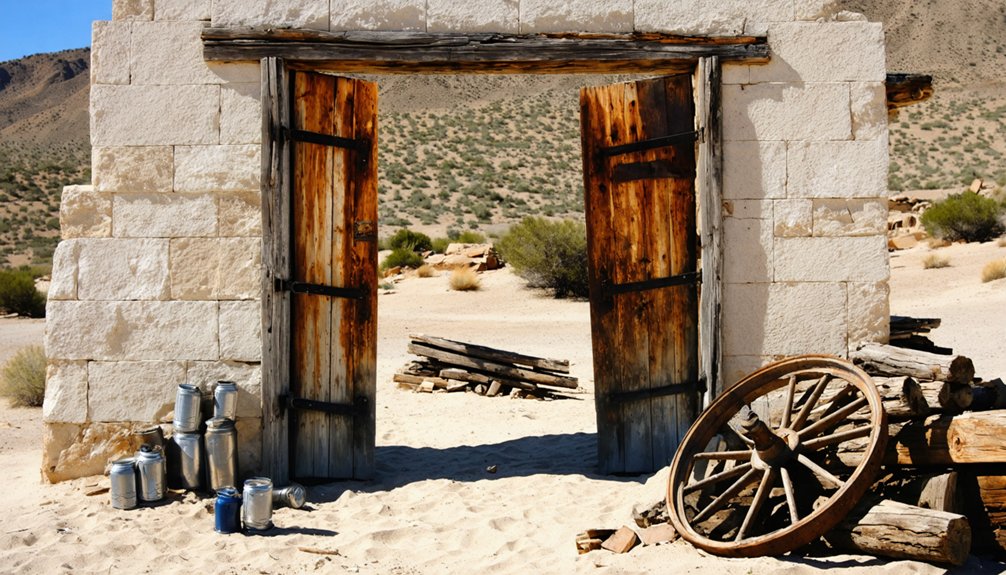
Today, Eberhardt’s physical remnants tell the story of a once-thriving mining camp through scattered ruins and deteriorating infrastructure.
Your ruin exploration reveals three distinct areas of historical significance:
- Eberhardt Tunnel Portal – The seven-foot-tall stone entrance stands accessible via an overgrown road, connected to the mine by a three-mile aerial tram whose fallen cables remain visible.
- Mill and Town Ruins – Stone structures wrap around the hill below the mine, with furnaces and tools abandoned as if workers left suddenly during the 1869-1880 mining period.
- Graveyard Site – Located half-mile from the original settlement, two pioneer sisters’ graves were re-interred after a 1940 cloudburst, marking the community’s tragic human cost.
These remnants preserve Nevada’s mining heritage for independent explorers.
Visiting Eberhardt Today
How do you reach this remote Nevada ghost town safely and legally? Access routes require driving 221 miles east from Fallon on US-50, then 15-16 miles south on County Road 11.
As you embark on your journey, take the time to explore the historic towns of Nevada that dot the landscape along the way. Each town has its own unique charm and stories that reflect the rich history of the region. Be sure to stop and appreciate the architecture and local culture that make these towns a fascinating addition to your adventure.
Drive 221 miles east from Fallon on US-50, then turn south 15-16 miles on County Road 11 to reach this isolated Nevada ghost town.
You’ll need high-clearance or 4WD vehicles for the rough dirt final stretch. Cell service is unreliable, so carry offline GPS maps and notify someone of your plans.
Essential safety precautions include bringing extra water, first-aid supplies, and emergency communication devices. The site contains dangerous open mine shafts and unstable structures—don’t enter workings or climb ruins.
Verify land ownership status before visiting, as parcels involve mixed federal, state, and private holdings. Artifact removal violates federal preservation laws.
Plan fuel and supplies in advance since no services exist on-site. Visit during daylight hours only, avoiding thunderstorms that trigger flash flooding.
Frequently Asked Questions
What Happened to the Original Buildings and Structures From the Town?
You’ll find only stone foundations and masonry ruins remaining—wooden structures collapsed from decay, fires, and systematic salvaging. Historic preservation wasn’t prioritized, leaving urban exploration enthusiasts with scattered remnants of freedom-seeking miners’ dreams.
Are There Any Safety Hazards Visitors Should Be Aware Of?
You’ll face serious safety precautions including open mine shafts, unstable building ruins, and structural collapse risks. Hazard awareness demands 4WD vehicles, recovery gear, water supplies, and informing others of your remote desert plans.
Can Visitors Legally Explore the Mine Shafts and Tunnels?
No, you can’t legally explore mine shafts and tunnels. Nevada’s sealed over 3,000 dangerous mines statewide. Mine access requires proper training and equipment, while exploration regulations restrict entry to protect visitors from deadly hazards.
What Wildlife Might Be Encountered in the Area Today?
You’ll encounter diverse desert wildlife including coyotes, kit foxes, bobcats, black-tailed jackrabbits, and various lizard species. Local fauna also features golden eagles, common ravens, and seventeen snake species roaming this rugged terrain.
Are There Any Camping or Overnight Accommodation Options Nearby?
You’ll find dispersed camping near the tunnel and mill ruins, plus primitive overnight stays at Green Springs Ranch oasis. No formal camping facilities exist, but flat desert spots accommodate self-contained setups among sagebrush.
References
- https://nvtami.com/2022/08/29/camping-with-the-godfather-of-ghost-towns/
- https://forgottennevada.org/sites/eberhardt.html
- https://www.nevadaghosttownsandmininghistory.com/copy-of-lincoln-county
- https://www.ghosttowns.com/states/nv/eberhardt.htm
- https://nevadagram.com/nevadas-dead-towns/
- https://www.nvexpeditions.com/whitepine/eberhardt.php
- https://travelnevada.com/nevada-magazine/odyssey-of-a-ghost-town-explorer-part-4/
- https://westernmininghistory.com/towns/nevada/eberhardt/
- https://westernmininghistory.com/mine-detail/10296039/
- https://stacksbowers.com/coin-resource-center/us-coins/silver-ingots/eberhardt-and-aurora-mining-co/