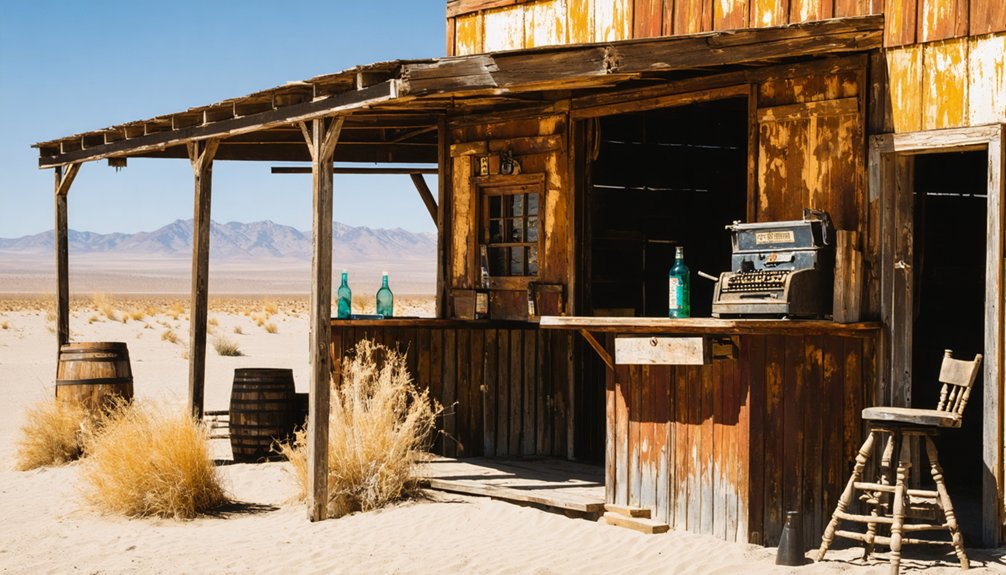
Nevada’s ghost towns generate over $160 million annually in tourism revenue while illustrating the state’s mining boom-bust cycles. You’ll find these 600+ abandoned settlements contribute considerably to rural economies, creating approximately 3,200 jobs and attracting heritage tourists who spend 61% more than recreational visitors. Some towns are experiencing revitalization through renewable energy projects and cultural programs. The economic transformation of these former single-industry communities offers valuable insights into resource-dependent regions’ sustainability.
Key Takeaways
- Ghost towns generate significant tourism revenue, contributing to Nevada’s economy where tourism accounts for one-third of state tax revenue.
- These historical sites create employment opportunities that help offset job losses during tourism industry downturns.
- Cultural heritage attractions like ghost towns provide economic diversification for communities vulnerable to boom-bust cycles.
- Ghost towns serve as educational assets illustrating Nevada’s mining history and economic development patterns.
- The preservation and promotion of ghost towns supports regional economic stability through sustainable heritage tourism.
The Rise and Fall of Mining-Dependent Settlements
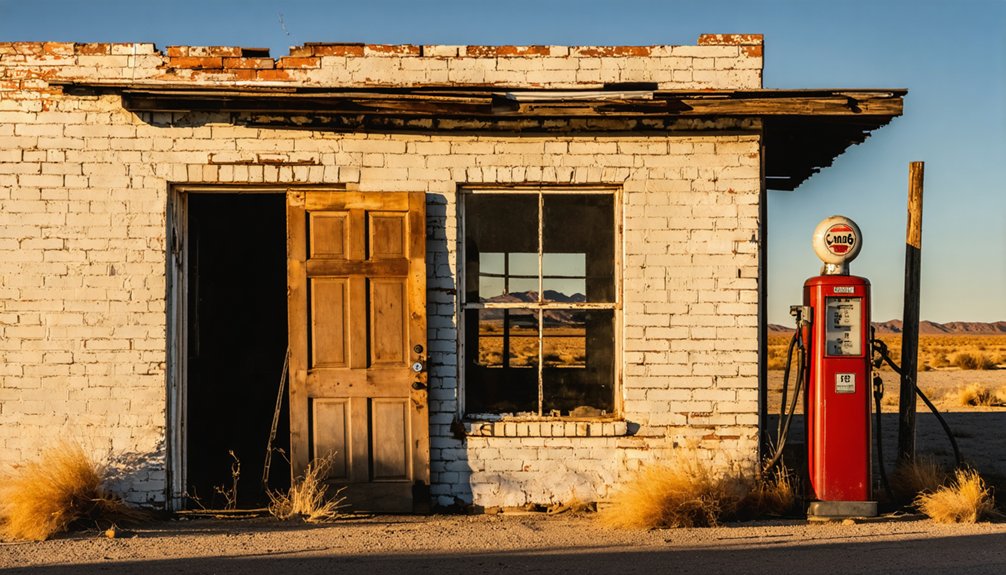
Nevada’s ghost towns represent the volatile economic lifecycle of mining-dependent settlements that flourished between the mid-19th and early 20th centuries.
These communities experienced dramatic population shifts directly correlated with mine productivity—places like Jarbidge surged to 1,200 residents during peak operations before collapsing in the 1930s.
Mining technology evolved from basic placer gold extraction to sophisticated underground operations, driving economic development through infrastructure like mills and smelters.
Towns functioned as complete economic ecosystems, with mining activity generating secondary markets in transportation, trade, and services.
When deposits depleted or became uneconomical, these mono-industry settlements quickly declined. This economic vulnerability is exemplified by Berlin, where mining operations produced $849,000 in revenue before complete abandonment in 1911.
The absence of economic diversification left them vulnerable when mines closed, resulting in rapid abandonment.
As many turned away from these desolate areas, curiosity grew about the mysterious military bases in America. Speculation surrounding their purpose and the activities conducted within them became a topic of conversation among locals. Amidst the silence of abandoned mines, whispers of secret initiatives and hidden technologies captured the imagination of those seeking answers.
This boom-and-bust pattern repeated across Nevada, leaving behind the skeletal remains of once-thriving economies dependent on finite resources.
Many towns like Delamar experienced rapid population decline after reaching peak residency of 3,000 in 1897, demonstrating the unsustainable nature of single-resource economies.
Ghost Towns as Tourism Revenue Generators
The remnants of Nevada’s gold and silver mining heyday have transformed into significant tourism assets that generate substantial economic value for the state.
These ghost towns help diversify revenue streams in an economy overly dependent on gaming, where tourism already accounts for one-third of state tax revenue and 22% of wages.
With current tourism declining by 7% statewide and Las Vegas visitation dropping 11.3%, ghost town tours offer critical economic lifelines to smaller communities. Recent social media posts show empty streets in Las Vegas, comparing it to a ghost town itself.
Cultural heritage attractions provide alternative revenue when rising hotel costs (up 70% since 2015) and resort fees are pricing out middle-income travelers.
As service sector workers face layoffs and reduced hours at major casino properties, these historical destinations create employment opportunities that could help offset the 32.5% job losses experienced during previous tourism downturns. Small towns like Baker that rely entirely on tourism traffic are especially vulnerable when visitor numbers decrease.
Historical Resource Extraction and Long-Term Employment Effects

While ghost towns now serve as tourism magnets, their original economic foundations relied on massive resource extraction operations that shaped Nevada’s development trajectory.
You’ll find evidence of this in operations like the Montgomery Shoshone mine, which processed 300 tons of ore daily and generated values reaching $10,000 daily during peak production.
Resource management evolved from simple placer gold extraction to complex underground operations requiring substantial infrastructure investments like the Sutro Tunnel.
This evolution directly influenced labor dynamics, creating transient employment patterns tied to mine viability. As extraction became more challenging and expensive, towns that couldn’t adapt faced abandonment. The Comstock Lode discovery was a critical mining development that dramatically accelerated Nevada’s economic growth. The boom-and-bust cycles common throughout Nevada’s mining history left behind the over 600 ghost towns that now dot the landscape.
The economic impact extended beyond direct mineral sales ($849,000 from Berlin’s mine alone) to support industries including smelting and freight, temporarily stimulating regional growth but ultimately creating the boom-and-bust cycle that defines these historic sites.
Economic Diversification Strategies in Former Mining Communities
As former mining towns throughout Nevada confront economic obsolescence, strategic diversification has emerged as their primary survival mechanism, replacing the single-industry dependency that once defined these communities.
You’ll find these towns leveraging their heritage while embracing economic innovation through renewable energy projects that create substantial employment—approximately 15,000 jobs statewide.
Infrastructure investments like broadband expansion enable technology sector growth, with manufacturing increasing at 8% annually.
Community partnerships between government, educational institutions, and businesses have established workforce training centers that prepare locals for emerging opportunities in advanced manufacturing and clean tech.
Rural areas particularly benefit from tourism-complementary clusters that integrate cultural attractions with outdoor recreation, creating sustainable business growth beyond transient visitation. These ghost towns also benefit from Nevada’s tax-friendly environment that attracts entrepreneurs seeking lower operational costs compared to neighboring states.
The integration of mining heritage with modern industries like battery production offers these communities resilience against future economic volatility. Similar to Reno’s experience with Tesla’s gigafactory, these communities can significantly reduce their reliance on single sectors while creating new economic opportunities.
Regional Recovery Patterns and Economic Resilience
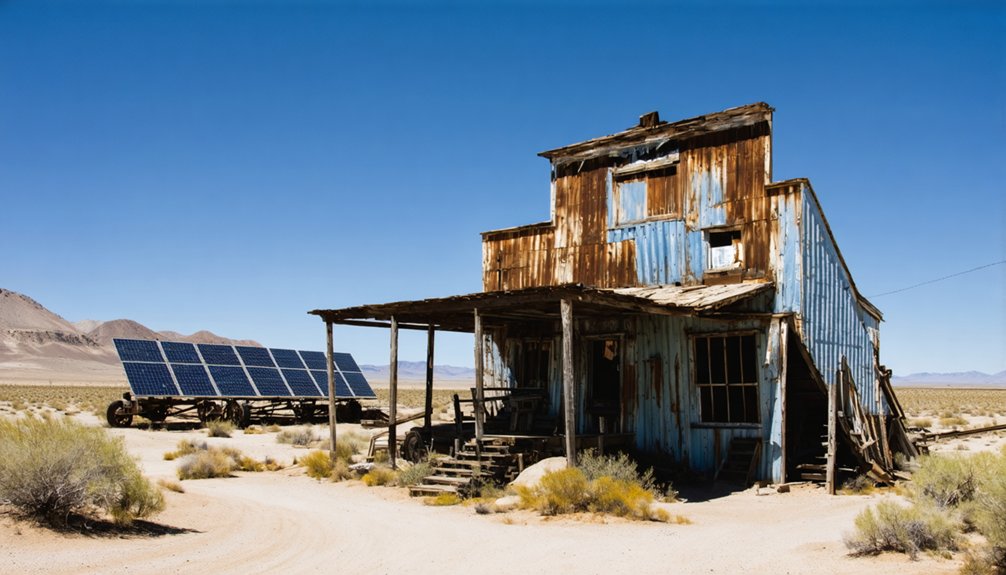
Nevada’s economic recovery patterns reveal distinct regional trajectories shaped by industry concentration and market dynamics.
You’ll find striking contrasts between gold-dependent Elko, which decoupled from the 2009 recession while precious metals surged, and tourism-reliant communities like Mesquite and Laughlin that experienced prolonged downturns.
Economic resilience varies dramatically across the state.
Northern Nevada’s diverse economy recovered faster than Southern Nevada, where tourism dependency led to 34% unemployment.
Mining towns demonstrate remarkable resilience when commodity prices rise – gold’s $3,300 peak in 2025 created economic buoyancy in central Nevada communities.
Pioche exemplifies this pattern with its historical production of $5 million worth of silver ore within just three years of its establishment.
Meanwhile, Carson City’s government employment provided stability despite experiencing 15% housing price declines and 90-day listing periods.
Las Vegas exemplifies the vulnerability of single-industry markets with home values plummeting from pandemic highs of $480,000 to $440,000, creating significant economic ripple effects.
Recovery patterns consistently show that communities with diversified revenue streams weather economic storms more effectively than single-industry towns.
Housing Market Fluctuations in Nevada’s Historical Mining Regions
You’ll observe a striking boom-bust property cycle in Nevada’s historical mining regions, where housing values have plummeted by 20% and vacancy rates exceed 20% in towns like Tonopa and Pioche.
These once-thriving areas now face significant market oversupply, with properties languishing unsold for over 120 days and new listings surging nearly 77% in communities near Las Vegas.
The collapse in demand stems from retreating retirees, diminished investor interest, and fading mining boom optimism, creating what economists describe as “ghost streets” of vacant homes in newly developed subdivisions.
Boom-Bust Property Cycles
Historical mining regions throughout Nevada exhibit pronounced boom-bust property cycles that parallel the fortunes of local extraction industries.
You’ll find evidence in towns like Elko, where home values climbed 39.9% over nine years before dropping 11% recently as mining production declined.
When commodity prices rise, these markets experience rapid appreciation—Yerington saw 112.4% growth due to mining spillover effects.
However, sustainability issues emerge when production slows. Housing inventory increases (28-40% in some areas) while demand contracts, creating vulnerable markets.
Property speculation fueled by low interest rates and the “gold rush” narrative led to bubble conditions in the early 2020s.
Now, out-of-state investors are exiting, pushing prices down. Towns with diversified economies like Battle Mountain show greater resilience than those solely dependent on mining.
Abandoned Assets Reconsidered
While ghost towns often conjure images of tumbleweeds and dilapidated structures, today’s housing markets in Nevada’s former mining boomtowns reveal a modern economic abandonment unfolding in real time.
You’ll find stark evidence in once-thriving communities like Reno, where median prices plummeted 19.4% to $500,000 and homes sit vacant for 130+ days.
Carson City’s inventory has surged 38% year-over-year with properties languishing for 90 days versus just 22 days during boom times. This abandoned infrastructure represents stranded capital as mortgage rates above 7% have mathematically eliminated affordability for average households.
Asset repurposing opportunities exist amid this correction, particularly in areas like Summerland where one in six homes in gated communities sit empty.
As speculative investors flee, local economies must reimagine these spaces or risk permanent economic hollowing.
Frequently Asked Questions
How Do Ghost Towns Impact Surrounding Property Values?
Ghost towns typically cause property depreciation in surrounding areas due to economic decline, while occasionally serving as tourism attractions that may marginally stabilize values through limited economic diversification and niche investment opportunities.
What Environmental Restoration Costs Remain From Abandoned Mining Operations?
Amid the shadows of history, you’re facing $21-32.4 billion in nationwide restoration costs through 2050, with Nevada requiring $400 million to address abandoned infrastructure while restoration funding remains critically insufficient.
Do Ghost Towns Qualify for Special Federal Preservation Funding?
Ghost towns can’t qualify for federal preservation funding grants unless they’re listed in the National Register and owned by Certified Local Governments. Private property owners remain excluded from these preservation efforts.
How Has Indigenous Culture Been Affected by Ghost Town Tourism?
You’d think ghost towns would celebrate all histories, but Indigenous culture faces marginalization with minimal tourism benefits. Cultural preservation efforts remain limited while traditional narratives and sacred sites continue facing commodification and environmental degradation.
What Digital Technologies Are Being Used to Preserve Ghost Town Histories?
You’ll find 3D scanning, drone photogrammetry, BIM/HBIM, digital archiving, and virtual reality technologies preserving ghost town histories through interactive environments and extensive data capture for future generations to freely access.
References
- https://www.youtube.com/watch?v=F-x0FMxCVHM
- https://nevadabusiness.com/2025/07/rural-nevada-where-the-past-and-the-future-meet/
- https://nevadamining.org/nevada-ghost-towns-pioche/
- https://www.reviewjournal.com/business/housing/contrary-to-census-data-las-vegas-no-ghost-town/
- https://goed.nv.gov/wp-content/uploads/2025/04/2024-GOED-Annual-Report.pdf
- https://jasontdunn.com/files/ghost_towns_big_cities.pdf
- https://www.leg.state.nv.us/App/InterimCommittee/REL/Document/23035?rewrote=1
- https://appliedgeographic.com/2021/09/23/boom-and-bust-towns/
- https://savingplaces.org/stories/explore-wild-west-mining-history-in-nevada-ghost-towns
- https://en.wikipedia.org/wiki/List_of_ghost_towns_in_Nevada