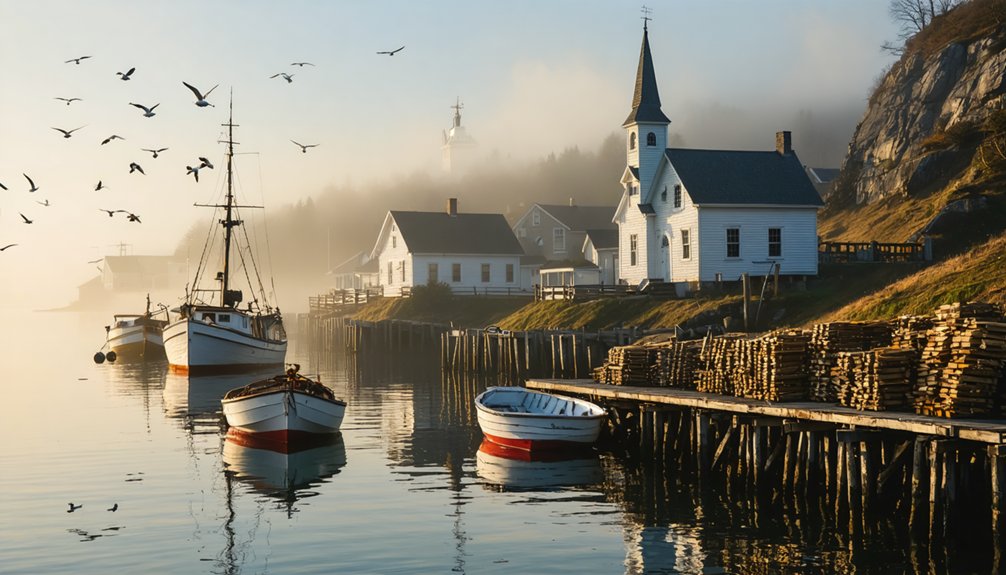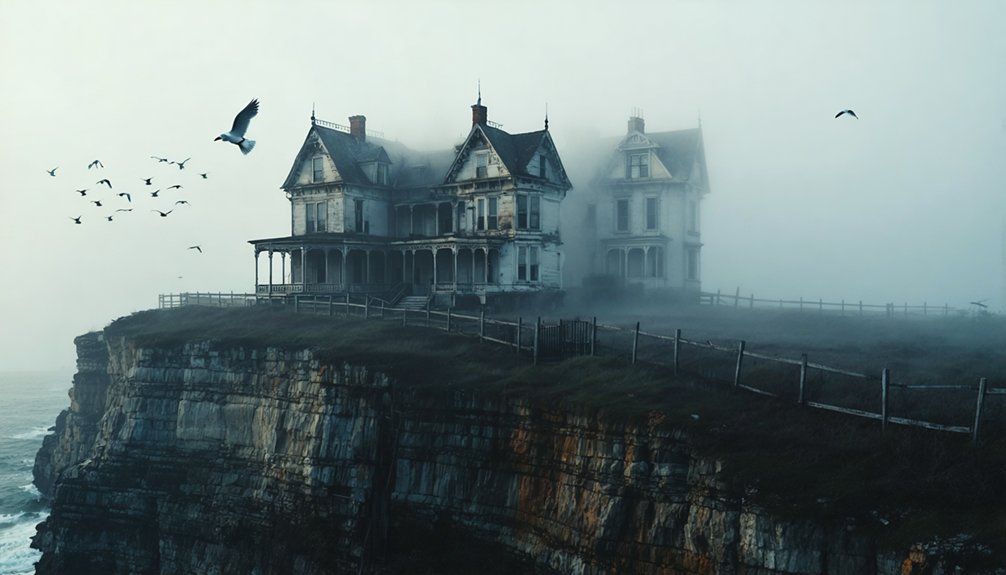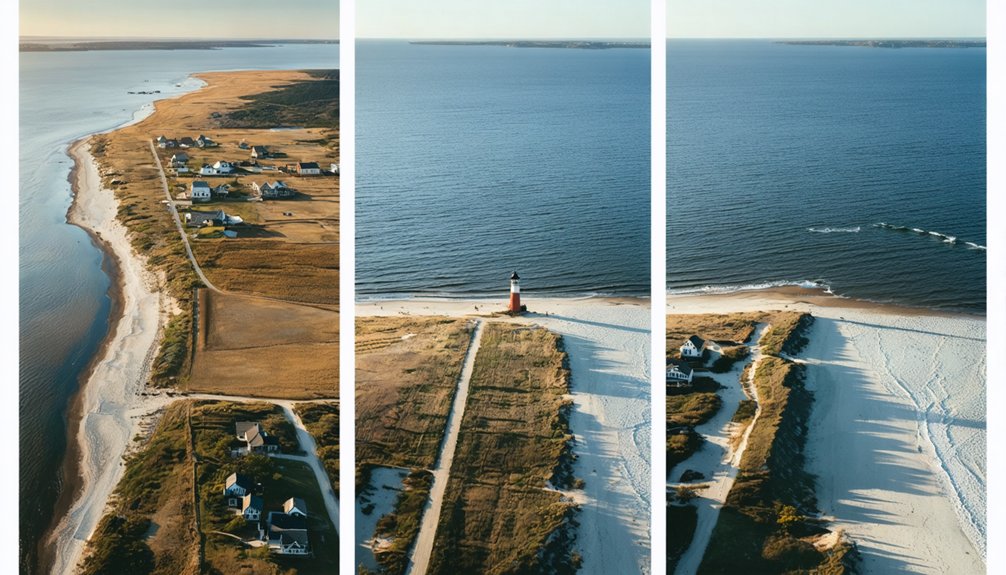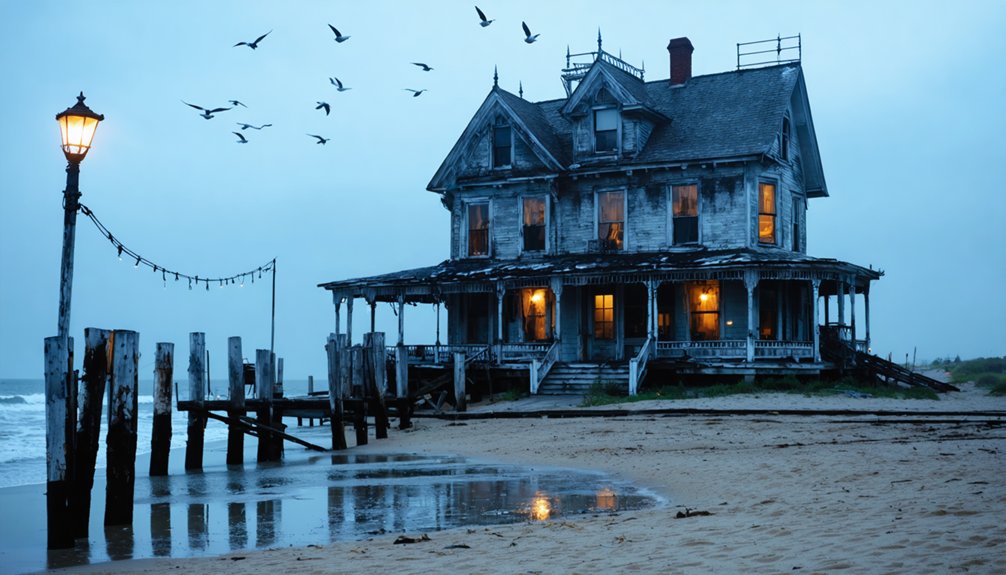
Along America’s East Coast, you’ll find hauntingly beautiful ghost towns where nature has reclaimed human ambition. Sea Breeze, New Jersey’s abandoned structures tell tales of coastal erosion and devastating storms. Cape Romano, Florida’s futuristic dome homes now form an underwater memorial. In Gilchrist, Texas, only the iconic yellow “Last House Standing” remains from Hurricane Ike. The Outer Banks’ Salvo features cottages slowly surrendering to the sea. These coastal phantoms await your exploration.
Key Takeaways
- Sea Breeze, New Jersey is a declining ghost town where coastal erosion has transformed former streets into wildlife refuge areas.
- Gilchrist, Texas features the iconic “Last House Standing” amid barren beachfront destroyed by Hurricane Ike in 2008.
- Salvo, North Carolina contains numerous abandoned cottages threatened by severe coastal erosion and storm damage.
- Cape Romano, Florida’s futuristic dome houses are now collapsed underwater structures that form an artificial reef.
- Whitby, England offers haunting abbey ruins, legends of headless horses, and ghost monks that inspired Bram Stoker.
Sea Breeze, New Jersey: The Resort Reclaimed by Nature
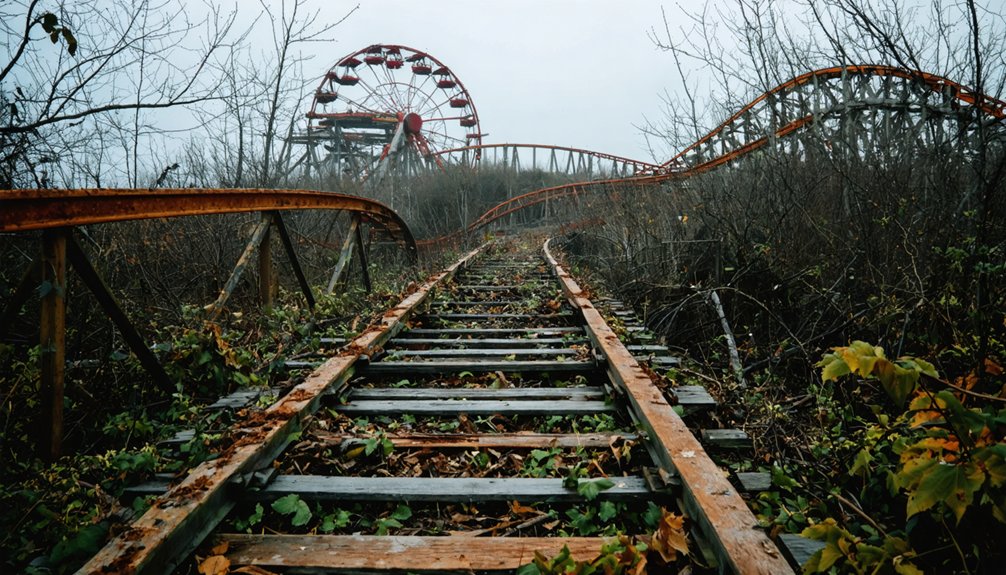
The town’s glory days featured carousel rides, clambakes, and the legendary Seabreeze Hotel—a rumored Prohibition-era speakeasy.
But relentless coastal erosion and devastating storms like Hurricane Gloria gradually consumed this paradise.
Today, you’ll discover abandoned structures, exposed foundations, and unpaved dead-end roads where elegant hotels once stood.
The Delaware Bay steadily devours what remains, transforming former streets into wildlife refuge.
For the adventurous explorer, this forgotten hamlet offers a poignant glimpse of impermanence—a place where nature has reclaimed humanity’s fleeting ambitions.
The once-popular John A. Warner steamboat initially helped establish Sea Breeze by ferrying visitors from Philadelphia starting in 1887.
Before its eventual demise, the resort town was known for its annual clam bakes that brought together vacationing families and locals alike.
Cape Romano, Florida: Futuristic Dome Homes Surrendered to the Sea
You’ll marvel at Cape Romano’s otherworldly dome homes, once a visionary eco-friendly vacation residence built 300 feet offshore, now reduced to submerged concrete ruins.
The futuristic compound, constructed in the early 1980s with innovative solar power and rainwater collection systems, gradually succumbed to relentless coastal erosion as hurricanes pushed shorelines inward. The structure was initially designed with concrete walls made from sand collected directly from the island. Bob Lee, the creative mastermind behind this architectural wonder, designed the domes to withstand hurricanes through their aerodynamic shape.
Hurricane Ian delivered the final blow in 2022, collapsing the remaining above-water structures with 150 mph winds, forever transforming this architectural oddity into an eerie underwater memorial to human ingenuity versus nature’s power.
Futuristic Ruins Underwater
Jutting from the turquoise waters off Cape Romano like concrete planets adrift in the Gulf of Mexico, Bob Lee’s futuristic dome homes have surrendered to the relentless advance of the sea.
Once a visionary vacation home built in the early 1980s, this otherworldly dome architecture now serves as an artificial reef where marine creatures dart between concrete pillars.
You’ll find local boat captains keen to guide you for underwater exploration of these haunting structures that have inspired countless legends and artistic interpretations.
- The domes’ shift from abandoned home to submerged attraction mirrors nature’s inevitable reclamation of human ambition.
- Their concrete shells, now adorned with graffiti and weathering, create an eerie juxtaposition against Florida’s pristine waters.
- What was designed to withstand hurricanes now stands as a monument to nature’s unstoppable power.
The remnants visible today are merely shadows of the original eco-friendly design that featured solar panels and rainwater collection systems meant to keep the structures entirely self-sufficient.
Hurricane Ian in 2017 delivered the final blow, with 150 mph winds completely submerging the remaining four domes that had stubbornly persisted against decades of coastal erosion.
Hurricane’s Relentless Destruction
While these half-submerged concrete planets provide sanctuary for marine life beneath, their story begins on solid ground with the vision of an oil magnate turned eco-pioneer.
Bob Lee’s 1981 creation stood as a tribute to sustainable living—solar-powered, rainwater-collecting domes designed to weather Florida’s fiercest storms.
For decades, they did just that. Hurricane Andrew barely scratched their innovative curves.
But nature plays the long game. Relentless coastal erosion transformed island to water, leaving the futuristic complex perched precariously on stilts above the advancing Gulf. Local legends and myths about secret cults arose as the abandoned structure became increasingly mysterious to visitors. The homes were originally constructed using sand from the island for their concrete walls, further demonstrating Lee’s commitment to using local resources.
The final blow came with Hurricane Ian‘s 150 mph fury in 2022, collapsing what remained of this once-revolutionary home.
You’re witnessing more than abandoned architecture—it’s the poignant surrender of human ambition to the sea’s unstoppable advance.
Gilchrist, Texas: The Ghost Town Left by Hurricane Ike
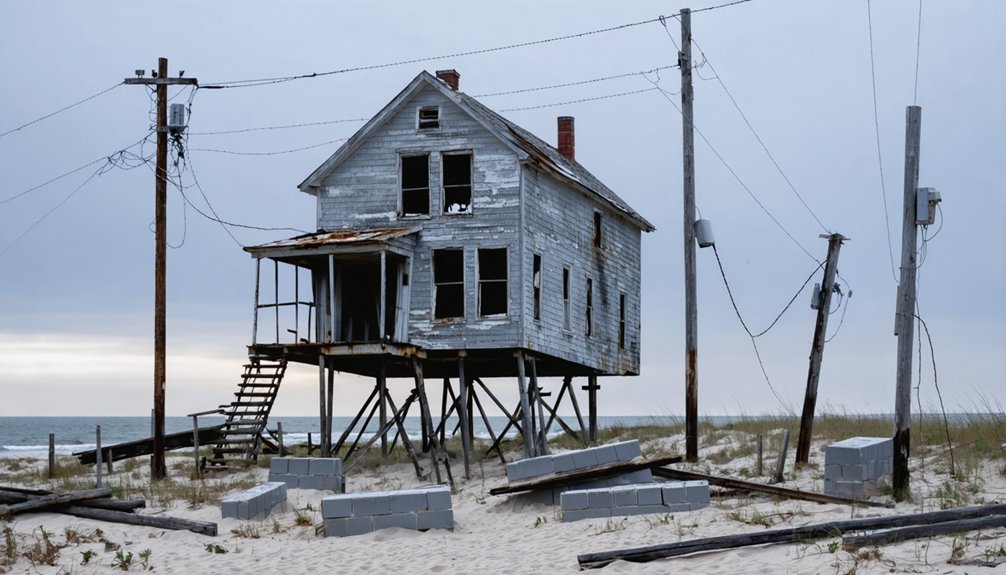
The haunting emptiness of Gilchrist today belies its once-thriving coastal community status before Hurricane Ike released its fury in September 2008.
What was a vibrant beach town of 700 residents transformed overnight into a ghost town, with only the iconic yellow “Last House Standing” remaining along miles of barren Gulf-front property.
As locals share the spooky legends of coastal towns, tales of the residents who once thrived here linger in the salty air. Whispers of mysterious figures wandering the shores at dusk add an eerie charm to the otherwise desolate landscape. Visitors often find themselves captivated by the history, drawn into the enchanting stories that echo through the empty streets.
Wandering through Gilchrist’s remnants, you’ll encounter:
- The solitary yellow beach house on 19-foot pilings, now a vacation rental symbolizing unlikely survival
- Miles of vacant beachfront where neighborhoods once flourished, erased by the 14-foot storm surge
- Scattered signs of community resilience as new structures slowly replace what Ike’s 110-mph winds destroyed
The peninsula’s painful recovery stands as a reflection of nature’s power and humanity’s stubborn determination to reclaim paradise, despite overwhelming odds. This determination is embodied by residents like Debbie Reynolds who returned to live in primitive conditions resembling camping more than modern life. Originally owned by Pamela and Warren Adams, the yellow house became a beacon of hope for the devastated community after the hurricane.
Salvo, North Carolina: Abandoned Cottages of the Outer Banks
Once a vibrant stretch of the Outer Banks, Salvo’s abandoned cottages now tell haunting stories of coastal erosion and natural reclamation.
You’ll find the remnants of a different era here, where the sea relentlessly reclaims what humans built. Houses that stood 430 feet from shore in 1980 now teeter just 47 feet from hungry waves. During recent nor’easters, homes have collapsed entirely, their debris scattering southward within days.
The area’s transformation is jarring—Aunt Phoebe’s Marsh, once a natural wetland, lies buried beneath an abandoned theme park and go-cart tracks. Condemned oceanfront properties stand empty, tagged as unsafe, while the historic Chicamacomico Life-saving Station preserves memories of heroic rescues and maritime heritage.
Nature’s power is unmistakable here, where coastal erosion continually rewrites the landscape.
Whitby, England: Haunted Abbey and Headless Horses of the Coastline
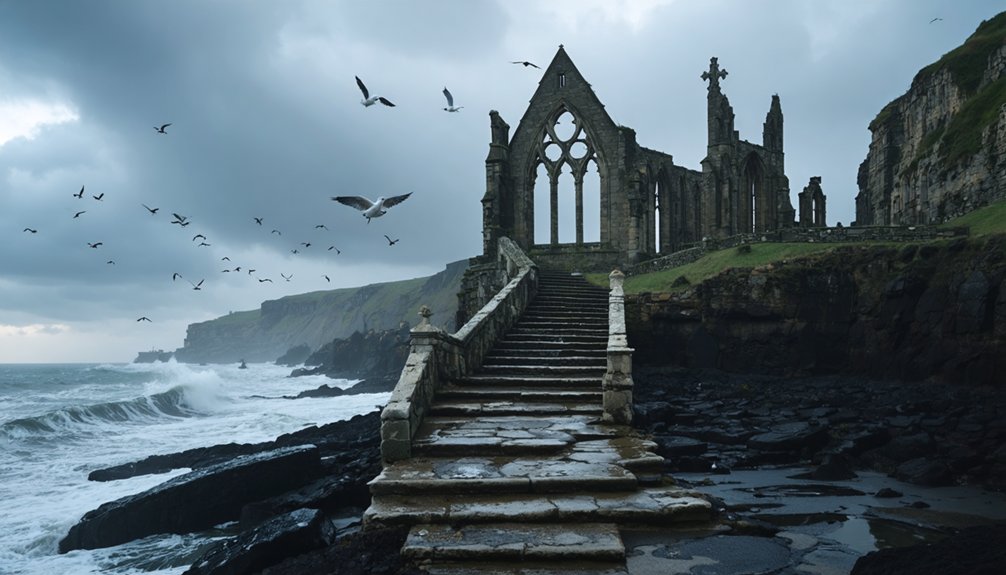
You’ll feel centuries of the supernatural watching over you when visiting the cliff-top Whitby Abbey, where St. Hilda’s ghost peers from the highest window and headless monks carry coffins through the grounds at night.
The abbey’s chilling legacy extends beyond its crumbling walls to the surrounding coastline, where phantom bells from a sunken ship still ring beneath the waves during storms.
As you wander the atmospheric headland, listen for the thundering hooves of the legendary headless horse that gallops along the dark beaches below, a spectral reminder of Whitby’s long association with the otherworldly.
Abbey’s Supernatural Legacy
Perched dramatically on England’s northeastern coastline, Whitby Abbey‘s haunting silhouette cuts a Gothic figure against the churning North Sea, its spectral legacy extending far beyond crumbling stone walls.
You’ll hear haunted whispers of St. Hilda’s apparition praying at high windows and the walled-up nun Constance’s desperate cries echoing among ruins.
Bram Stoker wandered these grounds in 1890, weaving local legends into his vampire masterpiece.
- Climb the legendary 199 steps at dusk when phantom hearses and headless riders make their ghostly appearances
- Listen for the impossible underwater ringing of phantom bells from a sunken monks’ ship
- Watch for unexplained flickering candlelight in the roofless abbey chambers, where spectral sightings occur most frequently
Coffin-Carrying Ghost Monks
Gasping for breath along Whitby’s notorious 199-step Church Stairs, coffin bearers of medieval times once strained under their macabre burdens—and according to local legend, they’re still at it.
If you’re wandering these coastal paths after dusk, you might encounter one of the town’s most chilling spectacles: ghostly processions of monks, eternally laboring to transport their deceased brethren to the clifftop cemetery.
Listen for the telltale wheezing of spectral pallbearers as they materialize from the mist.
These phantom monks represent the physical hardships that defined medieval burial practices at the Abbey. Their apparitions serve as a haunting reflection of Whitby’s layered history, where the boundaries between past and present blur along these ancient stone steps.
You’re not just visiting a coastal town—you’re walking alongside centuries of spiritual toil.
Headless Horse Hauntings
While the medieval monks of Whitby struggle eternally with their coffins, an even more terrifying procession awaits visitors brave enough to linger near St. Mary’s Churchyard.
The legendary Barguest Coach, pulled by headless black horses and driven by a decapitated coachman, emerges on the third night after a sailor’s burial, ready to claim another soul for the sea.
You’ll find these spectral sightings most chilling when:
- Standing atop the famous 199 steps as the phantom carriage barrels toward you
- Witnessing skeletal mourners circle a fresh grave three times before vanishing
- Hearing the coach’s thunderous descent down Henrietta Street before it plunges into crashing waves below
The coach isn’t alone in this coastal haunt—the abbey’s grounds teem with apparitions, from a wailing bricked-up nun to the black-robed monk who still walks the ruins.
Manzanita, Oregon: Mysterious Shipwreck Spirits and Unexplained Stone Formations
Beneath the misty shores of Manzanita, Oregon, a centuries-old mystery lurks in the form of the Santo Cristo de Burgos—a Spanish galleon that met its fate in 1693 when it drifted drastically off course and crashed into Nehalem Spit.
You’ll walk beaches where indigenous legends speak of foreign sailors who lived among native peoples after the wreck. The beeswax discovery—chunks marked with Spanish shipping symbols and containing Philippine bee wings—scattered mysteriously along shorelines and river valleys, confirms these ancestral stories.
Local tribes exchanged this treasure with fur traders until the 1860s.
When you explore the rugged sea caves near the coastline, you’re tracing the same path where hull fragments were finally discovered in 2013, validating centuries of oral histories and solving one of America’s oldest maritime mysteries.
Frequently Asked Questions
Are Any of These Abandoned Towns Legally Accessible to Visitors?
Yes, you’ll find legal access to abandoned towns like Cape Lookout Village, Sea Breeze, and Roanoke Island, where weathered structures whisper forgotten stories across windswept beaches awaiting your exploration.
What Paranormal Investigation Equipment Works Best in Coastal Environments?
You’ll discover weatherproof EMF detectors track energy anomalies while spirit boxes cut through coastal static. Kestrel meters and thermal cameras capture the invisible world where salt-kissed air meets paranormal whispers along windswept shores.
How Do Insurance Companies Now Assess Properties in These Areas?
Prepare for puzzling property valuation as insurers scrutinize your coastal home. They’ll analyze flood risks, proximity to water, erosion history, and satellite imagery before calculating your risk assessment—often demanding hurricane-grade fortifications to maintain coverage.
Can Tourists Stay Overnight Near Any of These Locations?
Yes, you’ll find beachfront accommodations near these spectral shores. Cape May’s haunted hotels embrace you with Victorian charm, while St. Augustine offers seaside lodgings where whispers of the past accompany your dreams.
Have Any Television Shows or Movies Featured These Ghost Towns?
You’ll witness ghostly legends come alive in “Ozark,” which featured Wilsonville’s submersion—similar to real East Coast ghost towns. These cinematic hauntings capture the haunting freedom that abandoned settlements offer curious wanderers.
References
- https://wpst.com/abandoned-town-new-jersey/
- https://www.beach.com/beaches/haunted-beach-towns/
- https://www.idyllicpursuit.com/10-abandoned-american-seaside-towns-that-once-overflowed-with-tourists/
- https://www.youtube.com/watch?v=vj0-iX7eCEY
- https://www.atlasobscura.com/lists/americas-best-preserved-ghost-towns
- https://thedigestonline.com/new-jersey/the-forgotten-beach-town-of-nj-sea-breeze/
- https://www.youtube.com/watch?v=In9mSRUUA-g
- https://southjerseyadventures.wordpress.com/2012/09/03/sea-breeze-nj/
- https://en.wikipedia.org/wiki/Sea_Breeze
- https://wildwoodvideoarchive.com/the-abandoned-town-of-sea-breeze-new-jersey/