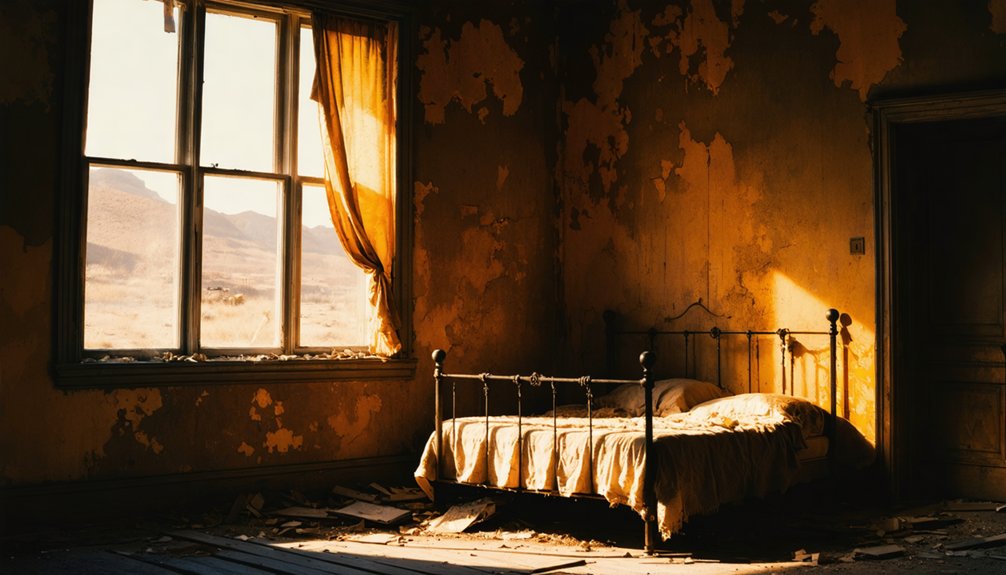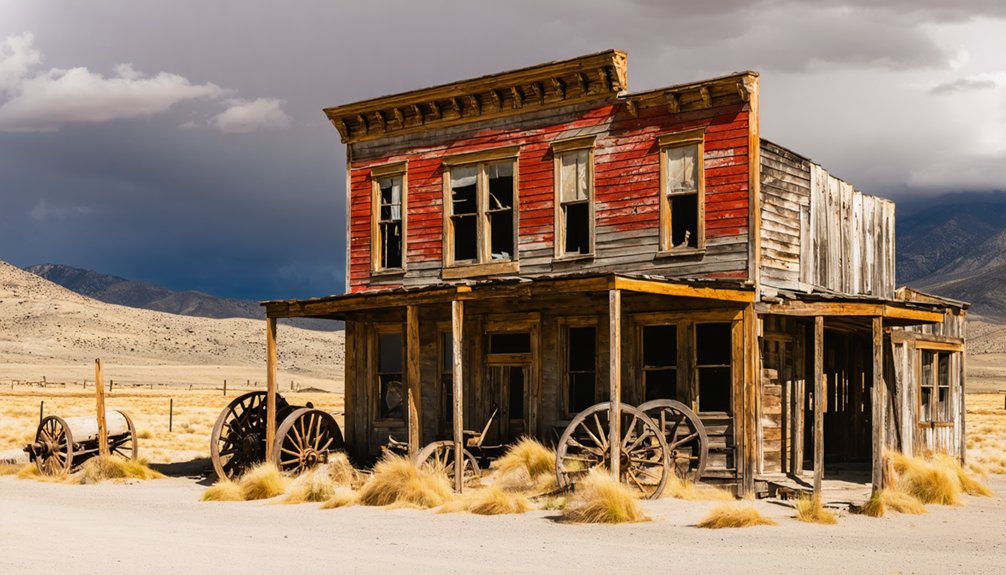
You’ll discover America’s most haunting architectural remnants scattered across 857 documented ghost towns, where weathered saloons, crumbling mining offices, and abandoned homesteads stand as silent witnesses to the nation’s boom-and-bust cycles. From Texas’s 511 ghost towns to California’s 346 mining settlements, these atmospheric ruins showcase distinctive features from different eras—Bodie’s 110 preserved buildings frozen since 1942, Kennecott’s copper mill ruins, and Route 66’s graffiti-covered trading posts that transform decay into art. These crumbling monuments hold deeper secrets within their walls.
Key Takeaways
- Texas leads with 511 documented ghost towns, while California follows with 346, primarily concentrated in former mining regions.
- Bodie, California features 110 preserved buildings unchanged since 1942, showcasing distinctive architectural elements from the gold rush era.
- Ghost town tourism thrives through guided tours, overnight workshops, and museum installations that bring forgotten histories to life.
- Abandoned structures reflect boom-bust economic cycles, from miners’ shacks to mansions, illustrating America’s rapid development and decline patterns.
- Preservation efforts focus on maintaining architectural authenticity while preventing deterioration, transforming ruins into living historical narratives.
The Scale of Abandonment Across America
Across America’s sprawling landscape, you’ll discover a haunting reality that stretches far beyond the romanticized ghost towns of the Old West.
Today’s abandonment factors create modern wastelands in unexpected places—from San Francisco’s 7.4% population drop to New York’s 6.2% decline between 2020 and 2023. You’ll find 1.3 million vacant homes scattered across the nation, with entire ZIP codes like Montgomery’s 36104 showing 19.6% vacancy rates.
Modern America faces unprecedented urban abandonment, with major cities losing substantial populations while millions of homes sit empty across entire neighborhoods.
Urban exploration reveals stark contrasts: some areas display median home values at just 14% of statewide averages. Augusta, Georgia, emerges as the nation’s most likely ghost town candidate, with its retail vacancy rate reaching 5.9%—34% higher than the national average.
You’re witnessing cities like Johnstown shrinking from 67,000 residents in 1920 to merely 18,400 by 2020. The most extreme cases show vacancy rates reaching 32.1% in certain ZIP codes identified as modern ghost towns. Over 3,800 documented ghost towns now dot America’s map, offering countless opportunities for those seeking authentic adventures off the beaten path.
Texas and California Lead the Ghost Town Count
Five hundred eleven documented ghost towns pepper Texas’s vast terrain, cementing the Lone Star State’s dominance as America’s abandoned settlement capital.
You’ll discover Wilson County leads with thirty-one sites, while New Braunfels boasts twenty-five nearby ghost towns waiting for exploration. California follows with three hundred forty-six abandoned settlements, concentrated heavily in Kern County’s mining regions where one hundred thirteen ghost towns showcase the Golden State’s boom-and-bust heritage.
These numbers aren’t just statistics—they’re invitations to adventure.
Ghost town tourism thrives here, offering you freedom to explore authentic historical significance without crowds or restrictions. You can wander through preserved structures, investigate mining ruins, and experience the raw atmosphere of America’s forgotten places. Some settlements like Bluffton remain hidden beneath Lake Buchanan, creating an underwater ghost town accessible only to divers. Across the entire nation, over 3,000 abandoned settlements tell the story of America’s dynamic evolution.
Texas Hill Country and California’s desert landscapes provide the perfect backdrop for discovering your own piece of abandoned history.
Historic Mining Towns That Time Forgot
When gold fever struck the American West, entire communities erupted from barren mountainsides within months, transforming desolate valleys into bustling hubs where thousands of fortune-seekers carved civilization from raw wilderness.
Fortune-seekers transformed barren wilderness into thriving communities overnight, carving entire civilizations from desolate mountainsides in pursuit of gold.
You’ll discover these forgotten legacies scattered across Nevada’s silver districts and Colorado’s high country, where weathered structures stand as monuments to humanity’s relentless pursuit of precious metals.
Walk through Bodie’s preserved streets, where 110 buildings remain frozen since 1942’s final mine closure. Explore Kennecott’s massive copper mill ruins rising against Alaska’s wilderness backdrop.
These mining heritage sites reveal boom-and-bust cycles that shaped the frontier—Virginia City’s explosive growth, St. Elmo’s 2,000-person peak before rapid abandonment. Many of these abandoned communities emerged during the period of westward expansion between 1880 and 1940 when industrialization drove settlers into previously unexplored territories. In South Dakota’s Black Hills, towns like Spokane flourished during the late 1920s with thriving schools before complete abandonment by 1940.
Each crumbling foundation tells stories of dreams pursued and fortunes lost.
Urban Decay in Modern American Cities
Unlike their Wild West predecessors, today’s ghost districts emerge from concrete and steel rather than wooden storefronts and mining shafts.
You’ll find entire city blocks where Detroit’s population crashed from 1.8 million to 600,000, leaving behind 100,000+ vacant lots like scattered teeth in a broken smile.
These urban wastelands stretch beyond single buildings—they’re sprawling graveyards of the American Dream where boarded windows stare blindly at crumbling streets.
When you explore these districts, you’re witnessing economic collapse made visible.
Crime-driven exodus creates zones where abandoned properties become canvases for decay. Cities like Gary, Indiana exemplify this crisis, with crime rates reaching four times the national average as the population plummeted by 60%.
However, recent data shows violent crime decreases of 10% in aggravated assaults and 20% in robberies across major cities, suggesting some urban areas may be stabilizing.
Yet within this desolation, urban revitalization strategies and community engagement initiatives spark hope.
Some neighborhoods transform vacant lots into urban farms, proving that even ghost districts can resurrect through collective determination and grassroots vision.
Architectural Remnants of Forgotten Communities
You’ll notice how weather and time sculpt these forgotten structures into haunting monuments of decay, where sagging timber frames and crumbling masonry reveal the skeletal remains of once-thriving communities.
Each building tells its own story through distinctive architectural features—ornate corbelled brickwork speaks of prosperous times, while exposed floor joists and collapsed rooflines chronicle decades of abandonment.
As you move through these ghostly streetscapes, you’re witnessing the eternal struggle between human preservation efforts and nature’s relentless reclamation of the built environment. From California’s Bodie to Pennsylvania’s Centralia, these structures exist in a state of arrested decay, carefully maintained to prevent further deterioration while preserving their haunting authenticity.
Along Route 66, places like Twin Arrows showcase graffiti art that transforms abandoned trading posts into unexpected canvases, where modern expression meets historical decay.
Historic Building Decay Patterns
As you step through the weathered doorframes of abandoned settlements, you’ll witness how time carves distinct signatures into forsaken architecture. Each ghost town reveals unique decay dynamics shaped by geography, climate, and human intervention.
Exploring abandoned properties in California towns offers a peek into the past, showcasing remnants of lives once vibrant. As nature reclaims these spaces, the stories behind the disrepair come to life, inviting curiosity about the communities that once thrived. Every crumbling wall and rusted fixture serves as a testament to a bygone era, whispering secrets to those who dare to listen.
Understanding these patterns helps you navigate the complex stories written in crumbling timber and rusted metal.
Structural deterioration follows predictable paths across America’s forgotten communities:
- Arrested decay – Sites like Bodie, California maintain buildings through minimal stabilization, preserving authentic abandonment.
- Natural entropy – Exposure strips copper wiring and accelerates wood rot in unprotected structures.
- Catastrophic damage – Fire, flooding, and subsidence create dramatic skeletal remains.
- Material degradation – Poor foundations and inferior construction materials expedite collapse.
From Kennecott’s preserved mining infrastructure to Centralia’s subsiding streets, you’ll discover how environmental forces sculpt architectural ruins.
Structural Design Evolution
Beyond the weathered surfaces and crumbling foundations lies a deeper architectural narrative—one that reveals how entire communities adapted their built environments to harsh realities and fleeting opportunities.
You’ll discover how builders evolved from permanent masonry structures to rapid balloon-frame construction as boom-bust cycles accelerated. Material adaptations tell stories of resourcefulness—dismantled buildings cannibalized for parts, lightweight corrugated metals replacing heavy slate roofing, and foundation designs shifting from deep concrete to shallow stone footings based on expected settlement longevity.
Structural failures follow predictable patterns: roof collapses from neglected maintenance, foundation undermining from mine subsidence, and fire devastation through wooden main streets.
Each ruin represents a community’s calculated gamble between permanence and mobility, revealing America’s restless pursuit of fortune.
Preservation Vs Natural Erosion
When you explore these decaying structures, you’re observing nature’s relentless advance:
- Freeze-thaw cycles split masonry walls while wind abrasion strips paint from weathered clapboards.
- Root systems buckle foundations as vegetation transforms buildings into vertical gardens.
- Moisture infiltration through failing roofs accelerates timber rot and adobe dissolution.
- Salt crystallization eats away mortar joints, leaving stone walls precariously balanced.
Each abandoned building tells a preservation story—some receive grants and stabilization efforts, while others surrender completely to natural forces, becoming atmospheric ruins that blend seamlessly into their landscapes.
Economic Collapse and Population Exodus
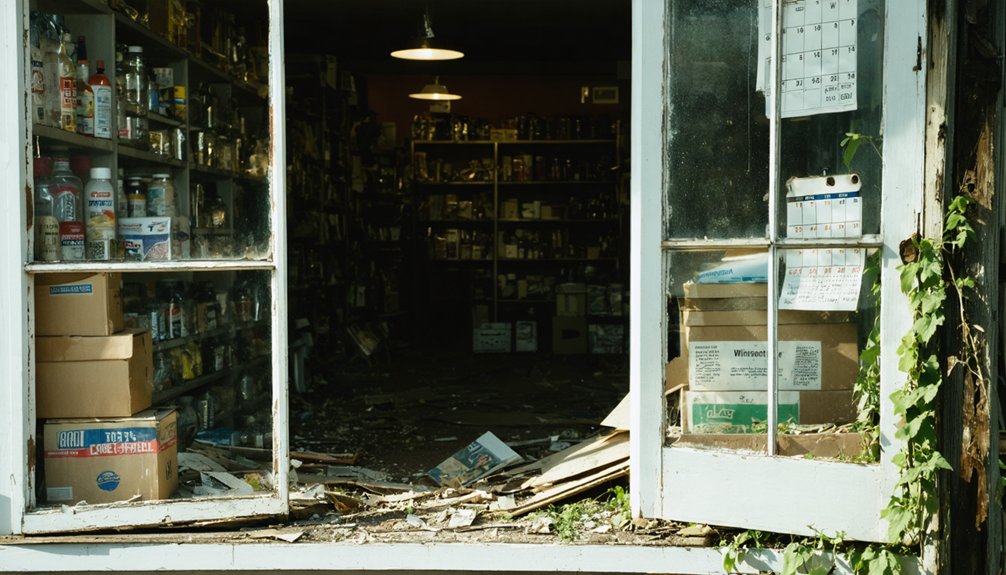
The wind whistles through broken windows where fortunes once thrived, carrying whispers of economic dreams that crumbled faster than the buildings they left behind.
You’ll witness stark economic disparities as you explore these remnants—Bodie’s gold rush mansions standing hollow beside miners’ shacks, both equally abandoned when the ore ran dry in 1942.
Population migration tells its story through empty doorframes and collapsing roofs. In St. Elmo, Colorado, 2,000 residents fled by 1936 when poor ore quality shattered dreams.
You’ll find similar tales across the West—Castle Dome’s 3,000 residents discovering their “gold” was worthless lead, Dust Bowl farmers abandoning Kansas homesteads for city jobs.
Each building represents someone’s broken promise, a reflection of America’s boom-bust cycles.
The Most Haunting Abandoned Structures
Towering headframes pierce the sky like skeletal sentinels, their rusted steel bones creaking ominous warnings as you approach the most haunting structures ghost towns offer.
These forgotten legacies hold haunting memories within their decaying walls, each telling stories of lives abruptly abandoned.
The most spine-chilling structures you’ll encounter include:
- Sanatorium wings with isolation wards where desperate patients once fought tuberculosis, their personal belongings still scattered across moldering floors
- Prison cellblocks bearing inmate inscriptions carved into crumbling walls, echoing with decades of confinement
- Stamp mills housing massive rusted machinery that once thundered day and night, now silent monuments to industrial ambition
- Company boarding houses where miners’ boots still sit by doorways, frozen in time’s grip
Each structure whispers secrets you’re free to discover.
Cities on the Brink of Becoming Ghost Towns
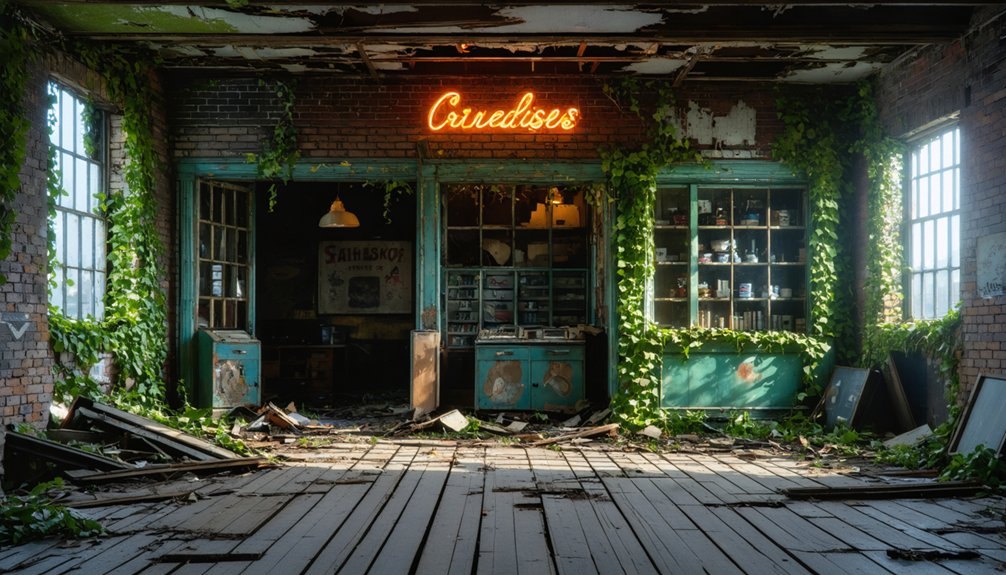
You’ll find America’s future ghost towns aren’t relics of the past—they’re cities gasping for breath right now, their streets already echoing with the hollow sound of shuttered storefronts and exodus-bound U-Hauls.
When you walk through neighborhoods where nearly 30% of Detroit’s homes sit vacant or witness San Francisco’s unprecedented hemorrhaging of 65,000 residents, you’re observing the slow-motion collapse that precedes total abandonment.
These urban vacancy crisis zones reveal themselves through crumbling infrastructure, skeletal downtowns, and the unmistakable atmosphere of communities watching their futures slip away one moving truck at a time.
Urban Vacancy Crisis Zones
Shadows creep across America’s urban landscapes where entire city blocks stand hollow, their windows dark and streets eerily quiet—a haunting preview of what happens when housing crises push communities past their breaking point.
You’re witnessing urban vacancy zones where economic impacts cascade like dominoes, transforming once-thriving neighborhoods into skeletal remains of their former selves.
These crisis zones emerge when housing becomes unattainable for ordinary residents:
- Newark, Cincinnati, and Little Rock lead the nation’s worst housing shortage zones
- Over 770,000 people experienced homelessness in 2024—an 18% spike
- 22.6 million renter households face crushing cost burdens at record highs
- Three-fourths of metro areas suffer critical housing shortages
You’re exploring America’s newest frontier—cities bleeding residents faster than they can replace them.
Population Decline Warning Signs
Before these urban wastelands reached complete abandonment, they displayed telltale symptoms that you can spot today in cities teetering on the edge of total collapse.
You’ll notice the exodus begins when major employers shutter operations, triggering cascading business failures within five years. Manufacturing job losses exceeding 20% accelerate urban migration as residents flee toward opportunity.
Watch for demographic shifts—young adults vanishing from neighborhoods while median age climbs dangerously high.
You’ll observe housing vacancy rates spiking above historical norms, creating pockmarked streetscapes of broken windows and overgrown lots.
School enrollments plummet as families escape deteriorating public services and rising crime.
Population loss becomes inevitable when deaths exceed births, municipal budgets collapse, and infrastructure crumbles.
These warning signs reveal tomorrow’s ghost towns hiding in plain sight.
Vacancy Rates That Signal Urban Decline
When rental vacancy rates climb above 7% in a neighborhood, you’re witnessing the early tremors of urban decay that often precede complete abandonment.
These vacancy signals serve as your roadmap to understanding which areas are teetering on the edge of becoming tomorrow’s ghost towns.
Watch for these critical urban indicators that forecast decline:
- Clustering of long-term vacancies exceeding 12 months within single blocks predicts accelerated abandonment.
- Owner-occupied vacancy spikes above the national 1.2% rate, signaling impending tax foreclosures.
- Persistent quarterly vacancy growth across three consecutive periods marks meaningful deterioration.
- Disproportionate vacancy in pre-1940 housing stock correlates with faster physical abandonment.
You’ll discover that metros like Jacksonville, with apartment vacancy rates hitting 14.6%, exemplify how localized decline unfolds before your eyes.
Preserving the Stories Within Empty Buildings
While decay threatens to erase decades of human stories, you’ll find that abandoned buildings hold irreplaceable narratives within their crumbling walls—narratives that disappear forever once water damage destroys handwritten ledgers or structural collapse buries family photographs beneath rubble.
You’re witnessing architectural significance that spans centuries, from 18th-century structures to 1960s designs that preserve the “spirit” of their eras.
Effective storytelling techniques emerge through guided tours, overnight workshops, and museum installations that breathe life into silent spaces.
The Bannerman Trust’s website and Eastern State Penitentiary demonstrate how creative interpretation transforms forgotten ruins into living histories.
You’ll discover that preservation isn’t just about saving buildings—it’s about rescuing the human experiences etched into every weathered beam and faded doorframe.
Frequently Asked Questions
Is It Legal to Enter and Photograph Abandoned Buildings in Ghost Towns?
You’ll face serious legal considerations since abandoned buildings aren’t ownerless—property rights persist despite decay. Trespassing charges await unauthorized explorers, so secure written permission from owners before venturing into these atmospheric ruins.
What Safety Precautions Should Visitors Take When Exploring Abandoned Structures?
With 11 fatalities since 1982 in Utah’s abandoned mines alone, you’ll need essential safety gear and must test structural integrity before entering these atmospheric ruins that whisper tales of forgotten dreams.
How Can You Determine if an Abandoned Building Is Privately Owned?
You’ll uncover property ownership through weathered legal notices posted on crumbling walls, county tax records revealing mysterious owners, and whispered neighbor tales that pierce the veil of abandonment shrouding these forgotten structures.
Are There Guided Tours Available for Famous Ghost Town Locations?
You’ll discover guided ghost tours at famous ghost towns like Goldfield, Oatman, and Vulture City, where atmospheric nighttime walks and underground mine explorations let you experience haunting history firsthand.
What Equipment Is Recommended for Safely Documenting Abandoned Buildings?
Like a modern explorer’s arsenal, you’ll need essential camera gear including a sturdy tripod and spare batteries, plus vital safety tools: FFP3 masks, closed-toe boots, headlamps, and gloves for traversing these haunting, debris-filled sanctuaries.
References
- https://247wallst.com/special-report/2018/11/02/30-american-ghost-towns-3/
- https://themortgagepoint.com/2024/10/25/americas-new-ghost-towns/
- https://blog.batchgeo.com/ghost-towns/
- https://abcnews.go.com/Business/Economy/story?id=6914381&page=1
- https://www.loveexploring.com/gallerylist/188219/the-us-state-with-the-most-ghost-towns-revealed
- https://www.youtube.com/watch?v=aTbMdOZRZO4&vl=en
- https://www.lovemoney.com/gallerylist/86648/americas-empty-ghost-towns-and-why-theyre-abandoned-today
- https://www.geotab.com/ghost-towns/
- https://joybird.com/blog/top-ghost-towns-in-america/
- https://247wallst.com/housing/2024/04/11/americas-modern-ghost-towns-2/