When exploring abandoned eastern seaside villages, you’ll need respiratory protection, non-slip footwear, and cut-resistant gloves. Always check tide tables and weather forecasts, as rising waters can trap you quickly. Never explore alone, and carry emergency signaling devices. Research cultural significance through anthropological archives, and verify land access regulations to avoid trespassing. These forgotten coastal communities reveal complex narratives of environmental adaptation and maritime heritage that continue to shape regional identities.
Key Takeaways
- Plan visits based on tidal schedules to avoid being trapped by rising waters during storm surges.
- Wear respiratory protection (N95/P100 masks) to guard against mold and asbestos in abandoned structures.
- Research land-use regulations and understand public trust doctrine regarding beach access to avoid trespassing.
- Carry physical maps, a compass, and emergency signaling devices as technology may fail in remote areas.
- Document findings responsibly using soft brushes for artifacts and photograph items in their original position.
Planning Your Exploration of Abandoned Coastal Sites

While abandoned seaside villages offer a fascinating window into coastal histories and cultural shifts, proper planning remains vital for meaningful exploration.
Begin by researching the site’s cultural significance through anthropological archives and local folklore narratives that contextualize abandonment patterns.
Every abandoned village holds stories waiting to be discovered through careful research of local narratives and historical records.
Before setting out, acquire detailed topographic maps and verify land-use regulations to avoid trespassing. Many coastal ruins exist within protected zones that honor cultural traditions while preserving architectural remnants.
Plan your visit according to tidal schedules and weather conditions—coastal access often depends on environmental factors that local communities have navigated for generations.
Consider connecting with heritage organizations for interpretive guidance, as they frequently maintain repositories of indigenous knowledge that deepens your understanding beyond physical structures.
This methodical approach guarantees respectful engagement with these liminal spaces where human history intersects with natural forces.
For areas like Hong Kong’s northeastern New Territories, consider starting your exploration from Luk Keng, which is accessible via minibus from Fanling MTR station and serves as an excellent gateway to the abandoned Hakka villages.
Villages like Lai Chi Wo showcase well-preserved Hakka architecture despite being mostly abandoned, providing an authentic glimpse into historical settlement patterns.
Essential Equipment and Safety Preparations
Beneath the allure of weathered maritime structures lies a landscape fraught with physical hazards that demand methodical preparation and specialized equipment.
You’ll need to prioritize respiratory protection—N95 or P100 masks shield against the invisible threats of mold and asbestos that permeate abandoned coastal settlements.
Your gear maintenance regimen must include regular inspection of waterproof boots with non-slip soles and cut-resistant gloves, essential for maneuvering through decaying infrastructure.
Establish rigorous safety protocols: never explore alone, inform trusted contacts of your itinerary, and carry emergency signaling devices.
The coastal explorer’s arsenal should include a headlamp with backup batteries, first aid supplies, and location-sharing technology.
A durable waterproof backpack will protect your equipment from salt spray and unexpected weather changes common in coastal environments.
For optimal documentation of your explorations, consider bringing a GoPro chest mount to capture hands-free POV footage while navigating through tight spaces.
These tools aren’t merely precautionary—they’re the foundation of responsible exploration, allowing you to traverse the liminal spaces between human history and natural reclamation.

When exploring coastal ghost towns, you’ll need to interpret weather patterns that can shift from calm to dangerous within hours, particularly during hurricane season’s peak from August through October.
Your survival depends on monitoring tide tables, as routes that appear passable during low tide may trap you when waters rise up to 4-6 meters during storm surges.
GPS devices often fail in remote coastal areas where signal degradation occurs due to atmospheric conditions and limited satellite coverage, so carry physical maps and a compass as essential backups.
Be aware that many historical sites along the Eastern Shore are experiencing more frequent flooding as sea levels rise at rates two to three times faster than the global average.
In abandoned places like Cape Lookout Village, expect to encounter weather-beaten cabins and historic lighthouses reclaimed almost entirely by nature.
Weather Pattern Awareness
For explorers venturing into the forgotten corners of abandoned coastal settlements, understanding weather patterns becomes not merely a matter of comfort but one of survival.
The increasing frequency of nor’easters along the East Coast demands vigilance, particularly during late fall through early spring when storm intensity peaks dramatically.
You’ll need to monitor real-time weather data obsessively when exploring these liminal spaces where nine homes recently collapsed into the Atlantic during a single storm event.
Remember that nuisance flooding occurs 300-900% more frequently than half a century ago, even without major weather systems present. The accelerating coastal erosion transforms these abandoned villages daily, rendering them increasingly unstable.
Like the residents of Hatteras Island, try to observe natural signs that might indicate an approaching storm beyond what official forecasts predict.
Pay close attention to high tide cycles which can significantly worsen flooding conditions in coastal areas like Buxton, North Carolina.
Before venturing out, check forecasts meticulously and always carry emergency communication devices—these forgotten places lack the infrastructure to protect you when the inevitable storm surges arrive.
Tide Table Tracking
While understanding weather patterns protects you from violent coastal storms, mastering tide table tracking proves equally essential for safe exploration of abandoned seaside villages.
Cultural access points along Eastern coastlines often become inaccessible during high tides, transforming previously viable pathways into dangerous marine environments.
Monitor these four critical elements to navigate tidal zones effectively:
- Check tide height measurements before departing – abandoned settlements frequently occupy low-lying areas accessible only during specific tidal windows.
- Calculate current direction precisely as this determines your approach strategy to coastal ruins.
- Plan village explorations during ebbing tides rather than incoming ones for maximum safety.
- Identify tidal diamonds on nautical charts that indicate potential hazardous areas near settlement remains.
Indigenous knowledge historically informed village placement relative to tidal patterns—understanding these relationships enhances both safety and interpretive depth during explorations. Always bring nautical charts that mark channels, shoals, and depth changes to navigate unfamiliar coastal areas safely.
Remember that both spring tides and neap tides affect water levels differently, with spring tides creating more extreme conditions that can either completely submerge or fully expose historical coastal structures.
GPS Signal Limitations
Although modern navigation tools have revolutionized exploration, GPS signal limitations present significant challenges when investigating abandoned seaside villages along rugged coastlines.
You’ll encounter signal obstructions from steep cliffs and dense vegetation that characterize these forgotten settlements, compromising your positioning accuracy.
The coastal environment itself introduces additional complications—saltwater readily absorbs and reflects GPS signals, while atmospheric errors intensify in these maritime regions.
Many abandoned villages in the East are situated in narrow valleys or beneath thick canopies that further degrade satellite reception.
Be particularly vigilant about jamming risks in politically sensitive coastal areas of the Eastern Mediterranean and South China Sea, where interference incidents have increased.
When maneuvering through these culturally significant sites, rely on traditional methods alongside technology—magnetic compass, paper charts, and local knowledge remain indispensable when modern signals fail.
Legal Considerations and Access Restrictions

As you venture into abandoned seaside villages, understanding the complex legal framework that governs these spaces becomes essential for responsible exploration.
The public trust doctrine affirms your legal rights to access many eastern coastal beaches, even when adjacent to private property. However, these rights exist in tension with property owners’ responsibilities for deteriorating structures.
When traversing these contested spaces, remember:
- Access paths from the road to the beach typically can’t be legally obstructed by private owners.
- Structures below the vegetation line occupy public trust land.
- Local governments often lack authority to remove hazardous structures.
- Documentation of obstructed public access can be reported to state coastal authorities.
The ethnographic landscape of seaside ruins represents both cultural heritage and regulatory challenge, where public access interests intersect with property rights in increasingly complex ways.
Documenting and Preserving Maritime History
The meticulous process of documenting and preserving maritime history represents the scientific backbone of seaside exploration, where each fragment tells a story of coastal life and human adaptation.
When encountering artifacts, you’ll want to employ maritime documentation techniques that respect both the historical integrity and legal protections surrounding these sites. Using soft brushes rather than abrasive tools prevents damage to delicate surfaces during your investigation.
For responsible interaction, photograph artifacts in situ before any movement, capturing their contextual relationship to surrounding elements.
Consider contributing your documentation to local heritage preservation efforts. Artifact preservation begins with minimal handling—salt and moisture fluctuations pose significant threats to maritime materials.
Remember that proper documentation isn’t just scientific protocol; it’s your contribution to preserving collective coastal memory for future generations.
Notable Ghost Villages Along the Eastern Seaboard
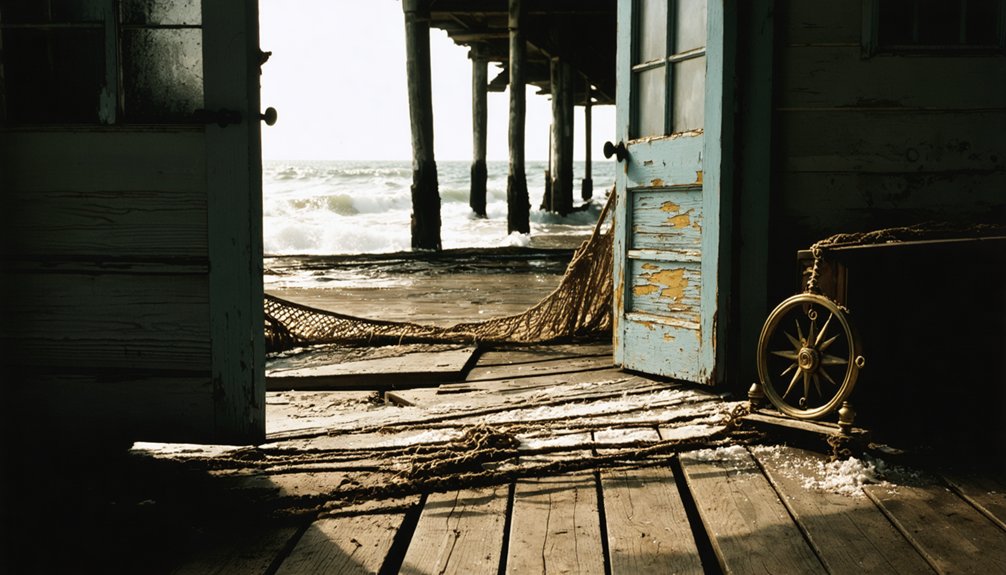
The Atlantic’s ghost villages from Maryland to Texas present compelling records of coastal communities’ adaptation and eventual surrender to natural forces, with each abandoned structure telling a story of maritime livelihood.
Exploring the ghost towns of the California Gold Rush reveals similar narratives of ambition and decline. From bustling mining camps that flourished overnight to desolate streets echoing with memories, each location offers insights into the transient nature of fortune. As nature reclaimed these sites, the stories of those who once sought wealth and adventure linger on in the remnants of their endeavors.
You’ll find these weathered remains particularly valuable as photographic subjects that capture the intersection of human settlement patterns and environmental vulnerability.
When you document these sites, from Gilchrist’s hurricane-ravaged foundations to Portsmouth Island’s reclaimed cottages, you’re preserving not just architectural remnants but cultural narratives that would otherwise disappear with the tide.
History Through Structures
Abandoned structures along America’s eastern coastline reveal layered narratives of economic ambition and environmental defeat. When exploring these ghost villages, you’ll encounter architectural remnants that chronicle the historical significance of past communities facing both natural and economic challenges.
Concrete tells many stories of human resilience against rising seas:
- Examine Mockhorn Island’s toppled seawalls for evidence of the futile battle against freeze-thaw cycles and persistent storm surges.
- Note structural adaptations in Bath Creek settlements, where indigenous Secotan sites evolved to colonial occupation.
- Compare Feltville/Glenside Park’s mill town-turned-resort buildings showing socioeconomic stratification through material culture.
- Observe stilted house foundations at Wachapreague, revealing desperate attempts to outlast accelerating shoreline recession.
These structural remains document the cultural patterns of communities that flourished briefly before environmental realities or economic shifts rendered them unviable.
Photographic Preservation Opportunities
Documenting ghost villages through photography serves as both creative pursuit and essential cultural preservation along the Eastern Seaboard, where each decaying structure silently narrates unique socio-environmental histories.
You’ll find compelling subjects from the undeveloped beaches of Tide Mills, East Sussex to Virginia’s storm-ravaged Parramore Island, where ocean encroachment creates dramatic decay narratives.
Cape Charles offers colorful abandoned cottages juxtaposed with vibrant community life, while Maine’s Monhegan and Manana Islands present authentic maritime scenes with minimal human presence.
For industrial contrast, Cape Cod’s railyard ruins provide textural studies against tidal marsh backdrops.
These sites offer freedom to capture abandoned architecture within evolving coastal landscapes—each photograph preserving fleeting moments of cultural transformation before nature reclaims these haunting spaces completely.
Frequently Asked Questions
Are There Any Haunted Seaside Villages With Documented Paranormal Activity?
Time’s ghostly fingers have touched several coastal settlements where you’ll discover haunted history in St. Augustine, Florida, Cape May, New Jersey, and Stony Brook, New York—all with documented paranormal investigations confirming spectral residents.
How Do Local Residents Typically Feel About Explorers Visiting Abandoned Sites?
Local sentiments vary widely—many residents feel protective of their heritage sites. You’ll encounter community concerns about cultural respect, environmental degradation, and privacy. Understanding these sensitivities helps you navigate local boundaries while exploring abandoned spaces.
Can I Legally Remove Artifacts or Items From Abandoned Coastal Properties?
You can’t legally remove artifacts without risking serious legal ramifications. Artifact ownership depends on location—federal, state, tribal, or private lands each have different protections that prioritize cultural preservation over personal collection.
Which Abandoned Villages Are Accessible Without a Boat or Special Transportation?
You’ll find Salvo in North Carolina’s Outer Banks and Sea Breeze in New Jersey most accessible by road. These locations offer freedom to explore coastal abandonment patterns without watercraft constraints.
Do Seasonal Factors Affect Which Abandoned Villages Are Worth Visiting?
Absolutely. You’ll find seasonal accessibility transforms your exploration experience, with summer offering easier access but larger crowds. Winter creates atmospheric authenticity but hazardous weather conditions that limit your freedom to safely engage with cultural remnants.
References
- https://www.idyllicpursuit.com/10-abandoned-american-seaside-towns-that-once-overflowed-with-tourists/
- https://247wallst.com/special-report/2018/11/02/30-american-ghost-towns-3/4/
- https://wpst.com/abandoned-town-new-jersey/
- https://en.wikipedia.org/wiki/List_of_ghost_towns_by_country
- https://whyy.org/articles/us-coastal-growth-continues-despite-lessons-of-past-storms/
- https://www.loveexploring.com/gallerylist/188219/the-us-state-with-the-most-ghost-towns-revealed
- https://www.laujessie.com/writing/the-ghost-villages-a-guide-to-hong-kongs-abandoned-hakka-settlements
- https://hkoutdooradventures.com/2019/10/31/abandoned-villages/
- https://www.propertyturkey.com/blog-turkey/abandoned-villages-of-turkey
- https://www.barnesandnoble.com/w/abandoned-villages-stephen-fisk/1129011758