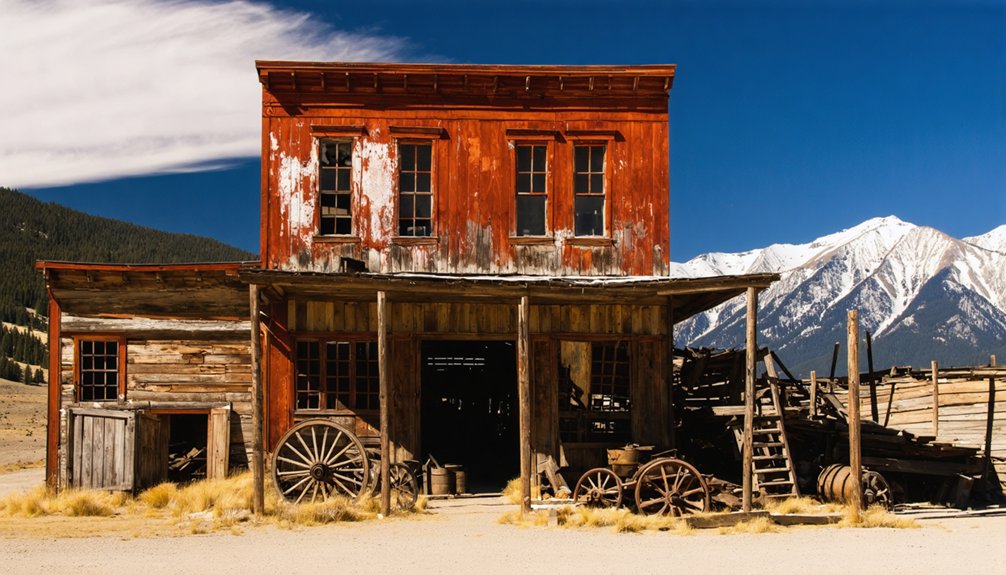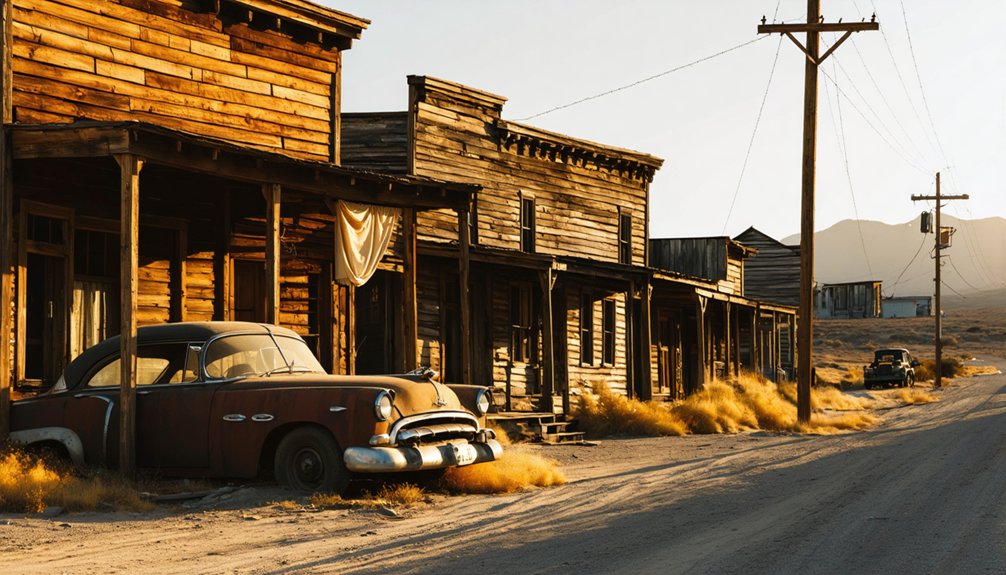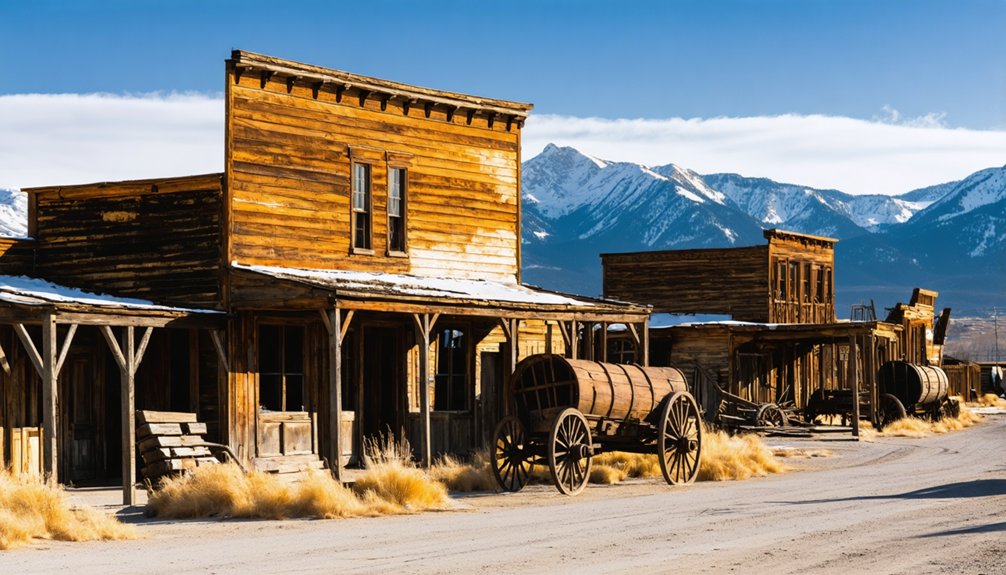
Exploring the Rocky Mountains’ abandoned Wild West towns offers glimpses into America’s mining heritage. You’ll discover well-preserved sites like St. Elmo with 43 original structures, architectural treasures from Victorian to log cabins, and legendary tales like Annabelle Stark’s ghost. Consider accessibility factors—some towns require standard vehicles while others need 4x4s—and prepare for high altitudes and weather fluctuations. These remote historical treasures await with untold frontier stories beneath their weathered facades.
Key Takeaways
- St. Elmo offers 43 preserved original structures accessible year-round via plowed roads with overnight cabin accommodations available.
- Hidden ghost towns like Nevadaville, Gothic, and Rico provide authentic glimpses into frontier life through diverse architectural styles.
- The Mary Murphy Mine and other historic claims showcase the economic foundation that supported these once-thriving Rocky Mountain communities.
- High altitude conditions require proper preparation with layered clothing, emergency gear, and appropriate hydration for safe exploration.
- Many abandoned towns contain museums with authenticated antiques, while some offer ghost tours highlighting local legends like Annabelle Stark.
The Rise and Fall of Mining Boomtowns

As the American West opened to exploration in the mid-nineteenth century, mining boomtowns erupted from the landscape with astonishing speed, transforming desolate wilderness into bustling centers of commerce and industry.
You’ll find their origins in the dramatic gold rushes of the 1850s and 1860s, when populations swelled from dozens to thousands within months. The California Gold Rush of 1848 sparked a massive global migration westward that would forever change the American landscape.
These communities thrived through mining innovations like hard rock excavation and coke-fueled smelting that accessed deeper veins, while railroads connected once-isolated settlements to wider markets.
The community dynamics reflected America’s diversity, with European immigrants and displaced groups forming distinct ethnic enclaves amidst the chaos of rapid growth.
Yet prosperity proved fleeting.
When ore veins tapped out or silver prices crashed after the 1893 Sherman Act repeal, these vibrant communities emptied just as quickly as they’d filled. The Bland-Allison Act of 1878 had previously created a silver boom by driving up prices, significantly accelerating mining operations throughout Colorado.
St. Elmo: Colorado’s Best-Preserved Ghost Town
When you visit St. Elmo, you’ll witness the impressive remains of a once-booming mining town that reached its peak in 1881 with nearly 2,000 residents and five hotels.
The town’s 43 original structures, including the general store, undertaker’s parlor, and telegraph office, stand as proof of the Stark family’s preservation efforts that culminated in National Historic District designation in 1979.
Today’s visitors can explore former mining roads as off-road vehicle trails and admire the well-preserved architecture while experiencing a genuine slice of Colorado’s mining heritage at 9,961 feet above sea level. The nearby Mary Murphy Mine produced over $60 million in gold during its operation, making it the most prosperous mine in the area. Local legend claims that the ghost of Annabelle Stark, known as “Dirty Annie,” still watches over the town to protect it from vandals.
Town’s Golden Era
During the 1880s, St. Elmo transformed from a fledgling settlement into a thriving nexus of commerce and culture. Following the gold rush that swept through Colorado’s Sawatch Range, the town’s population swelled to nearly 2,000 residents.
You’d have found a remarkable cultural diversity among its inhabitants, from rugged miners to shrewd merchants.
The economic backbone of St. Elmo consisted of over 150 patented mining claims extracting precious metals from the surrounding mountains. The Mary Murphy mine was particularly productive, yielding approximately 220,000 ounces of gold during its operation. The Denver South Park & Pacific Railroad provided vital transportation infrastructure, connecting this remote alpine community at 9,961 feet elevation to broader markets.
Walking through town during its heyday, you’d encounter five hotels, numerous saloons, dance halls, and essential services like telegraph and postal offices. It’s worth noting that the name shares no connection to the St. Elmo Society of Yale University despite similar frontier-era origins.
Saturday night revelries became legendary, particularly during the Alpine Tunnel construction period.
Preserved Building Features
Standing amid Colorado’s best-preserved ghost town, you’ll find St. Elmo’s architectural preservation showcases 43 original structures dating to the 1880s-1890s.
You can explore the authentic blacksmith and livery building, remnants of the American House Hotel, and the settlement-era school building—all surviving the devastating 2002 fire that claimed the town hall.
The Stark family’s dedication to historical authenticity preserved the General Store, which still operates today selling antiques and souvenirs.
Interior spaces reveal period-specific details with authenticated antiques and photographs displayed throughout accessible buildings like the undertaker’s parlor with its original furnishings. Located at an elevation of 9,961 feet in the Sawatch Range, the town offers visitors a true high-altitude mining town experience.
Notable preserved structures include the Telegraph Office, Heightley Cottage (circa 1881), and the Home Comfort Hotel—each offering glimpses into unfiltered frontier life without modern sanitization or commercial interference.
Before the railroad was abandoned in 1922, St. Elmo was a thriving community with 5 hotels, multiple saloons, and even its own newspaper office.
Modern Visitor Experience
Visitors to St. Elmo experience a rare blend of authentic Wild West preservation with limited modern amenities.
Though situated nearly 10,000 feet high in the Sawatch Range, the ghost town remains accessible year-round via plowed roads, approximately three hours from Denver.
The privately-owned site offers overnight cabin stays for those wishing to extend their exploration beyond day trips. After exploring the historic town, visitors can unwind at Mount Princeton Resort which offers natural hot springs just 12 miles away.
Your adventure options include:
- Self-guided tours along Main and Poplar Streets, where the General Store and Home Comfort Hotel contain authentic artifacts
- Off-road excursions on historic mining trails via ATV or jeep
- Ghost tours featuring the infamous Annabelle “Dirty Annie” Stark, whose spectral presence allegedly protects the town
Unlike completely abandoned ghost towns, St. Elmo’s handful of permanent residents maintain the site’s historical integrity while providing basic visitor services. Once home to over 2,000 residents during the peak gold rush days, the town offers a fascinating glimpse into Colorado’s mining heritage.
African American Heritage at Dearfield
You’ll find the remarkable vision of Oliver Toussaint Jackson at Dearfield, Colorado’s only all-Black agricultural colony established in 1910, which grew to nearly 700 residents and 19,000 acres during its 1917-1921 peak.
The community’s agricultural prosperity couldn’t withstand the devastating combination of falling crop prices, severe drought conditions, and the Great Depression, leading most residents to abandon their homesteads by the 1930s.
Today, Dearfield’s historical significance as a beacon of African American self-determination in the West is preserved through its National Register of Historic Places designation and ongoing conservation efforts by the Black American West Museum.
Black Pioneers’ Dreams
The vision of a self-sufficient Black community materialized in 1910 when Oliver Toussaint Jackson, an entrepreneur from Ohio and successful businessman from Boulder, established Dearfield on arid land in Weld County, Colorado.
Inspired by Booker T. Washington’s “Up From Slavery,” Jackson created a settlement where Black homesteading flourished despite initial challenges.
These pioneers achieved remarkable agricultural innovations:
- Mastered dry farming techniques to cultivate oats, corn, and alfalfa in unfavorable conditions
- Successfully grew water-intensive crops like watermelons without irrigation access
- Established a concrete block factory, creating economic diversification beyond farming
Depression Era Collapse
Despite enjoying remarkable agricultural success in its early years, Dearfield’s promising future unraveled dramatically as economic forces and environmental catastrophes converged in the mid-1920s.
Crop prices plummeted, creating severe economic hardship for farmers who lacked irrigation water rights from the nearby South Platte River.
The situation worsened when devastating drought conditions evolved into the catastrophic Dust Bowl of the 1930s.
Soil literally flipped over, destroying farms and shattering the community’s resilience. From a thriving settlement of 700 residents with dozens of wooden cabins, a church, and businesses, Dearfield hemorrhaged population as families abandoned their homesteads.
Only a handful of stubborn residents, including founder O.T. Jackson and blacksmith Squire Brockman, remained as evidence of the once-vibrant Black pioneer community that had mastered innovative dry farming techniques.
Preserving Historical Significance
Today, Dearfield’s weathered remains stand as silent witnesses to a remarkable chapter in African American history that nearly vanished into the dust.
Historical preservation efforts have focused on safeguarding this unique cultural heritage site—Colorado’s only all-Black agricultural colony established in 1910 by O.T. Jackson as a self-sufficient farming community.
When you visit these preserved buildings, you’ll connect with three profound aspects of Dearfield’s legacy:
- The entrepreneurial spirit of 300 Black pioneers who built economic independence through innovative dry farming techniques.
- The physical manifestation of African American westward migration and homesteading during the early 20th century.
- A rare intact example of Black self-determination in the American West, now recognized on the National Register of Historic Places.
Life at 10,000 Feet: Surviving Rocky Mountain Winters
Surviving winter in Rocky Mountain ghost towns presented perhaps the most formidable challenge for frontier settlers, where atmospheric oxygen plummets to just 14.3% of sea-level availability.
Your body would struggle dramatically during high altitude winter survival, with heart rate increasing 10-30% even at rest as your cardiovascular system worked overtime to deliver sufficient oxygen.
Without proper acclimatization, you’d face potentially deadly altitude sickness, while the combined effects of hypoxia and extreme cold would multiply your energy expenditure.
Settlers needed to maintain proper hydration despite increased respiratory rates, and consume additional calories when digestion naturally slowed.
The physiological stress was particularly dangerous during physical labor, where oxygen demands soared while your body simultaneously battled against freezing temperatures and the constant threat of snowstorms or avalanches.
What Remains: Architectural Treasures of the Wild West
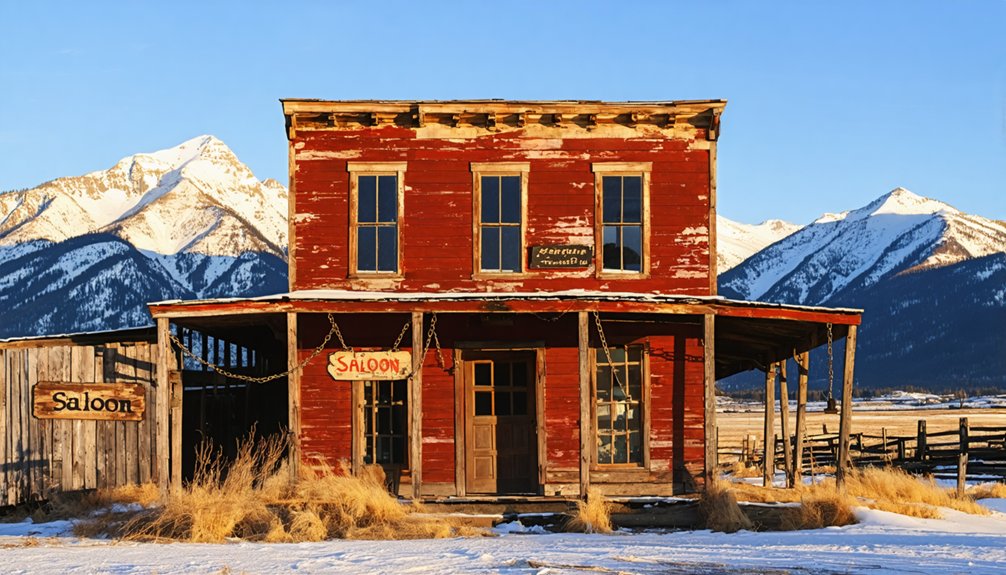
While settlers battled the harsh physiological realities of high-altitude winters, they left behind remarkable architectural remnants that now stand as silent witnesses to frontier life.
These structures reveal distinctive architectural styles from Victorian false-fronts to primitive log cabins, each demonstrating the resourcefulness of frontier settlers.
The historical significance of these buildings can’t be overstated.
You’ll find:
- South Park City’s 44 reconstructed buildings showcasing authentic Victorian mining town designs
- Gothic’s scientific repurposing of original structures at 11,000 feet elevation
- Virginia City’s meticulous preservation of Gold Rush architecture with authentic merchandise
When exploring these abandoned settlements, you’re witnessing more than weathered wood and rusting metal—you’re experiencing the physical manifestation of American frontier independence, preserved in architectural form despite the ravages of time and elements.
Hidden Gems: Lesser-Known Ghost Towns Worth Visiting
Beyond the well-trodden paths of famous ghost towns lie numerous hidden treasures that offer equally compelling glimpses into America’s frontier past.
Nevadaville, with its timber headframes and still-active Freemason lodge, preserves forgotten legacies between Central City and Black Hawk. The abandoned Prize Mine stands hidden behind aspen groves, nature slowly reclaiming what miners built.
For alpine exploration, consider Independence near Aspen or Gothic near Crested Butte, where scientific research now thrives where silver mining once dominated.
The Rocky Mountain National Park conceals Lulu City’s remains, where just nine cabin ruins mark what was once a 1,500-resident boomtown.
South-central Colorado offers additional hidden treasures in Bonanza, Rico, and Silver Cliff—towns where history remains largely untouched by mainstream tourism.
Planning Your Rocky Mountain Ghost Town Adventure
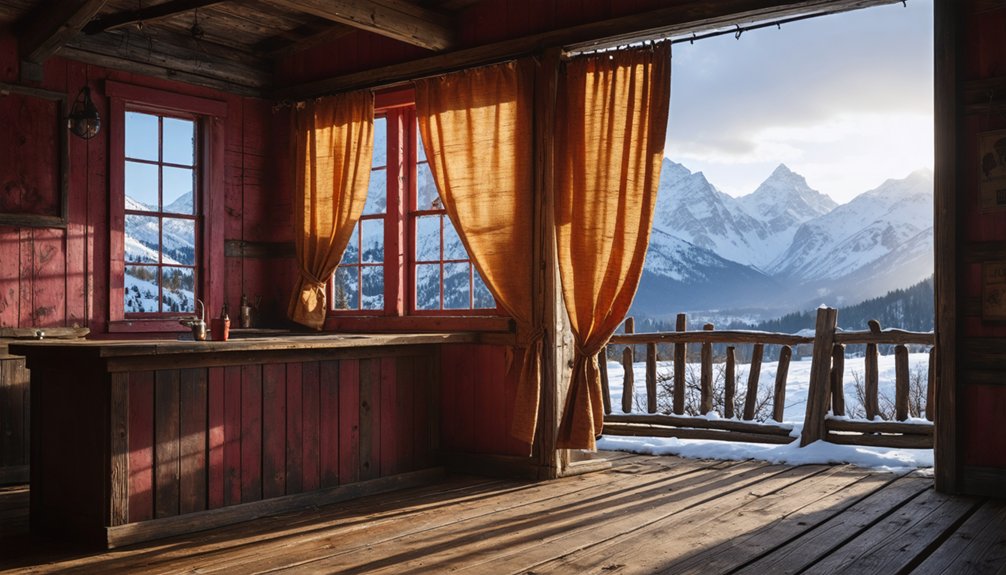
Starting a Rocky Mountain ghost town adventure requires methodical planning and preparation to guarantee both safety and historical immersion. Assess route accessibility before departure—towns like St. Elmo permit standard vehicles, while Animas Forks demands 4×4 capabilities.
Weather conditions dramatically affect road passability, necessitating current updates and offline navigation resources for areas lacking cell coverage.
Mountain weather dictates your journey—always check forecasts and download maps before losing signal.
At elevations exceeding 10,000 feet, prioritize these essential safety tips:
- Pack altitude sickness prevention supplies, including hydration systems and appropriate medications.
- Prepare for rapid weather shifts with layered clothing and emergency gear.
- Establish communication protocols with others about your planned route before venturing into remote areas.
Planning loop routes connecting multiple sites optimizes exploration efficiency while minimizing backtracking—the Alpine Loop offers a prime example connecting Silverton, Lake City, and Ouray.
Frequently Asked Questions
Are Ghost Towns Legally Protected From Treasure Hunting or Relic Removal?
With over 1,500 ghost towns in Colorado, you’ll face serious legal ramifications for treasure hunting without permission. Most sites are protected by state law, private property rights, and federal regulations against artifact removal.
Can Visitors Experience Paranormal Activities in These Abandoned Towns?
You’ll likely encounter ghostly encounters in these abandoned towns, especially in Crested Butte, St. Elmo, and Doyleville, where documented paranormal activities connect directly to their haunted history of mining disasters and sudden abandonment.
In addition to these captivating sites, you can explore other historic ghost towns in New Mexico that offer a unique glimpse into the past. Places like Silver City and Town of Lincoln are rich with stories of pioneers and outlaws, drawing visitors eager to learn about their colorful history. These locations not only showcase the remnants of bygone eras but also invite those brave enough to uncover the mysteries hidden within their crumbling walls.
Which Ghost Towns Are Accessible by Regular Vehicles Versus 4WD?
You can explore St. Elmo, Alta, Camp Bird Mine, Ironton Townsite, and Red Mountain Town with regular vehicles, while Animas Forks, Carson, Old Carson, Vicksburg, and Winfield require 4WD for ghost town accessibility.
Are Any Former Residents or Their Descendants Still Living Nearby?
Like finding a smartphone in a ghost town, you’ll discover descendants with historical significance in nearby communities. Local folklore connects families from Dearfield, St. Elmo, and Winfield through preservation societies and annual reunions.
What Wildlife Dangers Should Visitors Be Aware of When Exploring?
Watch for bears, mountain lions, rattlesnakes, and scorpions during your wildlife encounters. Store food properly, maintain distance, and carry bear spray as essential safety precautions in these remote environments.
References
- https://www.mycoloradoparks.com/park/rocky-mountain-ghost-town-ruins/
- https://www.denver7.com/news/local-news/colorado-ghost-towns-their-past-present-and-future-in-the-rocky-mountains
- https://thedyrt.com/magazine/local/colorado-ghost-towns/
- https://en.wikipedia.org/wiki/List_of_ghost_towns_in_Colorado
- https://www.colorado.com/articles/colorado-ghost-towns
- https://www.uncovercolorado.com/ghost-towns/
- https://www.coloradolifemagazine.com/printpage/post/index/id/172
- https://www.mountainliving.com/3-historic-mountain-ghost-towns-in-colorado/
- https://www.youtube.com/watch?v=SXVTtQjK8lU
- https://hobblecreek.us/blog/entry/mining-towns-of-the-old-west