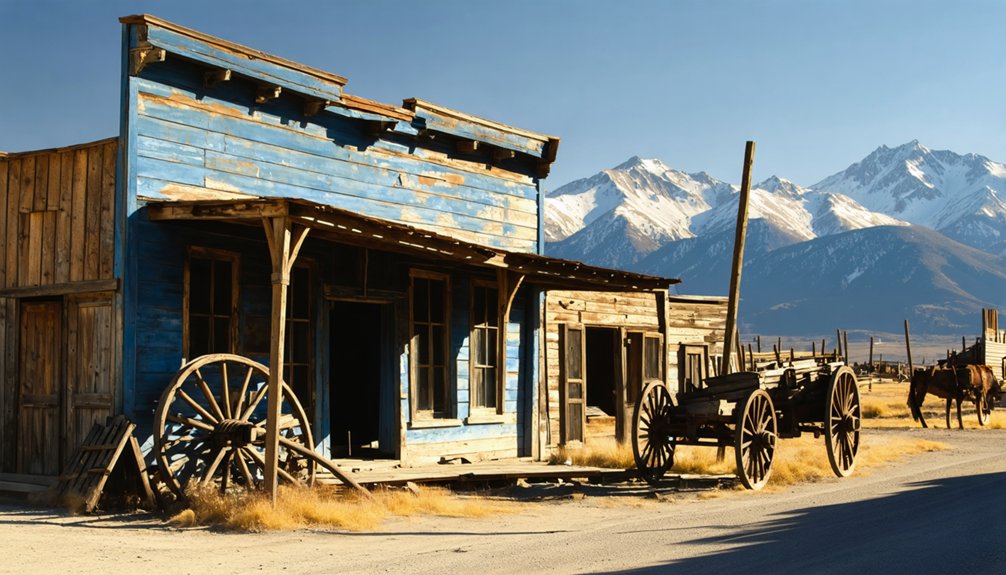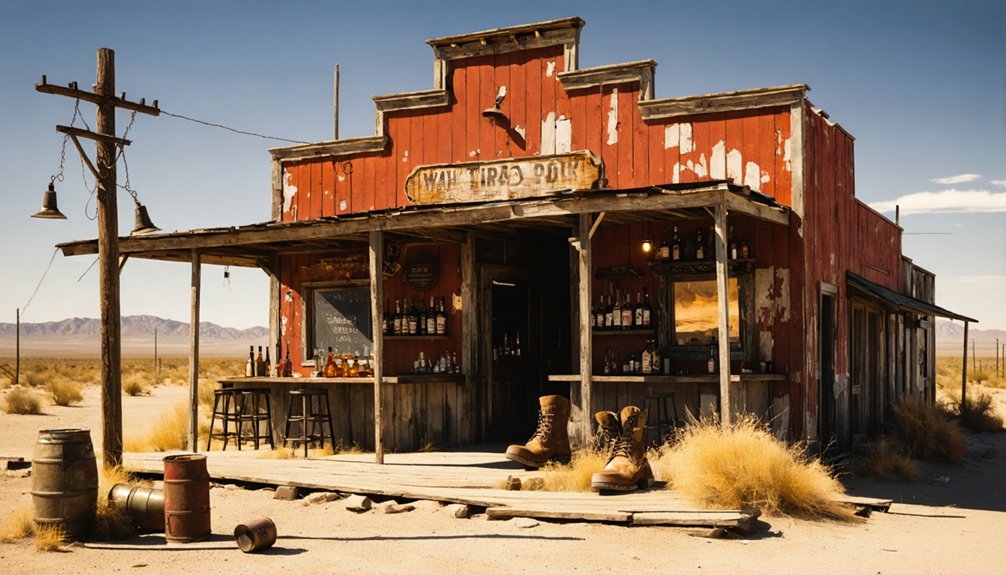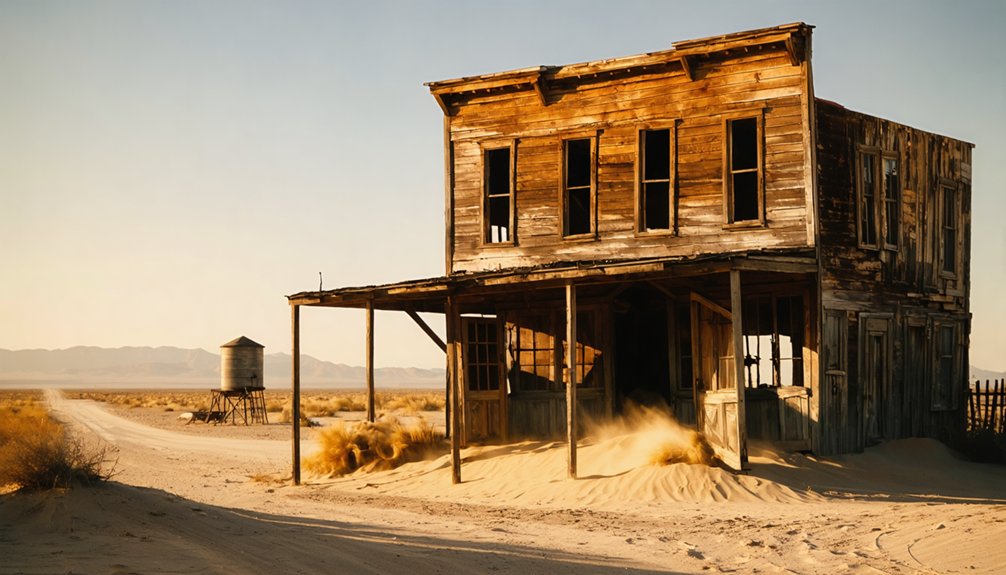
America’s ghost towns—numbering over 3,800—reveal the complex evolution of national development. You’ll discover abandoned mining settlements that once boomed from 100 to 20,000 residents, towns evacuated after environmental disasters like dioxin contamination, and communities slowly hollowed by economic shifts. These silent witnesses now serve as both historical time capsules and heritage tourism destinations. Modern preservation techniques, including 3D scanning, guarantee these haunting remnants will share their stories long after their physical structures have crumbled.
Key Takeaways
- America has over 3,800 documented ghost towns, with Texas (511), California (346), and Kansas (308) leading the count.
- Mining booms created rapid settlements like Virginia City, which grew from 100 to 20,000 residents before declining after mineral depletion.
- Environmental disasters forced abandonment of towns like Times Beach (dioxin contamination) and Valmeyer (flooding).
- Ghost towns like Bodie preserve “arrested decay” with original furnishings and architecture intact as historical time capsules.
- Abandoned settlements now function as tourist destinations with guided tours, seasonal events, and immersive digital experiences.
The Geography of Abandonment: Where America’s Ghost Towns Thrive
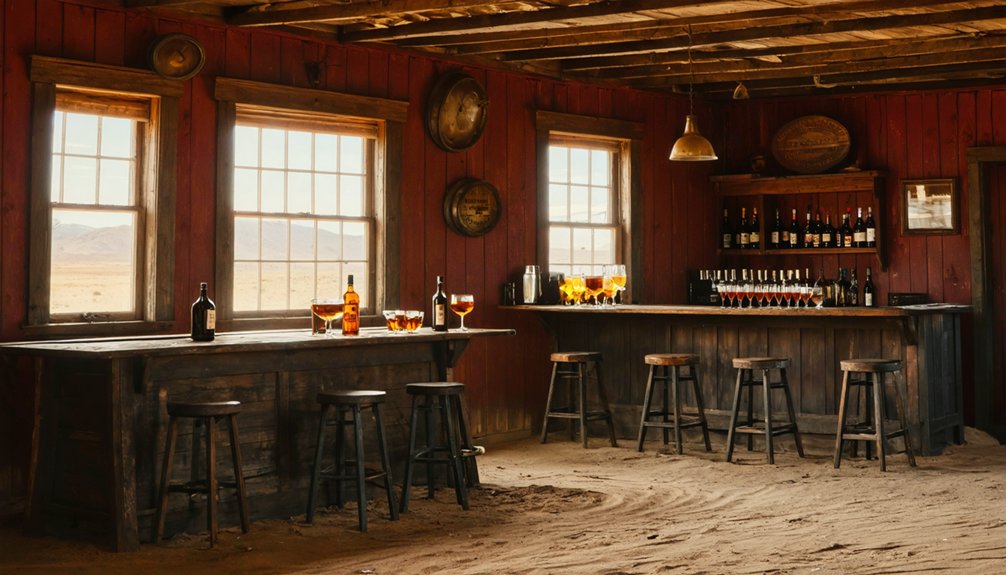
While the American landscape evokes images of bustling cities and thriving communities, it simultaneously harbors thousands of abandoned settlements that tell a different story of the nation’s development.
Behind America’s vibrant façade lie forgotten places that reveal our nation’s complex evolution.
You’ll find over 3,800 documented ghost towns scattered across the continental United States, with Texas leading at 511, followed by California (346) and Kansas (308).
Geographic influences have shaped distinct settlement patterns of abandonment. The Rocky Mountain and Sierra Nevada ranges cluster former mining communities, while the Great Plains’ ghost towns emerged from environmental devastation during the 1930s Dust Bowl.
Kern County, California hosts an astonishing 113 abandoned settlements, while Lawrence County, South Dakota contains 93 near the Black Hills mining region.
Conversely, northeastern states demonstrate remarkable stability, with Rhode Island claiming just a single ghost town. These high-resolution photos offer visitors a visual exploration of current ghost town conditions. These abandoned locations now offer unique opportunities through heritage tourism for visitors to experience America’s dynamic past.
Mining Booms and Busts: The Birth and Death of Western Settlements
When gold was discovered at Sutter’s Mill in 1849, it ignited a transformative cycle of boom-and-bust settlements that would define America’s western expansion for decades.
The mining impact on settlement patterns was dramatic and swift. You’d witness towns like Virginia City explode from 100 to 20,000 residents within two years following the Comstock Lode discovery.
These instant communities developed remarkable infrastructure—hotels, saloons, schools, and churches—within months of their founding. The Silverado mining district followed this pattern with the establishment of a private school for children, emphasizing its unusual character as a family town rather than a typical rough mining camp.
The economic drivers were substantial: ore yielding $50 per ton in silver fueled industrial development and railroad expansion. Electrification demands dramatically increased the value of copper, elevating towns like Butte, Montana to prominence.
Yet these communities existed on borrowed time. When minerals depleted, abandonment followed quickly. The stark male-to-female ratio of 9-to-1 reflected the transient nature of these settlements.
While most faded into ghost towns, some like Cripple Creek survived by reinventing themselves as tourist destinations.
When Nature Takes Back: Environmental Disasters That Emptied Towns
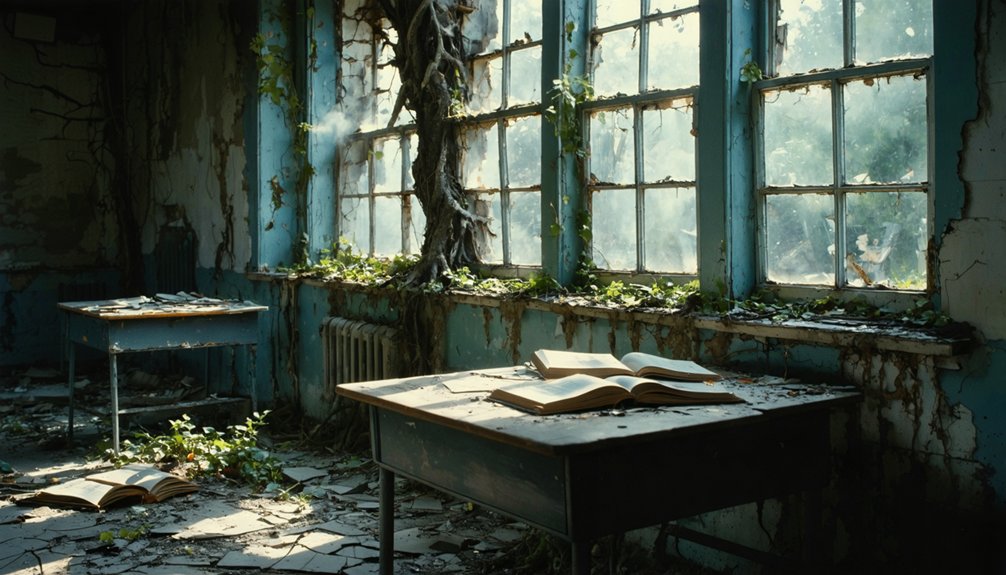
Unlike mining towns that collapsed due to economic factors, numerous American communities have been abandoned due to overwhelming environmental catastrophes.
You’ll find Times Beach, Missouri stands as a sobering example, where dioxin contamination from toxic waste spraying prompted federal evacuation in 1983.
Similarly, Valmeyer, Illinois demonstrates community resilience through relocation after the devastating 1993 Mississippi River floods.
The environmental impact of coastal erosion and hurricanes claimed both Burrwood, Louisiana and Holland Island, Maryland, with rising sea levels gradually submerging once-thriving settlements. Hurricane Betsy in 1965 marked one of the worst hurricanes for Burrwood until Katrina’s arrival in 2005.
Fort Jefferson, Florida suffered a similar fate after hurricane damage in 1906 made recovery impossible.
These ghost towns reveal nature’s formidable power to reclaim human settlements, despite our best efforts to establish permanent communities in vulnerable locations.
The Great Depression also contributed significantly to the economic decline of many towns that were already struggling with environmental challenges.
Economic Decline and Transportation Shifts: The Slow Fade of Communities
In contrast to the sudden abandonment caused by environmental catastrophes, economic decline has orchestrated a more gradual disappearance of American communities through shifting industrial landscapes and transportation patterns.
You’ll witness this slow fade most prominently in the upper Midwest, where manufacturing exodus triggered cascading failures across entire regions. Augusta, Georgia exemplifies this trend with the fourth-highest rental vacancy rate nationwide at 8.9%. Recent studies revealed that housing abandonment has moved from urban cores to suburban areas, particularly affecting outer ring suburbs in previously prosperous regions.
Economic migration patterns reveal sobering statistics: San Francisco’s 7.4% population drop leads metropolitan declines, with St. Louis and New York following closely behind.
Transportation hubs like Cincinnati’s have diminished into “faint shadows,” severing essential economic lifelines.
Meanwhile, urban decay manifests through retail vacancies—St. Louis exceeding national averages by 35%—creating visual markers that accelerate disinvestment.
The shift from production to service economies has created profound skill mismatches, while banking institutions redirect capital away from struggling downtowns, further starving communities of critical resources for potential revival.
Time Capsules: Preserved Architecture and Artifacts in Ghost Towns

America’s abandoned communities offer more than decaying structures and forgotten streets; they serve as pristine temporal repositories where artifacts and architecture stand frozen at the moment of departure.
You’ll witness this “arrested decay” principle most vividly in Bodie, California, where original furnishings and schoolhouse equipment remain untouched since the gold rush era.
The architectural preservation at sites like Fort Jefferson—America’s largest brick structure—and Batsto Village’s 18th-century industrial complex illustrates diverse historical periods.
When you visit Virginia City or St. Elmo, you’ll encounter mining tools and household objects displayed in situ, providing authentic context rather than museum recreations.
Conservation agencies maintain these time capsules through careful protocols that prevent deterioration while avoiding modern reconstruction, ensuring these historical artifacts continue telling America’s story of boom, bust, and abandonment.
Towns like Garnet, Montana host annual visitor events that allow tourists to experience the authentic remnants of 1890s mining life firsthand.
Rhyolite, Nevada serves as another remarkable example, with its unique Bottle House and train depot remaining as testament to the rapid boom-and-bust cycle of early 20th-century mining towns.
Underwater Memories: America’s Submerged Ghost Settlements
While ghost towns across the American landscape preserve their history in the open air, a more enigmatic category of abandoned settlements lies hidden beneath reservoir waters, their streets and structures silenced by deliberate flooding.
Among these forgotten remnants are abandoned gold mines in Nevada, where the glint of untold wealth once attracted hopeful prospectors. Now, these silent tunnels echo the dreams and fears of those who sought fortune in the arid landscape. Exploring these sites reveals not only the harsh realities of mining life but also the profound beauty of the desolate surroundings.
These submerged memories represent America’s complex relationship with progress and displacement.
The underwater archaeology reveals:
- The Tennessee Valley Authority’s dam projects of the 1930s-40s submerged entire communities like Proctor, Loyston, and Butler.
- Lake Hartwell consumed Andersonville’s remains in the early 1960s, accelerating its economic decline.
- Toledo Bend Reservoir, filled by 1969, engulfed farming communities along the Texas-Louisiana border.
- Cemetery relocations accompanied these projects, with some families forced to exhume loved ones while other burial grounds remained permanently underwater.
The Last Residents: Those Who Refused to Leave

Throughout America’s ghost town narratives, the most compelling stories often belong to the holdouts—those residents who stubbornly refused to abandon their communities despite overwhelming economic collapse, population exodus, and infrastructure decay.
In places like Detroit, where nearly 30% of homes sit vacant for years, and St. Louis, with its plummeting building permits, you’ll find defiant spirits making their last stand.
These individuals remain even as San Francisco lost 7.4% of its population and New York City saw 6.2% depart between 2020-2023.
When highways diverted from small Texas towns and rural hospitals shuttered, most residents fled.
Yet in communities like Claude, some maintained essential services despite neighboring towns becoming virtual ghost towns.
Eastern panhandle settlements with just 30 inhabitants represent the ultimate holdouts—people who’ve chosen to witness their community’s final chapter.
From Forgotten to Famous: Ghost Towns as Tourist Destinations
Where the last residents once stood as witnesses to decline, a surprising reversal of fortune has emerged for many abandoned settlements across the United States. Through heritage preservation efforts and strategic development, these historical relics have transformed into centers of ghostly tourism that contribute substantially to local economies.
- You’ll find towns like Bodie and St. Elmo functioning as living museums, maintaining “arrested decay” to authentically showcase 19th-century mining life.
- Your visit supports job creation in hospitality, tour guiding, and artifact preservation.
- You’re participating in educational tourism that communicates complex narratives about boom-and-bust economic cycles.
- Your experience may include seasonal events, guided tours, or paranormal investigations designed to boost tourism revenue while preserving historical integrity.
Digital Preservation: How Technology Documents Vanishing Places
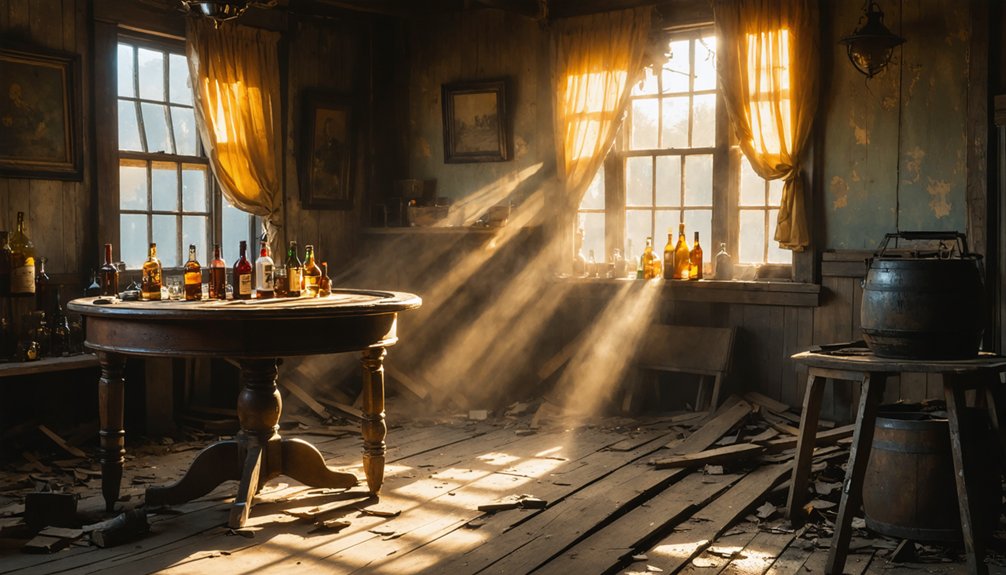
As abandoned settlements gradually surrender to the elements, cutting-edge technologies have emerged to document America’s ghost towns in unprecedented detail before they disappear entirely.
Through digital documentation efforts, these fragile historical sites gain immortality in virtual form. You’ll find 3D scanning and drone photogrammetry creating precise digital twins of crumbling structures, while GIS platforms overlay historical data with current environmental conditions to track deterioration patterns.
Digital preservation breathes eternal life into our disappearing heritage, capturing every weathered detail for future generations.
The technology impact extends beyond mere recording—AI algorithms now process vast datasets to identify architectural features invisible to the naked eye.
Virtual and augmented reality applications transform these digital archives into immersive experiences, letting you walk through restored versions of decayed towns.
Community involvement further enhances preservation through citizen science platforms where your contributions help document these vanishing legacies to America’s past.
Frequently Asked Questions
Are Ghost Towns Legally Accessible or Considered Trespassing?
You’ll encounter legal implications when entering ghost towns, as they’re often private abandoned properties. Some are publicly accessible historic sites, while others require permission to avoid trespassing charges.
How Do Paranormal Investigators Document Supernatural Activity in Ghost Towns?
You’ll document supernatural phenomena through meticulous EVP recordings capturing disembodied voices, while employing spirit photography techniques to reveal apparitions invisible to the naked eye—all methodically logged with precise environmental context.
Can Someone Purchase and Restore an Abandoned Ghost Town?
Yes, you can purchase ghost towns through standard real estate processes, though ghost town ownership involves managing complex restoration challenges including infrastructural deterioration, regulatory requirements, and substantial financial investments for successful revitalization.
What Safety Precautions Should Visitors Take When Exploring Ghost Towns?
Like walking through time’s crumbling doorway, you’ll need safety gear including sturdy boots, first aid kits, and respirators. Always inform others of your route, respect structures, and watch for wildlife hazards.
Do Indigenous Communities Have Connections to Ghost Town Territories?
Yes, you’ll find significant Indigenous connections to ghost towns, where cultural heritage remains embedded in these territories despite displacement. Their historical significance often predates settler occupation that created these abandoned settlements.
References
- https://www.lincolninst.edu/publications/articles/new-american-ghost-towns/
- https://infrastructureusa.org/spooky-infrastructure-ghost-towns-across-the-united-states/
- https://www.geotab.com/ghost-towns/
- https://devblog.batchgeo.com/ghost-towns/
- https://www.loveexploring.com/gallerylist/188219/the-us-state-with-the-most-ghost-towns-revealed
- https://nightofthejack.com/2025/01/23/top-creepy-ghost-towns-in-america/
- https://247wallst.com/special-report/2018/11/02/30-american-ghost-towns-3/
- https://figshare.le.ac.uk/articles/thesis/The_Archaeology_of_Abandonment_Ghost_Towns_of_the_American_West/10120007
- https://en.wikipedia.org/wiki/Lists_of_ghost_towns_in_the_United_States
- https://joybird.com/blog/top-ghost-towns-in-america/