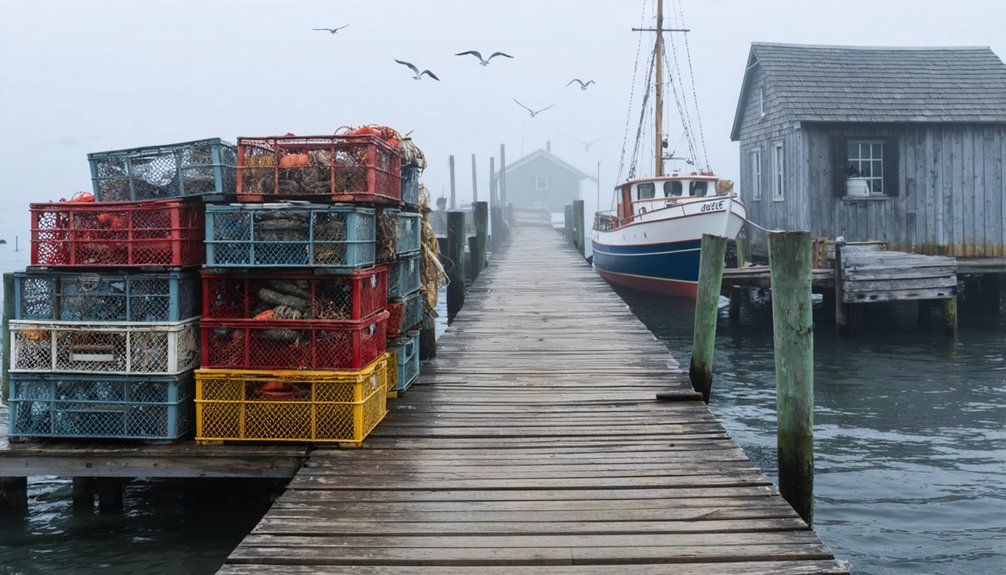
You’ll discover America’s coastal fishing villages through both living traditions and archaeological remains. From Carrabelle’s 19th-century maritime legacy to Cortez Village’s 97 historic structures, these communities maintain authentic cultural continuity. Explore Port Townsend’s Victorian architecture, Gloucester’s 400-year fishing heritage, and ancient shell rings dating back 4,200 years. These sites reveal how fishing communities have adapted to environmental challenges while preserving traditional practices across generations.
Key Takeaways
- Carrabelle preserves authentic fishing heritage with operations dating to the 1800s and was Florida’s first exporter of salted mullet.
- Cortez Village features 97 historic structures including original fishermen’s cottages still inhabited by descendants of founding families.
- Port Townsend maintains functioning boatyards and traditional wooden vessel construction as part of its Victorian seaport heritage.
- Archaeological shell rings along southeastern coastlines provide evidence of sophisticated fishing communities dating back 4,200 years.
- Stonington demonstrates sustainable fishing practices through its cooperative model established in 1948 and multi-generational knowledge transfer.
The Enduring Legacy of Carrabelle: Florida’s Panhandle Fishing Haven
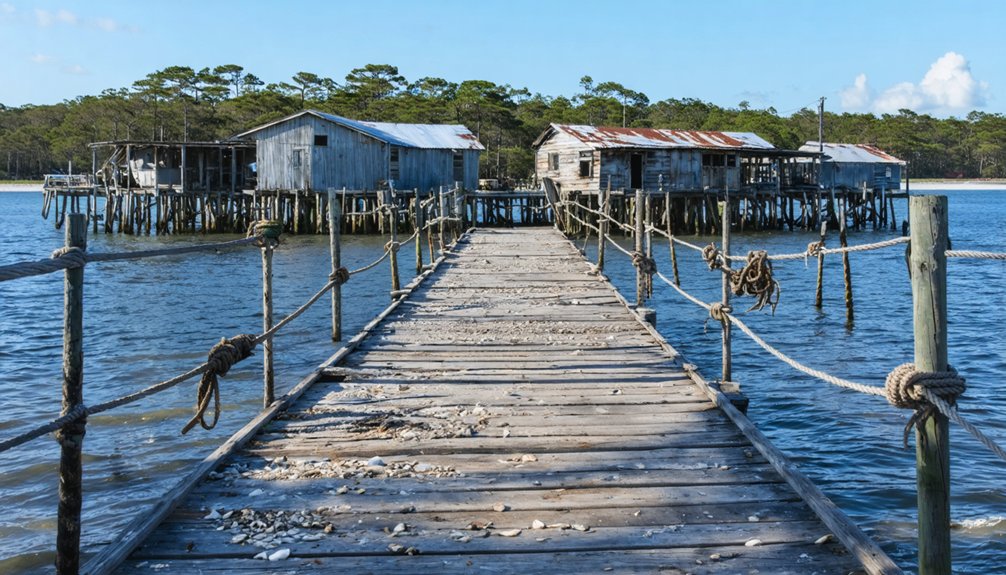
Nestled along Florida’s forgotten coast, Carrabelle represents one of America’s most authentic remaining fishing villages, with documented maritime activities dating to the early 1800s.
You’ll find this fishing heritage preserved in both practice and artifact—from the continued commercial harvesting operations to the museum’s chronicles of mullet and snapper expeditions that have sustained local economies for over two centuries.
Originally named “Rio Carrabella,” the settlement’s economic evolution traces a complex interdisciplinary narrative: pre-Civil War subsistence fishing transformed into industrial-scale operations following the 1875 establishment of lumber mills, with strategic rail connections facilitating seafood exports to northern markets.
Economic adaptability defines Carrabelle’s journey from subsistence fishing to industrial production through strategic transportation networks.
When timber industries declined post-WWI, Carrabelle’s adaptive community pivoted back to maritime endeavors, developing party fishing tourism in the 1950s that attracted even country music luminaries. Today, visitors can enjoy fresh seafood cuisine at dockside restaurants while overlooking the beautiful blue harbor. Carrabelle holds the distinction of being the first location in Florida to export salted mullet by train, establishing its importance in the state’s early seafood industry.
Cortez Village: Preserving Florida’s Maritime Heritage Since the 1890s
A coastal vestige of nineteenth-century maritime tradition, Cortez Village stands as one of Florida’s last authentic commercial fishing communities, with origins dating to the 1880s when North Carolinian fishing families from Carteret County established the settlement initially called Hunter’s Point.
The village’s resilience through the devastating 1921 hurricane and Great Depression exemplifies the tenacity of Cortez culture. You’ll find 97 historic structures on the National Register, with many original cottages still inhabited by descendants of founders. The village notably required no federal aid during the Great Depression, showcasing its self-sufficiency and strong community bonds. The historic Bratton Store, built in the 1890s, was the first commercial establishment in the village and housed essential services including the post office.
Despite the 1990s mullet net ban that transformed century-old practices, locals adapted while maintaining their maritime heritage. The Florida Maritime Museum and annual Commercial Fishing Festival document this living history, while collaboration with F.I.S.H. demonstrates the community’s commitment to fisheries sustainability and environmental conservation amid increasing development pressures.
Maine’s Stonington: Generations of Lobster Fishing Expertise
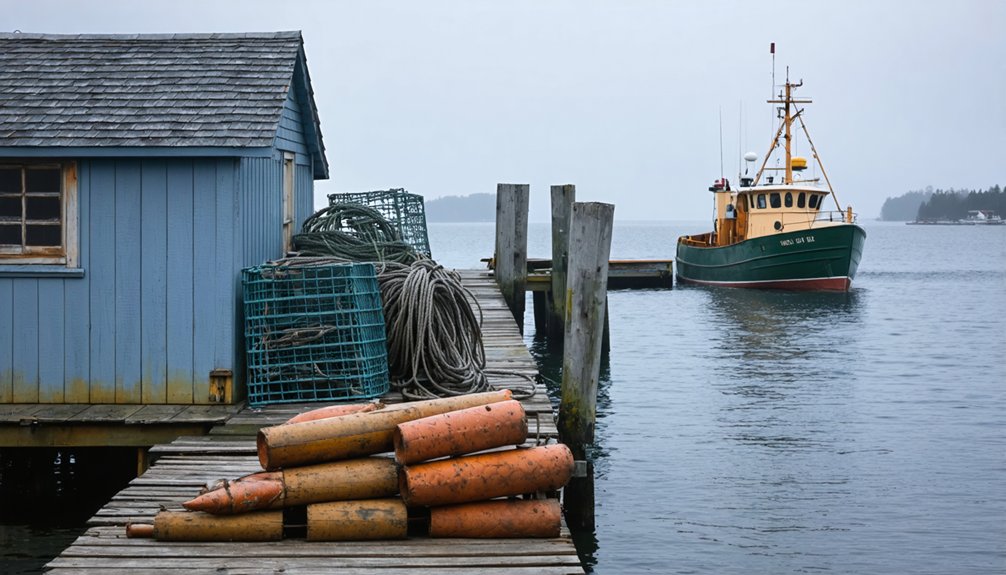
Perched at the southern tip of Deer Isle, Stonington stands as Maine’s preeminent lobster harbor, where the cooperative model has sustained both marine ecosystems and cultural heritage since 1948.
You’ll find lobster sustainability principles embedded in multi-generational knowledge transfer systems, wherein trap evolution progressed from wooden lath constructs to wire mesh in the 1970s.
The Co-op’s 80+ working members participate in cooperative management through self-imposed catch limits and apprenticeship protocols, effectively preventing corporate consolidation while maintaining owner-operator paradigms.
Regulatory frameworks, championed by Stonington representatives like Ed Blackmore, extend conservation measures from inshore waters to 25 miles offshore under Atlantic States Marine Fisheries Commission jurisdiction.
The Co-op’s infrastructure—strategically positioned docks and processing facilities—serves as both economic hub and knowledge exchange nexus, where competitive fishermen unite despite territorial rivalries to guarantee inter-generational stewardship. Remarkably, Maine’s lobster landings have increased from a modest 17 million pounds in 1973 to an impressive 109 million pounds in 2023. Members receive annual dividends based on their catch volume, reinforcing the collective economic benefit of cooperative participation.
Gloucester: America’s Oldest Working Fishing Port
Founded in 1623 by the Dorchester Company, Gloucester holds the distinction as America’s oldest continuously operating fishing port, predating even Stonington’s established maritime traditions.
Originally inhabited by the Agawam people, this Cape Ann settlement evolved from a small outpost to a pivotal maritime hub. The harbor was first mapped by Champlain in 1605-06, establishing its geographic significance well before European settlement.
You’ll observe the evolution of fishing techniques documented in Gloucester’s architectural landscape—from the gill-net fishing revolution of the 1870s to the shift from wooden schooners to steel draggers mid-century.
The Eastern Point Lighthouse (1833) and the Fisherman’s Memorial statue (1923) exemplify the community’s commitment to historic preservation while honoring over 10,000 lives lost at sea.
The port’s cultural identity was further enriched by Portuguese and Italian immigrants, contributing to Gloucester’s enduring legacy as a working seaport with approximately 30,730 residents maintaining America’s maritime heritage.
The historic Rocky Neck colony continues to inspire artists who are drawn to Gloucester’s picturesque harbor and maritime charm, just as they have been for generations.
Pacific Northwest Traditions: Astoria’s Fishing and Canning History
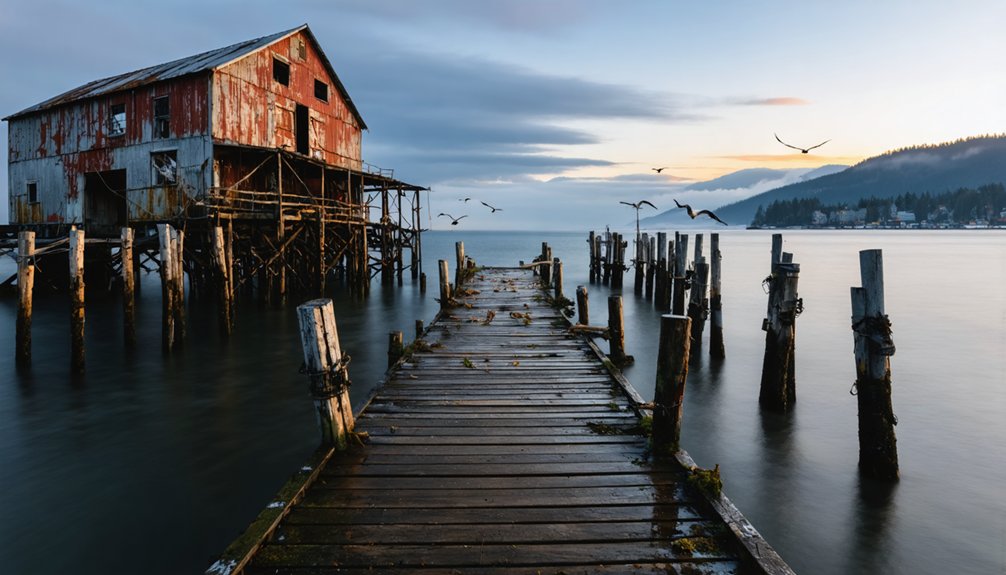
Located at the mouth of the Columbia River where it meets the Pacific Ocean, Astoria represents a quintessential example of maritime industry evolution in the Pacific Northwest.
The region’s fishing heritage began with fur traders in the early 19th century before evolving to salmon canning—earning Astoria the title “Salmon Canning Capital of the World” by the late 1800s. The indigenous Chinook people had established thriving fishing societies centuries before European contact. The Hudson’s Bay Company made significant contributions when they began packing salmon for export in 1823.
You’ll discover Astoria traditions deeply influenced by immigrant labor patterns: Chinese workers initially dominated processing operations until the 1882 Exclusion Act, after which Scandinavian immigrants reshaped the cultural landscape.
The Columbia River Packers Association‘s 1899 consolidation centralized operations until the industry’s decline in 1980.
Despite these changes, Astoria’s economy maintains fishing connections while diversifying through tourism, with recent Dungeness and shrimp harvests demonstrating continued maritime resilience.
Port Townsend’s Victorian Waterfront and Wooden Boat Culture
You’ll find Port Townsend’s status as one of America’s three surviving Victorian seaports evidenced in its 1880s Queen Anne and Eastlake architecture, preserved largely due to economic downturns following the 1893 national crisis.
The waterfront district, designated a National Historic Landmark in 1977, maintains functioning boatyards where traditional wooden vessel construction continues through institutions like the Northwest School of Wooden Boatbuilding.
Maritime traditions persist in this deep-harbor port through annual celebrations such as the Wooden Boat Festival, which documents the integration of historical shipbuilding techniques with contemporary fishing practices.
Maritime Architecture Preserved
While preserving its maritime heritage through careful architectural conservation, Port Townsend stands as one of only three surviving Victorian-era seaports in the United States, earning National Historic Landmark designation in 1977.
The district’s waterfront preservation efforts maintain the authenticity of late 19th-century commercial structures that once served as the Pacific Northwest’s customs gateway.
You’ll discover three distinct architectural zones:
- Commercial Core – Richardsonian Romanesque buildings (2-4 stories) featuring progressive elements like the Hastings Building’s 96″x100″ plate glass storefronts
- Residential Bluff – Queen Anne, Stick, and Eastlake Victorian architecture showcasing period socioeconomic stratification
- Institutional Structures – Romanesque Revival government buildings including the Jefferson County Courthouse with its 124-foot clock tower
This living maritime museum liberates you from contemporary architectural homogeneity.
Boat Building Heritage
Port Townsend’s wooden boat heritage emerged from humble beginnings in the late 1960s, when Skookum Marine’s relocation from Seattle catalyzed the development of a robust maritime industry infrastructure.
By the 1970s, you’d find a diversity of boat craftsmanship traditions flourishing—Chinook Marine pioneered fiberglass construction while Ron Radon brought his expertise in fast fish boats from California in 1973.
The establishment of the Northwest School of Wooden Boatbuilding (1981) and Port Townsend Shipwrights Co-op (1980) institutionalized traditional techniques and educational pathways.
The Wooden Boat Festival, initiated in 1977, transformed from a local gathering into a premier maritime event attracting 30,000 visitors annually.
This convergence of skilled labor, educational infrastructure, and cultural celebration cultivated a self-sustaining ecosystem where approximately 20% of vessels in local marinas showcase wooden construction methodologies spanning 120+ years.
Ongoing Fishing Traditions
Nestled within the sheltered harbor of Puget Sound, Port Townsend’s Victorian waterfront continues to function as a living tribute to the region’s enduring fishing heritage.
The reconstructed Union Wharf (1996) integrates historical preservation with working marina functionality, supporting both commercial fisheries and recreational vessels.
You’ll discover a thriving maritime heritage anchored by three key elements:
- Active commercial fishing operations harvesting salmon, shellfish, and groundfish from traditional grounds
- Wooden boat culture emphasizing vessel maintenance techniques and craftsmanship derived from centuries-old maritime traditions
- Seasonal fishing festivals celebrating indigenous Klallam practices alongside Victorian-era fishing methodologies
The waterfront balances economic viability with historic conservation, allowing you to experience authentic fishing traditions while respecting treaty rights.
This symbiotic relationship between past and present continues to define Port Townsend’s maritime identity.
Archaeological Discoveries: Shell Rings and Pre-Pottery Fishing Settlements
Along the southeastern U.S. coastline, you’ll encounter circular or semi-circular shell rings dating from 4,200-3,000 years B.P., representing some of North America’s earliest coastal settlements.
These anthropogenic structures, composed primarily of discarded oyster shells reaching heights of 9 feet and diameters of 300 feet, typically encircle central plazas that functioned as communal spaces for ceremonies, trade, and social gatherings.
Archaeological evidence suggests these shell rings weren’t merely waste accumulation sites but intentionally constructed village layouts where dome-shaped dwellings clustered around central areas, indicating sophisticated social organization among Late Archaic coastal peoples.
Coastal Settlement Patterns
Archaeological investigations along the South Atlantic Coast have revealed complex settlement patterns in pre-pottery fishing communities, characterized by distinct shell ring formations that predate ceramic technologies.
You’ll find Hokfv-Mocvse (9CH160) representing the oldest documented shell ring, establishing the historical significance of these fishing innovations.
The settlement evolution demonstrates sophisticated coastal adaptation through:
- Initial isolated village rings with minimal clustering
- Shift to multiple contemporaneous villages after 4500 cal BP
- Geographical dispersal across various islands and coastal areas
Bayesian statistical modeling has provided high-resolution chronologies documenting this shift from concentrated to dispersed settlements.
Feature-rich habitation zones along plaza edges contained abundant artifacts, while pits and posts concentrated in ring gaps indicate organized community spatial planning—evidence of deliberate social structure in these pre-ceramic maritime societies.
Shell Ring Construction
During the Archaic period (5000-3000 BP), indigenous coastal communities constructed monumental shell rings that represent North America’s earliest large-scale architecture and permanent settlements.
These circular or semi-circular structures, primarily composed of oyster shells, reached 3-4 feet in height and 30-170+ feet in diameter, demonstrating sophisticated spatial organization.
The shell ring significance extends beyond mere refuse disposal; they functioned as ceremonial centers, territorial markers, and communal gathering spaces where homes encircled central plazas.
Their strategic positioning near estuaries reflects intimate knowledge of coastal ecology, with distinct regional variations—Florida’s U-shaped rings open toward land while South Carolina’s C-shaped variants face marshlands.
This architectural differentiation likely reflects sociopolitical distinctions between communities that maintained these impressive structures through fluctuating environmental conditions, showcasing indigenous resilience across a millennium of continuous occupation.
Passing the Torch: How Fishing Villages Maintain Cultural Continuity
Despite mounting environmental and socioeconomic pressures, fishing villages in coastal United States have established multifaceted mechanisms for maintaining cultural continuity across generations.
These communities leverage cultural storytelling and community resilience to preserve their heritage while adapting to change—a process documented extensively in Gullah/Geechee communities and St. Croix’s Gallows Bay.
You’ll find three primary continuity mechanisms in these communities:
- Intergenerational knowledge transfer – Traditional harvesting techniques and seasonal rhythms passed through familial apprenticeship
- Place-based heritage narratives – Community identity reinforced through collective storytelling despite geographic dispersal
- Adaptive diversification – Strategic occupational flexibility while maintaining fishing as a cultural cornerstone
Archaeological evidence from shell ring sites provides context for understanding this resilience, revealing how fishing traditions have anchored coastal cultural identity for millennia despite continual environmental and regulatory challenges.
the historical significance of fishing villages extends beyond their economic contributions; they serve as a testament to the adaptable and enduring spirit of local communities. By fostering unique cultural practices and a strong sense of place, these villages have shaped regional identities and responses to ecological changes over generations. As custodians of fishing knowledge, the inhabitants have ensured that traditional methods are passed down, preserving their heritage in an ever-evolving landscape.
Frequently Asked Questions
What Environmental Threats Do Historic Fishing Villages Currently Face?
You’re witnessing accelerated coastal erosion from sea level rise, pollution impacts including nutrient runoff affecting 60% of coastal waters, habitat degradation of essential fish nurseries, and intensifying extreme weather events threatening village infrastructure.
How Have Fishing Quotas Impacted Village Economies and Populations?
You’re witnessing quota effects dismantling village socioeconomic structures through forced outmigration, reduced commercial activity, and cultural dissolution. Resource access limitations fundamentally challenge fishing communities’ economic sustainability, triggering cascading interdependent sector contractions and demographic shifts.
Can Visitors Participate in Commercial Fishing Experiences?
You can access commercial fishing tours in 74% of coastal villages. Local fishing workshops provide hands-on experience with industry-standard equipment while adhering to regulatory frameworks that permit controlled visitor participation in commercial operations.
What Government Programs Exist to Preserve Historic Fishing Communities?
You’ll find the Historic Preservation Program, Rivers and Trails Conservation, and ATBC initiatives actively preserving fishing heritage through community engagement, strategic ecosystem restoration, and interdisciplinary documentation of maritime cultural landscapes.
How Has Climate Change Altered Traditional Fishing Patterns?
You’re witnessing profound disruption as shifting habitats force migratory species northward, altering catch compositions, reducing yields, and compelling adaptation to unfamiliar grounds where hydrographic conditions fundamentally transform traditional fishing patterns you’ve historically relied upon.
References
- https://worthydetours.com/carrabelle-the-sleepy-fishing-village-on-floridas-forgotten-coast/
- https://airial.travel/attractions/united-states/cortez/cortez-historic-fishing-village-ewaZDs2X
- https://www.nature.com/articles/s41598-024-55047-z
- https://herlifeadventures.com/8-historic-us-coastal-towns-where-fishing-culture-still-thrives/
- https://vanlifebydesign.com/2025/08/19/charming-fishing-villages-on-the-coast-of-maine/
- https://www.topworldrank.com/cities/photogenic-fishing-villages/
- https://www.worldatlas.com/cities/9-of-the-most-captivating-small-towns-on-the-atlantic-coast.html
- https://www.floridasforgottencoast.com/carrabelle-history/
- https://www.floridianamagazine.com/carrabelle-florida-get-hooked/
- https://guidesly.com/fishing/places/carrabelle-fl-fishing-a-small-and-charming-coastal-city-on-the-florida-panhandle