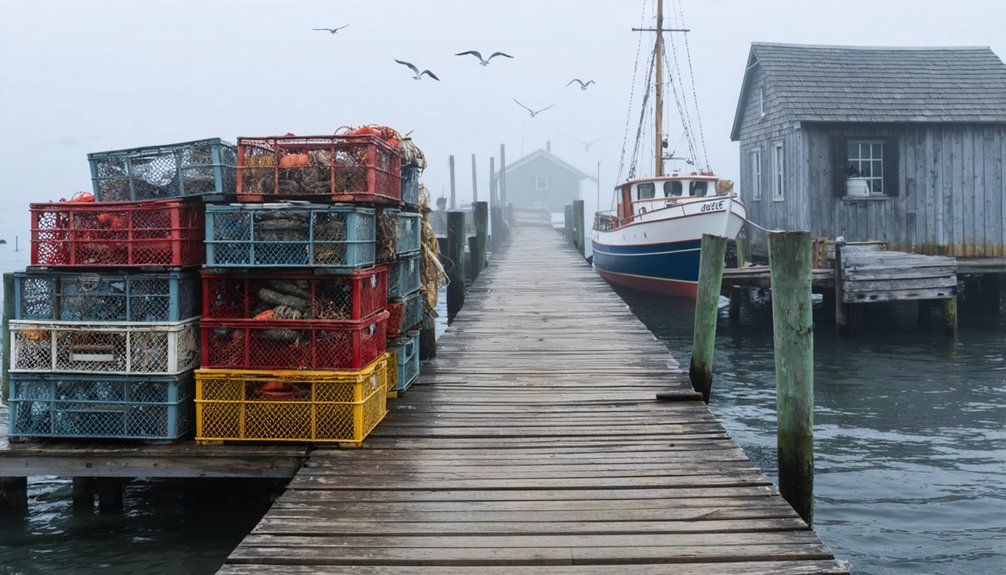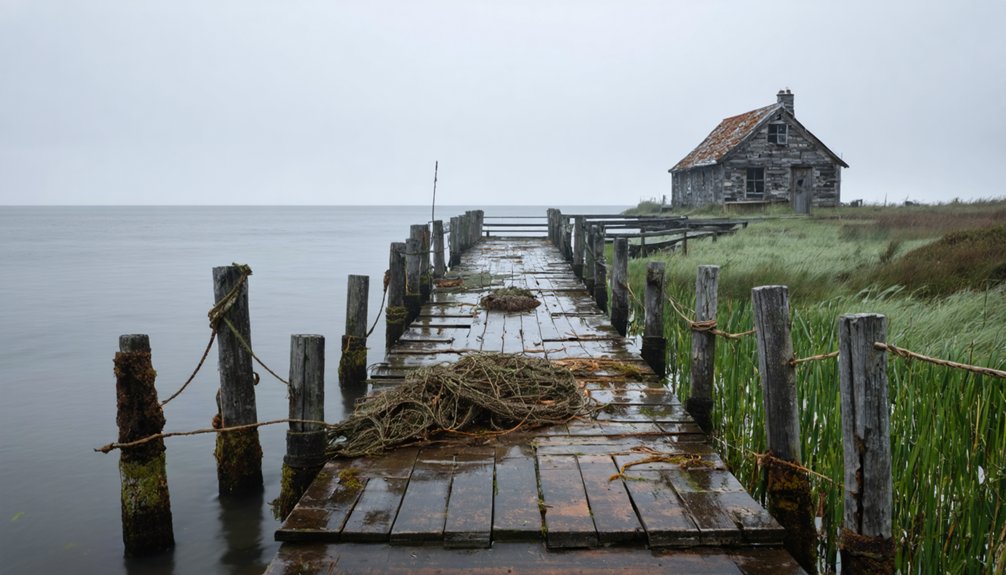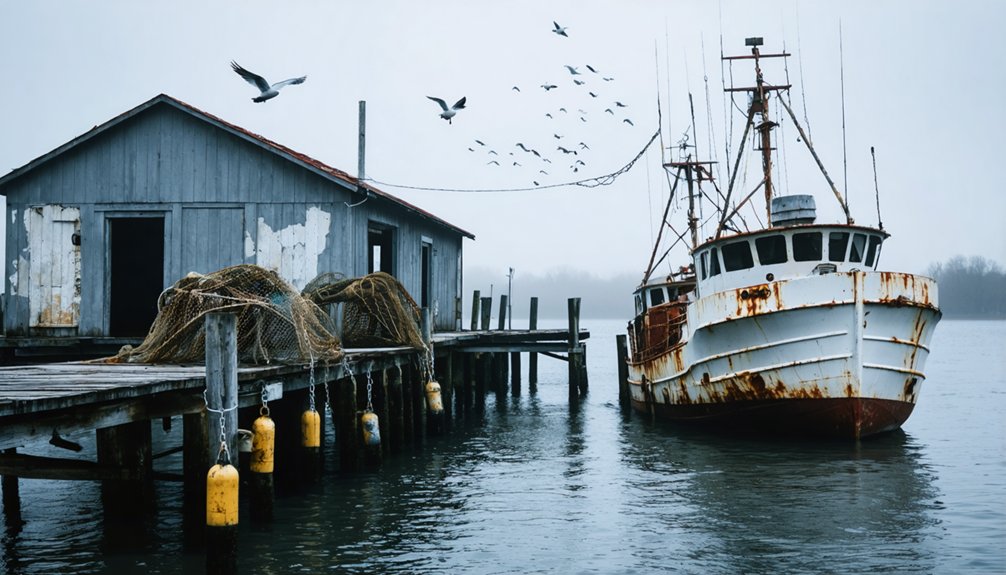
America’s coastal landscapes reveal centuries of maritime heritage—from 13,000-year-old Indigenous fishing sites to colonial cod villages that built the nation’s first economy. You’ll find weathered ghost towns like Cape Lookout Village surrendering to nature alongside resilient communities that’ve adapted to environmental challenges through diversification and sustainable practices. Today’s coastal destinations balance preservation of authentic fishing culture with tourism that breathes new life into harbors once bustling with schooners and trawlers.
Key Takeaways
- Abandoned fishing communities along the Atlantic Coast preserve maritime heritage through weathered structures and rich folklore.
- Communities like Gloucester and New Bedford demonstrate successful adaptation through economic diversification beyond traditional fishing.
- Historical sites like Cape Lookout Village showcase how isolation and environmental factors contributed to community abandonment.
- Tourism development in former fishing villages creates sustainable economic alternatives while preserving cultural heritage.
- Archaeological preservation efforts document submerged cultural resources and transform deteriorating structures into educational spaces.
The Ancient Roots of American Coastal Communities
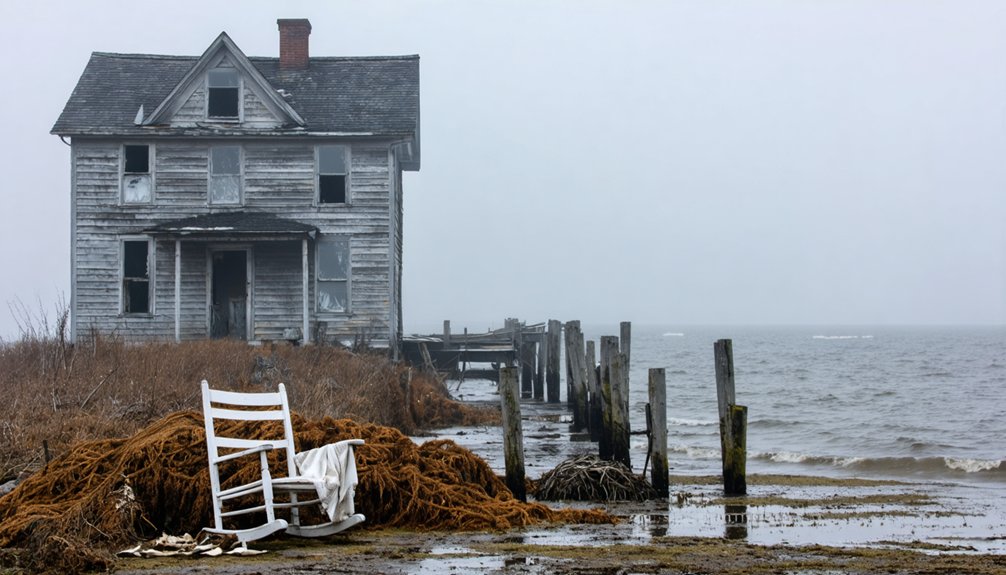
While modern fishing towns often evoke images of weathered docks and colonial architecture, America’s coastal communities have roots reaching far deeper into the continent’s past.
Archaeological evidence reveals human presence along these shores as early as 13,000 years ago, with ancestors of many Indigenous peoples developing sophisticated ancient fishing techniques that sustained their communities.
You can trace coastal migration patterns through sites like the Channel Islands, where the earliest bone fishhooks in the Americas date back 9,000 years.
As warming climates transformed tundra into rich coastal environments, mobile hunter-gatherers adapted to marine resources around 7,500 years ago.
These abundant waters enabled permanent settlements and complex societies to flourish, particularly along the Northwest Coast where salmon runs supported hierarchical communities with intricate social structures and trading networks. Evidence from the Triquet Island shows human habitation 14,000 years ago, supporting First Nations’ oral histories about their ancient presence in these coastal regions.
In New Hampshire’s Seacoast region, native populations established seasonal villages that utilized food from salt marshes about 3,000 years ago when pottery development occurred.
Colonial Fishing Villages: Birth of an American Industry
You’ll find the first true American industry not in factories or workshops, but in the coastal waters where colonial fishermen launched their vessels in pursuit of cod and other groundfish in the early 1600s.
These maritime entrepreneurs established settlements like Marblehead and Colonial Pemaquid, strategically positioned near natural harbors where their simple boats could access abundant fish stocks. Marblehead, settled in 1629 by fishermen from the Channel Islands and Cornwall, England, quickly developed into a prominent fishing and shipbuilding center.
Their daily catches not only fed growing communities but formed the backbone of a nascent economy that would fuel shipbuilding, international trade, and eventually, revolutionary aspirations. Archaeological evidence shows sheepshead fish comprised a significant portion of colonial diets, making up 29% to 45% of total identified fish remains at early Maryland settlement sites.
Dawn of Groundfishing
Long before industrial trawlers and GPS navigation transformed American fisheries, the shores of early colonial New England buzzed with a groundbreaking maritime enterprise.
You’d have found fishermen shifting from simple nearshore operations to more ambitious ventures, sailing two-masted schooners with hierarchical crews to the rich cod stocks of the Grand Banks.
This groundfishing industry—America’s first colonial industry—shaped New England’s economic foundation through ingenious fishing techniques.
Hook and line methods, seine nets, and night fishing using fire attracted abundant catches.
The economic impact rippled through communities as processing and trade networks emerged, connecting coastal villages to transatlantic markets. Fish exports contributed significantly to the region’s prosperity, accounting for 35% of income from overseas trade in the pre-Revolutionary period.
Tax exemptions for fishing vessels encouraged local growth, while villages like Marblehead balanced shore settlements with maritime needs, becoming essential nodes for fishing, shipbuilding, and trade.
The industry attracted primarily young, unmarried men who valued the freedom of fishing life at places like Cape Ann, where they enjoyed liberties uncommon in strict Puritan society.
Cod’s Economic Backbone
As groundfishing operations expanded beyond primitive nearshore ventures, cod emerged as colonial America’s economic cornerstone—transforming isolated settlements into thriving maritime hubs.
You’re witnessing the birth of America’s first industry, where by 1775, cod fishing employed a remarkable 8% of New England’s adult male workforce and generated 35% of the region’s export revenue.
The economic significance of cod fishing can’t be overstated:
- Brought substantial wealth to colonial settlements, becoming the region’s most lucrative trade good
- Employed 10,000 New Englanders by the Revolutionary War period
- Received tax exemptions from the General Court to foster local industry growth
- Established a complete maritime industrial complex that challenged British authority
This economic foundation would ultimately help fuel American independence, as fishermen later converted their vessels and skills to wartime purposes. These settlements demonstrated long-lived institutions similar to prehistoric shell-ring villages that once dotted the South Atlantic coast.
The Rise and Fall of New England’s Fishing Havens
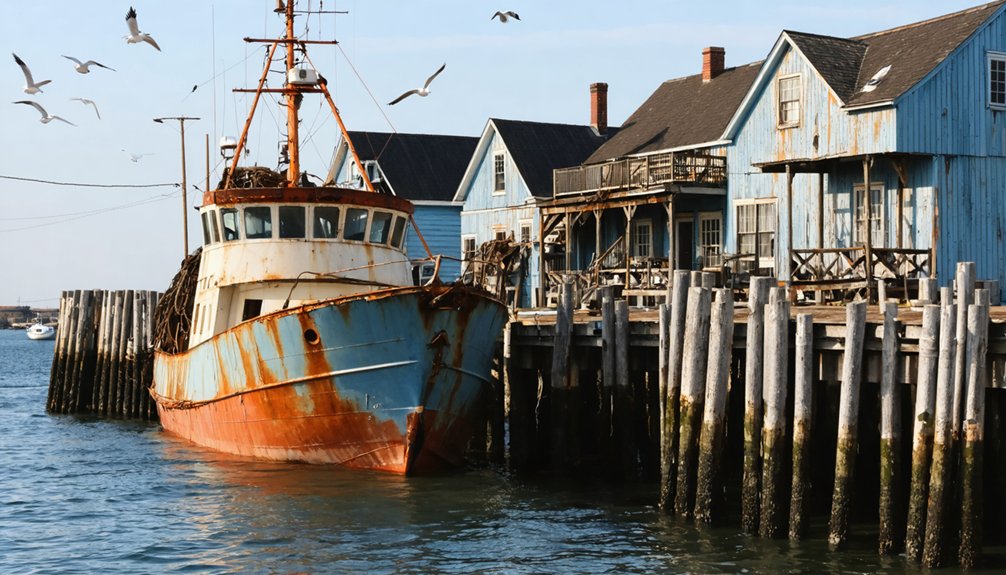
Walking through New England’s fishing villages, you’ll notice the distinctive saltbox houses and weathered wharves that reflect centuries of maritime heritage.
Historical records dating back to the nineteenth century reveal the shifting baseline syndrome that has masked the dramatic decline in fish populations since 1850.
The mid-20th century brought a technological revolution with otter trawls and larger vessels, transforming small family operations into industrial powerhouses that briefly flourished before devastating fish stock collapses.
Communities like Gloucester and New Bedford have since fought to reinvent themselves through diversification and sustainable fishing practices, their storied waterfronts standing as monuments to both prosperity and resilience.
Indigenous people of the region practiced sustainable fishing methods for thousands of years before European colonization, demonstrating a balanced relationship with marine resources that modern management seeks to recapture.
Traditional Village Architecture
Three distinct architectural periods tell the story of New England’s fishing villages, from their humble beginnings to their golden age and eventual transformation.
When you walk these weathered streets, you’ll witness how English post-medieval techniques evolved to embrace local materials and withstand harsh coastal conditions. The massive center chimneys provided essential warmth against bitter ocean winds while serving as the heart of these early coastal homes.
- First Period homes (1635-1720) feature exposed quirk-beaded beams and practical saltbox roofs, embodying traditional craftsmanship.
- Federal/Adam style buildings showcase the prosperity of maritime trade through brick construction and refined white trim details.
- Shingle style cottages with cedar shakes and natural forms represent coastal sustainability through local material usage.
- Vernacular homes with central fireplaces and wide pine floors reflect multi-generational fishing families adapting their spaces to maritime livelihoods.
Technological Boom Era
The technological revolution that swept through New England’s fishing villages in the early 20th century transformed sleepy coastal hamlets into bustling industrial powerhouses before ultimately contributing to their decline.
Walking New Bedford’s waterfront today, you’ll find remnants of this dramatic transformation. As steam-powered trawlers replaced wind-dependent schooners and synthetic nets overcame natural limitations, fishing innovations enabled unprecedented harvests.
Captain Dan Mullins pioneered auxiliary-powered sloops in 1909, launching New Bedford’s rise to prominence.
But freedom from natural constraints came at a price. By the mid-1950s, massive foreign factory fleets descended on Georges Bank with technological advancements that devastated fish stocks.
The very innovations that created prosperity eventually triggered collapse. Corporate ownership replaced family operations, younger generations abandoned tradition, and thriving ports became economic shells—haunting reminders that technological progress without restraint leads to boom and bust.
Adapting Through Crisis
When catastrophic declines struck New England’s once-thriving fishing grounds in the 1970s, few coastal communities foresaw the permanent transformation awaiting them.
You witnessed vibrant harbors hollow into seasonal tourist destinations as groundfish stocks plummeted—cod down 70%, haddock 94%, and yellowtail flounder 89%.
The crisis demanded coastal resilience through:
- Economic diversification beyond fishing traditions
- Adaptation to regulatory measures cutting fleet sizes from 719 vessels to barely 194
- Reinvention of community identities once anchored in year-round fishing
- Navigation of climate impacts reducing catches by 2% per event
Between 2007-2015, nearly 800 crew positions vanished.
Family operations bore the brunt of this collapse, while management measures created partial biological recovery but limited economic revival.
The freedom of independent fishing livelihoods gave way to consolidated permits and seasonal economies.
Abandoned Fishing Communities Along the Atlantic Coast
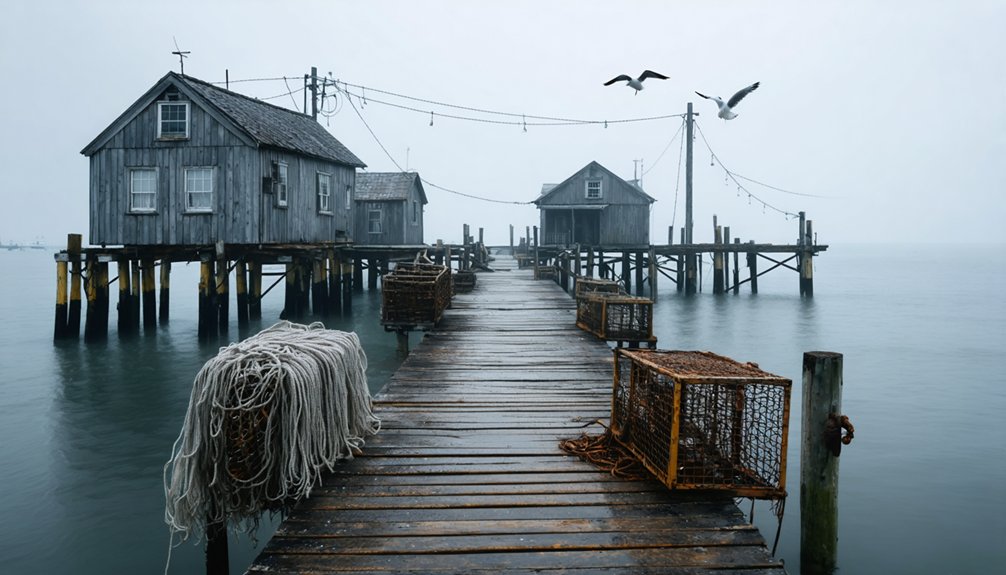
Along the rugged Atlantic seaboard, countless fishing communities that once thrived with maritime activity now stand abandoned, their weathered structures bearing silent testimony to lost livelihoods.
You’ll find places like Cape Lookout Village and Portsmouth Island, where isolation and repeated storms gradually emptied once-vibrant communities.
In Chesapeake Bay, rising sea levels and erosion have nearly erased settlements like Poplar Island, though ecological restoration efforts preserve their memory.
Cape Cod’s mysterious Helltown carries rich fishing folklore despite limited historical records.
The bleached wooden houses of these ghost towns tell stories of families who lived for generations without formal land ownership, creating tight-knit communities bound by maritime traditions.
Hurricane devastation, particularly in places like Gilchrist, Texas, delivered the final blow to many vulnerable coastal settlements already struggling with changing environmental conditions.
The Transformation of Modern Fishing Towns
Modern fishing towns across the United States have undergone dramatic transformation since their humble beginnings, shaped by forces both external and self-directed.
You’ll notice these coastal communities balancing tradition with innovation as fishing regulations tighten and economic pressures mount.
- Historical processing plants evolved from simple operations into sophisticated facilities employing cutting-edge technology.
- Tourism development created dual economic engines, both supporting and competing with traditional fishing operations.
- Community resilience manifests through collaborative data collection between fishermen and scientists.
- Real estate pressures transform working waterfronts into mixed-use spaces where commercial vessels share docks with pleasure craft.
As you explore these evolving harbors, you’ll witness the delicate dance between preservation and progress—fishermen adapting centuries-old practices to modern sustainability demands while maintaining their cultural identity against urbanization’s relentless tide.
Climate Change and the Shifting Geography of Fishing Communities
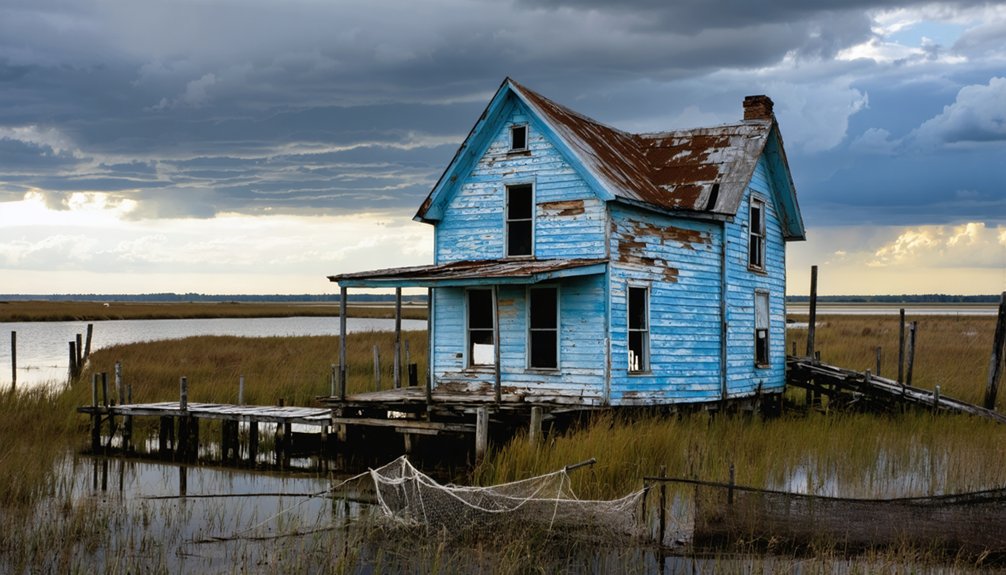
You’ll witness a dramatic reshaping of America’s coastal fishing communities as rising sea levels force some villages to retreat inland while marine species migrate to cooler waters.
The geography of fishing is fundamentally changing, with northern fleets experiencing faster ocean warming and southern communities losing access to traditional catches like Pacific cod.
These climate-driven shifts disproportionately affect communities with narrow species portfolios and limited adaptive capacity, transforming once-thriving fishing towns into potential ghost towns unless they diversify their catch or develop new economic foundations.
Rising Seas, Retreating Villages
As coastlines across America slowly surrender to the encroaching sea, fishing communities that have weathered centuries of storms now face an existential threat unlike any before.
The Northeast is particularly vulnerable, with sea levels rising 3-4 times faster than global averages, accelerating coastal erosion and testing community resilience.
By 2050, you’ll witness high tide flooding triple in frequency, transforming once-vibrant harbors into regularly submerged landscapes.
The economic toll is staggering:
- Up to $106 billion in coastal property underwater by 2050
- Nearly 1,100 essential buildings facing monthly flooding
- Some villages becoming unlivable within 20-30 years
- Wetland losses eliminating natural buffers and vital fishing grounds
Many historic fishing communities now confront impossible choices—rebuild, adapt, or retreat from shores their ancestors have called home for generations.
Species Migration Reshapes Communities
The Northeast’s fishing fleets now chase phantoms, as the iconic species that once defined coastal communities migrate northward in search of cooler waters.
You’ll find cod populations dwindling by 90% on the East Coast by century’s end, while black sea bass invade the Gulf of Maine. This radical shift in fish population dynamics threatens billions in economic losses and disrupts generations of traditional knowledge.
When fish swim beyond reach, communities face stark choices. Native American tribes can’t follow species beyond treaty-defined territories, while commercial fleets must adapt or perish.
Community resilience strategies emerge through necessity—targeting new tropical arrivals, adjusting fishing seasons, or developing alternative livelihoods. NOAA’s tracking systems now help fishers navigate these changes, but for many villages, the transformation has already begun, turning vibrant harbors into monuments to a vanishing way of life.
Preserving Maritime Heritage in Coastal Ghost Towns
Preserving maritime heritage in America’s coastal ghost towns represents one of the most complex conservation challenges facing historic preservationists today. When you visit places like Mallows Bay or Portsmouth Island, you’re witnessing successful maritime preservation efforts that balance ecological needs with historical significance.
Exploring the hidden gems of ghost towns also allows visitors to uncover stories of resilience and adaptation in the face of changing environments. Each site offers a unique glimpse into a bygone era, with relics that tell tales of the communities that once thrived there. As preservation efforts continue, these locations stand as reminders of our shared history and the importance of maintaining the delicate balance between nature and heritage.
Ghost town restoration projects often involve collaborative management between federal agencies, local governments, and preservation groups to guarantee these fragile sites endure.
- National Marine Sanctuary designations offer critical legal protection for maritime artifacts
- Archaeological documentation prevents the loss of submerged cultural resources
- Adaptive reuse transforms deteriorating structures into educational spaces
- Community-driven initiatives create sustainable heritage tourism opportunities
These preservation approaches don’t just protect physical remnants—they safeguard the stories of coastal communities that shaped America’s relationship with the sea, allowing you to experience these connections firsthand while guaranteeing their survival for future generations.
Adaptation Strategies of Surviving Fishing Villages
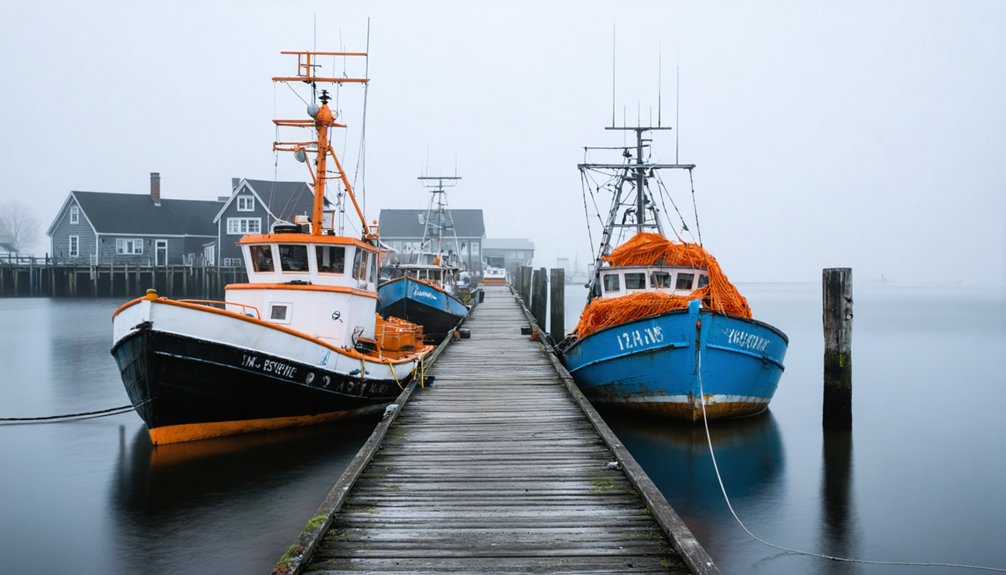
While coastal ghost towns offer haunting reminders of maritime decline, surviving fishing villages demonstrate remarkable resilience through strategic adaptation.
You’ll find these communities diversifying their catch portfolios, embracing emerging fisheries like squid and sea bass to build economic resilience against environmental uncertainties.
The most adaptable villages show geographic mobility, with vessels venturing into deeper waters or northward to follow shifting fish populations.
They’re implementing sustainable practices through community-based planning that balances conservation with livelihoods.
Technological innovation plays an essential role too—from advanced GPS systems to modified fishing gear that targets diverse species.
Fishers embrace innovation—deploying cutting-edge GPS and adaptive gear to pursue diverse catches in changing seas.
Perhaps most importantly, strong social networks facilitate knowledge sharing among fishers, allowing rapid adaptation to changing conditions.
These interconnected strategies help guarantee these coastal communities remain vibrant rather than becoming tomorrow’s ghost towns.
Tourism and Revival in Former Fishing Hubs
Once bustling with commercial fishing vessels, many former fishing hubs across America’s coastlines have found new economic life through tourism-driven revitalization strategies.
You’ll discover that cultural revitalization efforts have transformed these communities while sustainable tourism creates over 3.1 million jobs nationwide.
When you visit these revived coastal towns, you’ll witness:
- Marine protected areas generating millions in tourism revenue while allowing fisheries to recover
- Property values stabilizing as natural ecosystems are restored and protected
- Local economies diversifying beyond extraction to include recreation and hospitality
- Former fishers finding new opportunities as guides, boat captains, and hospitality workers
The economic impact is substantial—coastal tourism generates $141 billion annually, with the Pacific region alone contributing $39 billion from ocean recreation activities.
Documenting Disappearing Coastal Ways of Life
As coastal fishing ways of life rapidly vanish across America’s shorelines, researchers and cultural anthropologists have begun extensive documentation efforts to preserve these maritime traditions for future generations.
You’ll find these specialists recording community rituals like annual fish festivals that once anchored coastal identities but now face cancellation due to dwindling participation.
Their work captures the dissolution of generations-old fishing traditions as species depletion forces entire fleets to disappear—58% of small-vessel trawl communities have effectively vanished from records.
Beyond economic impacts, they’re preserving stories of community resilience and the social fabric that unravels when key leadership relocates.
With wetlands disappearing at 80,000 acres annually and habitats deteriorating nationwide, these documentarians race against time to archive cultural knowledge before it’s irretrievably lost.
Frequently Asked Questions
What Underwater Archaeological Discoveries Exist Near Abandoned Fishing Villages?
Like shipwrecks frozen in time, you’ll discover ancient dugout canoes, submerged burial sites, underwater artifacts, and prehistoric fishing tools. Submerged history reveals Indigenous watercraft and settlements preserved beneath coastal waters near abandoned villages.
How Do Indigenous Fishing Practices Compare With Colonial Techniques?
You’ll find indigenous fishing used traditional methods aligned with nature’s rhythms, employing sustainable practices and spiritual reverence, while colonial techniques favored efficiency and yield with less concern for environmental balance.
Which Fishing Ghost Towns Are Accessible Only by Boat?
Like shipwrecked memories on time’s shore, you’ll find Portlock (Alaska), Ocean Falls (BC), Andersonville Island (Lake Hartwell), and Port O’Connor’s ghost areas all preserve their fishing history through boat access only.
How Have Fishing Community Dialects and Language Evolved Over Time?
You’ll hear fishing slang evolve through isolation, with historic dialects fading as communities integrate. Dialect preservation efforts battle against tourism’s tide, trying to salvage centuries-old linguistic traditions before they disappear forever.
What Role Did Women Play in Historic Fishing Village Economies?
You’ll find women’s labor was foundational—managing businesses, steering ships, processing catches, and providing essential shore support. Their economic contributions sustained communities despite going largely unrecognized until modern times.
References
- https://www.nature.com/articles/s41598-024-55047-z
- https://www.fisheries.noaa.gov/new-england-mid-atlantic/commercial-fishing/brief-history-groundfishing-industry-new-england
- https://www.fisheries.noaa.gov/new-england-mid-atlantic/about-us/century-conservation-brief-history-noaa-fisheries
- https://academic.oup.com/icesjms/article/81/10/1972/7822309
- https://www.nationalfisherman.com/top-u-s-ports-for-a-quarter-century
- http://toolkit.climate.gov/fisheries-and-coastal-communities
- https://pubmed.ncbi.nlm.nih.gov/38409395/
- https://en.wikipedia.org/wiki/Coastal_migration_(Americas)
- https://www.ryenhhistoricalsociety.org/people/history-of-indigenous-peoples-of-the-seacoast
- https://www.historicalconquest.com/single-post/lesson-plans-of-ancient-america-the-northwest-coast-cultures