You’ll find fascinating physical remnants of America’s failed utopian experiments across the country. Visit Fruitlands’ preserved 1820s farmhouse in Massachusetts, explore Brook Farm’s transcendentalist foundations, or tour Oneida’s Mansion House in New York. While Helicon Home Colony left no structures in New Jersey, Drop City’s innovative geodesic domes in Colorado represent counterculture architectural experimentation. These abandoned idealistic communities offer compelling insights into alternative social visions that couldn’t withstand real-world challenges.
Key Takeaways
- Fruitlands’ preserved 1820s red farmhouse stands as the only original structure from this seven-month utopian experiment.
- Brook Farm’s archaeological foundations reveal the physical layout of this transcendentalist community designed to balance nature with communal living.
- Oneida’s Mansion House remains a National Historic Landmark preserving the history of this controversial 300-member communal experiment.
- Drop City’s innovative geodesic dome architecture pioneered sustainable design using salvaged materials in 1960s counterculture communities.
- Utopian community remains provide valuable insights into alternative living arrangements and their architectural solutions to social ideals.
Physical Remnants of Fruitlands: Massachusetts’ Brief Agricultural Experiment
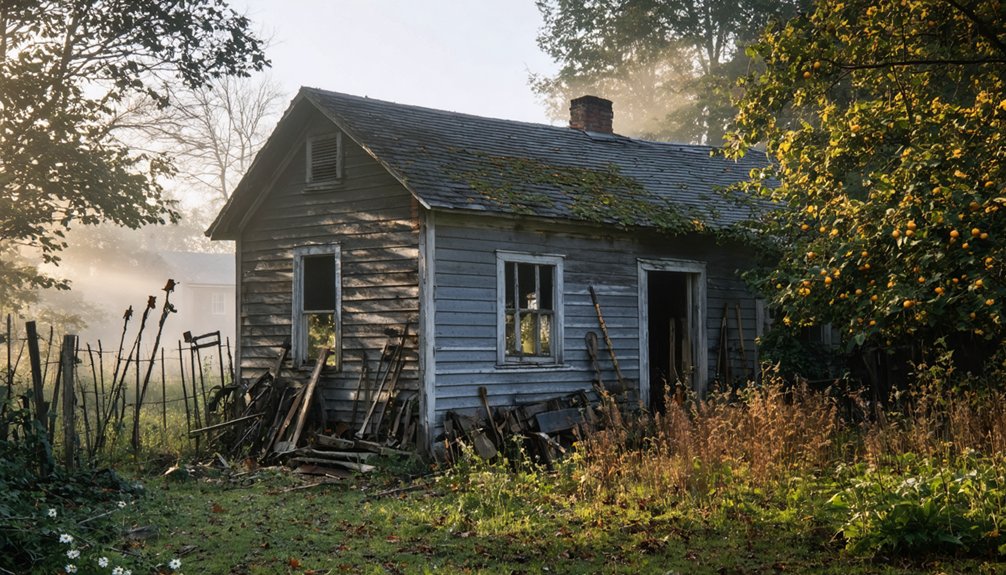
Though its tenure lasted a mere seven months in 1843, Fruitlands has left behind remarkable physical evidence of one of America’s most ambitious—and swiftly abandoned—utopian experiments.
Fruitlands endures as a monument to transcendentalist ambition, its brief flame extinguished but never forgotten.
When you visit the site today, you’ll find the preserved 1820s red farmhouse where Bronson Alcott, Charles Lane, and their idealistic companions attempted their transcendentalist community. This structure, rescued by Clara Endicott Sears in 1914, stands as the sole original building from the experiment. The site was officially recognized for its historical significance when it was designated a Landmark in 1974.
The Fruitlands legacy now encompasses 210 acres managed by The Trustees of Reservations, featuring period furnishings that illuminate the community’s brief existence.
The landscape itself tells the story of agricultural failures—particularly the barley crops that couldn’t sustain the community through winter. These physical remnants provide a tangible connection to a fleeting moment when idealists rejected industrial society through communal living. Visitors can also trace the path taken on June 1, 1843, when the Alcotts made their journey from Hosmer Cottage to establish their short-lived utopian community.
Brook Farm’s Architectural Legacy: Tracing Transcendentalist Foundations
Unlike its ephemeral Massachusetts counterpart Fruitlands, Brook Farm left behind a substantial architectural footprint that embodied transcendentalist principles in physical form.
You can trace these ideals through the thoughtful arrangement of buildings like “The Hive,” which served as the central communal hub where intellectual exchange flourished alongside daily work.
When you examine Brook Farm’s communal architecture, you’ll notice how spaces were deliberately designed to balance nature with community life.
The flexible workspaces reflected their commitment to equality and personal choice.
The community’s weekly magazine The Harbinger provided intellectual discussions on social reform and political issues that complemented their physical environment.
The ambitious Phalanstery project—tragically destroyed by fire in 1846—marked their evolution toward Fourierist philosophy, with plans for extensive shared living quarters.
Though original structures have vanished, archaeological investigations continue to reveal foundations that speak to this bold experiment in transcendentalist ideals of harmonious living. The site later functioned as a Civil War training camp, representing just one of its many transformations after the community’s dissolution.
As researchers delve deeper into this historical tapestry, they uncover the eerie remnants of utopian communities that once aspired to create a perfect society. These findings not only enrich our understanding of the past but also invite reflection on the ideals that shaped these experimental living arrangements. Each discovery reveals a narrative of human ambition and the complexities of communal life in a rapidly changing world.
Silverware and Stirpiculture: Visiting Oneida’s Complex Historical Site

When you step onto the grounds of Oneida Community’s Mansion House today, you’re walking through one of America’s most fascinating contradictions—a radical religious commune that transformed into a thriving silverware enterprise.
This 93,000-square-foot National Historic Landmark preserves tangible evidence of John Humphrey Noyes’s perfectionist experiment, where 300+ members once practiced “complex marriage” and mutual criticism within a shared economic system.
The community’s economic transformation began with steel trap manufacturing before expanding into silverware production, which ultimately outlasted the community itself. They embraced the principle of ascending fellowship through pairing experienced members with younger ones in both economic and social contexts.
After external pressures forced the abandonment of their unconventional social arrangements in 1879, members reorganized as Oneida Community, Ltd.—a joint-stock company that continued commercial operations.
The museum now presents this complex history through exhibitions documenting both the community’s utopian ideals and their surprising industrial success, offering visitors an unfiltered glimpse into this ambitious social experiment. The community’s controversial Stirpiculture program represented an attempt at selective human breeding where only certain members were allowed to reproduce, reflecting their commitment to scientific and spiritual perfection.
The Vanished Exclusionary Vision: Where Helicon Home Colony Once Stood
In the affluent suburbs of Englewood, New Jersey, Upton Sinclair’s ambitious Helicon Home Colony briefly emerged as a progressive communal experiment before vanishing almost as quickly as it appeared.
If you visit the site today, nothing remains of the luxurious three-story building where 60 residents once engaged in communal living.
For five short months in 1906-1907, the colony attempted to embody equality and shared domestic responsibilities in a former boys’ school with modern amenities.
The colony featured social spaces including an atrium with a central fireplace where group readings and debates regularly took place.
Despite attracting notable intellectuals like William James and Charlotte Perkins Gilman, the experiment struggled with economic sustainability.
The colony employed hired servants for cooking, cleaning, and laundry while emphasizing equality among all members.
Sinclair invested heavily, yet the tension between utopian ideals and financial realities remained unresolved until a devastating fire in March 1907 consumed the building, ending this brief exercise in cooperative domesticity.
Geodesic Ghosts: Searching for Drop City’s Revolutionary Structures
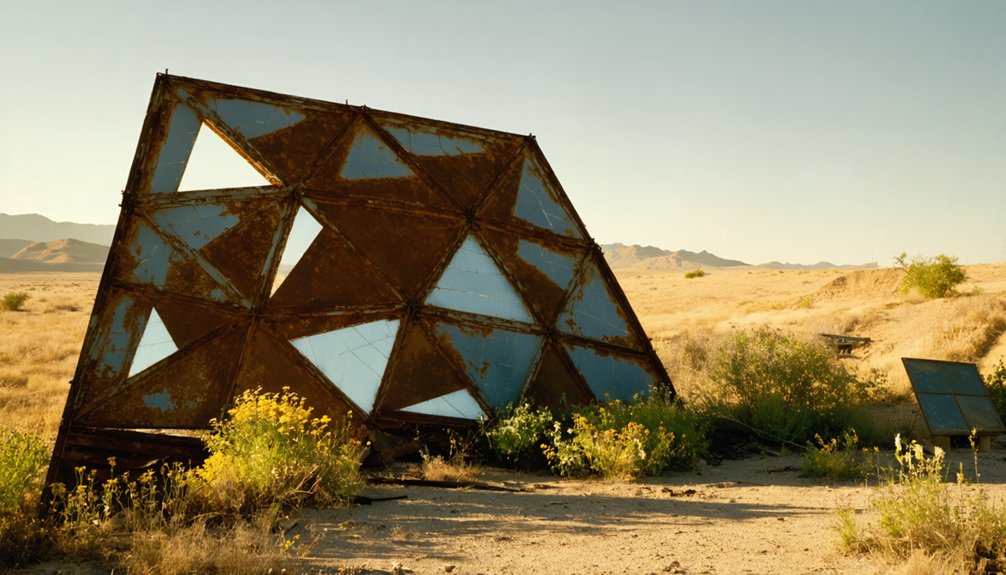
Off a winding highway in southern Colorado, little remains of what was once America’s boldest counterculture architectural experiment.
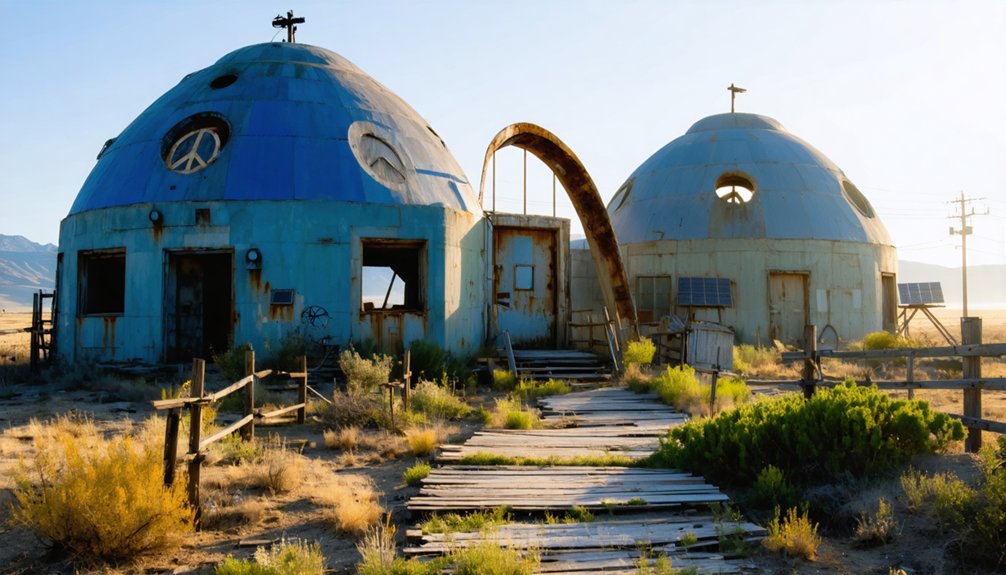
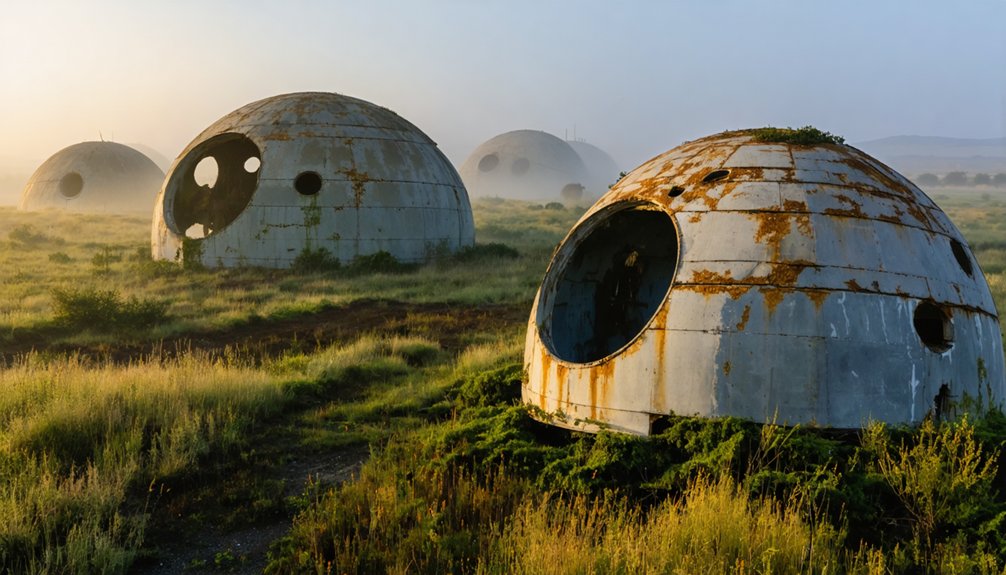
Drop City’s geodesic innovation transformed car tops and salvaged materials into eleven revolutionary domes that housed America’s first rural hippie commune. Founded in 1965, these structures earned Buckminster Fuller’s Dymaxion award for their economical ingenuity.
You’d find no conventional blueprints here—their communal architecture rejected mainstream design principles just as their social structure rejected capitalism.
The Solar Dome pioneered sustainable energy while the Theater Dome imagined immersive art experiences decades ahead of their time. Each structure, rising up to 40 feet in diameter, represented both physical and philosophical rejection of conventional American life. The founders, who purchased the six-acre plot for just $450, transformed what was once a simple goat pasture into an artistic haven. The community’s non-hierarchical structure empowered individuals through collective decision-making and shared responsibilities.
Steve Baer’s experimental geometric designs further pushed the boundaries of what shelter could be in a truly free society.
Frequently Asked Questions
What Personal Items From Community Members Can Visitors See Today?
You’ll discover personal artifacts including handwritten diaries, clothing fragments, handcrafted jewelry, and tools, alongside community memorabilia like furniture, artworks, photographs, and educational materials preserved at historical sites and museums.
Did Any Utopian Architectural Innovations Influence Mainstream American Design?
While you might assume utopian architecture merely faded away, you’ll find Sea Ranch’s ecological integration, Wright’s Usonian principles, and Brook Farm’s communal spaces have profoundly shaped mainstream American residential design today.
How Do Former Residents’ Descendants View These Failed Communities?
You’ll find descendant perspectives range from community nostalgia to critical reflection—many valuing ancestral idealism while acknowledging practical shortcomings that doomed these experimental societies to historical footnotes rather than sustained realities.
What Role Did Women Play in Leadership Positions?
Behind every great utopian community, there was a woman fighting for recognition. You’ll find women’s empowerment was limited—they influenced through education and domestic governance while facing substantial leadership challenges from entrenched patriarchal structures.
Were Any Utopian Community Practices Adopted by Modern Intentional Communities?
You’ll find many modern intentional communities have adopted communal farming practices and shared governance models from historical utopian experiments, though they’ve typically implemented these with more pragmatic, flexible approaches to avoid past failures.
References
- https://www.mentalfloss.com/history/failed-utopias
- https://fee.org/articles/the-dark-side-of-paradise-a-brief-history-of-americas-utopian-experiments-in-communal-living/
- https://www.yesmagazine.org/health-happiness/2022/06/01/american-communes-failed-experiment
- https://isismagazine.org.uk/2012/05/top-5-failed-utopias/
- https://www.vice.com/en/article/failed-utopias-throughout-history-v25n1/
- https://constitutingamerica.org/90day-aer-americas-founding-knowledge-of-failed-utopian-ideologies-establishing-a-us-constitution-based-on-tradition-and-natural-rights-to-prevent-tyranny-guest-essayist-joerg-knipprath/
- https://www.nps.gov/articles/utopias-in-america.htm
- https://freedomsway.org/place/fruitlands-farmhouse/
- https://www.walden.org/work/fruitlands-community-in-harvard/
- https://www.americanheritage.com/fruitlands