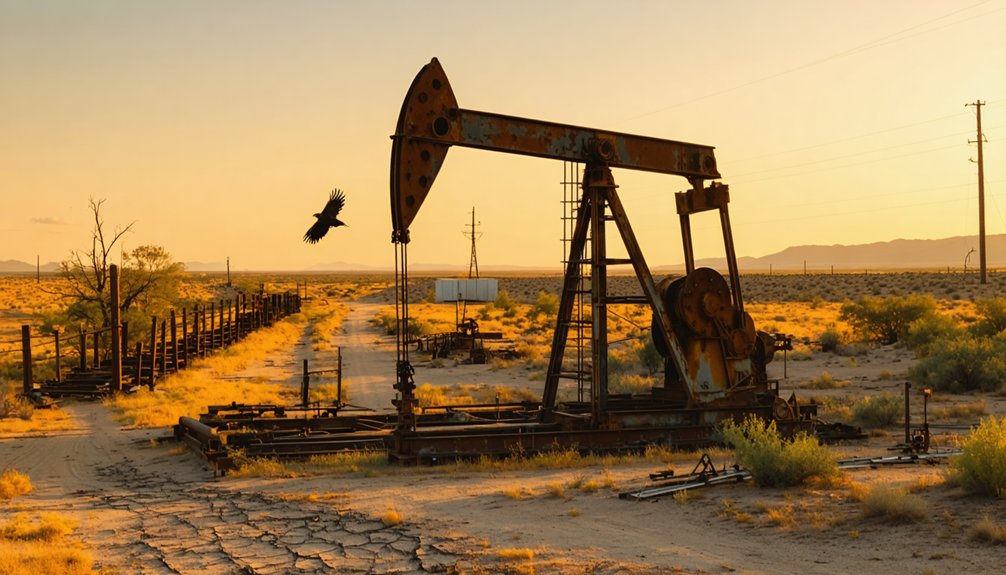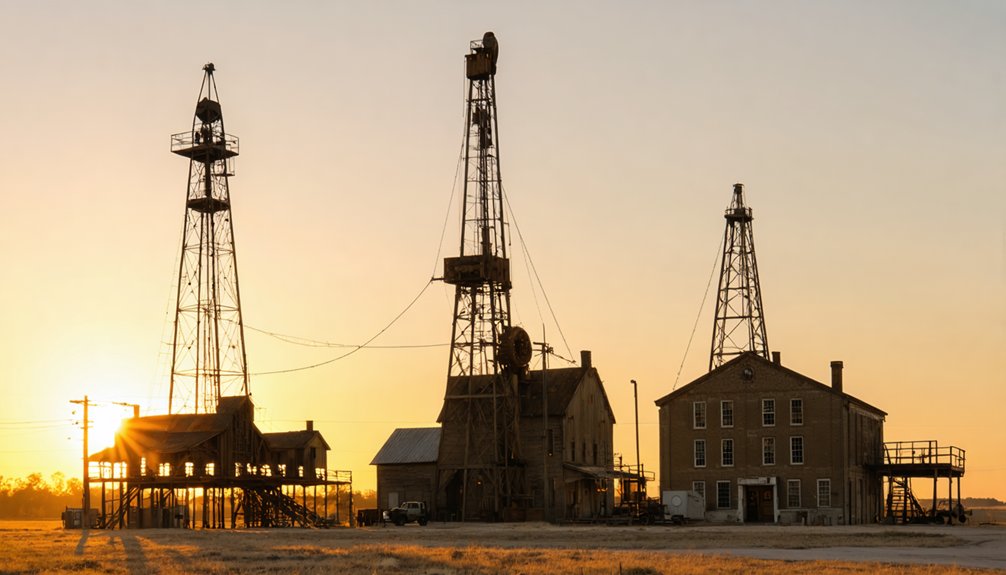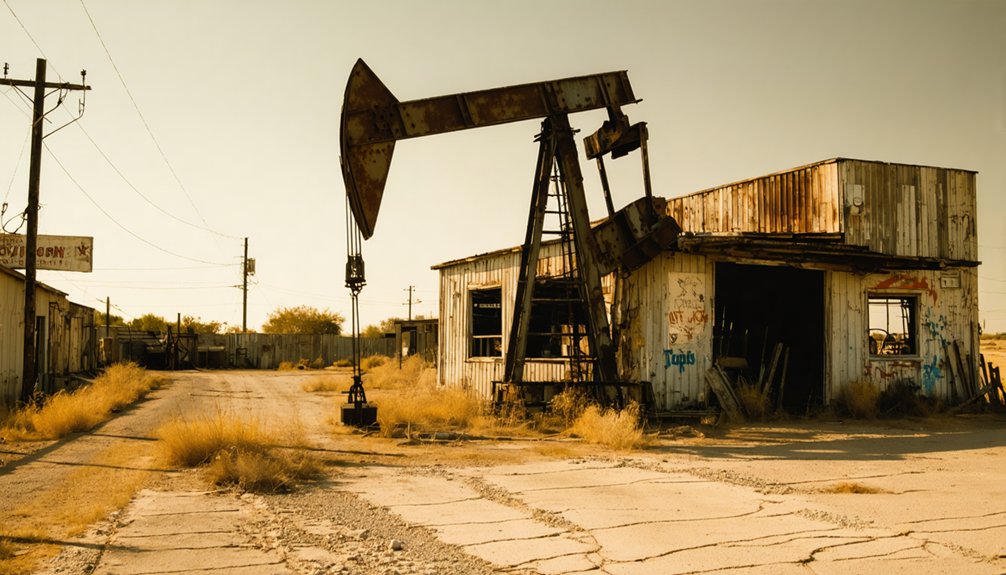
When you explore America’s forgotten oil town ruins, you’ll witness the skeletal remains of the petroleum boom-bust cycle that shaped our nation. From Pennsylvania’s Pithole to Texas ghost towns, these abandoned sites feature rusting derricks, collapsed wooden structures, and industrial artifacts dating back to 1859. Environmental damage and cultural heritage impacts continue today, while preservation efforts face ongoing challenges. The stories behind these ghostly landscapes reveal America’s complex relationship with resource extraction.
Key Takeaways
- America’s oil ghost towns like Pithole transformed from 15,000 residents to abandoned ruins within months after oil depletion.
- Skeletal derricks and rusting machinery serve as industrial archaeology artifacts documenting America’s petroleum heritage.
- Forgotten oil towns in Pennsylvania, Texas, and California contain visible foundations, collapsed structures, and abandoned infrastructure.
- Environmental damage including toxic seepage and soil contamination continues long after these boomtowns were abandoned.
- Sites like Drake Well Museum, Thurber, and Mentryville preserve America’s oil history through protected ruins and interpretive displays.
The Rise and Fall of America’s Oil Boomtowns
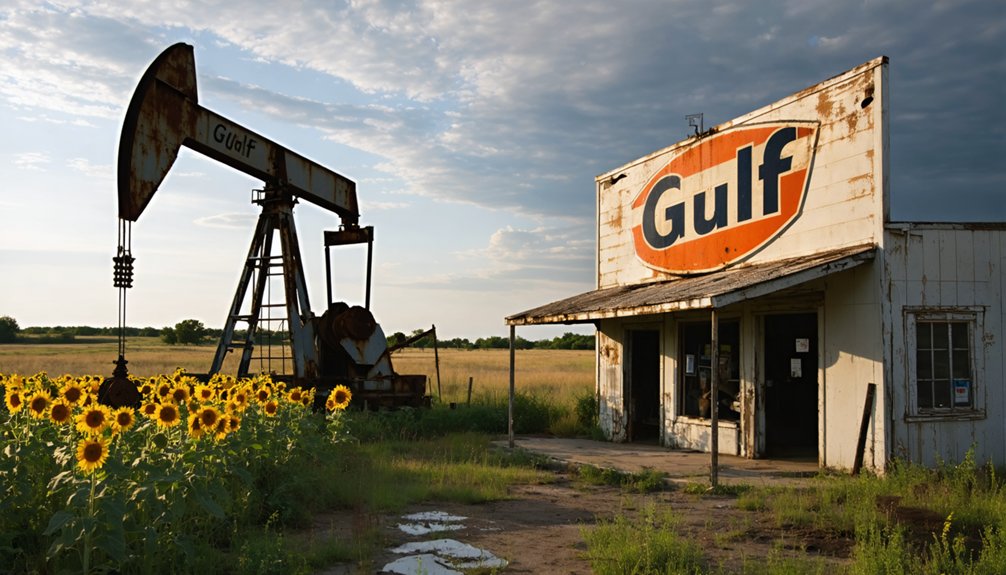
When Edwin L. Drake struck oil in Titusville, Pennsylvania in 1859, he released a transformative force that would reshape America’s landscape. These initial oil discoveries triggered explosive growth patterns you can still trace today.
Overnight, sleepy farmland transformed into bustling centers of commerce and industry. Towns like Oil City and Pithole exemplify this community transformation, growing from tiny settlements to thousands of inhabitants within months. California saw similar patterns when Mentryville emerged as a thriving boomtown community after the successful drilling of Well No. 4 in Pico Canyon in 1876.
Dusty crossroads exploded into industrial hubs as petroleum fever swept the countryside, transforming landscapes and fortunes overnight.
You’ll find that infrastructure materialized almost instantly—pipelines, warehouses, and machine shops appearing as if conjured from thin air. The first major oilfield pipeline, a 2.5-mile cast iron system, was established in Pennsylvania in 1863, revolutionizing how crude oil was transported from wells to refineries.
This rapid development came with profound costs. Most boomtowns experienced the same fate: spectacular growth followed by devastating collapse once wells ran dry.
Environmental degradation, abandoned infrastructure, and ghost towns stand as evidence to the transient wealth that oil extraction promised but couldn’t sustain.
Uncovering Petroleum’s Ghost Towns in the Southwest
If you’re exploring the Southwest’s petroleum ruins, you’ll find abandoned derricks still standing amid desolate landscapes that once thrived with activity.
Native American lands face ongoing environmental threats from abandoned wells that leak contaminants into groundwater and soil, creating hazards that extend far beyond the initial boom periods. This pattern is evident in areas like South Bend, which was once part of a Tonkawa tribes reservation before becoming an oil boomtown.
These boom-bust desert settlements follow a predictable pattern – explosive growth during high oil prices followed by rapid abandonment when prices collapse, leaving ghost towns scattered across Texas and New Mexico where thousands of orphaned wells remain. Many of these sites release poisonous gases that pose significant health risks to nearby residents who continue to live in the shadow of the industry’s abandoned infrastructure.
Hidden Derricks Still Standing
Across the vast landscapes of the American Southwest, thousands of abandoned oil derricks stand as rusting sentinels of a bygone industrial era.
You’ll find over 2,000 identified wells in New Mexico alone, with 200 near Chaco Culture National Historic Park, while Texas harbors nearly 8,900 orphaned wells concentrated in the Permian Basin.
These hidden hazards frequently erupt with toxic chemicals, creating contaminated lakes and sinkholes.
Many were improperly plugged with obsolete materials, leading to dangerous structural instability and ongoing leaks. The nationwide problem extends to approximately 32,000 orphaned wells within 30 miles of U.S. National Parks. Pecos County has emerged as the epicenter with over 600 wells requiring urgent remediation.
The cultural scars run deep, as these industrial relics physically alter landscapes sacred to Native Americans.
Sites like Alkali Ridge National Historic Landmark and Bears Ears face permanent damage from this decaying infrastructure, while cleanup costs approach $1 billion—a burden that typically falls to taxpayers after companies abandon their responsibilities.
Indigenous Lands Under Threat
The shadow of America’s oil industry stretches far beyond abandoned derricks, reaching deep into the ancestral homelands of Indigenous peoples throughout the Southwest.
You’ll find this conflict most evident at Chaco Canyon, where the monumental Great Houses built between 850-1250 CE now face unprecedented threats from extraction activities.
As you explore these lands, you’ll encounter thousands of cultural sites dating back 12,000 years across the 3-million-acre planning area in northwestern New Mexico.
Despite ongoing cultural preservation efforts since the 1930s, federal protections remain inadequate.
Navajo families currently live at ground zero of development above the Mancos Shale formation, while sacred sites suffer from land exploitation that federal agencies have failed to properly address despite years of advocacy from Native American tribes. The ancestral heritage is particularly rich in this region, with Pueblo Bonito containing over 650 rooms and dozens of ceremonial kivas that stand as testament to this sophisticated civilization. Similar to Canyon de Chelly National Monument, these areas represent sacred Navajo sites that deserve protection from industrial encroachment.
Boom-Bust Desert Settlements
Scattered throughout America’s southwestern landscape, petroleum ghost towns stand as skeletal monuments to the boom-and-bust cycle of oil exploration.
You’ll find places like Alanreed, Texas, where population plummeted from thousands to just 52 residents as oil reserves dwindled and extraction became unprofitable.
These desert settlements flourished briefly during the early 20th century, when oil discoveries triggered rapid growth alongside railroad expansion and Route 66 development.
The ruins evoke a peculiar desert nostalgia—abandoned oil rigs, historic gas stations, and rusted infrastructure that once supported thriving communities.
Economic cycles proved merciless, as oil price volatility and the Great Depression transformed boomtowns into ghost towns.
Today, sites like Two Guns, Arizona, and Mineral, Oklahoma, persist as preserved historical markers, where tourism now sustains what petroleum once built. Depew, Oklahoma exemplifies this pattern, experiencing a dramatic population boom in 1911 when oil was discovered before declining sharply during the Depression. Many of these areas now face environmental threats from over 2,000 abandoned wells that leak methane and toxic chemicals into surrounding ecosystems.
Pennsylvania’s Legacy: America’s First Oil Ruins
When you travel through Pennsylvania’s historic oil country, you’re witnessing the cradle of America’s petroleum industry, beginning with Drake’s 1859 well near Titusville that transformed the nation’s energy landscape.
The ghost town of Pithole stands as the most dramatic evidence of oil’s boom-and-bust cycle, having exploded from wilderness to a city of nearly 20,000 people before collapsing into ruins within just 500 days.
Beyond these landmark sites, thousands of abandoned wells, derricks, and small settlement remains dot the Pennsylvania countryside, creating an archaeological record of America’s first oil rush that continues to influence the modern energy industry.
Drake Well’s Lasting Impact
Birth of America’s modern petroleum industry took place on August 27, 1859, when Edwin Drake struck oil at his revolutionary well near Titusville, Pennsylvania.
As you explore this historic site, you’ll witness Drake Well’s Innovation firsthand—the pioneering use of steam-powered cable-tool drilling and iron pipe casing that prevented wellbore collapse.
The Economic Ripple from this 69½-foot well was extraordinary. Producing 12-20 barrels daily, it triggered Pennsylvania’s production surge from 2,000 barrels in 1859 to 500,000 by 1865.
Drake never patented his method, allowing rapid technology adoption that fueled America’s industrial advancement.
Today, the Drake Well Museum preserves this National Historic Landmark where a single drill transformed America’s energy landscape and established technological foundations still influencing modern petroleum extraction methods.
Pithole: Boom to Dust
The meteoric rise and catastrophic fall of Pithole stands as America’s most dramatic oil boom-bust story. When you visit this historical preservation site today, you’ll find only mowed fields marking where 15,000 people once lived among 54 hotels and bustling streets in 1865.
Within months of discovering wells producing 1,200 barrels daily, Pithole became Pennsylvania’s third busiest postal center.
Yet by 1866, plummeting oil prices from $8 to $1.35 per barrel triggered economic collapse. Devastating fires destroyed wells and buildings, accelerating abandonment.
Urban exploration here reveals nothing of the original structures—just interpretive panels across former streets.
Endless Scattered Well Ghosts
Unlike Pithole’s consolidated ghost town, Pennsylvania’s first oil region left behind countless scattered ruins across its landscape.
When you explore Oil Creek Valley today, you’ll encounter the physical remnants of America’s original petroleum rush—crumbling stone walls protruding from the creek, abandoned wells, and refinery ruins dotting the countryside.
These fragments tell the story of the 1859 Drake Well discovery that launched the modern oil industry.
Though production dwindled by 1871 as speculators moved elsewhere, the historical significance remains embedded in the terrain.
The valley’s transformation was dramatic—from $20 per barrel in 1859 to just 49 cents by 1861 due to overproduction.
Visit the Drake Well Museum to see preserved artifacts from this “Valley that changed the World”—a landscape of freedom, innovation and industrial heritage.
Environmental Scars and Cultural Heritage at Risk
As you wander through America’s forgotten oil towns, environmental devastation reveals itself in alarming ways—toxic seepage from improperly abandoned wells, contaminated groundwater, and soil poisoned by decades of industrial negligence.
These environmental impacts threaten both ecological systems and community resilience, as toxic substances like benzene and hydrogen sulfide continue leaking into neighborhoods.
The environmental-cultural nexus becomes evident through:
- Historic landmarks crumbling amid contaminated landscapes that complicate preservation efforts
- Property values plummeting by 30-40%, forcing multi-generational families to abandon ancestral homes
- Cultural identity erosion as once-proud oil heritage sites become hazardous no-go zones
You’re witnessing the collision of America’s industrial past with environmental justice, where $250 billion in cleanup costs remains largely unfunded while communities bear the burden of this toxic inheritance.
What Remains: Derricks, Buildings, and Industrial Artifacts
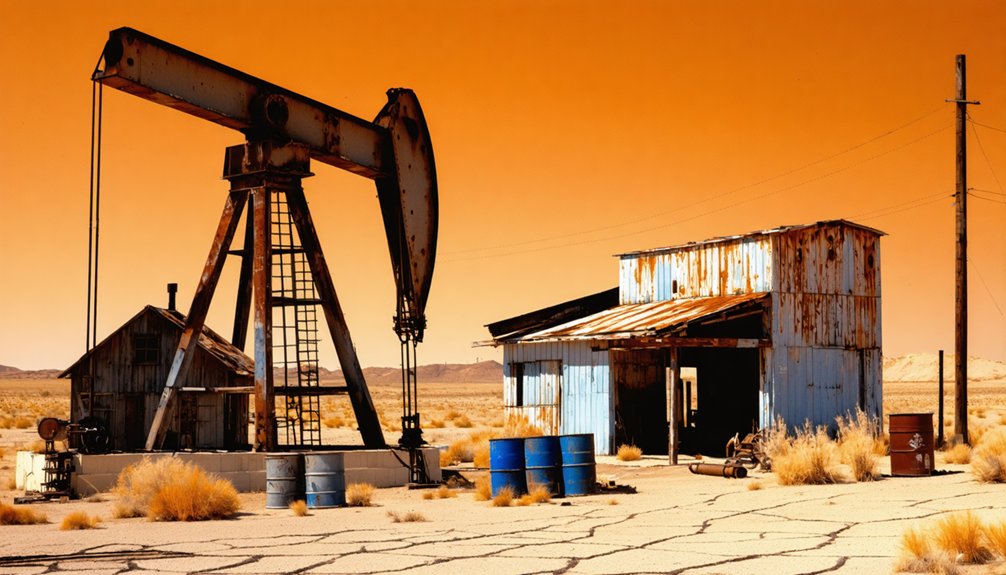
Walking through abandoned oil towns reveals a haunting industrial archeology where America’s petroleum past stands frozen in time.
You’ll encounter skeletal derricks, their metal frameworks rusting against the sky—silent sentinels of boom-era extraction. Nearby, nodding donkeys stand permanently stilled, their mechanical lives ended when wells were abandoned.
These mechanical giants now rest in eternal vigil, monuments to America’s oil fever and the fleeting nature of industrial prosperity.
Scattered throughout these landscapes are the physical remnants of once-vibrant communities: collapsed wooden housing, gutted office buildings, and equipment sheds slowly surrendering to nature.
The true value of derrick preservation becomes evident as you stumble upon industrial artifacts—pipes, valves, gauges, and storage tanks—that tell the story of early petroleum technology.
This industrial archaeology offers a tangible connection to the workers who once populated these ghost towns, their daily lives now preserved only in rust and ruin.
Notable Oil Town Ruins Worth Visiting Today
Adventurers seeking to explore America’s petroleum heritage can find remarkable ruins scattered across the country, each telling a unique story of boom and bust.
These forgotten legacies offer glimpses into the transient nature of resource-dependent economies.
- Thurber, Texas – Between Fort Worth and El Paso, this once-bustling town preserves early 20th-century industrial archaeology with several original structures still standing as evidence to Texas’s extractive past.
- Oil Hill, Kansas – Near El Dorado, explore the foundations and decaying industrial structures of this former company town where over 8,000 people once lived.
- Reagan, Texas – Witness the complete abandonment resulting from resource depletion, with visible ruins of residential areas and oil infrastructure highlighting the environmental aftermath of boom-cycle economics.
Preservation Challenges and Heritage Tourism Opportunities
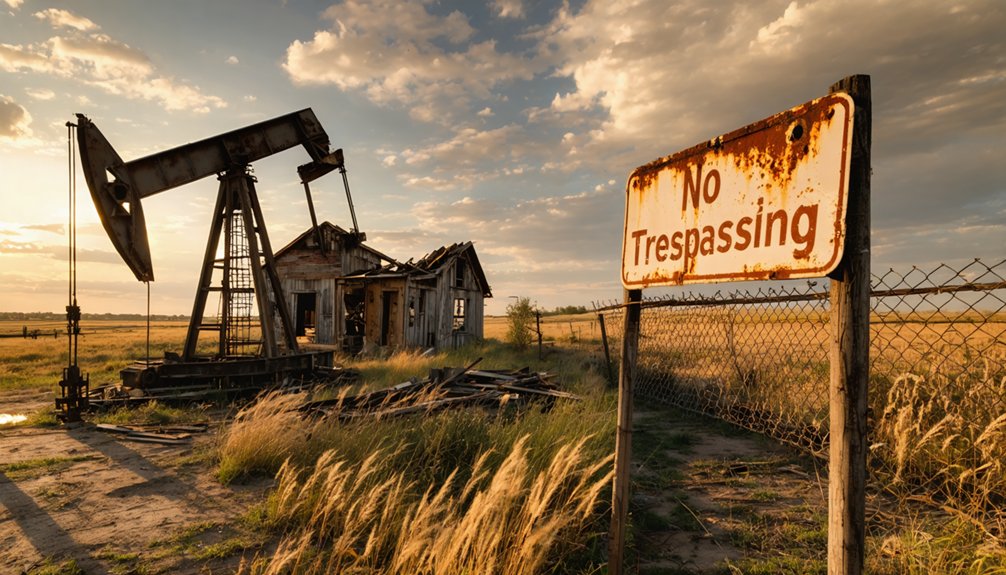
While these abandoned oil towns offer fascinating windows into America’s industrial past, they face serious threats to their continued existence. Environmental factors like coastal oil spills and rising sea levels endanger nearly 20,000 sites, including oil town ruins, projected to be underwater by 2100. Urban expansion and agricultural development further jeopardize these historical treasures.
Many of these forgotten oil towns in America have become ghostly reminders of a bygone era, drawing the interest of historians and adventurers alike. Their decay serves as a poignant reflection of the boom-and-bust cycles that characterize the oil industry, leaving behind stories waiting to be uncovered. As the threat of further deterioration looms, there is an urgent need to raise awareness about the cultural significance of these sites before they vanish completely.
Security challenges compound preservation issues, with inadequate staffing on public lands leaving ruins vulnerable to looting and vandalism—similar to how over 90% of Native American sites suffer damage.
Climate change-induced disasters and industrial activities create additional preservation challenges.
The tension between redevelopment pressures and heritage conservation remains unresolved in many areas, requiring balanced approaches that can transform these endangered sites into heritage tourism destinations while protecting their historical integrity.
Frequently Asked Questions
Are There Paranormal Reports or Ghost Sightings at Abandoned Oil Towns?
Yes, you’ll encounter numerous ghost stories at abandoned oil towns. Mentryville, California features documented sightings of oil workers’ apparitions, while these haunted locations often report unexplained sounds and spectral figures.
Can You Legally Collect Artifacts From Oil Town Ruins?
You can’t legally collect artifacts from public land ruins. On private property, you’ll need the landowner’s written permission, as artifact ownership belongs to them under legal permissions.
How Dangerous Is Exploring Abandoned Oil Infrastructure Without Guides?
Ever wonder why explorers sometimes don’t return? It’s extremely dangerous. You’re facing toxic chemical exposure, structural hazards, unpredictable gas pockets, and legal consequences. Without safety precautions, you’re risking your life.
Which Oil Town Ruins Are Completely Underwater or Submerged Today?
Unlike the submerged towns you’ve studied, no major oil towns are completely underwater today. You’d need underwater exploration equipment to find only scattered oil infrastructure beneath reservoirs and coastal waters.
Are Any Abandoned Oil Towns Being Repopulated or Experiencing Revivals?
Like phoenix birds struggling to rise, you’ll find limited revival success. Some towns see small-scale revitalization efforts and community initiatives, but widespread repopulation remains rare due to persistent economic challenges and infrastructure decay.
References
- https://www.theartnewspaper.com/2024/11/25/how-abandoned-oil-wells-are-threatening-us-heritage-sites
- https://westernpriorities.org/2024/03/orphaned-and-abandoned-oil-and-gas-wells-threaten-cultural-resources-in-the-southwest/
- https://www.geotab.com/ghost-towns/
- https://www.atlasobscura.com/things-to-do/united-states/oil
- https://www.youtube.com/watch?v=oW66pgyhMYM
- https://www.youtube.com/watch?v=ns4M-ar6uJQ
- https://www.loveexploring.com/gallerylist/67994/americas-eeriest-gold-rush-ghost-towns
- https://www.epa.gov/mo/town-flood-and-superfund-looking-back-times-beach-disaster-nearly-40-years-later
- https://en.wikipedia.org/wiki/History_of_oil_in_California_through_1930
- https://aoghs.org/oil-almanac/chronology-of-u-s-petroleum-history/