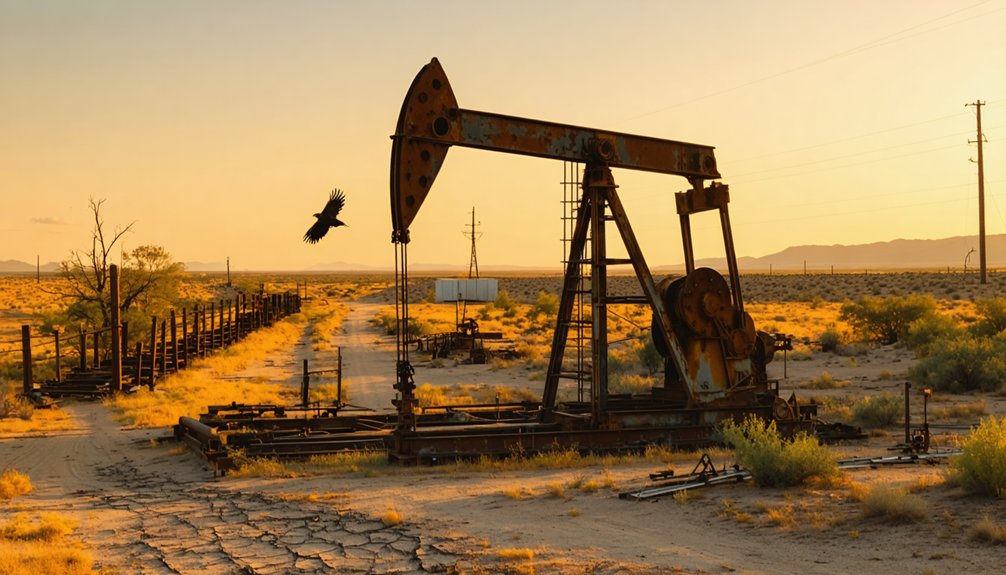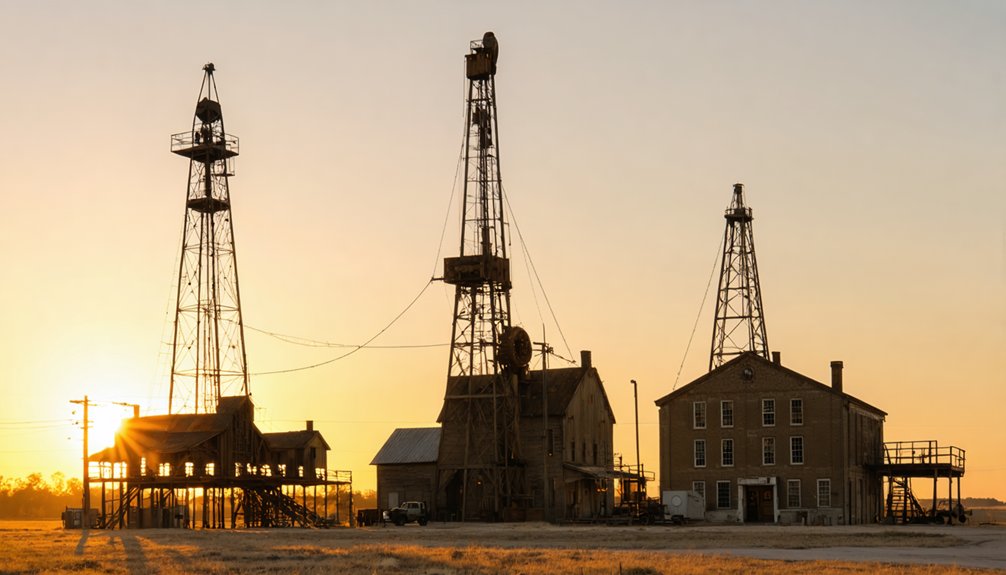
When you explore America’s forgotten oil towns, you’ll discover weathered Victorian buildings, rusting derricks, and silent pump jacks. These abandoned settlements, from Pennsylvania’s Pithole to California’s Mentryville and Oklahoma’s Slick, reveal stories of explosive growth and dramatic collapse. Photographers can capture haunting structures against recovering landscapes, while historians examine archaeological remnants of early petroleum technology. These petroleum ruins offer a tangible connection to the raw capitalism and environmental impacts that shaped America’s 160-year relationship with oil.
Key Takeaways
- America’s forgotten oil towns like Pithole and Mentryville offer profound insights into boom-and-bust industrial capitalism cycles.
- Archaeological sites in Pennsylvania reveal both Native American petroleum usage and rapid 19th-century development followed by abandonment.
- Accessing remote oil town ruins requires careful planning, proper vehicles, and permission research for public and private lands.
- Photography opportunities include capturing weathered structures against recovering landscapes, best during early morning or late afternoon light.
- Historical markers and preservation efforts document these abandoned communities through plaques, museums, and digital archives.
The Rise and Fall of Pithole: America’s 500-Day Wonder
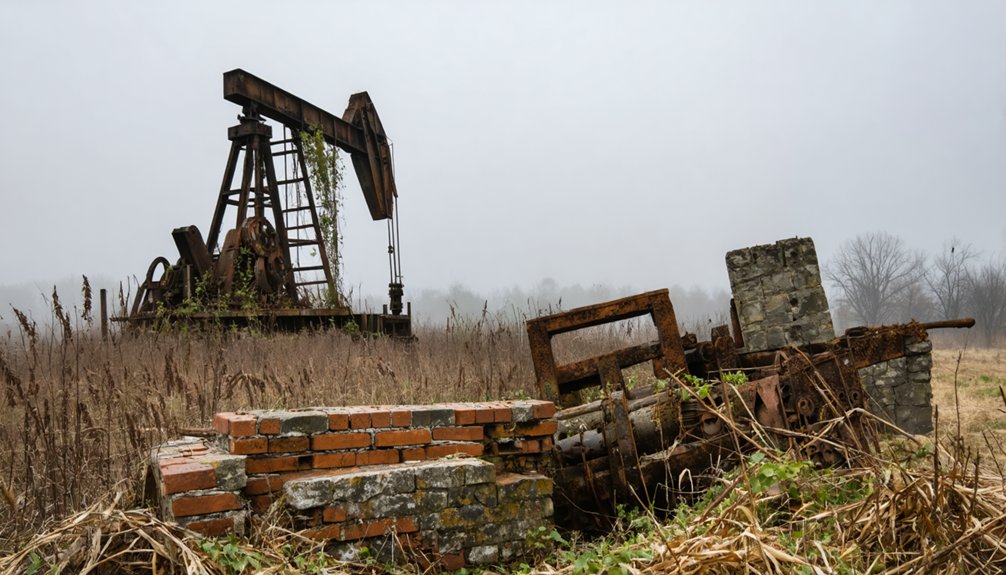
In the rolling hills of Western Pennsylvania, the discovery of oil in 1859 by Edwin L. Drake sparked America’s first oil rush.
But nothing captures the meteoric rise and fall of early petroleum boomtown economy like Pithole history.
When businessman Ian Frazier struck oil at Pithole Creek in 1864, prosperity erupted as violently as the crude itself.
Within months, wells were producing up to 1,200 barrels daily, and by summer 1865, a 15,000-person metropolis materialized complete with hotels, churches, and theaters.
At its peak, Pithole generated one-third of America’s petroleum, with oil fetching $8 per barrel.
The town boasted an impressive post office that processed 5,000 letters daily as commerce and communication thrived.
Samuel Van Syckel’s introduction of the first oil pipeline in October 1865 revolutionized transportation and drastically reduced costs for producers.
Yet this prosperity proved ephemeral.
Yet as with all windfalls of fortune, Pithole’s riches dissipated like morning fog before the harsh sun of reality.
By 1866, production declined precipitously, prices crashed to $1.35, and pipelines eliminated teamster jobs.
Devastating fires and bank collapses accelerated the exodus, transforming a thriving city into abandoned ruins within just 500 days.
Mentryville’s Preserved Buildings: Touring California’s First Oil Community
What remains of California’s first oil boomtown stands preserved among the Santa Monica Mountains, offering visitors a rare glimpse into petroleum’s pioneering days. Founded in 1876 by Charles Mentry, this settlement birthed the California Star Oil Works and housed Pico No. 4, which operated continuously until 1990.
When touring Mentryville architecture, you’ll encounter:
- Mentry’s grand 13-room Victorian mansion, showcasing the prosperity oil brought
- The historic one-room Felton Schoolhouse built in 1885
- A period barn that served the community of over 100 families
- Worker cabins that housed Pennsylvania drillers who brought oil industry advancements
Since 1995, the Santa Monica Mountains Conservancy has maintained these structures as a California State Historical Landmark, preserving the legacy of America’s longest-running oil well and Chevron’s birthplace. The town was named after French immigrant Alex Mentry whose father anglicized their surname from Mentrier to Mentry. Following Charles Mentry’s death in 1900, the once-thriving community began its gradual decline, eventually becoming the ghost town visitors explore today.
Ghost Signs and Abandoned Machinery at Oklahoma’s Slick and Empire City
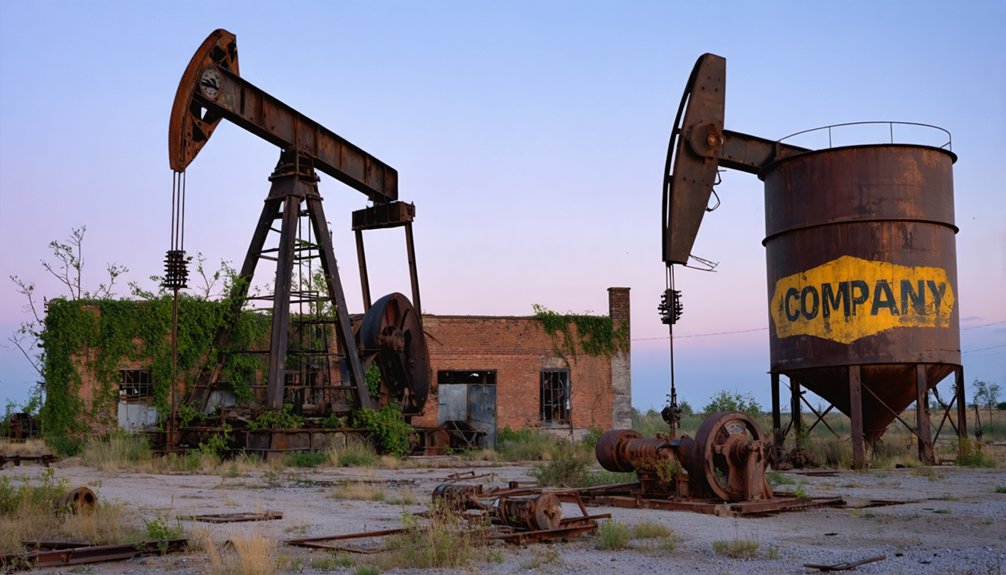
While California’s Mentryville stands carefully preserved as a historical landmark, Oklahoma’s forgotten oil towns of Slick and Empire City tell their stories through weathered remnants left to the elements.
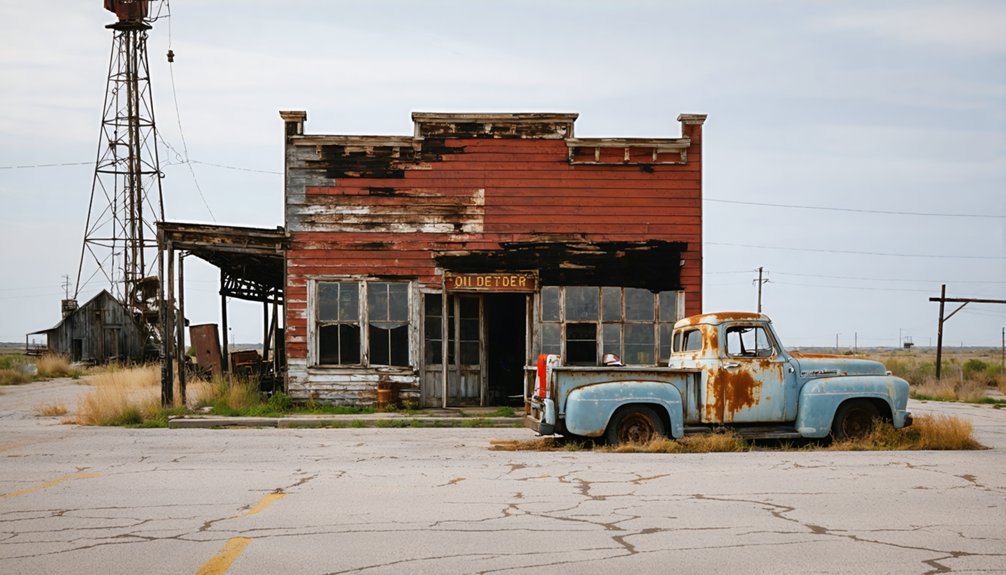
Walking these abandoned settlements, you’ll discover faded ghost signs on brick walls advertising defunct oil companies that once fueled the 1920s boom when Thomas B. Slick’s discovery wells transformed empty prairie into 5,000-person boomtowns.
Rusting derricks and pump jacks that once produced up to 10,000 barrels daily now stand as silent monuments to collapsed prosperity. Today, Slick maintains a small community of approximately 400 residents who continue to uphold their connection to the oil-rich history.
Unlike organized ghost sign preservation efforts elsewhere, these painted advertisements remain largely undocumented, while machinery restoration is virtually nonexistent.
The deteriorating infrastructure—from loading facilities to worker housing—chronicles how quickly fortunes reversed when production declined and the railroad departed by 1930. These locations represent just a fraction of the 2,000 ghost towns estimated to exist throughout Oklahoma according to historian John W. Morris.
The Archaeological Treasures of Pennsylvania’s Forgotten Petroleum Landscape
Long before European settlers arrived in Pennsylvania, Native Americans had discovered and utilized the region’s abundant petroleum resources.
Archaeological methods have revealed wood-lined pits along Oil Creek dating to 1410-1440 AD, predating Columbus by decades. These sophisticated extraction sites, excavated near present-day Titusville, demonstrate indigenous engineering knowledge.
When you explore this forgotten petroleum landscape, you’ll encounter:
- Wood-reinforced pits up to 69.5 feet deep that targeted specific oil-bearing sandstone
- The ghostly remnants of Pithole City, once home to 15,000 souls during the 1860s boom
- Foundations of bustling industrial buildings that processed 5,000 barrels daily
- Trails through Oil Creek State Park where nature has reclaimed abandoned extraction sites
This archaeological record chronicles America’s earliest oil extraction traditions, flourishing long before Drake’s famous 1859 well. Native Americans constructed collection devices at the bottom of their pits using natural materials to gather petroleum effectively. Archaeological research has documented the rapid decline of Pithole City to just 281 residents by 1870, making it one of America’s most dramatic boom-and-bust stories.
Environmental Recovery in Former Big Thicket Extraction Zones
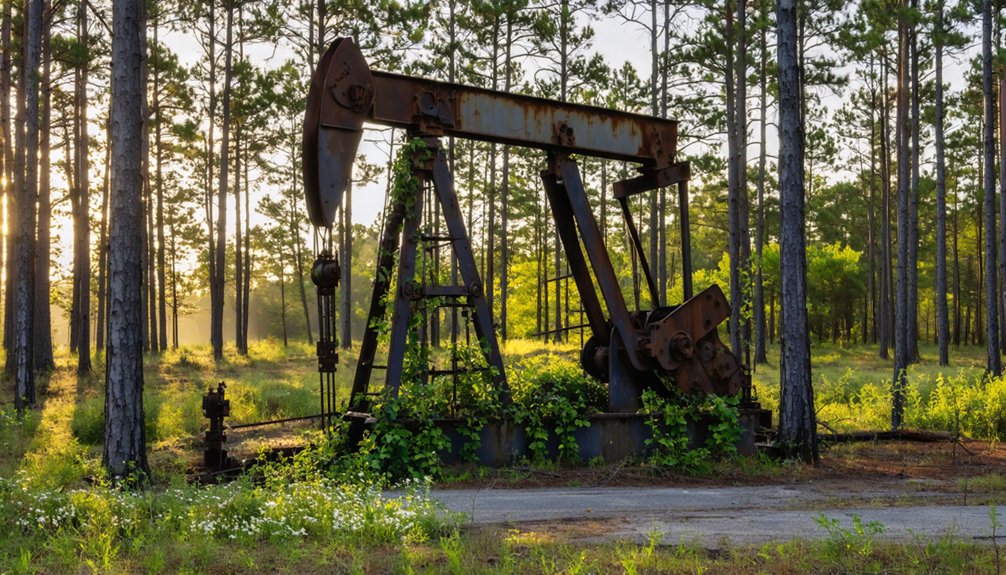
After nearly a century of intensive petroleum extraction and timber harvesting operations, the Big Thicket ecosystem of Southeast Texas faced catastrophic ecological damage, with its original 3.5 million acres reduced to less than 300,000 by the mid-twentieth century.
When you visit today, you’ll witness remarkable ecological restoration in progress. The 1974 National Preserve designation halted timber harvesting while establishing a framework for managing remaining extraction activities. The area’s history of oil production dates back to when Native Americans utilized sulfur-laced waters in Sour Lake for medicinal purposes long before commercial drilling began.
You’ll find biodiversity resurgence throughout the preserve’s 97,550 protected acres across 12 distinct units. The United Nations recognized this recovery by designating Big Thicket an International Biosphere Reserve in 1981.
As you explore, you’ll notice ongoing tension between preservation mandates and permitted oil and gas operations, representing America’s complex relationship with both resource extraction and conservation within this unique ecosystem. The preserve’s rich biodiversity includes insect-eating plants found in only a few places in North America.
Photographing Weathered Structures: Tips for Capturing Oil Town Remnants
The stark beauty of abandoned oil infrastructure offers photographers exceptional creative opportunities against the recovering Big Thicket landscape.
When capturing these weathered structures, utilize early morning or late afternoon light to emphasize textural contrasts and architectural decay. Weather-sealed equipment is essential as you’ll encounter damp, grimy conditions inside these industrial remnants.
- Position your camera at low angles, shooting upward to accentuate the vastness of derricks and processing facilities.
- Set your aperture to f/8 or higher for front-to-back sharpness across expansive interiors.
- Employ light painting techniques to illuminate specific structural elements invisible to the naked eye.
- Focus on weathered textures—rust patterns, peeling paint, and nature’s reclamation of man-made surfaces.
Always secure permission before exploring these historically significant but potentially hazardous locations.
Accessing Remote Oil Boom Ruins: Transportation and Permission Guidelines
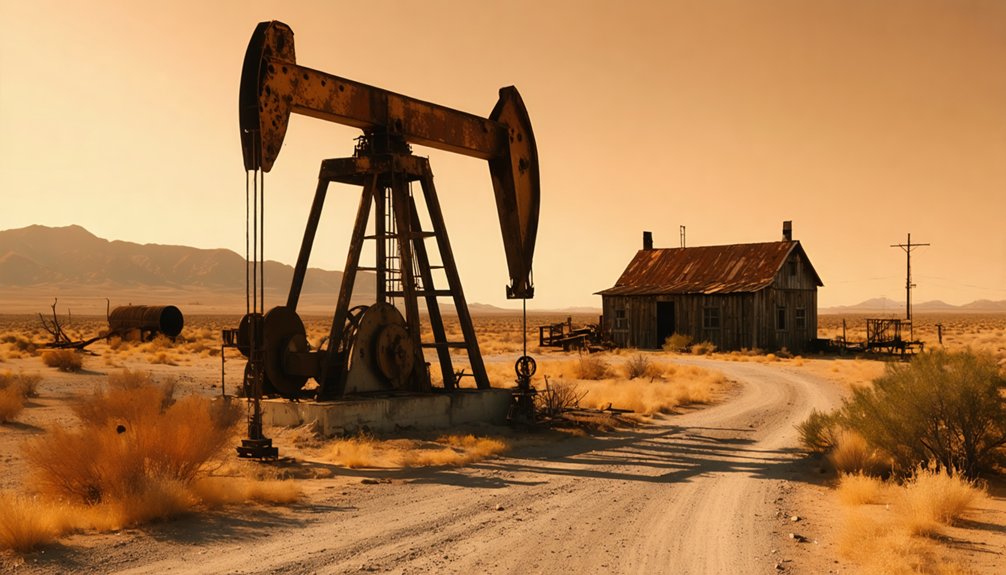
Exploring abandoned oil boom towns requires careful planning, as most ruins lie nestled in remote regions where conventional transportation proves inadequate.
Understanding the environmental impact of oil drilling is essential for responsible exploration. Regulations often aim to mitigate the long-term effects on local ecosystems and wildlife. Additionally, the footprint left by such activity can hinder future restoration efforts in these areas.
You’ll need 4WD vehicles capable of handling unpaved roads and rugged terrain. Standard transportation methods like public transit are nonexistent, though some sites offer guided tours for difficult-to-reach locations.
Before setting out, research permission requirements thoroughly. Many ruins sit on public lands managed by the BLM, requiring no special permits but demanding adherence to preservation rules.
Private property locations necessitate landowner approval to avoid trespassing. State and national parks typically require standard admission fees.
Prioritize safety when visiting these sites. Wear sturdy footwear, avoid deteriorating structures, and be mindful of environmental hazards like residual hydrocarbons.
Weather conditions can render access routes impassable, so always check forecasts before your journey.
Historical Markers and Commemorative Efforts in Vanished Petroleum Communities
As you explore vanished oil towns, you’ll notice historical markers have evolved from simple wooden posts to today’s bronze and aluminum plaques, with many undergoing restoration due to weathering and vandalism.
These commemorative fixtures require significant maintenance, with local historical societies often struggling to fund repairs for damaged or deteriorated markers dating back to the 1930s-1960s.
Community-driven memorial initiatives have expanded beyond official markers to include annual remembrance events, small museums housed in repurposed buildings, and digital archives that preserve photographs and oral histories of these once-thriving petroleum communities.
Historical Markers’ Physical Evolution
While standing as silent sentinels to America’s petroleum past, historical markers have undergone significant physical transformation over the decades.
The evolution of marker materials reflects both technological advances and preservation challenges faced at vanished oil boom sites across America. Early commemorative plaques utilized cast iron for durability, though these proved vulnerable to theft and weathering, as evidenced by disappearing markers at sites like Oil Springs.
- Cast iron markers from early commemoration efforts (1930s-1950s) – heavy, monochromatic, and designed for permanence
- Changeover metal plaques (1960s-1980s) – incorporating simple graphics with enhanced text layouts
- Modern enamel-coated displays (1990s-2000s) – featuring photographic elements and color for enriched storytelling
- Contemporary integrated installations (2010s-present) – combining traditional markers with QR codes linking to digital archives
Plaque Restoration Challenges
Beneath the faded paint and weathered surfaces of historical markers in abandoned petroleum towns lies a complex web of preservation challenges that specialists must navigate with increasing urgency.
Cast-iron markers from the early 20th century battle rust in humid environments, while aluminum plaques suffer UV-induced paint flaking that renders text illegible.
You’ll find restoration techniques vary by material and damage type. Specialists strip old paint layers, prime surfaces, and apply weather-resistant finishes to extend marker lifespans.
In remote oil ghost towns, these efforts face additional hurdles: overgrown vegetation, vandalism, and insufficient local oversight complicate plaque preservation work.
State historical commissions establish restoration standards, but the hands-on work often falls to volunteer groups and historical societies who document conditions, coordinate equipment for heavy markers, and fight the accelerating effects of environmental exposure.
Community Memorial Initiatives
The physical restoration of weathered plaques represents only one facet of preserving petroleum boom town legacies.
Modern community preservation efforts have expanded dramatically since Illinois State Historical Society erected their marker for Oilfield this May.
These memorial awareness projects document communities that rapidly transformed from bustling centers to forgotten landscapes:
- Butternut School’s conversion to Oilfield Cafe stands as the sole physical remnant of a once-thriving petroleum community.
- Historical markers in Titusville commemorate downtown sites where nothing physical remains.
- Documentation of Pithole City’s remarkable 15,000-person boom and subsequent abandonment within two years.
- Detailed records of dangerous living conditions where oil saturation created blindness and perpetual hazards.
Warren County and Clark County collaborations demonstrate how regional heritage programs preserve these vanishing histories despite complete environmental transformation.
What These Ruins Reveal About Early American Industrial Capitalism
Early American industrial capitalism reveals its raw essence through these abandoned oil town ruins, where both the promise and peril of unfettered economic expansion materialized in physical form.
You can trace the rapid capital concentration in places like Pithole, where 54 hotels sprang up virtually overnight to accommodate the influx of fortune-seekers. These speculative ventures often ended catastrophically—Pithole’s population plummeted from 20,000 to 2,000 in just one year following bank collapses.
The physical vulnerability of these boom settlements mirrored their economic fragility. Hastily constructed wooden buildings in Volcano and Pithole burned easily, destroying millions in property.
The abandoned $1 million school standing empty after the mid-1960s well closures represents the shortsightedness of profit-driven development that failed to take into account sustainability beyond immediate resource extraction.
Frequently Asked Questions
Did Oil Town Residents Face Unique Health Issues From Petroleum Exposure?
Yes, you’ll find oil town residents suffered unique health implications from petroleum exposure, including respiratory problems, skin rashes, neurological symptoms, increased cancer risks, and reproductive concerns throughout their residency.
How Did Racial Segregation Manifest in Early American Oil Towns?
Like scars on the American landscape, you’d find racial segregation policies shaped early oil towns through exclusionary hiring, segregated company housing, redlined neighborhoods, and exploitative community dynamics that confined Black workers to the most dangerous positions.
What Specific Safety Regulations Existed for Early Oil Field Workers?
Before 1958, you’d find virtually no federal safety regulations. You weren’t entitled to safety equipment or labor rights. State protections emerged gradually, with meaningful federal oversight only appearing after 1970’s OSHA establishment.
How Did Indigenous Communities Respond to Oil Development on Traditional Lands?
Indigenous resistance stopped emissions equivalent to 400 coal plants. You’ll see communities asserting land rights through legal challenges, direct action, and highlighting environmental impact while incorporating traditional knowledge to protect their sovereignty and cultural heritage.
Were Women Allowed to Own or Operate Oil Wells?
Yes, women could own oil wells, despite legal barriers. You’ll find pioneers like Sarah Rector and Emma Summers secured oil ownership rights, gradually expanding women’s rights throughout the industry’s history.
References
- https://www.geotab.com/ghost-towns/
- https://aoghs.org/petroleum-pioneers/pithole-creek/
- https://www.youtube.com/watch?v=oW66pgyhMYM
- https://okmag.com/blog/a-ghostly-site/
- https://www.nps.gov/bith/learn/historyculture/oil-gas-industry.htm
- https://en.wikipedia.org/wiki/Pithole
- https://savingplaces.org/guides/ghost-towns-on-route-66
- https://fee.org/articles/pithole/
- https://www.aapg.org/news-and-media/details/explorer/articleid/63602/pithole-the-rapid-rise-and-sudden-fall-of-an-oil-boomtown
- https://wordpress.lehigh.edu/specialcollections/2016/06/24/pithole-pennsylvania-oil-boom-ghost-town/