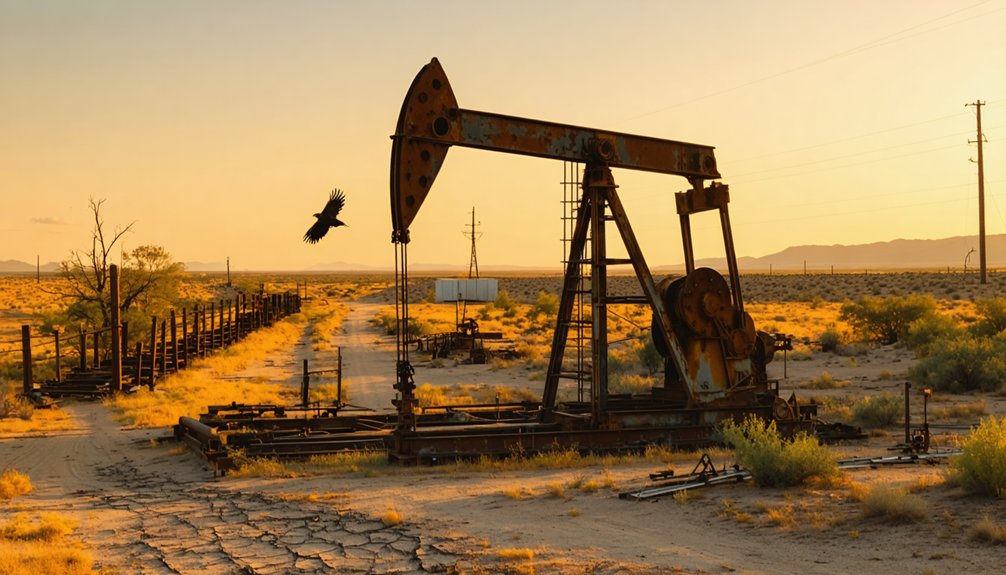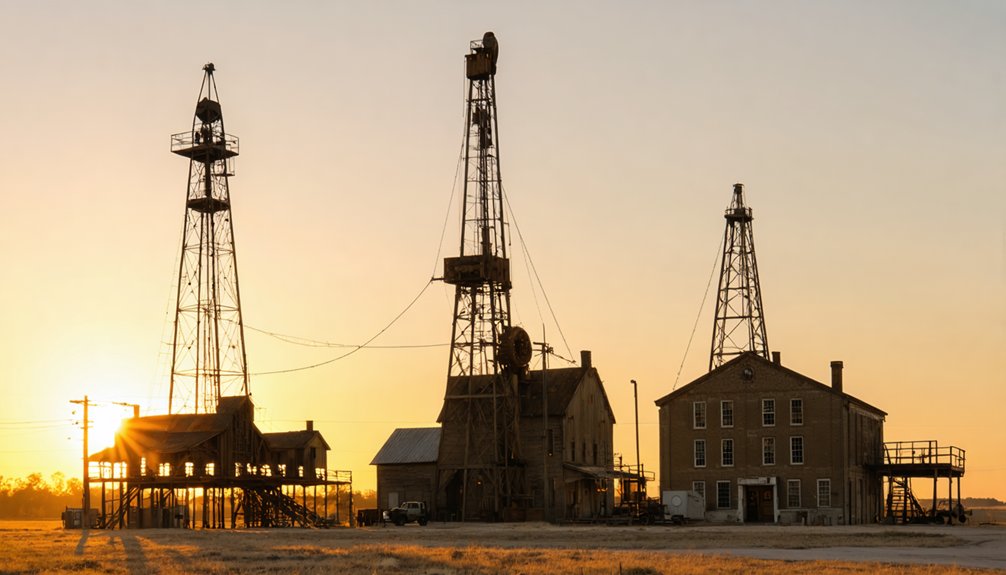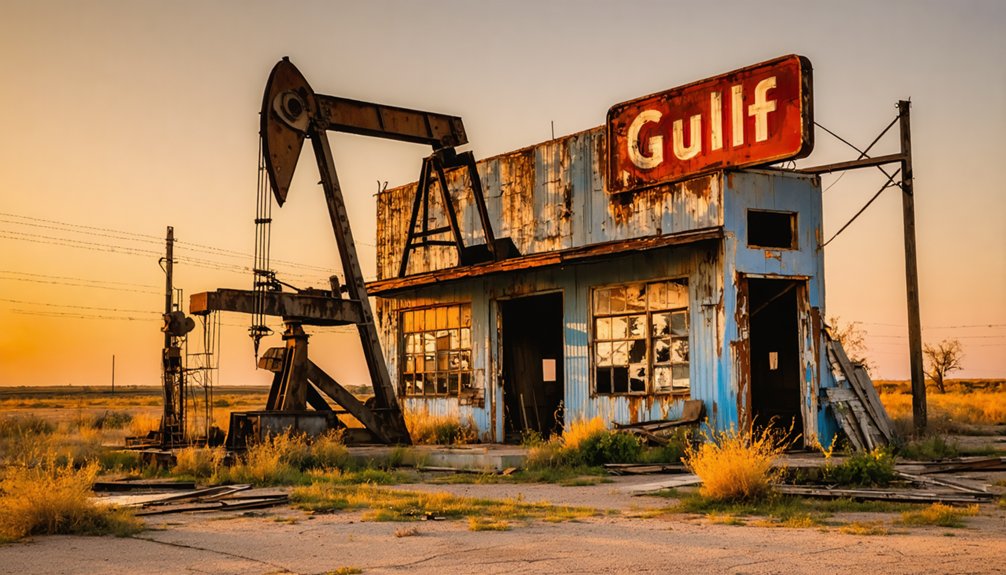
Exploring America’s forgotten oil boomtowns offers a glimpse into spectacular rise-and-fall stories from the early 20th century. You’ll find abandoned structures in Texas, Pennsylvania, and Oklahoma where populations once exploded by 1000% before vanishing just as quickly. When photographing these sites, visit during spring or fall mornings for ideal lighting conditions. Be cautious of environmental hazards like methane emissions and groundwater contamination—these toxic legacies affect millions of Americans today.
Key Takeaways
- Former oil boomtowns like Ranger, Texas and Pithole, Pennsylvania offer accessible historical ruins for exploration.
- Spring and fall mornings provide ideal lighting conditions for photographing decaying industrial landscapes.
- Many abandoned sites contain remnants of oil derricks, machinery, and infrastructure that tell America’s petroleum history.
- Visitors should be aware of environmental hazards from orphaned wells and contamination when exploring these locations.
- Documentation initiatives catalog these disappearing historical sites through photography and preservation efforts.
America’s Ghost Oil Metropolises: The Rise and Sudden Collapse
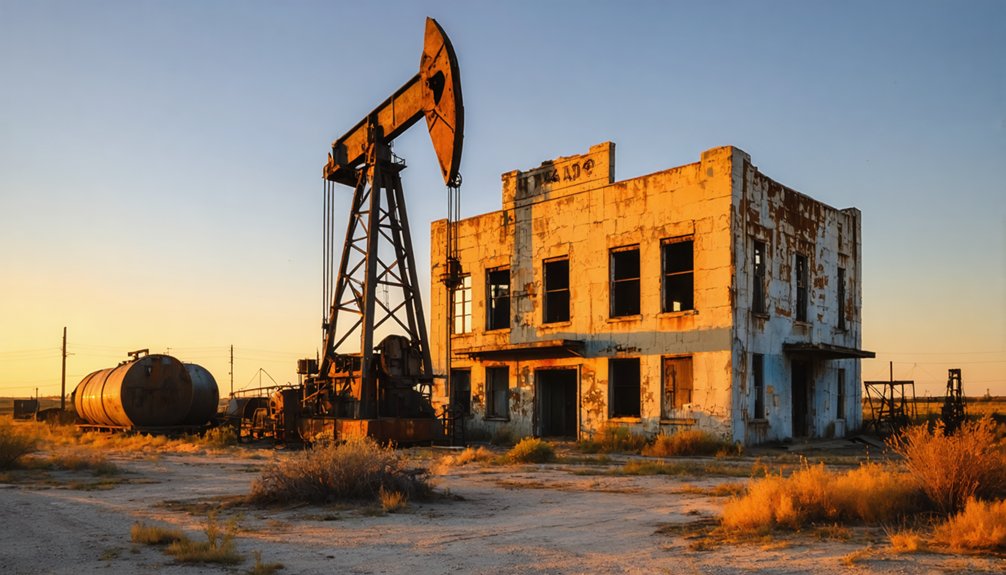
In the early twentieth century, as America’s thirst for oil grew insatiable, once-barren landscapes across Texas and Oklahoma transformed into bustling metropolises virtually overnight. Following oil discovery in places like Ranger, Texas, and Empire City, Oklahoma, populations exploded—Slick, Oklahoma reached over 5,000 residents within mere years.
When you examine these phenomena, you’ll find railroad access proved critical, enabling the rapid influx of the transient workforce drawn by promises of instant wealth.
Towns constructed infrastructure with remarkable speed: paved streets, schools, and electric lighting emerged where only fields had existed before. The First National Bank constructed a prominent Beaux Arts building in 1920, symbolizing the unprecedented economic growth these oil towns experienced.
But prosperity proved fleeting. As oil wells depleted, these towns emptied just as quickly as they’d filled. The oil boom of the 1920s initially brought prosperity, but many towns eventually suffered from resource depletion. Workers departed en masse for the next opportunity, leaving behind abandoned buildings—physical remnants of America’s relentless pursuit of energy resources.
Pennsylvania’s Pithole: The 500-Day Wonder That Vanished
Pithole’s meteoric rise to a bustling city of 15,000-20,000 residents occurred in just months after Ian Frazier’s 1865 oil discovery yielded an impressive 1,200 barrels daily.
You’ll find that this prosperity was tragically short-lived, as plummeting oil prices from $8.00 to $1.35 per barrel by late 1866 combined with devastating fires and pipeline competition to decimate the town’s economic foundation.
The introduction of Samuel Van Syckel’s first oil pipeline in October 1865 revolutionized transportation but ultimately contributed to the downfall of teamsters who had previously controlled oil shipping.
The city’s population collapsed by more than 90% within 500 days of its founding, leaving behind only memories of its 54 hotels, theater, and once-thriving oil infrastructure as Pennsylvania’s most dramatic boom-to-bust story.
Miss Eloise Bridges’ celebrated performance as Lady Macbeth at Murphy’s Theater in December 1865 represented the cultural peak of Pithole before its swift decline began.
Booming Boomtown Breakdown
Meteoric in its rise and precipitous in its fall, Pennsylvania’s Pithole City transformed from an unremarkable rural area to a bustling oil metropolis of nearly 20,000 residents within months during 1865, only to collapse with equal speed.
You’ll find that Pithole’s economy exploded when early wells produced up to 1,200 barrels daily from the Venango Third Sand. Oil extraction techniques remained primitive, yet the economic impact was profound—creating a 90-acre city with 50+ hotels and Pennsylvania’s third-busiest post office.
Post-Civil War veterans fueled this growth, investing capital in the $8-per-barrel petroleum market. The town boasted impressive amenities including a theater with 1,100 seats where residents could enjoy entertainment during the height of the boom.
But by late 1866, overproduction slashed prices to $1.35, while devastating fires consumed wooden structures throughout the town. The Commonwealth of Pennsylvania acquired the site in 1963, preserving this remarkable piece of American industrial history. Within a year, 85% of residents fled, leaving today’s visitor with only mown fields marking where America’s most remarkable oil boomtown once stood.
Vanishing Oil Prosperity
While prosperity initially flowed as freely as crude oil in Pithole City, the town’s decline proved even swifter than its miraculous rise.
By December 1866, oil production plummeted from 1,200 to fewer than 1,000 barrels daily, triggering catastrophic economic instability.
You’d scarcely recognize the once-thriving boomtown as its population collapsed from 20,000 to under 2,000 within months.
Oil wealth evaporated when prices crashed to $1.35 per barrel, bankrupting speculators and triggering bank failures.
The emergence of new oil fields in nearby regions like Pleasantville and Tidioute redirected investment and workers away from Pithole.
Devastating fires, particularly the August 1866 blaze that destroyed 27 wells and 13,000 barrels, accelerated Pithole’s demise.
The Forgotten Boomtowns of Oklahoma’s Oil Rush Era

As Oklahoma’s landscape became dotted with derricks in the late 19th and early 20th centuries, a remarkable transformation swept across the state’s terrain, giving birth to dozens of instant communities that would later fade into historical footnotes.
These forgotten histories began with the Nellie Johnstone well near Bartlesville in 1897, launching Oklahoma’s oil legacy.
You’ll discover these boomtowns followed a predictable pattern:
- Explosive population growth, often increasing 1000% within years
- Brief periods of wild prosperity accompanied by lawlessness
- Minimal infrastructure despite immense wealth generation
- Rapid decline when oil production waned
While Tulsa rose from 1,390 residents in 1900 to 140,000 by 1930 as the “Oil Capital of the World,” places like Whizbang flourished briefly before disappearing into Oklahoma’s plains. The arrival of the Kansas, Oklahoma Central and Southwestern Railway in 1899 enabled the transport of crude oil to markets, fueling the rapid development of these boomtowns. Daring individuals known as wildcatters risked everything to strike it rich, contributing to the rapid economic fluctuations that characterized these frontier communities.
Environmental Scars: The Toxic Legacy of Abandoned Oil Sites
The oil boomtowns that once symbolized Oklahoma’s economic prosperity left behind more than just abandoned buildings and forgotten stories.
They’ve created environmental scars that persist decades later. As you explore these ruins, you’re likely standing near some of the 123,318 documented orphaned wells nationwide—with potentially millions more undocumented.
What you can’t see are the invisible threats: methane emissions equivalent to 2-5 million cars annually and toxic contamination of soil and groundwater affecting nearly 4.6 million Americans.
These abandoned sites decrease property values by up to 50% in affected areas while posing serious health risks. The inadequacy of environmental monitoring is alarming—only 8% of wells have groundwater quality data within a kilometer radius.
The REGROW Act allocated $4.7 billion for plugging these dangerous orphan wells, though remediation costs still far exceed available funding.
The cost to remediate exceeds federal funding by billions, leaving these toxic legacies largely unaddressed.
Preserving History: Ghost Town Tourism and Heritage Conservation
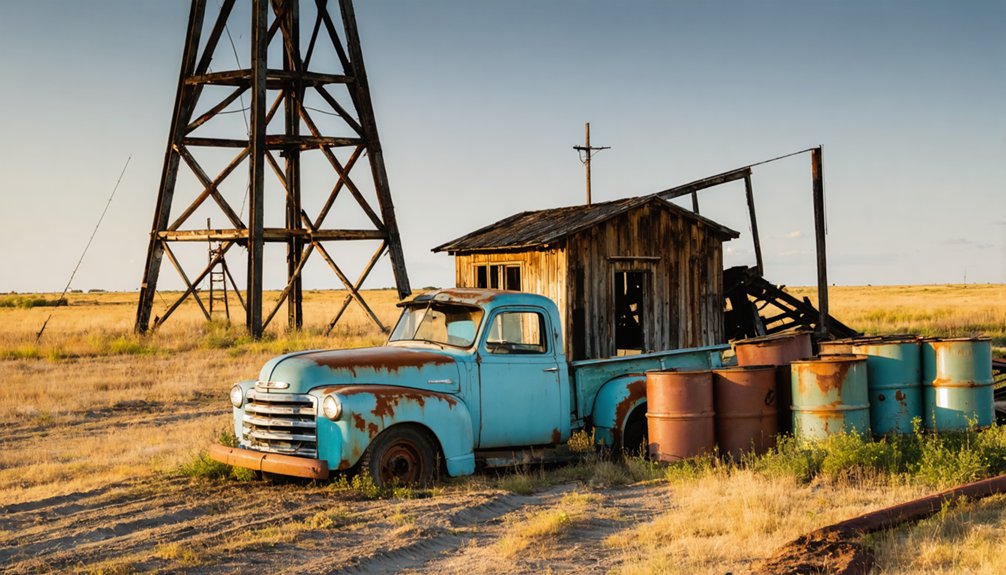
Five distinct approaches have emerged in the preservation of Oklahoma’s abandoned oil town ruins, transforming these deteriorating sites into valuable heritage tourism destinations.
You’ll find these conservation efforts balance historical authenticity with sustainable access:
- Documentation initiatives cataloging structures before intervention
- Adaptive reuse projects converting industrial sites into museums
- Community engagement programs recruiting local volunteers as tour guides
- Sustainable tourism management plans limiting visitor numbers to protect fragile ruins
The tourism impact extends beyond mere economic benefits, revitalizing communities through renewed pride and identity.
When you visit these sites, you’re participating in a reciprocal relationship—your interest funds preservation while the experience connects you to America’s industrial past.
Multi-stakeholder partnerships between governments, historians, and residents guarantee these preservation efforts reflect authentic local heritage rather than commercialized versions of history.
Hidden Treasures: Photography and Exploration of Oil Town Ruins
When you venture into abandoned oil town ruins, the interplay of light through deteriorated structures creates striking visual opportunities that photographers prize for their atmospheric qualities.
You’ll find the remnants of industrial equipment and weathered buildings serve as compelling subjects that document America’s petroleum heritage while challenging your technical skills with unstable structures and environmental hazards.
Capturing these decaying landscapes requires patience and timing—spring and fall mornings offer ideal conditions with soft light that accentuates textures and casts dramatic shadows across forgotten machinery and crumbling architecture.
Light Among Ruins
Capturing ethereal beauty amid destruction requires mastering light in abandoned oil town ruins, where photographers discover hidden dimensions through specialized techniques.
You’ll find creative illumination most dramatic during golden and blue hours, when the sun’s position creates a natural canvas for your compositions.
For maximum impact in these forgotten landscapes:
- Use light painting to highlight weathered architectural details—sweep your flashlight across textures during 15-30 second exposures.
- Apply graduated ND filters to balance bright skies against shadowed ruins.
- Capture time’s passage with long exposures that blur clouds while structures remain static.
- Employ post-processing techniques like HDR and focus stacking to enhance atmospheric depth.
The freedom to experiment with these methods will transform decaying industrial sites into compelling visual narratives that preserve their haunting dignity.
Capturing Industrial Ghosts
The haunting presence of industrial ghosts within abandoned oil towns offers photographers a rich tapestry of visual storytelling opportunities that transcend conventional landscape photography.
As photographers seek to capture these ethereal remnants of the past, they often find themselves drawn to the haunted coastal villages of New England. The crumbling homes and whispering winds tell stories of long-forgotten lives, providing a haunting backdrop that inspires both introspection and creativity. Each frame encapsulates not just the decay but also the enduring beauty of these places, inviting viewers to ponder the mysteries that lie beyond the surface.
When engaging in urban exploration, bring wide-angle lenses to capture the expansive scale of derelict refineries and derricks against decaying horizons.
Industrial photography thrives on contrasts—employ long exposure techniques in dim interiors to reveal hidden textures while balancing complex lighting through HDR blending.
Focus your lens on evocative details: rusted machinery, scattered tools, and peeling paint tell powerful stories of abandonment.
For maximum impact, shoot during golden hour when angled light creates dramatic shadows across architectural features.
Post-process with desaturated palettes or convert to black and white to emphasize the timeless quality of these forgotten spaces, where human industry has surrendered to nature’s slow reclamation.
Documenting Decay’s Beauty
Beyond the surface decay and deterioration, abandoned oil towns reveal an unexpected aesthetic splendor that rewards patient photographers who venture beyond the obvious shots.
These sites offer rich historical narratives through their decay aesthetics, where nature reclaims what industry once dominated.
When documenting these forgotten landscapes, consider:
- Texture contrasts – Capture the interplay between rusted machinery and encroaching vegetation for compelling visual tension.
- Golden hour lighting – Utilize sunrise or sunset to enhance weathered surfaces and create dramatic shadows through broken structures.
- Scale juxtapositions – Frame large industrial remnants against small personal artifacts to tell human stories.
- Seasonal variations – Return to sites during different seasons to document how natural cycles transform these static monuments.
Your photographs serve as essential documentation of these disappearing historical treasures before environmental forces complete their reclamation.
Frequently Asked Questions
Is It Legal to Collect Artifacts From Abandoned Oil Town Sites?
Finders aren’t always keepers. You can’t legally collect artifacts without permission, as artifact ownership depends on land status. Legal consequences include fines, imprisonment, and confiscation when laws are disregarded.
How Dangerous Are Structural Hazards in These Forgotten Towns?
Structural hazards pose severe dangers due to compromised structural integrity from subsidence, sinkholes, and collapsing buildings. You’ll need robust safety precautions including testing for toxic gases and avoiding unstable foundations entirely.
When Is the Best Season to Visit Oil Ghost Towns?
When nature awakens its gentler disposition, you’ll find ideal conditions. Spring visits offer mild temperatures and fewer crowds, while autumn exploration provides stable weather, enhanced photographic opportunities, and reduced wildlife concerns.
Are There Paranormal Reports Associated With Abandoned Oil Towns?
Yes, you’ll encounter numerous ghost sightings in abandoned oil towns like Mentryville and Indianola, where electromagnetic anomalies and toxic contamination generate urban legends rooted in historical trauma and environmental degradation.
Can Modern Fracking Revive Any of These Ghost Towns?
Fracking technology won’t revive these ghost towns, as it targets different geological formations and creates new problems. Despite economic revival hopes, abandoned well sites require costly remediation before any meaningful redevelopment can occur.
References
- https://www.okhistory.org/publications/enc/entry?entry=GH002
- https://www.geotab.com/ghost-towns/
- https://aoghs.org/petroleum-pioneers/pithole-creek/
- https://www.youtube.com/watch?v=oW66pgyhMYM
- https://grist.org/abandoned-oil-gas-wells-permian-texas-new-mexico/
- https://okmag.com/blog/a-ghostly-site/
- https://www.epa.gov/mo/town-flood-and-superfund-looking-back-times-beach-disaster-nearly-40-years-later
- https://en.wikipedia.org/wiki/Pithole
- https://savingplaces.org/guides/ghost-towns-on-route-66
- https://texashighways.com/culture/history/from-boomtown-to-ghost-town-ranger-breckenridge-and-thurber-museums-recall-early-20th-century-oil-rush/