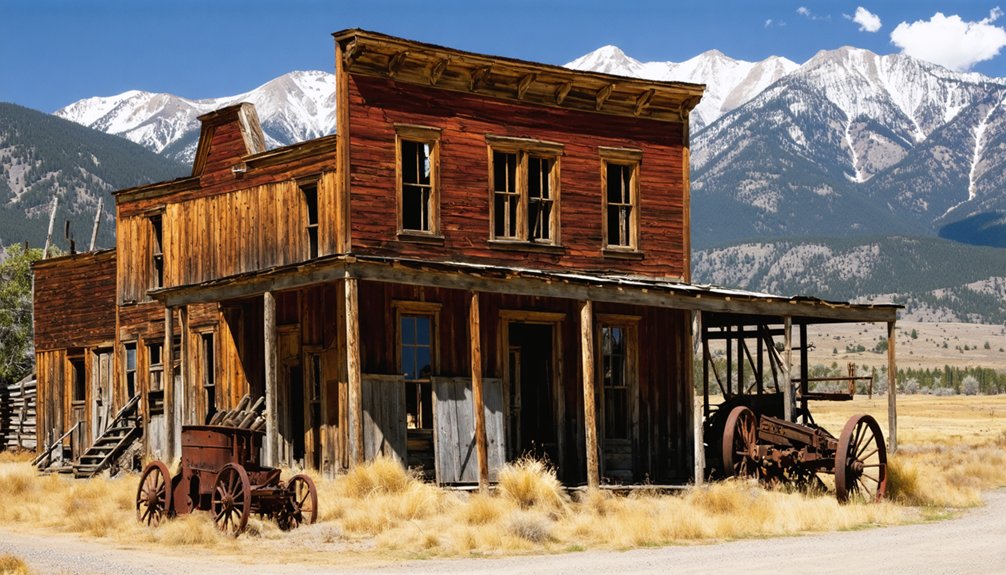
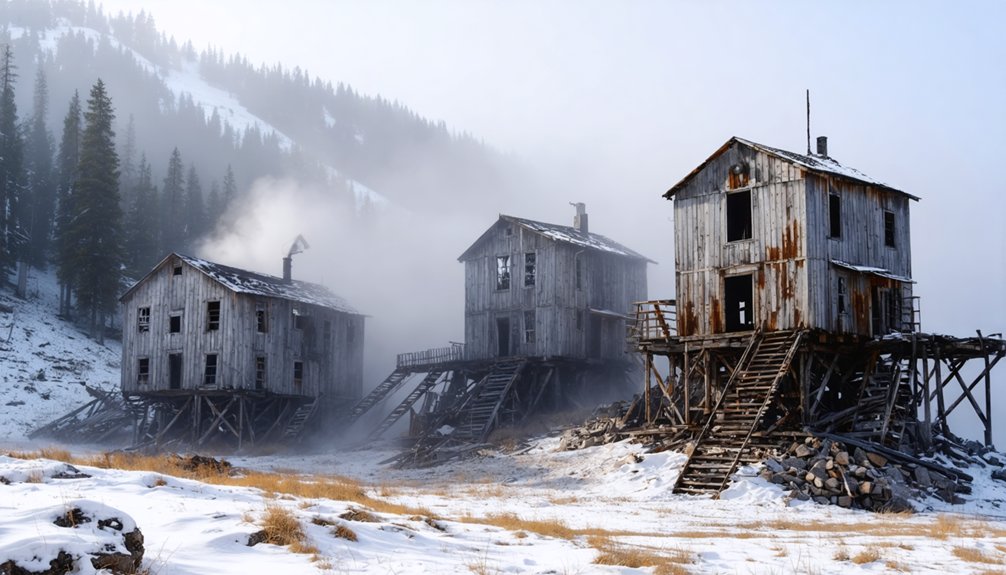
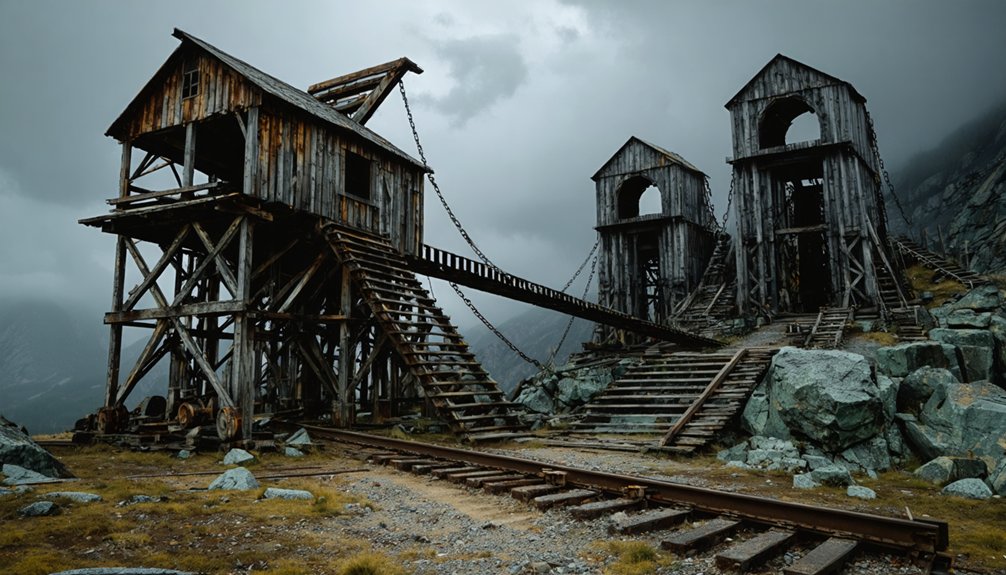
You’ll discover Colorado’s ghostly mining camps from the 1870s silver boom that generated over $1.1 billion across the San Juan Mountains. These high-altitude remnants, like Animas Forks at 11,200 feet, feature preserved saloons, mills, and tramways that tell stories of boom-and-bust cycles. Today, preservation organizations protect these cultural treasures while enabling 4WD exploration on routes like the 63-mile Alpine Loop. The towns’ silent structures await your investigation.
Key Takeaways
- Colorado’s Alpine Loop features numerous accessible ghost towns requiring 4WD vehicles to navigate the 63-mile byway connecting historic mining communities.
- Preserved mining camps showcase infrastructure like mills, tramways, and ore cars that tell the story of boom-and-bust cycles in Western mining history.
- Grassroots preservation efforts by organizations like the San Juan County Historical Society protect mining remnants for future generations.
- Photography opportunities are best at dawn or dusk, with techniques like using tripods and wide-angle lenses capturing the essence of ghost towns.
- Beyond Colorado, similar mining ghost towns exist throughout the American West, each offering unique insights into 19th-century frontier life.
The Rise and Fall of Colorado’s Silver Boom Towns

When silver was discovered in Leadville in 1877, it triggered one of the most significant mining booms in Colorado’s history, forever altering the state’s economic and social landscape.
Within two years, news spread and Leadville transformed from a declining gold camp into a thriving silver mining metropolis producing over $82 million in silver.
You can trace the boom’s expansion as prospectors established towns across the mountains: Silver Plume, Caribou, Telluride, and Aspen.
Railroad extensions enabled this growth, with Creede marking the last major boom in 1891.
This rapid development created immense wealth but also economic volatility.
When the Sherman Silver Purchase Act was repealed in 1893, prices collapsed, triggering widespread unemployment.
Once-bustling communities became ghost towns or struggled through “Quiet Years” until finding new economic foundations.
Mining conditions were extremely hazardous, with workers facing risks from silicosis and collapses that claimed many lives throughout the boom period.
Notable figures like Horace Tabor made immense fortunes during the silver boom, contributing to Leadville’s cultural development with landmarks such as the Tabor Opera House.
Historic Mining Settlements in the San Juan Mountains
If you’re exploring the San Juan Mountains, you’ll discover former silver-rich transportation hubs like Silverton, Ouray, and Lake City that once served as essential centers in Colorado’s mining economy.
The Alpine Loop connects numerous ghost towns including abandoned mining sites established after the 1873 Brunot Treaty opened the region to settlement.
Current preservation efforts maintain structures from the 1870-1910 mining era, protecting remnants of operations like the Little Giant and Sunnyside mines that transformed this remote mountain wilderness into an industrial powerhouse. Ironton, which connected Red Mountain Town and Ouray, became a significant transportation junction with two daily trains arriving from Silverton during its peak period.
The harsh winter conditions in these mountainous regions caused many prospectors to avoid year-round settlement, forcing them to abandon camps during the coldest months despite the area’s mineral wealth.
Silver-Rich Transportation Hubs
Following the Brunot Agreement of 1873, the San Juan Mountains transformed from Ute tribal lands into a network of bustling silver-rich settlements that would define Colorado’s mining frontier.
You’ll find Silverton at the heart of this transformation, strategically positioned as a critical silver transportation hub after the Denver & Rio Grande Railway’s 1882 arrival. The town’s population swelled to 2,000, largely due to the Sunnyside Mine’s exceptional productivity. The Otto Mears railroads further enhanced connectivity with engineering masterpieces like the Chattanooga Loop that navigated the steep mountain terrain.
Surrounding settlements like Ouray, Eureka, and Howardsville formed an interconnected extraction network dependent on mining infrastructure to overcome the region’s rugged terrain.
What you’re witnessing in these towns is the rapid industrialization that followed indigenous displacement. The San Juan mining district became one of the four major districts that collectively generated over $1.1 billion during Colorado’s mining boom. The $25,000 annual payment to Ute tribes facilitated Euro-American access to approximately 4 million mineral-rich acres, forever altering the economic and social landscape of Colorado’s mountainous frontier.
Alpine Loop Ghost Towns
The Alpine Loop‘s constellation of ghost towns stands as a tribute to Colorado’s boom-and-bust mining era, threading through some of North America’s most challenging alpine terrain.
You’ll need a high-clearance 4WD vehicle to navigate the 63-mile byway connecting Silverton, Ouray, and Lake City, where over 100,000 annual visitors discover remnants of frontier ambition.
Animas Forks, perched at 11,200 feet, preserves the memory of miners who once tunneled through 25-foot snowdrifts between buildings. By 1876, this remote outpost had grown to include 30 cabins, a hotel, a saloon, a post office, and a general store.
Nearby, ghost town legends persist in Alta, Capitol City, and Sherman, where abandoned structures silently chronicle silver’s rise and fall.
The journey over Cinnamon Pass at 12,640 feet offers thrilling shelf roads that hug the mountain’s edge while revealing sweeping alpine vistas.
Throughout your journey, alpine flora frames these historical tableaus—a delicate contrast to the rugged determination that briefly transformed these remote mountain passes into centers of commerce and community.
Mining Preservation Efforts
Mining preservation efforts in Colorado’s San Juan Mountains represent a complex intersection of historical stewardship, environmental remediation, and cultural reconciliation.
You’ll find grassroots organizations like the San Juan County Historical Society working alongside the Ghost Town Club of Colorado to protect these remnants of America’s mining past despite dwindling federal support.
These preservation efforts include:
- Volunteer-driven initiatives securing $12+ million in grants for stabilizing structures like the Old Hundred Mine
- Creative logistics solutions using helicopters and mules to access remote historic sites
- Community engagement through archival work preserving maps, photographs, and diaries
Among the most successful preservation projects is Animas Forks, where nine well-preserved wooden structures stand as testament to the region’s mining heritage.
The challenge remains balancing the region’s mining heritage with environmental stewardship and addressing Indigenous land claims—a reflection of how preservation extends beyond mere conservation to include ecological healing and cultural justice. Visitors should ensure JavaScript is enabled in their browsers when accessing digital preservation archives and virtual tours of these historic sites.
Perched at dizzying elevations between 9,600 and 12,000+ feet above sea level, Colorado’s high-altitude ghost towns present unique logistical challenges that require careful planning and preparation.
You’ll face significant access challenges ranging from unpaved roads demanding high-clearance 4×4 vehicles to seasonal closures lasting from October through May. Notable sites like Animas Forks (11,200 ft) and Carson (12,000 ft) sit beyond narrow canyons and steep ridges that test both vehicle capabilities and driving skills.
Altitude acclimatization is essential when visiting towns above 11,000 feet, as the thin air affects breathing and physical exertion.
The thin air at 11,000+ feet demands respect—plan for reduced stamina and slower movement while your body adjusts.
Most locations lack modern amenities—no water, electricity, or emergency services—so you’ll need to be entirely self-sufficient. Weather conditions change rapidly, requiring flexible planning and appropriate gear regardless of season.
Life in Mining Communities: From Saloons to Supply Stores

When you visit Colorado’s mining ghost towns today, you’ll find the skeletal remains of saloons that once served as bustling social hubs, banking institutions, and safe storage for miners’ gold dust and earnings.
The economic infrastructure extended beyond drinking establishments to include extensive merchant networks of general stores, hardware suppliers, and assay offices that remained open even on Sundays to accommodate underground workers’ schedules.
Despite the harsh living conditions at high altitudes, miners found recreation through gambling parlors, dance halls, and various entertainment venues that helped foster community in these isolated mountain settlements.
Saloons and Social Gatherings
Among the first establishments to appear in any burgeoning mining camp, saloons quickly became the beating heart of Colorado’s frontier communities. Operating around the clock during boom times, these establishments transcended mere drinking venues to function as multi-purpose social hubs where miners could escape harsh mining conditions.
You’d find these saloons illuminated at night, serving as beacons of warmth and community gathering in remote mountainous regions.
Beyond saloon entertainment and whiskey consumption, these establishments fulfilled critical community functions:
- Acting as informal banks where prospectors stored gold dust in iron safes
- Hosting political discussions and impromptu town meetings
- Providing space for card games, gambling, music, and dancing
As mining evolved from individual prospectors to company operations, saloons gradually transformed, reflecting the changing economic landscape of these now-ghostly camps.
Merchant Supply Networks
While saloons provided social gathering spaces for miners, the merchant supply networks formed the economic backbone of Colorado’s mining communities.
You’d find these savvy businesspeople establishing diverse economic foundations beyond mineral extraction, recognizing mining’s transitory nature.
Through merchant collaboration, shopkeepers built connections across multiple camps to reduce dependency on single districts. Their supply strategies included stocking everything from canned oysters to dried beef, carefully planning procurement from distant railheads like Cañon City.
When railroads reached northeastern Colorado, previously isolated communities connected to national markets, allowing specialization of labor and expanded trade.
The Colorado Fuel & Iron Company even operated stores using proprietary currency systems to compel worker purchases.
These merchants lived precariously—their success entirely dependent on continued mineral prosperity. When mines closed, thriving communities transformed into the ghost towns you explore today.
Recreation Amid Hardship
Despite the grueling nature of mining life, Colorado’s mining communities developed rich social outlets that provided essential relief from daily hardships. Saloons functioned beyond mere drinking establishments—they became community hubs where miners exchanged vital information and organized mutual aid during emergencies.
Your mining ancestors found freedom from their demanding routines through:
- Community events like July 4th drilling contests, dances, and fairs that strengthened social bonds
- Musical gatherings featuring fiddle players and brass bands that offered cultural escape
- Recreational activities including ice skating and mineral baths that provided physical respite
While men frequented saloons, women created their own social networks through church activities and Ladies Aide Societies.
Children, despite their work responsibilities, incorporated play into camp life, often with burros as companions—creating moments of joy amid harsh realities.
Preserved Mining Infrastructure: Mills, Shafts, and Equipment
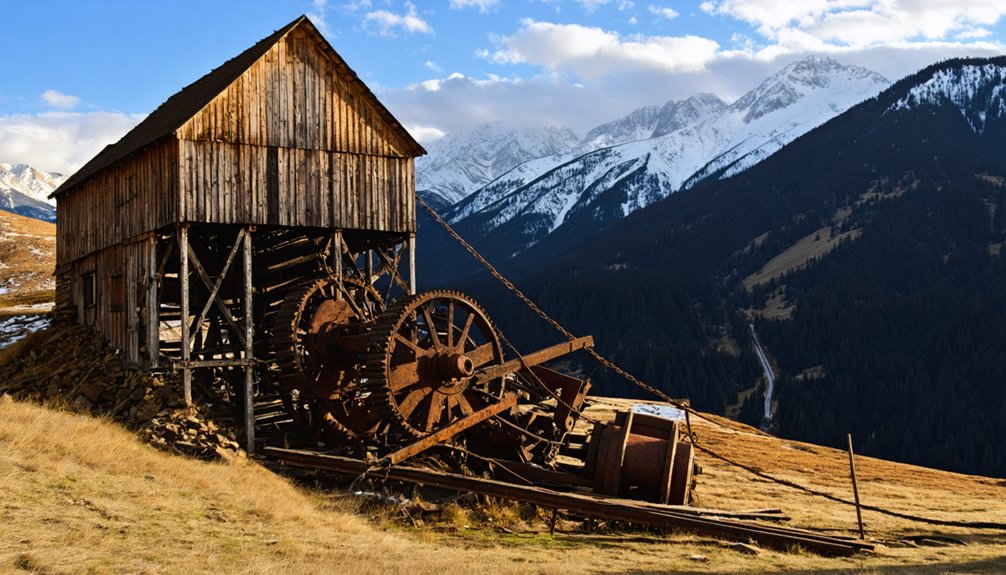
The preserved mining infrastructure across Colorado’s ghost towns offers tangible connections to the state’s industrious past, with mills, shafts, and equipment standing as silent witnesses to the once-booming mineral extraction industry.
You’ll find stamp mills and flotation facilities showcasing evolution in mining techniques, from primitive ore-crushing operations to sophisticated processing systems. The historical significance of these structures is evident at sites like the Matchless Mine in Leadville or the National Historic Landmark Mayflower Mill in Silverton.
Explore sealed mine shafts marked by towering headframes, or venture into stabilized adits with original timber supports at locations like the Mollie Kathleen Gold Mine.
The infrastructure extends beyond extraction points to include tramways, ore cars, and support facilities—blacksmith shops, assay offices, and powerhouses—all carefully preserved for your educational exploration.
Gold Rush Legacies: Cripple Creek and Goldfield
Colorado’s most iconic gold rush legacy emerged from Cripple Creek in the 1890s, transforming a cattle-grazing area into one of America’s richest mining districts practically overnight.
Bob Womack’s 1890 strike in Poverty Gulch ignited the rush, while Winfield Scott Stratton’s Independence Mine staked on July 4, 1891, created the district’s first millionaire.
When you visit these historic sites, you’ll discover:
- The American Eagles Mine at 10,700 feet elevation, once owned by Stratton, standing as the district’s highest underground operation
- Goldfield, which exploded from nothing to 3,500 residents by 1900
- Evidence of the area’s intense labor conflicts, where miners organized and fought for the eight-hour workday
Nearby Victor and smaller settlements like Altman showcase how quickly boomtowns rose and fell with mining fortunes.
Cultural Heritage and Preservation Efforts

While these ghostly mining camps stand as silent witnesses to Colorado’s boom-and-bust history, dedicated preservation organizations have worked tirelessly to guarantee their stories remain accessible for future generations.
Groups like the Ghost Town Club of Colorado and San Juan County Historical Society maintain critical sites and archives documenting mining heritage across the state.
Cultural stewardship thrives through innovative partnerships between federal agencies and local volunteers who monitor sites for vandalism while educating visitors about proper etiquette.
Community involvement proves essential—trained stewards conduct seasonal monitoring at adopted sites, addressing the most urgent preservation needs.
When visiting these historic treasures, you’ll find interpretive trails with educational signage keeping you safely distanced from hazardous mine openings.
Remember that artifact removal is both illegal and unethical—experience these remnants of the past responsibly.
Year-Round Adventures in Former Mining Camps
Throughout changing seasons, these dormant mining camps transform into vibrant destinations for adventurers seeking both historical immersion and natural beauty. Year-round hiking opportunities abound, with trails like North Pole Basin and Crystal Mill from Schofield Pass offering varying challenges while revealing remnants of Colorado’s mining heritage.
Mining camp tourism has evolved beyond mere sightseeing:
- Seasonal experiences – Prime hiking from late June through early October, with autumn foliage enhancing historical landscapes.
- Immersive stays – Year-round cabin accommodations in places like Crescent City Mining Camp near Leadville.
- Interactive learning – Hands-on activities including underground tours at Mollie Kathleen Mine and gold panning experiences.
Whether you’re exploring luxury redevelopments like Binder’s Camp V or hiking to preserved sites like Winfield, you’ll find these historical treasures accessible with proper preparation regardless of season.
Photography Tips for Capturing Mining Town Remnants
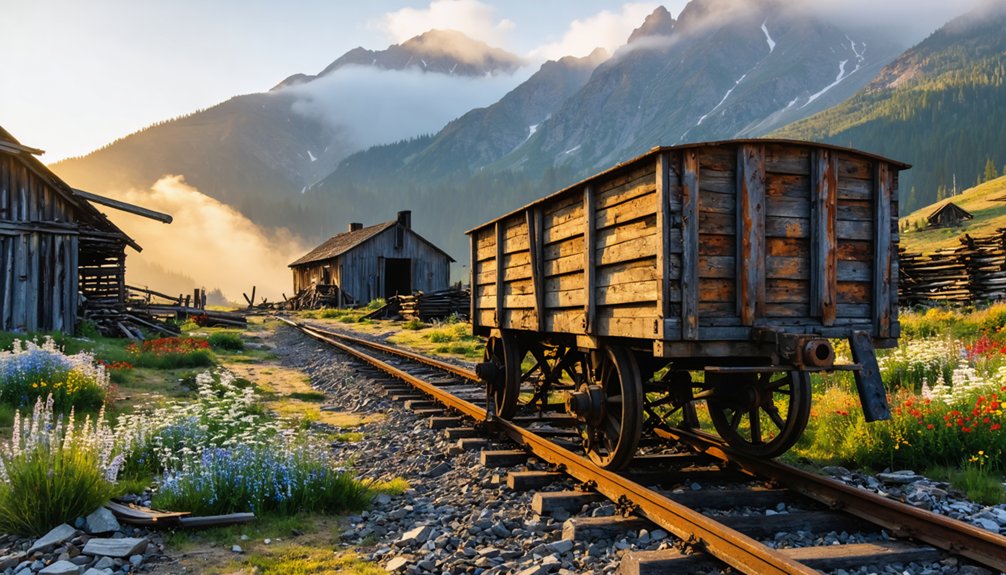
Capturing the essence of abandoned mining towns requires both technical skill and artistic vision to transform these weathered remnants into compelling visual narratives.
For ghost town photography, shoot during dawn or dusk when soft, directional light enhances textures and shadows. Use a tripod for stability in low-light conditions and to frame deliberate compositions.
When exploring mining camp aesthetics, start with wide-angle shots of entire structures before moving to detail work with macro lenses. Doorways, windows, and sand incursions create natural framing opportunities.
Consider monochrome processing to emphasize the timeless quality and textural contrasts. For interior shots, selective lighting with flashlights reveals hidden details while maintaining the authentic atmosphere.
Seek unconventional viewpoints and include artifacts that tell stories—rusted machinery, faded signage, or personal items—to create images that resonate beyond mere documentation.
Frequently Asked Questions
Are Any Ghost Towns Still Inhabited by Descendants of Original Miners?
Against all odds, Vicksburg sustains descendant lifestyles through seasonal residents. You’ll find descendants actively maintaining mining heritage properties there, while Alta and St. Elmo also preserve familial connections to their mining past.
What Paranormal Activity Has Been Reported in Abandoned Mining Camps?
You’ll encounter reports of ghost sightings in mining bunkhouses, eerie sounds like phantom footsteps, unexplained moving objects, temperature drops, and photographic anomalies capturing spectral figures at sites with tragic histories.
In addition to these chilling experiences, many individuals have sought out haunted locations in mill towns, where the remnants of industrial pasts seem to linger in the air. Stories of restless spirits and mysterious occurrences often draw thrill-seekers and paranormal enthusiasts to these historic sites. Each visit promises an opportunity to uncover the secrets that have long been buried in the shadows of these former bustling hubs of activity.
How Did Women’s Roles Differ Across Various Colorado Mining Communities?
Birds of a feather flock together. You’ll find women’s labor varied by camp size and community dynamics—some prospected independently in remote areas, while others managed brothels or boarding houses in established towns.
Which Ghost Towns Are Accessible for Visitors With Mobility Limitations?
You’ll find wheelchair friendly sites at Ghost Town Museum in Colorado Springs, downtown Glenwood Springs, and Ashcroft Ghost Town, which offers accessible tours with boardwalks despite some uneven surfaces.
What Safety Precautions Should Visitors Take When Exploring Abandoned Mines?
You shouldn’t enter abandoned mines as they’re prone to mine collapse. If exploring nearby, wear safety gear including helmets, bring multiple light sources, and tell someone your location and timeline.
References
- https://gunnisoncrestedbutte.com/blog/hike-to-colorados-abandoned-mining-camps/
- https://www.colorado.com/articles/colorado-ghost-towns
- https://www.uchealth.org/today/ghost-towns-abound-in-colorado/
- https://www.motortrend.com/features/1812-adventure-exploring-the-abandoned-mining-camps-of-colorado
- https://www.durango.com/colorado-ghost-towns/
- https://www.coloradolifemagazine.com/blog/post/11-colorado-ghost-towns
- https://www.sandradallas.com/colorado-ghost-towns-and-mining
- https://en.wikipedia.org/wiki/Colorado_Silver_Boom
- https://www.townoflakecityco.gov/gold-silver-booms-in-colorado
- https://leadville.com/a-time-line-of-leadvilles-history/