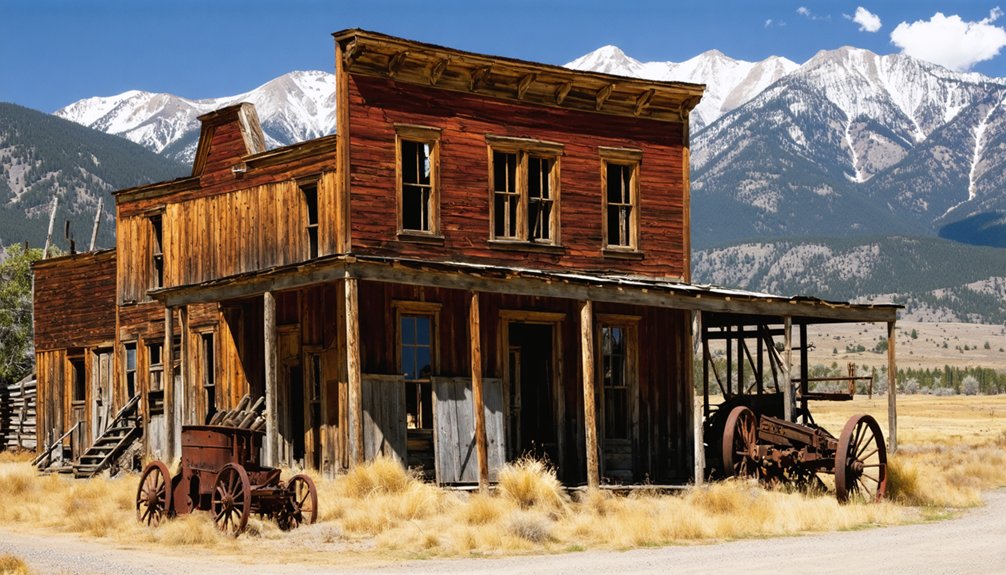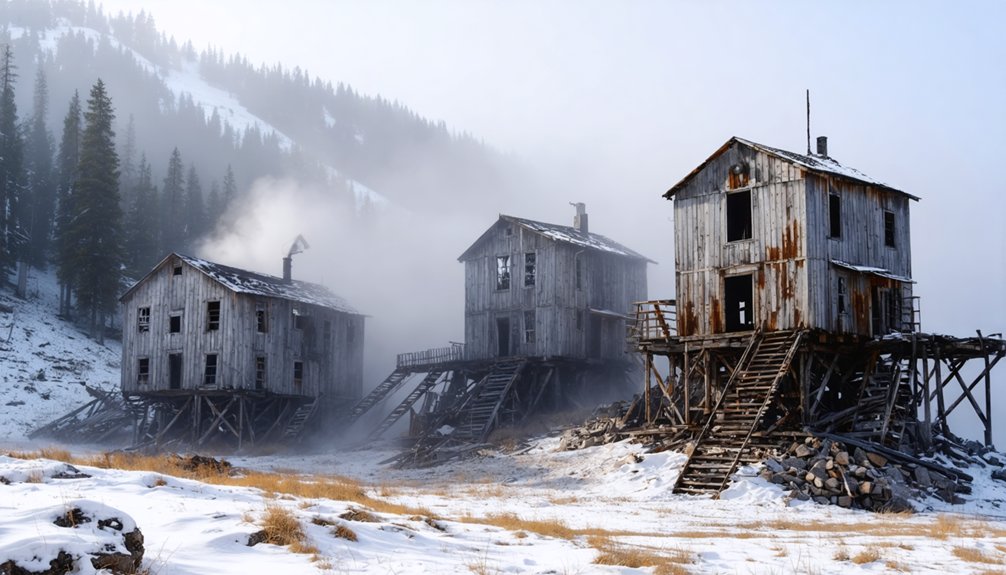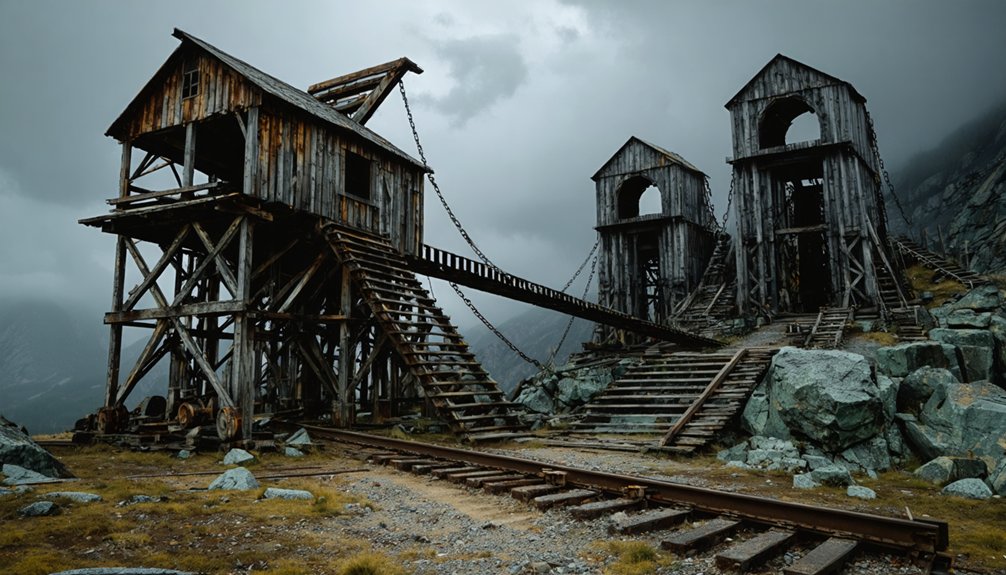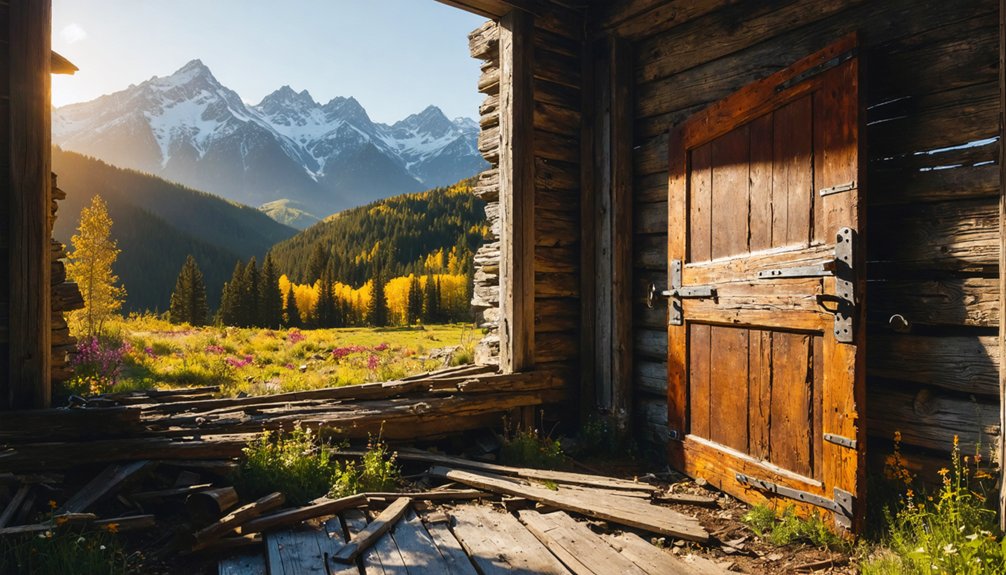
Colorado’s ghost towns offer you a unique blend of mining history and paranormal activity. You’ll find well-preserved structures in St. Elmo, where Annabelle Stark’s spirit reportedly wanders, and eerie abandoned buildings in towns like Nevadaville and Tincup. Visit between late spring and early fall with appropriate vehicles for best accessibility. Bring your camera for golden hour shots that capture these haunting remnants. The whispers from Colorado’s mining past await your discovery.
Key Takeaways
- St. Elmo offers 43 preserved structures including the reportedly haunted Stark family home where Annabelle’s spirit is frequently sighted.
- Visit ghost towns during late spring to early autumn for optimal accessibility and bring proper vehicles for remote locations.
- Popular haunted locations include Colorado Grande Casino, Central City Masonic Cemetery, and Mary Murphy Mine.
- Pack adequate water, emergency supplies, and monitor weather conditions as alpine environments change rapidly.
- Capture eerie beauty during golden hour with aperture priority settings and a tripod for atmospheric photographs.
The Rise and Fall of Colorado’s Mining Empires
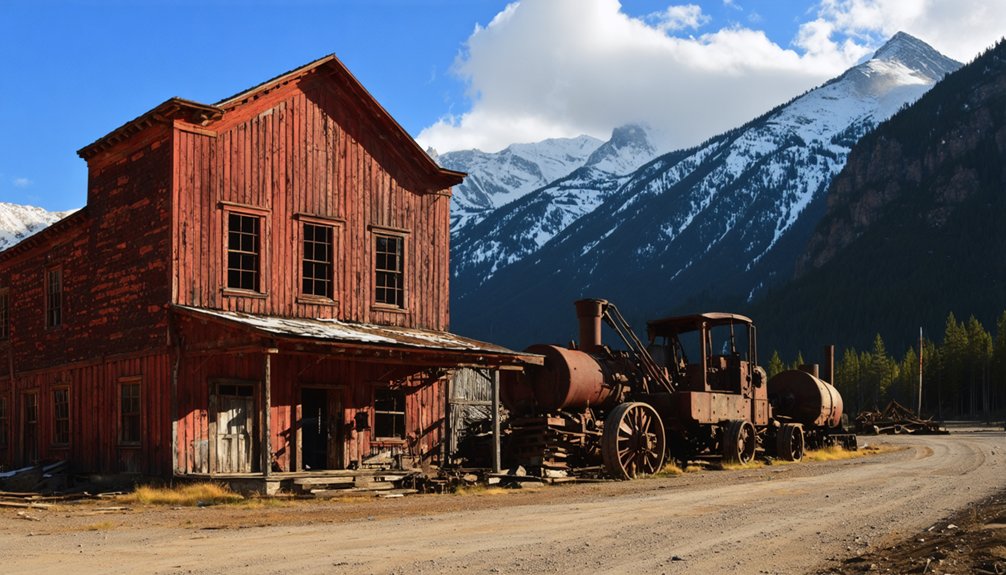
While Montana City (later Denver) was founded in 1858 by hopeful gold seekers, their initial strikes along the South Platte River proved disappointing.
The true mining boom erupted with the 1859 Pikes Peak Gold Rush, which birthed settlements like Central City, Golden City, and Boulder. As placer mining declined by the mid-1870s, silver emerged as the new treasure. Leadville’s 1879 silver discovery generated over $82 million, transforming it into a globally significant mining district.
You’ll find that Colorado’s mining fortunes shifted dramatically with the 1893 repeal of the Sherman Silver Purchase Act. This legislative change devastated mining communities, converting once-thriving centers into ghost towns. Labor conflicts like the Ludlow Massacre highlighted the growing tensions between workers and mine owners during these economic downturns.
While some settlements collapsed entirely, others like Aspen and Leadville adapted, eventually changing toward tourism to preserve their rich mining heritage. Colorado’s gold rush was so significant that it led to the territory’s official designation in 1861, setting the foundation for statehood fifteen years later.
St. Elmo: Colorado’s Best-Preserved Ghost Town
As you stroll through St. Elmo’s remarkably intact collection of 43 original structures, you’ll encounter the general store, hotels, and miners’ cabins that have withstood a century of mountain winters since the town’s 1922 abandonment.
The Stark family home attracts paranormal enthusiasts who report encounters with Annabelle Stark’s watchful spirit, manifested through slamming doors and dramatic temperature drops. The town was originally named Forest City before being renamed after a popular 19th-century novel.
Don’t miss the remaining schoolhouse, now managed by the Buena Vista Heritage Museum, where visitors have documented unexplained footsteps and whispers from the 1880s mining era. The town sits at an impressive elevation of 9,961 feet surrounded by the scenic Sawatch Mountain Range.
Preserved Buildings Tour
Forty-three original structures stand as silent witnesses to St. Elmo’s mining heyday, offering you an authentic glimpse into 1880s mountain architecture.
As you stroll down Main Street, the wood-frame buildings showcase preserved architecture of remarkable historical significance, largely thanks to the Stark family’s conservation efforts.
Your self-guided tour highlights include:
- Stark Store – An 1870s general merchandise building that still operates seasonally (May-October)
- American House Hotel remnants – Once bustled with miners and travelers arriving by railroad
- Schoolhouse and Telegraph Office – Essential community structures reflecting frontier connectivity
- Town Hall – Rebuilt after the devastating 2002 fire that claimed six historic buildings
Though officially a ghost town, St. Elmo feels eerily alive, as if its dozen permanent residents are merely caretakers of a place waiting for its inhabitants to return. The town’s gold rush history brought 2,000 residents within 10 days during its peak, transforming it from Forest City to a thriving mining community. The town’s historical value is immeasurable as it represents one of Colorado’s most well-preserved ghost towns and a recognized National Historic Site.
Paranormal Activity Hotspots
Beyond its well-preserved architecture, St. Elmo offers visitors remarkable opportunities for ghostly encounters. The Home Comfort Hotel stands as the epicenter of paranormal activity, where Annabelle “Dirty Annie” Stark—the town’s most famous spirit—reportedly protects her family’s former properties.
You’ll find the most intense spectral sightings along Poplar Street, particularly in the general store and hotel where temperature drops of 20 degrees, slamming doors, and moving objects are commonly reported. Located at nearly 10,000 feet elevation, the thin mountain air adds to the ethereal atmosphere that many paranormal enthusiasts seek.
After dark, the paranormal intensifies throughout the mining ruins and railroad remnants. Witnesses describe seeing Annabelle in period clothing, nodding from windows before vanishing. The Mary Murphy Mine, which produced over $60 million in gold during its operation, is connected to numerous unexplained phenomena in the area.
For the best chance of experiencing these phenomena, explore the former Town Hall and jail area, where disembodied voices and footsteps echo from the town’s golden era.
Haunting Tales and Paranormal Activity
The spectral remnants of Colorado’s mining era linger prominently throughout the state’s historic boom towns, where paranormal activity has become as much a part of the landscape as the abandoned mine shafts themselves.
Colorado’s haunted mining towns echo with unsettled spirits, their ghostly presence as natural to the landscape as the mountains themselves.
As you explore these ghostly encounters, you’ll discover spectral phenomena documented since the late 1800s.
When visiting, expect to experience:
- The playful ghost of Maggie at Colorado Grande Casino, who operates slot machines after hours
- Young boy apparitions vanishing into trees at Central City Masonic Cemetery
- Temperature fluctuations and orbs in abandoned mine shafts dating to the 1880s
- The vengeful spirit of Mary Coffey at Delaware Hotel, killed by her husband in 1899
These haunted locations offer a tangible connection to Colorado’s violent and tragic mining history. At Ashcroft Ghost Town, visitors frequently report encounters with the spirits of miners who lost their lives during the Colorado Gold Rush of the 1880s. In Crested Butte, many believe the ghosts of approximately 60 men who died in the Jokerville Mine explosion of 1884 continue to haunt the historic buildings along Elk Avenue.
Essential Ghost Town Visiting Tips
Exploring Colorado’s ghost towns requires thoughtful preparation and strategic planning to guarantee both safety and an enriching historical experience.
Consider seasonal timing carefully—visit between late spring and early autumn when roads to high-elevation sites remain accessible. Winter conditions render many locations completely inaccessible.
Vehicle requirements vary considerably by destination. High-clearance or four-wheel-drive vehicles are essential for accessing remote towns like Animas Forks (11,200 feet) and sites along the Alpine Loop.
Alternatively, hiking trails or mountain biking routes provide access to places like Tomboy and Holy Cross City.
Safety precautions should include weather monitoring, as alpine conditions change rapidly. Pack adequate water, food, and emergency supplies.
For educational context, visit maintained sites like Ashcroft, where guided tours and informational signage enhance your understanding of Colorado’s remarkable mining heritage.
Off the Beaten Path: Hidden Mining Settlements
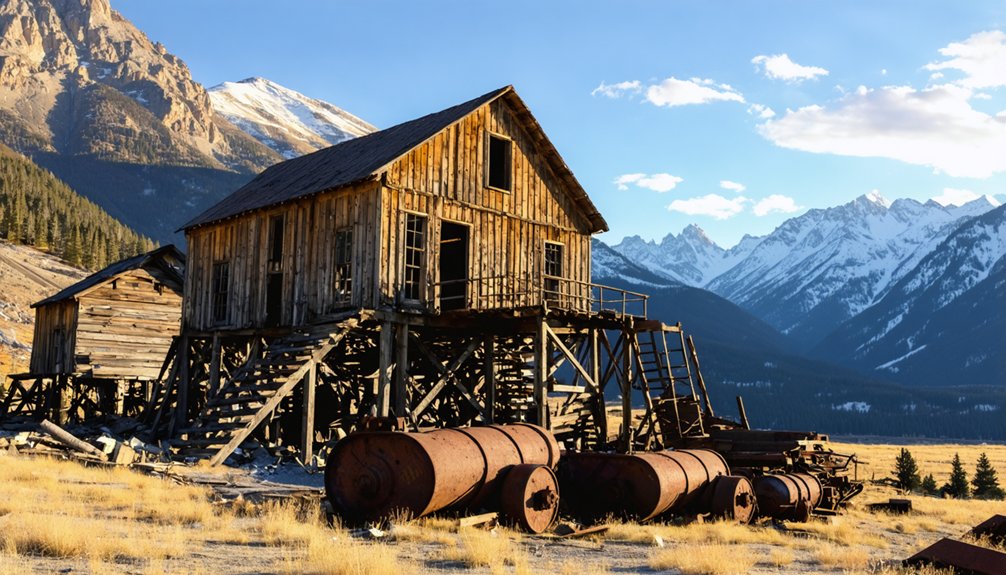
While Colorado’s famous ghost towns like St. Elmo and Silver Plume draw crowds, hidden mining settlements offer authentic glimpses into forgotten histories.
In contrast, haunting tales from Missouri ghost towns reveal eerie stories of those who once walked their streets. Legends of lost love, mining mishaps, and ghostly apparitions keep the spirit of these towns alive, inviting brave souls to explore the past. Each crumbling building resonates with whispers from a bygone era, making for an unforgettable journey into Missouri’s history.
Beyond tourist routes, the Gunnison Valley and Red Mountain District conceal remarkable remnants of Colorado’s mining era.
Four lesser-known mining settlements worth exploring:
- Tincup – Once home to 2,000 residents during its gold rush heyday, with original structures still standing near Taylor Park.
- Ironton – A transportation hub that housed 1,000 people, now featuring collapsed mills and rusted equipment along hidden trails.
- Henson – Active until mid-20th century near Lake City, preserving complete milling complexes.
- Nevadaville – Located between Central City and Black Hawk, showcasing Prize Mine’s timber headframes being reclaimed by nature.
These uncurated sites provide raw historical atmospheres where adventurous explorers can experience Colorado’s mining legacy firsthand.
Photographing Abandoned Mining Structures
When photographing Colorado’s abandoned mining structures, you’ll capture their eerie beauty best during golden hour when the low-angled sunlight accentuates textures on weathered timber headframes and stone foundations.
Set your camera to aperture priority (f/8-f/11) with a slightly underexposed EV compensation to preserve details in both shadows and highlights while using a tripod to maintain sharpness during the dim lighting conditions.
As you frame your shots, maintain a respectful distance from deteriorating structures—never moving artifacts or entering unstable buildings—to preserve both your safety and the historical integrity of these fragile remnants from Colorado’s mining era.
Golden Hour Lighting Tips
The magical transformation of Colorado’s abandoned mining structures during golden hour offers photographers a spectacular opportunity to capture the essence of these historic sites.
This precious window of time—just after sunrise or before sunset—bathes weathered buildings in warm, golden light that enhances textures and creates dramatic shadows.
To maximize your golden hour shooting:
- Position yourself with the sun at a 45-degree angle to illuminate textures of peeling paint and rusted metal.
- Use wide-angle lenses to capture the full scale of structures against the dramatic sky.
- Shoot in RAW format for greater control when enhancing shadows and highlights later.
- Look for natural light filtering through broken windows for atmospheric contrast that tells the building’s story.
Camera Settings For Ruins
Capturing the haunting beauty of Colorado’s abandoned mining structures requires mastering technical aspects of your camera to overcome the challenging lighting conditions you’ll encounter. Switch to manual mode for precise exposure control in these high-contrast environments.
Set your aperture between f/7.1 and f/14 to maintain sharpness throughout your frame while ensuring adequate depth of field. Mount your camera on a sturdy tripod to enable longer shutter speeds (often 20-30 seconds) without introducing motion blur. Keep your ISO low (50-100) to minimize noise in shadowy areas.
For composition, utilize a wide-angle lens to emphasize the vast, decaying spaces. Experiment with light painting techniques by moving portable LED panels or flashlights across surfaces during long exposures.
Preview your settings through live view to fine-tune focus before capturing these forgotten places.
Respecting Historical Integrity
Preserving the soul of Colorado’s mining past requires photographers to adopt a stewardship mindset that extends beyond capturing compelling images.
When documenting these spectral relics, ethical photography practices guarantee historical preservation for future generations.
Follow these principles when photographing abandoned mining structures:
- Document without disturbing – capture architectural elements and natural reclamation without repositioning debris or artifacts.
- Frame through existing openings – utilize doorways and windows as compositional elements rather than creating new perspectives.
- Focus on authentic textures – highlight rust, weathered wood, and peeling paint that tell the site’s genuine story.
- Share with purpose – contribute your images to historical societies to support conservation efforts and public education.
Seasonal Considerations for Ghost Town Exploration
Planning your Colorado ghost town adventure requires careful consideration of seasonal variations that dramatically impact accessibility and experience.
Summer offers ideal weather impacts, with comfortable temperatures making even high-elevation camps accessible via standard passenger cars. Visit during sunrise or sunset to avoid crowds while enjoying lush green mountain backdrops.
Fall transforms these historic sites with spectacular foliage. Between late September and early October, Ashcroft rivals Maroon Bells for golden aspen viewing, creating perfect photography conditions across abandoned mining landscapes.
Winter renders most sites snowbound, requiring specialized equipment like cross-country skis or snowmobiles. Many locations become completely inaccessible due to seasonal accessibility limitations and safety hazards.
Your vehicle choice matters year-round—two-wheel drives work for preserved towns like St. Elmo, while remote locations above 12,000 feet demand four-wheel drive vehicles or guided jeep tours.
Frequently Asked Questions
Are Children Allowed to Visit These Ghost Towns?
Wondering if ghost stories might be too much? Don’t worry! You’re free to bring your children to Colorado’s ghost towns, as they’re generally accessible for families and often include family activities tailored for all ages.
Can You Camp Overnight in or Near Ghost Towns?
You can camp overnight near most ghost towns, following BLM’s 14-day limit. Check local camping regulations, as some historic sites prohibit overnight stays and don’t offer ghost town amenities.
What Wildlife Hazards Might Visitors Encounter at Ghost Towns?
Rattlers hide in rubble, bears and lions lurk nearby, spiders nest in corners, and bats inhabit mine shafts. Your wildlife encounters demand safety precautions: watch your step, don’t corner animals, and carry repellent.
Are Metal Detectors or Artifact Collecting Permitted?
You can’t use metal detectors in historical sites. Metal detecting laws prohibit removing artifacts over 50-100 years old. Artifact preservation rules strictly forbid collecting from ghost towns—these sites are federally protected.
Do Any Ghost Towns Offer Guided Historical Tours?
Yes, you’ll find guided historical tours highlighting mining towns’ historical significance in Leadville, Breckenridge, and Aspen, with expert-led explorations of preserved structures, cemeteries, and stories of frontier life.
References
- https://www.legendsofamerica.com/co-ghosttowns/
- https://www.durango.com/colorado-ghost-towns/
- https://www.visitouray.com/ghost-towns
- https://www.atlasobscura.com/things-to-do/colorado/ghost-towns
- https://www.coloradolifemagazine.com/blog/post/11-colorado-ghost-towns
- https://www.colorado.com/articles/colorado-ghost-towns
- https://www.uncovercolorado.com/ghost-towns/
- https://www.coloradoan.com/story/news/2025/10/10/here-are-8-of-colorados-best-ghost-towns-to-visit-in-fall/86579217007/
- https://999thepoint.com/colorado-ghost-towns-2/
- https://www.denvergazette.com/2022/06/19/starting-in-1858-heres-a-look-at-the-timeline-of-colorados-mining-past-20bc26e4-e4d3-5eae-8520-8fa197554111/