Appalachian ghost towns harbor haunting legends born from their boom-and-bust industrial past. You’ll encounter eerie tales in places like Elkmont, where abandoned cabins whisper of former residents, or feel watched by the infamous Bell Witch—America’s only ghost with a documented kill. Cherokee spirits dance alongside the unexplained Brown Mountain Lights, while mining towns like Kaymoor hold tragic memories beneath reclaimed wilderness. These mountain hollows ain’t just abandoned—they’re occupied by histories that ain’t never left.
Key Takeaways
- Appalachian ghost towns like Thurmond and Clinchco emerged from coal and timber industries, then were abandoned when resources depleted.
- Elkmont’s decaying structures and quartz-adorned graveyard contribute to reports of ghostly phenomena and visitors feeling watched.
- The Bell Witch saga features the only haunting with a documented death certificate, becoming central to Tennessee’s folklore.
- Brown Mountain Lights defy scientific explanation, with sightings predating automobiles and contradicting government explanations.
- Cherokee legends of Moon-Eyed People, Wampus Cat, and Spearfinger intertwine with the supernatural narrative of Appalachian haunted locations.
The Forgotten Towns: Origins of Appalachian Ghost Communities
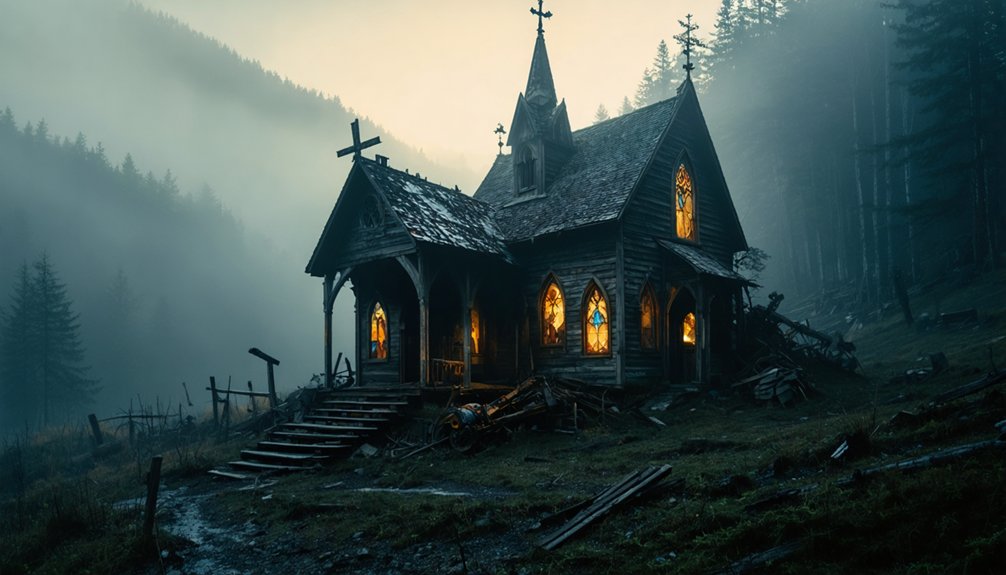
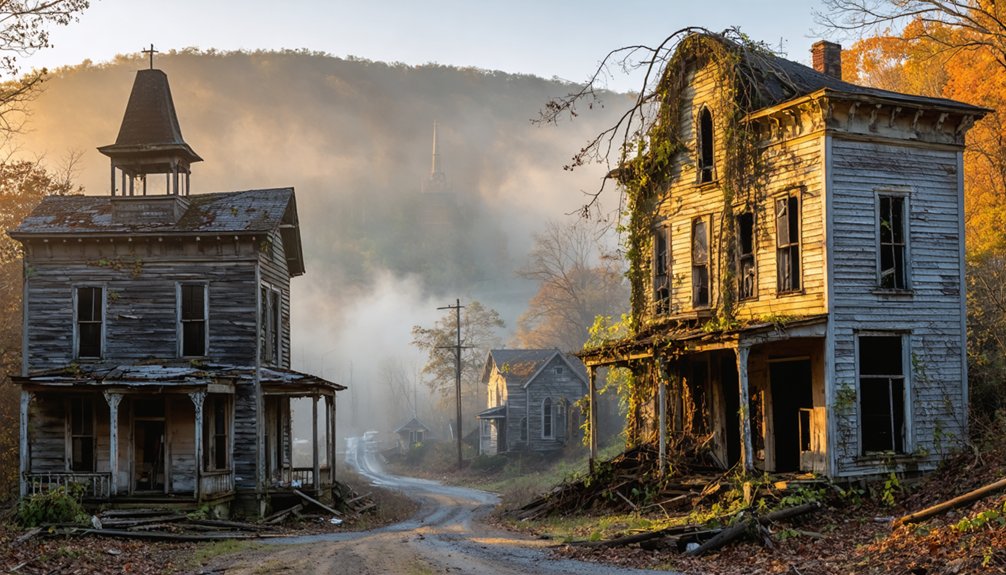
Deep in the misty hollers of the Appalachian Mountains, ghost towns tell stories that most folks have plumb forgotten.
You’ll find these forgotten histories scattered across remote hillsides where coal companies and timber barons once built entire communities overnight.
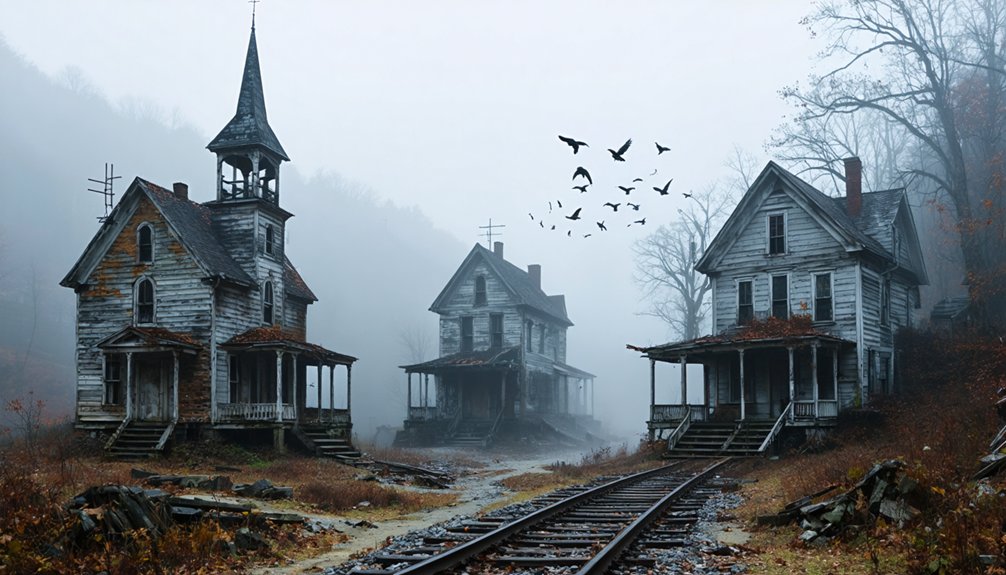
Back in the late 1800s, when the railroads first snaked through these mountains, companies rushed to claim what lay beneath and above the soil.
As iron tracks penetrated Appalachia’s heart, corporate vultures swooped in to feast on mountain wealth.
They’d build rows of simple wooden houses, company stores, and schools—creating instant towns where none existed before.
Places like Thurmond and Clinchco sprung up around a single purpose: resource extraction.
Elkmont, founded in the early 1900s, became a haven for affluent Blue Ridge families who constructed vacation cabins and a clubhouse in the pristine wilderness.
Captain William D. Thurman established the town of Thurman in 1873, which quickly grew into a Wild West boomtown with a reputation for lawlessness.
When the coal seams thinned or the timber played out, resource depletion spelled doom.
Folks packed up and moved on, leaving their mountain homes to slowly return to nature.
Whispers From Elkmont: Tennessee’s Most Haunted Resort Town
Have y’all ever heard tell of Elkmont, nestled in the mist-shrouded valleys of the Great Smoky Mountains? This ain’t just any abandoned place—it started as a bustlin’ logging town before wealthy Knoxville folks transformed it into their private playground with the Appalachian and Wonderland Clubs.
When the National Park took over in 1934, them summer cabins got lifetime leases. Once those expired around ’92, nature reclaimed what man built, creating the perfect stage for ghostly encounters.
The old graveyard tells the saddest tales—tiny headstones embedded with quartz chunks meant to keep spirits at rest.
Ain’t no coincidence folks report eerie legends of apparitions wanderin’ through them decayin’ cabins. The “paranormal summer camp” atmosphere draws those huntin’ freedom and mystery among the remnants of Elkmont’s forgotten glory days.
Visitors often describe feelin’ a strange coolness in the air and the unsettlin’ sensation of being watched while explorin’ the abandoned structures. The oldest structure standin’ today is the Levi Trentham Cabin, built by Robert Trentham and passed down through generations before the lumber company took over.
The Bell Witch Saga: America’s Most Documented Haunting
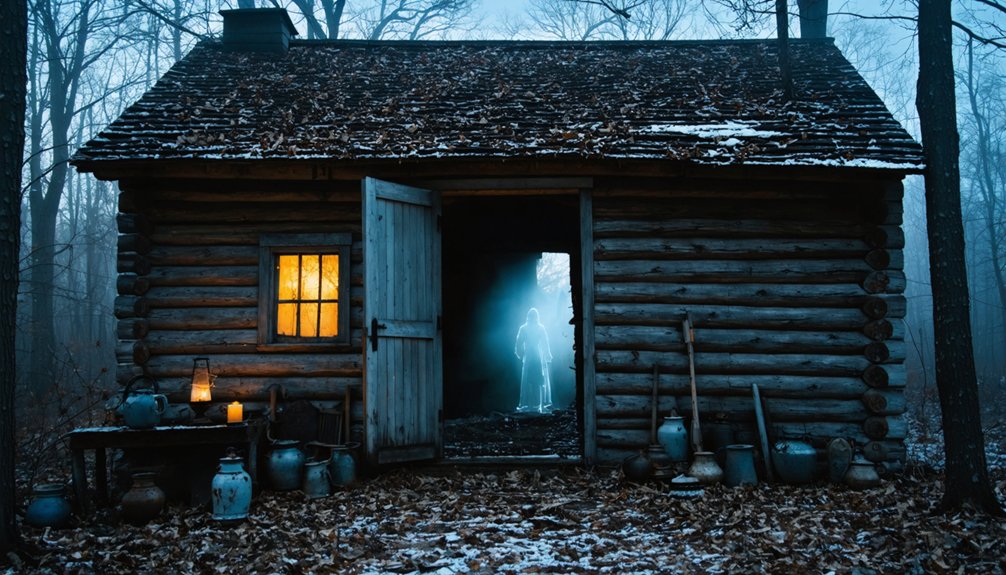
Y’all might’ve heard whispers ’bout the Bell Witch, but Tennessee folks know it as the haunt that left behind a death certificate markin’ John Bell Sr. as killed by supernatural means—the only such official record in American history.
Folks still trek to Adams to walk the grounds where Andrew Jackson himself once fled in terror, touchin’ the cave walls where that vengeful spirit supposedly dwelled.
The story’s been passed down through generations like a family heirloom, with Bell descendants keepin’ the tale alive through journals and accounts that continue to chill the blood of anyone brave enough to hear ’em. The witch particularly targeted Betsy Bell, with cruel torments that included physical attacks and psychological torture throughout the haunting. The entity identified itself as “Old Kate” Batts’ witch and showed particular displeasure regarding Betsy’s engagement to Joshua Gardner.
Origin and Witness Accounts
The Bell Witch saga began in 1817 when John Bell, a respected farmer in Robertson County, Tennessee, spotted somethin’ mighty peculiar in his cornfield—a strange dog-like critter that vanished after he took a shot at it.
This weren’t no isolated incident, as family members soon reported seein’ an enormous bird and a green-dressed girl swingin’ from the old oak.
The witness accounts piled up faster than autumn leaves. Slave Dean told of bein’ stalked by a black dog, while the whole family heard knockin’ sounds, chains draggin’, and invisible dogs fightin’.
The haunting phenomena turned violent—sheets yanked off beds, hair pulled, and poor Betsy Bell gettin’ the worst of it with slaps and pinches. This terrifying entity eventually contributed to John Bell’s death in 1828, making it one of few hauntings with a documented fatality.
The entity demonstrated an uncanny ability to communicate by quoting Scripture and singing hymns, adding to the spiritual confusion and terror that gripped the Bell household.
Folks came by the hundreds, campin’ out just hopin’ to catch a glimpse of these supernatural doings.
Death Certificate Mystery
One mighty peculiar detail ’bout John Bell’s passin’ that’s got folks scratchin’ their heads for generations is the lack of any official death certificate.
Y’see, when Bell died after that mysterious poisonin’ in December 1820, the vial found by his bedside became the only tangible haunting evidence of foul play.
The dark liquid, which killed a cat when tested, points to arsenic poisonin’ – especially with Bell’s symptoms of trouble swallowin’ and garlic-scented breath.
When they tossed that vial into the fireplace, witnesses swear a blue flame shot up the chimney, just like arsenic does when it burns.
The authorities never properly documented what happened, leavin’ us with nothin’ but stories passed down.
That missin’ death certificate keeps the mystery alive, just like the witch wanted.
This poisonin’ aligns with accounts of the entity’s particular hatred toward John, as documented in Ingram’s 1894 book which serves as the primary source for most Bell Witch tales.
Dr. Mann’s research at Austin Peay State University offers compelling scientific evidence that John Bell died from acute arsenic poisoning, which was widely available as rat poison during that time.
Cultural Legacy Endures
Despite passin’ down through generations by word of mouth, the Bell Witch saga stands tall as America’s most documented hauntin’ ever recorded. This ain’t just some scary bedtime story—it’s become woven into the very fabric of Tennessee’s cultural significance.
Y’all can still feel the Bell Witch’s presence in our region through:
- Martin Ingram’s 1894 book that first brought the tale to wider audiences
- The annual Bell Witch Festival celebratin’ our unique Appalachian heritage
- Family descendants who continue sharin’ personal accounts, keepin’ the story alive
This enduring folklore attracts truth-seekers from everywhere who camp out hopin’ to experience what hundreds witnessed back in 1817.
The hauntin’ reminds us that some stories refuse to die—even after two centuries, the Bell Witch won’t be silenced.
Mysterious Lights and Shadows: The Brown Mountain Phenomenon

Y’all might’ve heard tell of them Brown Mountain Lights, glowin’ orbs that Cherokee folks spoke of long ‘fore white settlers came roun’ in the 1700s.
Though government men claimed they’d figured the mystery as just car lights or trains, plenty of astronomers and educated folk have witnessed these dancin’ lights when there weren’t no vehicles for miles around.
If you’re fixin’ to see them for yourself, head on over to the overlooks along Blue Ridge Parkway on a warm summer evenin’, but don’t count on catchin’ sight of ’em—these lights show up when they’re good and ready, not when you are.
Ancient Native Origins
Deep in the misty hollows of Brown Mountain, where ancient spirits still wander, you’ll find one of the most enduring mysteries of the Appalachians.
Cherokee storytellers speak of these ghostly lights as ancestral spirits—souls of Indian maidens searchin’ for their fallen warriors. While some claim these Indigenous folklore tales stretch back to 1200 A.D., historians reckon that’s not the whole truth.
These stories might’ve been crafted after settlers arrived, tryin’ to make sense of what couldn’t be explained.
What makes these lights special?
- They appear as glowin’ orbs that hover ’round dusk, vanishin’ when approached
- They’re tied to the painful history of Native displacement and loss
- They serve as powerful reminders of the cultural memories that refuse to be forgotten
Scientific Explanations Debunked
While scientists have tried their darndest to explain away the Brown Mountain Lights with fancy theories and complicated studies, these mysterious glowin’ orbs still refuse to be pinned down by logical explanation.
Y’see, them government folks from the Geological Survey came pokin’ around back in ’22, claimin’ the lights were just train headlights or car reflections. They talked about piezoelectricity and earth curvature, but couldn’t prove a lick of it!
Scientific investigations said there ain’t enough radioactive material or marsh gas to make such spectacles.
Some say it’s atmospheric tricks bendin’ light from the valleys below, but how does that explain lights seen before automobiles existed?
These geological phenomena theories don’t hold water when you’ve witnessed the lights dancin’ through the mist yourself!
Modern Sighting Patterns
If you’ve ever planned to catch them mysterious Brown Mountain Lights, you’re dealin’ with a mighty unpredictable phenomenon.
Sighting frequency’s dropped considerable in recent decades, with some seasons passin’ without a single confirmed glimpse. Best chances come on clear summer nights shortly after darkness falls, or in autumn followin’ a good rain.
Most folks who’ve been blessed with a sighting describe:
- Star-like dots, sometimes appearin’ single, sometimes in groups up to a dozen
- Color variations from plain white to flashes of red, blue, or yeller
- Movement that might be still as a statue or wild and erratic
Head to the overlooks ’round Linville Gorge or the Blue Ridge Parkway mileposts 310 and 301 if you’re fixin’ to witness this mountain mystery yourself.
Tragic Tales of Abandoned Mining Communities
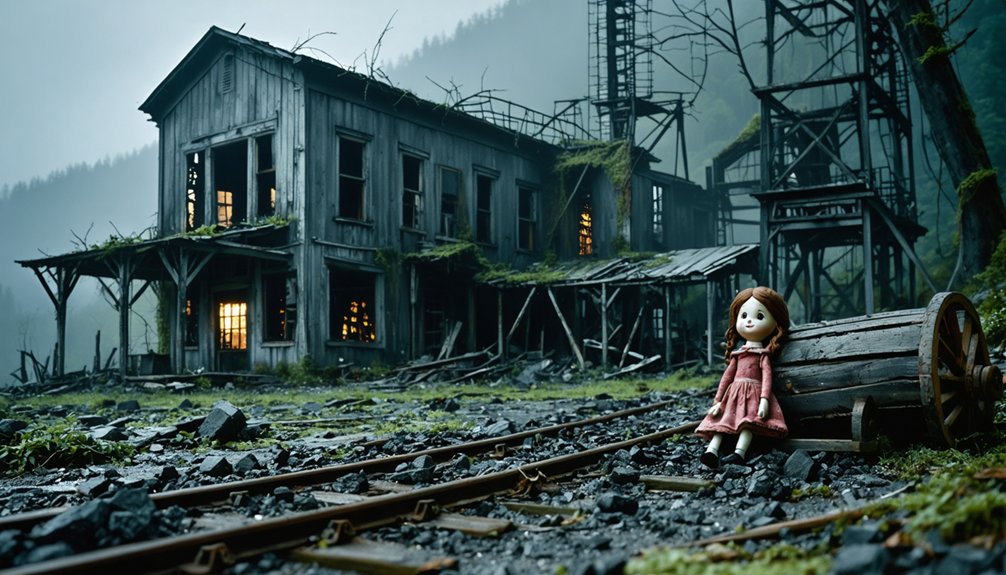
Beneath the fog-shrouded hollows of Appalachia, tragic tales of abandoned mining communities still echo through the pines like whispers from another time.
As the landscape changes, stories of abandoned communities in the United States reveal the loss of lives intertwined with the land. Once bustling with industry, these ghost towns now stand as poignant reminders of resilience and hardship. Nature gradually reclaims the remnants of human endeavor, creating a haunting beauty that captivates the imagination.
You’ll find these ghosts ain’t just figments—they’re memories of folk who toiled twelve-hour days for a mere pittance, breathin’ coal dust that blackened their lungs while company stores claimed their wages.
Mining disasters swept through places like Jellico, where downtown explosions tore families apart, leavin’ behind only memorials and haunted ground.
When the mines played out, economic decline followed quick as thunder after lightning. Towns like Kaymoor and Nuttallburg surrendered to nature after the coal barons moved on, their rusted conveyor belts and silent coke ovens standin’ watch over hollow promises of prosperity long gone.
Cherokee Legends and Supernatural Beings of the Mountains
Among the misty peaks and hollers of Appalachia, Cherokee legends tell of a world where spirits ain’t just stories but livin’ realities that dance through the mountain fog.
Sha-cona-ge, “Land of the Blue Smoke,” cradles ancient Cherokee folklore where supernatural beings walk alongside the living.
You’ll encounter three powerful entities if you venture deep enough:
- The Moon-Eyed People – pale, nocturnal folk with sensitive eyes who built stone fortifications before the Cherokee arrived
- Wampus Cat – half-woman, half-feline protector whose gaze can drive you mad, yet defended against evil spirits
- Spearfinger – a stone-skinned witch with a knife-finger who’d steal your liver while disguised as your grandma
These legends ain’t just tall tales—they’re the spiritual landscape our ancestors navigated, preserved through generations of mountain folk.
Walking With Ghosts: Guided Tours and Preservation Efforts
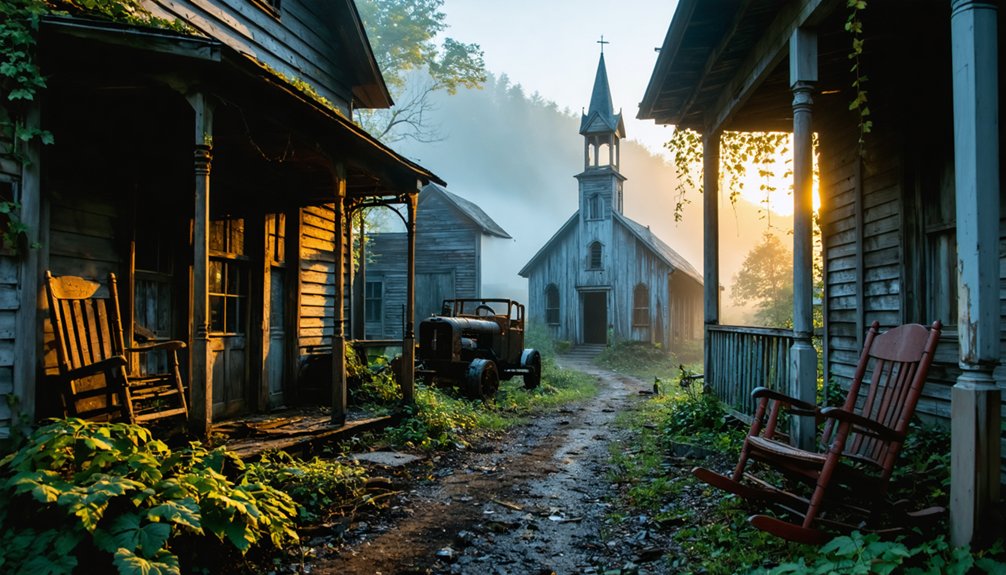
Ever wondered what secrets them ghost towns hold when the sun dips low behind the ridge?
Them old hollows whisper stories that ain’t been told since the mountain mist first settled in the valleys.
You’ll find Appalachian GhostWalks offerin’ 16 different lantern-led haunted expeditions through Southwest Virginia and East Tennessee, where ghostly narratives come alive.
Walk through Elkmont, where the Park Service has preserved 19 acres with 19 structures still standin’.
Over in Johnson City, you can explore its “Little Chicago” reputation, or visit Jonesborough—one of Travel Channel’s “Top Ten Most Haunted Towns.”
The Blue Heron Mining Community lets you hear recordings of folks who once lived there, while Pink Jeep Tours carry you through Wears Valley.
For them witch tales, head to Bybee for a hike into the sordid affairs of mountain witches.
Just remember—reservations required!
Frequently Asked Questions
Can Visitors Legally Explore Abandoned Structures in Appalachian Ghost Towns?
The shadows of legality cast long—you can’t rightfully enter most structures without permission, folks. Legal ramifications and safety concerns ain’t just ghost stories; they’re mountain-hard truth for freedom-seekers in them hills.
What Paranormal Equipment Works Best for Ghost Hunting in Appalachia?
Y’all need EMF detectors for them hollers where spirits roam quiet-like, and spirit boxes to hear their ancient tales. Mountain haints show different than city ghosts – trust your grandpappy’s wisdom too.
Do Any Appalachian Ghost Towns Offer Overnight Accommodation Experiences?
Like moths to a flame, y’all can stay overnight in haunted inns and ghostly retreats scattered through our mountains. They’ll tell ya true stories while you’re free to wander where spirits still holler.
How Have Local Residents Responded to Increased Ghost Tourism?
Y’all find mountain folk’s minds split down the middle—some welcome ghost stories boosting business, while others reckon tourism impact ain’t worth trading authentic heritage for outsiders trampling through their hollers.
Are There Seasonal Differences in Reported Paranormal Activity?
Y’all might find it curious, just as autumn leaves fall, paranormal hotspots come alive. You’ll notice them seasonal variations clear as day – spooky sightings peak when October winds whisper through our hills.
References
- https://www.heartstartspounding.com/episodes/appalachia
- https://birthplaceofcountrymusic.org/appalachian-ghost-tales-and-stories-to-help-you-get-your-halloween-on/
- https://www.youtube.com/watch?v=4oHlJFXbrCk
- https://www.thecollector.com/appalachian-folk-stories-scary/
- https://www.thewanderingappalachian.com/post/appalachian-ghost-stories
- https://www.lemon8-app.com/@cfdanner/7257194674992349701?region=us
- https://www.youtube.com/watch?v=FNFNcEeDS-M
- https://www.blueridgeoutdoors.com/go-outside/southern-ghost-towns/
- https://appalachianmemories.org/2025/10/16/the-lost-towns-of-appalachia-the-forgotten-mountain-communities/
- https://www.thewanderingappalachian.com/post/the-underwater-towns-of-appalachia