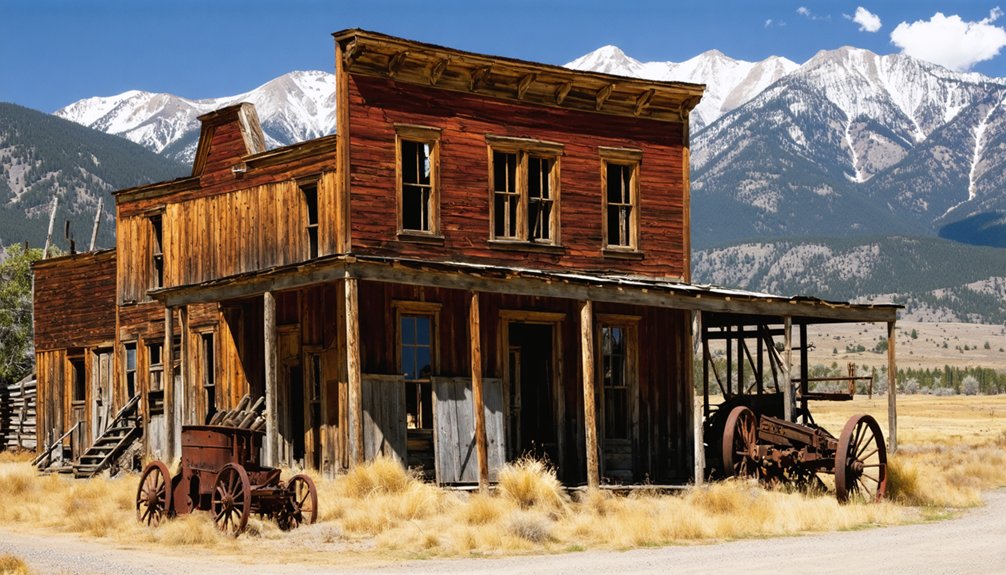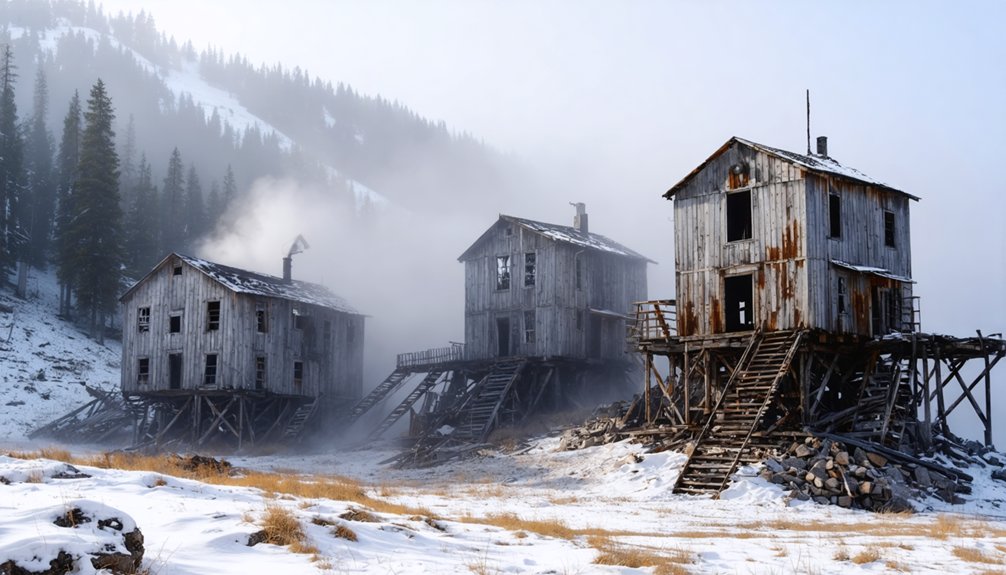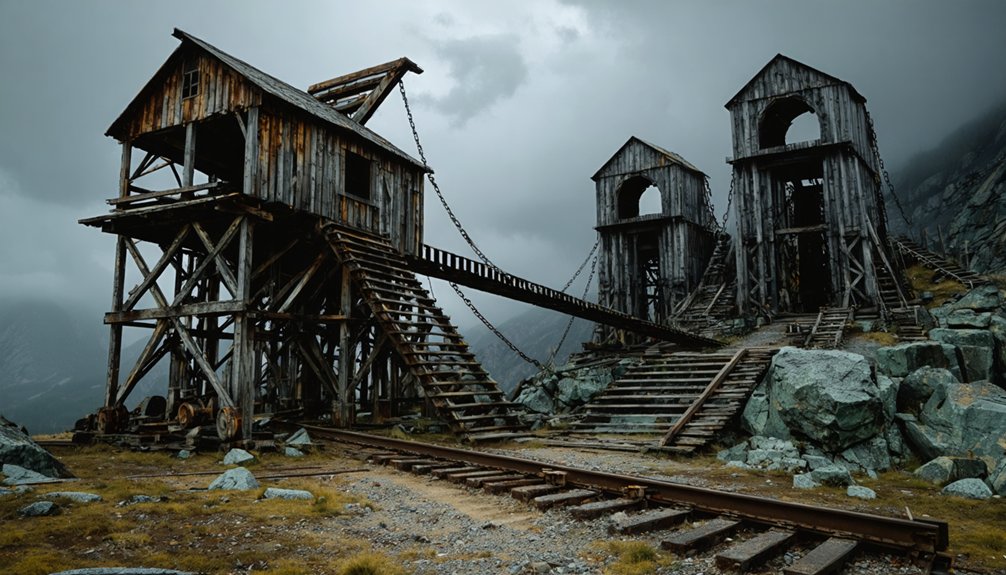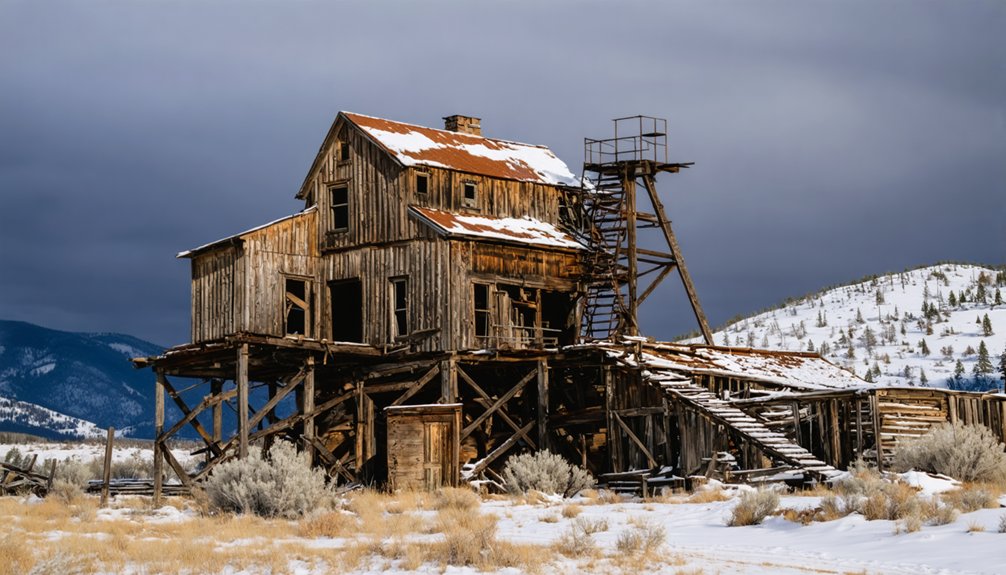
Colorado’s abandoned mining towns offer a paranormal journey through the state’s gold rush era. You’ll encounter spectral phenomena in places like Ironton, where soft, inexplicable sounds echo from the past, and Gilman, known for phantom lights and shadowy figures in evacuated buildings. At Tomboy Mine, apparitions of miners in period clothing appear amid phantom whistle sounds across alpine valleys. These historic sites, remnants of boom-and-bust cycles, reveal stories of labor struggles and environmental devastation when explored.
Key Takeaways
- Colorado boasts over 600 ghost towns with reported paranormal activity, including phantom mine whistles and apparitions in period clothing.
- Ironton, once a 1,000-resident transportation hub, features unexplained soft sounds believed to echo its mining past.
- Gilman, abandoned in 1984 due to environmental contamination, is known for phantom sounds, unexplained lights, and shadowy figures.
- Tomboy Mine, established in 1880, has a violent history contributing to reports of residual hauntings and miner apparitions.
- Preservation organizations like History Colorado and the Ghost Town Club support restoration of these haunted historical sites.
The Rise and Fall of Colorado’s Ghost Mining Towns
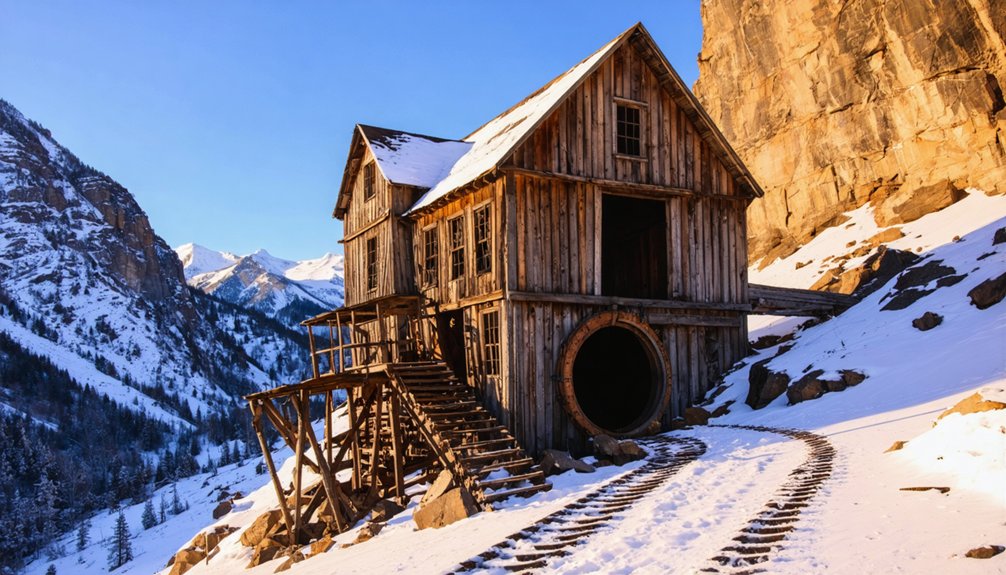
While prospectors first struck gold at Independence in 1879, creating the Roaring Fork Valley’s earliest mining settlement, the discovery ignited a pattern that would repeat across Colorado’s mountains.
You’ll find ghostly echoes of this gold rush across the state’s 600+ ghost towns. Alta quickly followed Independence, growing to 1,500 residents by 1882 at a breathtaking 10,900 feet elevation.
Towns like St. Elmo and Gilman boomed with populations approaching 2,000, complete with schools, businesses, and entertainment. Capitol City, initially named Galena City, was established with grand ambitions of becoming Colorado’s capital city.
The mining memories preserved in these places reveal staggering wealth—the Emma, Smuggler, and American mines produced $12 million ($280 million today) between 1874-1903.
Yet by the 1890s, many towns collapsed from ore depletion, silver devaluation, or extreme weather, leaving behind deserted monuments to frontier ambition.
Visiting these sites during autumn provides travelers with a uniquely beautiful experience as colorful aspen groves frame the historic ruins against mountain backdrops.
Ironton: Whispers Among Peeling Wallpaper
When you visit Ironton today, you’ll encounter the ghostly remnants of the once-thriving transportation hub where abandoned Victorian houses with peeling wallpaper stand as silent witnesses to the boom-and-bust cycle of Colorado mining.
You might hear what locals describe as whispers emanating from the decaying structures, particularly near the former railroad loading areas where supplies once arrived daily on pack trains from Ouray.
The mysterious sounds, coupled with the visible deterioration of buildings that once housed over 1,000 residents during the late nineteenth century, create an eerie atmosphere that connects you directly to the abrupt abandonment that followed the collapse of mining operations.
The settlement originally named Copper Glen was established in 1883 with an impressive hundred buildings constructed in just three weeks before later being renamed Ironton.
The town thrived until the Silver Panic of 1893 caused many mines to close, triggering the gradual population decline that would eventually leave Ironton deserted.
Abandoned Railroad Mysteries
After the Silverton Railroad reached Ironton in mid-1889, it established a critical lifeline for the mining community, connecting the remote outpost to Silverton over the treacherous Red Mountain Pass.
Otto Mears’ narrow gauge line operated two daily trains during peak silver production, though winter’s heavy snows forced closure from January to May yearly.
You can still trace where these ghostly railroads once carried silver ore and supplies. Following the 1893 silver crash, the line retreated to Red Mountain Town, later reorganizing in 1906 as the Silverton Railway.
The 1907 Joker Tunnel project briefly revived operations, but the abandoned trains became inevitable. During its heyday, the town saw constant wagon traffic on Mears’ toll road which complemented the railroad service. Modern security measures protect user data while allowing visitors to safely explore these historic sites. By 1922, the railroad was officially abandoned, with rails removed by 1926.
Today, these vanished transportation corridors exist only as whispers of the past—their routes now serving as highways and trails through Colorado’s storied mining country.
Wallpaper Whispers Haunt Visitors
The abandoned railroad tracks leading into Ironton may have vanished, but something more ethereal lingers within the town’s deteriorating structures. When you venture into the remaining buildings, you’ll notice peeling, mottled wallpaper that hasn’t seen maintenance since the town’s abandonment in the 1960s.
These decayed interiors amplify what many visitors describe as whispering echoes—soft, inexplicable sounds believed to emanate from Ironton’s mining past.
The town’s history of economic hardship following the 1893 Silver Panic forced residents to abandon their homes, leaving spectral stories in their wake. The town experienced rapid growth in its early days, with hundreds of buildings appearing within just months of its founding. The rust-colored mineral deposits staining the buildings and the highly contaminated waters of Red Mountain Creek create an eerie backdrop to these phenomena.
The arsenic-based wallpaper that once provided insulation for residents now adds another layer to the town’s mysterious atmosphere.
For those seeking paranormal encounters, Ironton’s isolation and desolation heighten the supernatural atmosphere that has made it one of Colorado’s most haunted mining outposts.
As visitors embark on the adventure of exploring ghost towns in Colorado, they may stumble upon remnants of the past that tell stories of lost fortunes and abandoned dreams. Each crumbling building and empty street invites a sense of curiosity and wonder, leaving many to ponder the lives that once thrived in these forgotten places. The haunting beauty of these towns captivates explorers, offering a glimpse into a world long gone but never forgotten.
Gilman’s Haunted Legacy: From Prosperity to Abandonment

If you venture into Gilman today, you’ll find a ghost town where environmental devastation meets paranormal activity, as decades of mining left behind toxic heavy metals that poisoned the landscape and, some say, trapped spirits in perpetual unrest.
Visitors have reported hearing the phantom sounds of miners’ tools echoing through abandoned tunnels at midnight, particularly near the zinc processing facilities where several documented accidents occurred.
The most frequently reported phenomena include unexplained lights in the mine shafts, disembodied voices calling out shift changes, and shadowy figures observed through buildings where company officials once calculated the fortunes extracted at such devastating human and environmental cost.
Founded in 1886, Gilman was once the most successful town in Eagle County before its designation as a Superfund site led to its abandonment.
The town transitioned from silver to zinc production in 1905 when the Iron Mask Mine reopened, shifting its economic focus for decades to come.
Environmental Contamination Issues
Beneath the rusting metal structures and crumbling foundations of Gilman’s once-thriving mining operations lies a toxic legacy that eventually forced the complete abandonment of this Colorado boomtown.
You can trace the environmental justice crisis to New Jersey Zinc Company’s extensive operations, which extracted over 12 million tons of ore while depositing 8 million tons of waste into the surrounding landscape.
By 1984, lead, zinc, cadmium, and arsenic had so thoroughly contaminated the soil, groundwater, and Eagle River that the EPA evacuated all residents and designated 235 acres as a Superfund site.
Remediation began in 1988 with waste relocation and soil capping, followed by a water treatment plant in 1990.
Despite these efforts, the area remains off-limits—a stark reminder of industrialization’s unregulated consequences on both community and environment.
Midnight Miners’ Whispers
While environmental devastation shuttered Gilman’s mining operations, legends of supernatural phenomena have persisted long after the last residents departed.
Locals report midnight echoes of machinery from the abandoned Eagle Mine tunnels, where the spirits of miners who toiled in these dangerous shafts allegedly linger.
The town’s dramatic transformation—from a thriving community of up to 1,500 residents to a toxic ghost town—has fueled rich miner folklore.
Former inhabitants describe unexplained lights flickering in abandoned company houses and strange noises emanating from the elevator shaft that once transported workers between the town and the mines below.
These haunting tales reflect Gilman’s dramatic rise and fall, where $8 million in precious metals extracted by 1900 gave way to environmental catastrophe and forced abandonment by 1984.
Spirits of the San Juan Mountains: Tomboy Mine at 11,500 Feet
Perched at a breathtaking 11,500 feet in the glacial cirque known as Savage Basin, the Tomboy Mine stands as one of Colorado’s most atmospheric abandoned settlements. Established in 1880, this once-thriving community reached a peak population of nearly 2,000 before closing in 1927 when gold reserves depleted.
As you traverse the shelf road carved into the mountainside, you’re walking where Tomboy spirits still linger from violent episodes of frontier justice. The 1919 execution of four miners and the 1907 deadly shooting at the company store exemplify the mining disputes that plagued this remote outpost.
Unlike neighboring operations, the wealthy Rothschild-owned settlement boasted unusual amenities like a YMCA and tennis courts.
Today, impressive ruins remain 3,000 feet above Telluride, accessible via the challenging Imogene Pass road that freedom-seeking explorers frequent.
Paranormal Encounters in the High-Altitude Wilderness

You’ll hear the phantom mine whistles echoing across alpine valleys at midnight, a phenomenon reported by hikers near abandoned outposts like Animas Forks and Henson.
Apparitions of miners in period clothing frequently materialize among aspen groves surrounding these high-altitude ghost towns, particularly in areas where tragic accidents claimed numerous lives.
These paranormal encounters intensify during winter months when isolation and extreme weather conditions amplify the already haunting atmosphere of Colorado’s mining wilderness.
Midnight Whistles Echo
Deep within Colorado’s remote mining regions, a haunting phenomenon has emerged that challenges rational explanation. As you venture into these deserted areas after nightfall, you’ll encounter mysterious echoes of train whistles piercing the mountain silence, followed by metallic grinding that mimics phantom locomotives traversing nonexistent tracks.
These spectral reminders are particularly concentrated near sites of mining tragedies, such as the Hastings Mine Disaster where 121 miners perished. The eerie whistles seem to announce the presence of those who died in Colorado’s treacherous mining history.
Hikers, railway workers, and locals consistently report these unexplained auditory phenomena, which researchers connect to residual hauntings – moments of intense tragedy imprinted on the landscape. You’ll find these sounds most pronounced in the stillness of midnight, when the veil between worlds thins.
Apparitions Among Aspens
Nestled at over 11,000 feet elevation, the abandoned mining town of Ashcroft harbors some of Colorado’s most persistent paranormal phenomena among its aspen groves and deteriorating structures.
You’ll discover haunted landscapes shaped by traumatic history—from indigenous Ute displacement in 1881 to the brutal conditions faced by silver miners who flocked here in 1880.
The well-preserved hotel remains a focal point for spectral sightings, where manifestations are frequently reported in corridors and rooms.
Though the town’s boom lasted merely five years before shallow silver deposits were depleted, the psychological trauma of frontier violence, disease, and harsh alpine conditions left spiritual residue throughout the valley.
As fall foliage transforms the surrounding aspens, atmospheric effects heighten perceptions of the paranormal—echoes of suffering from both native peoples and settlers alike.
Life and Death in Colorado’s Company Towns
While the Rocky Mountains provided immense mineral wealth throughout Colorado’s history, accessing these riches required corporations to establish complete self-contained communities in remote, often inhospitable locations. U.S. Steel created towns like Gary, while others emerged in high-altitude locations such as Camp Bird and Tomboy in the San Juan Mountains.
These isolated ecosystems revealed complex community dynamics where corporations controlled housing, schools, and governance structures. Despite assumptions about trapped workforces, labor struggles emerged during economic pressures—Colorado’s first labor strike occurred in Leadville in 1880.
When metal prices remained high, towns like Central City exploded from 15 to 10,000 residents in a month. Yet when resources depleted, entire communities vanished, leaving behind abandoned structures now serving as historical monuments to boom-and-bust cycles.
Guston: Where Miners’ Souls Still Answer the Mine Whistle
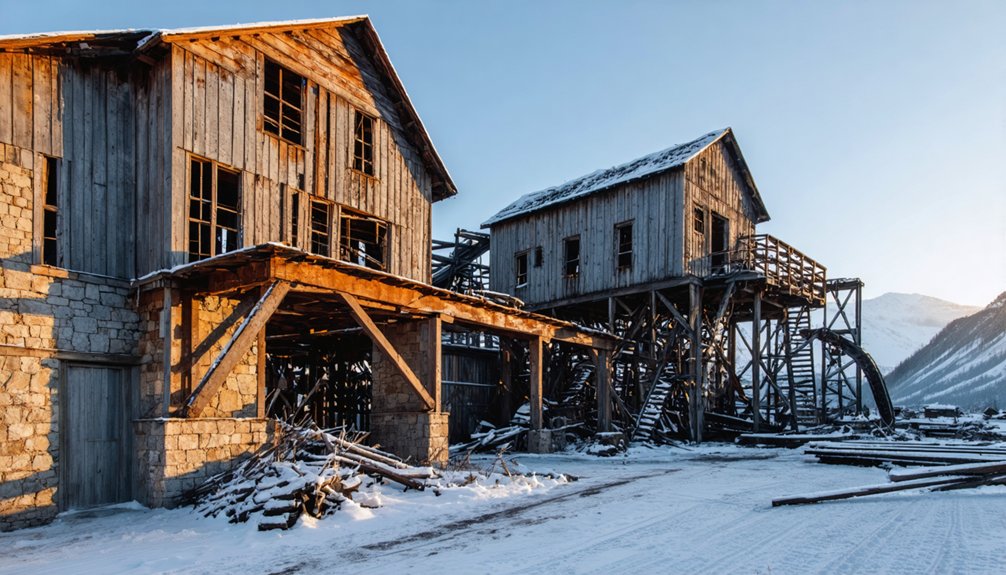
Among the forgotten mining camps dotting Colorado’s Red Mountain district, Guston emerged in 1883 following the discovery of rich silver deposits by prospectors Robinson, Meldrum, Long, and Deitlaf two years earlier.
Unlike planned settlements, Guston grew organically, with structures placed wherever terrain allowed. The camp’s population never exceeded 300, yet it produced over $30 million in minerals during its heyday.
Guston defied convention—a small camp of 300 souls that yielded millions from the rugged Colorado mountains.
As you wander among Guston’s ruins today, you might sense the ghostly echoes of its past:
- Mine whistles still reportedly summon spirits of departed miners
- Abandoned shafts and collapsed mills create an eerie atmosphere
- Autumn’s golden aspens contrast hauntingly against red soil
- Miner legends intertwine tales of sudden deaths with lost treasures
- Rusted ore carts and decayed cabins stand as silent witnesses
Surviving Winter: The Harsh Reality Behind the Hauntings
Behind the spectral tales that haunt Colorado’s abandoned mining towns lies a sobering reality of winter survival that often transcended human endurance.
At elevations reaching nearly 11,000 feet, places like St. Elmo endured isolation from October through May, with blizzards burying entire structures under 25-foot snowdrifts. You’d find residents of Animas Forks tunneling through snow just to reach neighbors after three-week storms.
Winter survival demanded ingenious adaptations—collecting melted snow through windows when pipes froze, constructing buildings with minimal drafts, and establishing communal boarding houses to preserve body heat and morale.
When conditions became unbearable, as in Independence in 1899, community resilience manifested in desperate measures: miners dismantled their own homes to craft escape skis.
Many ultimately chose seasonal migration, abandoning settlements that would later become the ghost towns we explore today.
Goldfield: Union Struggles and Lingering Presences

After the gold rush brought thousands of fortune seekers to the Cripple Creek and Victor Mining Districts in the 1890s, Goldfield emerged as a flashpoint in one of America’s most violent labor conflicts.
The promise of gold transformed Goldfield into a battleground where labor’s hopes collided with industrial might.
You can still feel the tension in these abandoned structures where the Western Federation of Miners fought desperately against powerful mine owners and state-sanctioned suppression.
- The 1894 strike initially secured an eight-hour workday and $3 daily wages
- General Sherman Bell’s military occupation crushed union resilience during the 1903-04 Colorado Labor Wars
- Martial law suspended civil liberties while miners faced mass arrests and deportations
- Mine owners implemented mandatory anti-union cards, effectively blacklisting organizers
- Despite brutal defeat, the miners’ struggle for dignity became embedded in the region’s collective memory
Walk these empty streets and you’re treading on hallowed ground of working-class defiance.
Preserving the Past: Ghost Towns as Historical Treasures
Colorado’s ghost towns stand as invaluable historical treasures, preserved through an extensive legal framework and dedicated community efforts.
History Colorado, the state’s official historical society since 1879, oversees ghost town administration under Colorado Revised Statutes Section 24-80-1201, which enables federal funding for historical preservation.
You’ll find remarkable community engagement throughout the San Juan Mountains region, where local citizens collaborate with land managers to maintain historic structures.
St. Elmo exemplifies this success with 43 original structures from the 1880s, while Animas Forks secured National Register listing in 2011 and $330,000 in restoration grants.
Organizations like the Ghost Town Club of Colorado and Colorado Preservation Inc. provide essential support mechanisms, ensuring these architectural time capsules remain intact for future generations to explore while mandatory signage reminds visitors that preservation depends on citizen participation.
Frequently Asked Questions
Are Children Allowed on Ghost Town Paranormal Tours?
Yes, most ghost tours allow children, but age restrictions vary from 6-13 years old. You’ll find child safety policies include discounted rates, family-friendly content options, and considerations for physical accessibility.
What Camping Options Exist Near These Abandoned Mining Towns?
You’ll find developed forest campgrounds with basic amenities near Saints John and Clear Creek Canyon ghost towns. Obtain camping permits where required. Dispersed camping exists, offering you freedom while respecting these historical mining landscapes.
Do Any Towns Have Cellular Reception or Emergency Services?
Most ghost towns lack reliable cellular coverage and have severely delayed emergency response. You’ll find patchy service at best, requiring satellite communicators for safety during your independent explorations.
Can Visitors Collect Artifacts or Metal Detect in Ghost Towns?
You’re legally restricted from collecting artifacts over 100 years old on public lands. Metal detecting requires landowner permission and follows strict legal regulations designed for artifact preservation. Violations carry substantial fines.
How Do Native American Histories Intersect With These Mining Communities?
Where ancestral footprints once claimed the land, you’ll now find mining’s harsh impact. These towns stand on Native American land, transforming sacred territories into sites of cultural displacement and environmental transformation.
References
- https://www.colorado.com/articles/colorado-ghost-towns
- https://westernmininghistory.com/state/colorado/
- https://www.coloradolifemagazine.com/printpage/post/index/id/172
- https://www.worldatlas.com/cities/7-old-timey-mining-towns-in-colorado.html
- https://www.visitouray.com/ghost-towns
- https://www.uchealth.org/today/ghost-towns-abound-in-colorado/
- https://www.durango.com/colorado-ghost-towns/
- https://www.uncovercolorado.com/ghost-towns/
- https://en.wikipedia.org/wiki/List_of_ghost_towns_in_Colorado
- https://www.americansky.co.uk/colorado-holidays/explore-colorados-most-fascinating-gold-rush-towns