Rust Belt ghost towns reveal America’s industrial decline through abandoned mining communities and factory hubs. You’ll find haunting remnants like Centralia, where an underground fire has burned since 1962 and will continue for 250 years. These forgotten landscapes tell stories of economic exile as populations plummeted by half during the 1970s. Urban explorers now document architectural decay with specialized photography techniques. Beyond the crumbling facades lies a deeper narrative of communities transformed by corporate abandonment and environmental devastation.
Key Takeaways
- Centralia’s underground mine fire has burned since 1962, creating a near-vacant landscape with toxic gases and sinkholes expected to continue for 250 years.
- Former mining towns across Pennsylvania stand abandoned, serving as haunting reminders of the once-thriving coal empire that employed 40,000 workers by 1865.
- Factory towns experienced population declines of up to 50% during the 1970s as corporations sought cheaper labor overseas.
- Shuttered stores and abandoned neighborhoods reflect the economic aftermath, with over 20,000 homes demolished to combat blight.
- Preservation efforts are sparked by physical remnants, as citizen preservationists recognize beauty in decay and work to transform vacant spaces.
The Rise and Fall of Pennsylvania’s Mining Communities
When you drive through Pennsylvania’s rolling hills today, it’s hard to imagine that these peaceful landscapes once bustled with the frenetic energy of coal mining operations dating back to the mid-18th century.
Beginning around 1760 on Pittsburgh’s Coal Hill, Pennsylvania’s mining history evolved from primitive extraction methods to industrial powerhouses.
The discovery of anthracite coal near Summit Hill in 1791 launched America’s first anthracite company. As canals and railroads developed, once-isolated communities transformed into essential economic centers.
By 1865, anthracite employment surged from 3,000 to 40,000 workers, demonstrating remarkable community resilience.
This prosperity wouldn’t last. Mid-20th century brought declining demand, environmental degradation, and technological shifts. The establishment of Abijah Smith & Company in 1807 marked the first successful commercial venture in anthracite coal shipping, setting a precedent for industrial expansion. The invention of the iron grate by Judge Jesse Fell in 1808 solved a critical ignition problem that had hindered anthracite’s widespread adoption.
Towns built solely around mining found themselves abandoned as jobs evaporated and transport systems became obsolete, leaving behind haunting reminders of Pennsylvania’s once-thriving coal empire.
Centralia: The Town That Still Burns Below
Beneath the rolling hills of Pennsylvania’s coal country, a peculiar and horrifying geological phenomenon has been unfolding since 1962—America’s most infamous underground mine fire.
What began as a routine trash burning in an abandoned pit ignited a coal seam that continues its relentless burn today, creating one of America’s most compelling environmental legacies. Scientists predict the underground fire will continue burning for approximately 250 years more, making it an environmental disaster spanning multiple generations. Visitors often report experiencing severe headaches when exploring the area due to the noxious gases seeping from the ground.
- Toxic gases and sinkholes transformed this once-thriving mining town of 3,000 residents into a near-vacant landscape, with only a handful of determined inhabitants remaining by 2010.
- The “Graffiti Highway” emerged as a canvas for visitors drawn to Centralia’s ghostly legends, before authorities buried it to prevent trespassing.
- Despite government buyouts and condemnation, legal battles ensued as some residents refused evacuation, eventually winning the right to live out their lives amid the smoldering ruins.
Hidden Stories Behind Abandoned Factory Towns
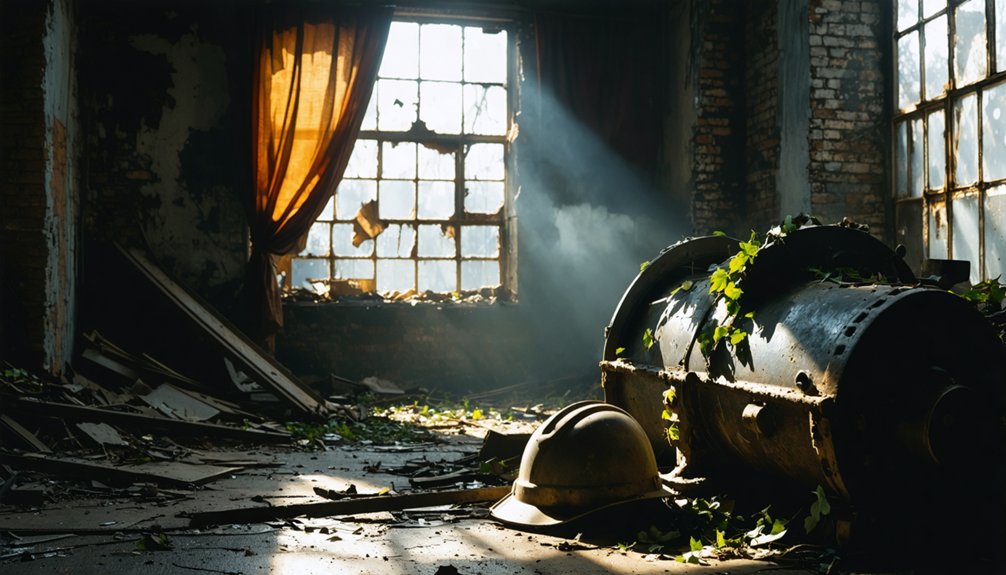
Across the vast industrial corridors of America’s heartland, thousands of factory towns once hummed with the rhythms of production and prosperity—only to fall silent as economic tides shifted.
You’ll find these communities were often company creations, where everything from housing to healthcare fell under corporate control. Workers paid in company scrip shopped at company stores, creating cycles of dependence that collapsed catastrophically when factories shuttered.
The hidden histories of these places reveal complex social dynamics—towns like Pullman, Illinois, where paternalism bred both security and resentment. The 1894 Pullman Strike led to significant unrest and federal intervention in what became a pivotal moment in labor history.
When industries fled overseas starting in the 1970s, populations plummeted by half in single decades. By the late 1900s, corporations aggressively sought cheap labor overseas after trade barriers were lifted, devastating local economies.
Today, industrial nostalgia draws photographers and preservationists to document crumbling theaters and dormant mills—physical remnants of communities where generations once built their American dreams.
Photographing the Ghosts of Industry Past
When you’re traversing the skeletal remains of America’s industrial past, your camera becomes both storyteller and historian, capturing the striking juxtaposition of crumbling factory walls against resilient vegetation reclaiming its territory.
You’ll need specialized equipment—wide-angle lenses for expansive interior shots, tripods for low-light stability, and bracketed exposures ranging from 1/1600 to 1/5 shutter speeds to properly document the contrast between bright skylights and shadowy machinery corners.
Before entering any abandoned structure, research its structural integrity, watch for hazards like exposed wiring or unstable floors, and always explore with at least one companion who can summon help if the ghosts of industry claim more than just your photographic attention. Unpredictable weather conditions like rain can actually enhance your images by creating unique lighting conditions and reflective surfaces throughout the space. The eerie atmosphere of these forgotten spaces adds a powerful emotional impact that resonates with viewers, evoking feelings of nostalgia and loss.
Documenting Decaying Architecture
Photographers seeking to document Rust Belt abandonment face unique technical challenges that transform structural decay into haunting visual poetry. The abandoned aesthetics of these forgotten industrial spaces demand technical mastery and artistic vision to properly convey their somber beauty.
When capturing architectural decay, you’ll need to balance extreme lighting conditions by manually controlling exposure and embracing HDR techniques.
- Use wide-angle lenses (18-35mm) to capture expansive interiors while emphasizing the vastness of industrial spaces through low-angle perspectives.
- Shoot during early morning or late afternoon when natural light creates angled illumination through windows and openings, adding emotional depth.
- Embrace desaturated color palettes in post-processing to emphasize the urban decay aesthetic while highlighting peeling paint, rust, and crumbling concrete structures.
A crucial aspect of this photography involves extended shutter speeds of 2-30 seconds to properly expose dimly lit interiors while preserving atmospheric qualities. Before committing to photographs, take time for initial site exploration to discover the most compelling compositions and unique details that tell the location’s story.
Urban Exploration Safety
Steering through the ghostly remains of America’s industrial past requires more than just artistic vision and camera equipment—it demands meticulous attention to safety protocols that can mean the difference between capturing haunting images and becoming part of the ruins yourself.
Before entering any abandoned structure, perform a thorough risk assessment: examine exteriors for structural integrity and secure written permission from property owners.
You’ll need proper protective gear—N95/P100 respirators for asbestos protection, sturdy boots, and headlamps with backup batteries. Never explore alone; bring a companion and maintain communication plans.
Walk near walls rather than across room centers where floors are weakest. Always look up before entering new spaces to identify potential falling hazards.
Remember that moisture accelerates structural decay, making rain-damaged areas particularly treacherous in these forgotten monuments to American industry.
The Human Cost of Economic Collapse
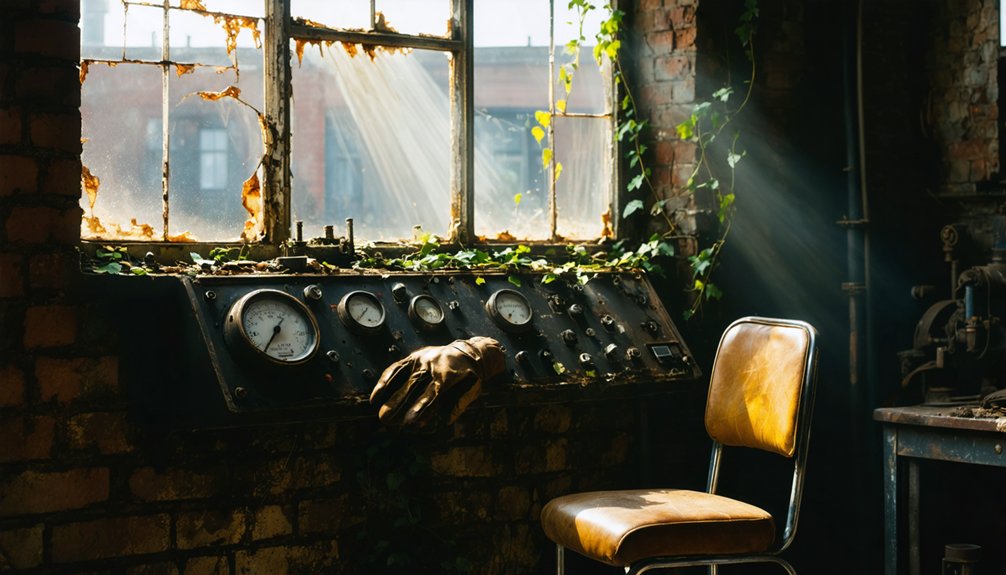
While factory ruins dominate the visual imagery of the Rust Belt’s decline, you’ll find that entire communities have been effectively stranded in the economic aftermath, with over 40% population losses in cities like Buffalo, Cleveland, and Detroit between 1970-2010.
You’re witnessing the collapse of social infrastructures in these left-behind towns, where shuttered stores, abandoned neighborhoods, and strained public services have created cycles of disinvestment affecting everyday life far beyond just lost jobs.
Your travels through these communities reveal stark disparities in economic mobility, where less-educated residents who remained face the harshest reality—their incomes growing at just 31% while those who migrated elsewhere saw gains of up to 110% in real terms.
Left Behind Communities
As factories shuttered their doors across America’s industrial heartland, they left behind more than vacant buildings and silent machinery—they abandoned entire communities.
These once-thriving neighborhoods transformed into modern ghost towns, where urban legends now flourish amid decaying infrastructure and broken dreams.
Among these forgotten streets, there are hidden gems in southern suburbs that still hold stories of resilience and community spirit. Artisans and small businesses are finding ways to thrive amidst the decay, breathing new life into their surroundings. Exploring these areas reveals a rich tapestry of culture and creativity waiting to be rediscovered.
You can witness the stark reality of these left behind communities through:
- Census tracts where over 50% of housing disappeared in just four decades
- Neighborhoods where median incomes plummeted 30% as manufacturing jobs vanished
- Communities where 20,000+ homes were demolished to combat blight
When you walk through Detroit or Buffalo today, you’re traversing the aftermath of economic exile.
As residents fled to Sun Belt states seeking employment, those without means to relocate remained trapped in fragmenting communities with dwindling services and collapsing property values.
Beyond Factory Ruins
Beyond the rusted skeletons of abandoned factories and decaying warehouses lies a devastating human reality that statistics alone can’t capture.
When you walk Cleveland’s emptied neighborhoods, you’re witnessing communities that lost 45% of their residents in just four decades. Real median household incomes plummeted by 30-35% in Detroit and Cleveland, leaving families struggling where industrial nostalgia remains the only vestige of prosperity.
Manufacturing’s collapse eliminated stable, high-wage union jobs that once supported middle-class lives without college degrees.
When factories shuttered, they triggered cascading economic damage throughout local economies. Chinese import competition alone cost up to 2.4 million American jobs between 1999-2011.
The harshest impacts concentrated in already vulnerable neighborhoods, creating pockets of extreme poverty where economic resilience proved nearly impossible amid declining opportunities and resources.
Forgotten Railroad Hubs of the Allegheny Region
The Allegheny region once pulsed with the rhythmic clanking of steel wheels on rail, where a complex network of railroads transformed isolated mining communities into essential industrial hubs during the late 19th century.
These forgotten railroads—Montour, Pan Handle, and Pittsburgh & Lake Erie—now lie dormant, industrial ghosts of Pennsylvania’s coal-powered past.
As you explore these abandoned corridors, you’ll encounter:
- Former mining towns like Imperial and Santiago, where coal extraction fueled Pittsburgh’s steel industry
- Converted rail-trails connecting historic sites from Noblestown to Glen Gormley
- Crumbling infrastructure marking where the Monongahela Railroad once carried coal to three major railroads
Preservation Efforts and Historical Significance

While the railroad corridors of the Allegheny region lie dormant, their physical remnants have sparked remarkable preservation movements throughout Rust Belt communities.
You’ll find citizen preservationists working beyond profit-driven models, recognizing beauty where others see decay. Their community engagement has transformed vacant factories and crumbling grain elevators into vibrant mixed-use spaces.
Without qualified historical preservation expertise, many significant structures face demolition for short-sighted developments.
Yet grassroots urbanism movements are changing this narrative from Kansas City to São Paulo. When you visit McDougall-Hunt in Detroit, you’ll witness neighborhoods where over half the housing stock disappeared between 1970-2010, now reimagined through local initiatives.
These community-led efforts reframe abandoned buildings not as liabilities but as opportunities, weaving material memory into sustainable urban revival while honoring the intrinsic identity of place.
Touring the Haunted Landscapes of the Rust Belt
Venturing into the forgotten corners of the Rust Belt reveals a haunting tapestry of abandoned towns that whisper stories of industrial collapse and human exodus.
As you explore Western Pennsylvania’s ghost towns like Port Perry or Whiskey Run, you’ll encounter sites where paranormal investigations frequently document unexplained phenomena near abandoned mines and factories.
- Visit Indiana County’s coal mining ghost towns, where organized ghost tours highlight unsolved murders and spectral miners still wandering their former workplaces.
- Explore Rushland’s old station after dark, where locals report shadowy figures and disembodied voices echoing through crumbling infrastructure.
- Trek to submerged Wilsonville near Lake Wallenpaupack, where brave visitors claim to hear underwater bells from the town’s flooded church.
You’ll find these destinations increasingly documented on social media, drawing freedom-seeking explorers year-round.
Frequently Asked Questions
Are Rust Belt Ghost Towns Legally Accessible to Visitors?
You’ll find most Rust Belt ghost towns have legal regulations restricting access. You’re often facing visitor restrictions requiring permission, guided tours, or admission fees for lawful exploration of these abandoned places.
What Paranormal Activity Is Commonly Reported in These Towns?
Send a telegram to your courage! You’ll encounter ghostly encounters from disembodied voices to spectral sightings, unexplained temperature drops, moving objects, and overwhelming sensations of dread throughout these decaying industrial monuments.
How Dangerous Are Deteriorating Structures in Ghost Towns?
You’ll face extreme dangers from structural hazards in ghost towns—unstable floors, collapsing roofs, and crumbling walls can fail without warning. Always take safety precautions like bringing proper gear and avoiding entry.
Can Metal Detecting Be Done Legally in Abandoned Sites?
You’ll need written permission from property owners to metal detect legally in ghost towns. All abandoned sites are owned by someone, and ghost town ethics demands respecting both regulations and historical preservation.
Which Ghost Towns Have Inspired Horror Movies or Literature?
Detroit and Gary have spawned haunted legends in films like “Barbarian,” while fictional towns like Vacca Vale inspire ghost stories in works such as “The Rust Maidens” and “The Rabbit Hutch.”
References
- https://en.wikipedia.org/wiki/List_of_ghost_towns_in_Pennsylvania
- https://www.lovemoney.com/gallerylist/86648/americas-empty-ghost-towns-and-why-theyre-abandoned-today
- https://www.geotab.com/ghost-towns/
- https://www.loveexploring.com/gallerylist/127789/then-and-now-us-rust-belt-cities-that-bounced-back
- https://247wallst.com/housing/2024/04/11/americas-modern-ghost-towns-2/
- https://www.atlasobscura.com/lists/americas-best-preserved-ghost-towns
- https://www.aol.com/12-ghost-towns-were-once-143618310.html
- https://en.wikipedia.org/wiki/Rust_Belt
- https://palaborhistorysociety.org/timeline-of-labor-history-in-pennsylvania/
- https://en.wikipedia.org/wiki/History_of_anthracite_coal_mining_in_Pennsylvania