America’s ghost towns offer windows into colonial and early American life through preserved architectural remnants. You’ll find abandoned settlements from resource extraction booms (Kennecott, Alaska), submerged towns beneath reservoirs, and forgotten communities representing diverse cultural heritage including Black mining settlements and Mormon pioneer outposts. These sites reveal economic cycles, architectural adaptations, and social structures that defined early American communities. Responsible exploration of these fragile historical landscapes discloses the complex narrative of America’s development.
Key Takeaways
- Colonial ghost towns contain architectural remnants that reveal early American construction techniques, materials, and regional adaptations.
- St. Mary’s City and similar preserved sites showcase historical structures that provide insights into colonial social hierarchies and daily life.
- Responsible tourism at colonial sites requires following Leave No Trace principles and respecting preservation guidelines.
- Many colonial settlements declined due to economic shifts, resource depletion, or changes in transportation routes.
- Community spaces in colonial ghost towns were typically arranged around central greens, reflecting period social structures.
America’s Forgotten Copper Kingdoms: Kennecott and Beyond
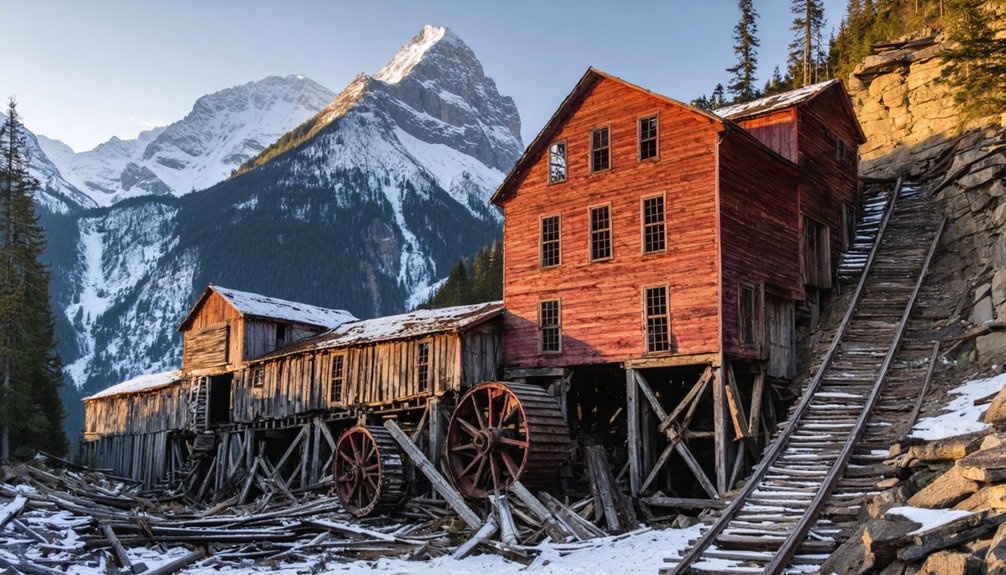
While tracing the contours of America’s abandoned industrial landscapes, one must acknowledge the remarkable story of Kennecott, Alaska, whose meteoric rise and fall epitomizes the boom-and-bust cycle of early 20th century resource extraction.
You’ll discover a copper legacy born in 1900 when prospectors unearthed ore containing an astounding 70% pure chalcocite. By 1916, this operation peaked with $32.4 million in production value, expanding into a thriving company town before inexorably declining as deposits depleted.
The Kennecott miracle: from rich chalcocite discovery to multimillion-dollar enterprise, then inevitable decline as Earth’s treasures vanished.
When the last train departed in November 1938, it left behind mining artifacts now preserved within Wrangell-St. Elias National Park. The mine’s total copper production generated over $100 million in revenue during its 27-year operation.
Unlike the restrictive Kennecott proper, nearby McCarthy evolved as its rebellious counterpart, offering miners unrestricted entertainments.
Today, these dual settlements stand as symbols of America’s industrial ambition and the ultimate impermanence of extractive economies. Visitors can now experience this historic mining town through guided tours that provide access to buildings and valuable historical context.
Coal Country’s Abandoned Heritage: Pennsylvania’s Mining Villages
Beneath Pennsylvania’s rolling hills and verdant forests lies a forgotten legacy of coal mining communities that once thrived as epicenters of America’s industrial revolution.
You’ll find company towns like Wehrum and Iselin, established in the early 1900s, where coal operators controlled every aspect of miners’ lives—from housing to stores and churches.
These ghost towns tell sobering stories of prosperity and tragedy, exemplified by Wehrum’s 1909 explosion that killed 21 miners before the town’s eventual abandonment by 1934.
While most mining villages disappeared as operations ceased between the 1930s-1960s, Eckley Miners’ Village survives as a preserved historical site.
Visitors to Eckley can explore narrow streets and original structures that offer a rare glimpse into the daily lives of coal miners and their families.
The landscape is dotted with remnants of abandoned coke ovens that once processed coal for steel production, serving as rusting monuments to Pennsylvania’s industrial past.
Perhaps most haunting is Centralia, where underground coal fires ignited in 1962 continue burning beneath the evacuated town, projected to smolder for centuries.
The Rise and Fall of Western Frontier Settlements

The westward expansion of America unfolded dramatically throughout the 19th century, creating a landscape dotted with settlements that would eventually become ghost towns across the frontier.
Following the Louisiana Purchase of 1803, you’ll find evidence of rapid frontier expansion across the Great Plains and beyond. Military outposts like Fort Pierre (1817) and Fort Leavenworth (1827) established infrastructure that supported pioneering communities, while homesteaders claimed 160-acre parcels under the 1862 Homestead Law. Many settlements emerged along the Santa Fe Trail after Bents Fort opened in 1833, becoming crucial trading hubs before their eventual abandonment. The Hudson’s Bay Company’s establishment of Fort Vancouver in 1825 created an important trade center on the Columbia River that influenced settlement patterns throughout the Pacific Northwest.
- Settlement decline accelerated after gold discoveries triggered boom-and-bust cycles, with towns emptying as rapidly as they’d filled.
- Native American displacement through conflicts like the Arikara War (1823) and forced relocations fundamentally altered territorial populations.
- Western ghost towns often preserve authentically primitive conditions that reveal the harsh realities of frontier life.
Underwater Specters: Submerged Ghost Towns Across America
Unlike their counterparts in the arid West, America’s submerged ghost towns represent a unique category of lost settlements that now exist as underwater archaeological sites across the nation’s reservoirs and lakes.
You’ll find these aquatic time capsules throughout Appalachia, where communities like Proctor, North Carolina and Gad, West Virginia now rest beneath man-made lakes. The creation of Fontana Lake in the 1940s left many family cemeteries inaccessible to descendants of Proctor’s residents. During periodic droughts or scheduled drainings, these submerged specters briefly resurface—as with Old Bluffton, Texas, which revealed its foundations during the 2009 drought, enabling critical historical preservation efforts. The town was originally home to about 50 families with rich agricultural land before being submerged after the Buchanan Dam construction in 1937.
The pattern extends nationwide: from Elbowoods, North Dakota to Butler, Tennessee, hundreds of communities were sacrificed for hydroelectric development and expanding water needs. Underwater archaeology has become essential for documenting these displaced settlements, where roadways, foundations, and artifacts tell stories of American communities erased by progress but preserved beneath the waves.
Preserving Black History Through Abandoned Mining Communities
While America’s underwater ghost towns preserve communities displaced by reservoir construction, a parallel yet distinct historical narrative exists in the abandoned mining settlements that once housed thriving Black communities across the nation’s coal regions.
These stories are often overshadowed by the grandeur of well-documented urban centers, yet they reflect the resilience of those who once called these places home. The recovering history of coastal towns offers insights into the cultural practices and community bonds that endured even as the landscapes changed. By uncovering these narratives, we can better appreciate the rich tapestry of America’s social history.
These vanished coal towns represent a significant chapter in Black mining heritage that demands cultural preservation efforts.
America’s forgotten Black coal towns deserve recognition as crucial monuments to African American resilience in our industrial past.
- Dana, Wyoming stands as America’s first documented Black-majority mining community, established in 1888 when Union Pacific recruited Black strikebreakers, only to abandon the settlement three years later.
- By 1920, nearly 89,000 African Americans resided in central Appalachia, comprising over 26% of West Virginia’s mining workforce despite facing segregated housing and dangerous work conditions.
- Federal eminent domain policies displaced historic Black mining communities like Virginia’s Cabin Branch, erasing physical evidence of these pioneering settlements from the landscape.
Black miners in Dana faced threats and violence from both White supervisors and fellow miners, contributing to the town’s short-lived existence as a mining community.
The Cabin Branch Pyrite Mine employed many African Americans who established post-Civil War communities that were later forcibly displaced when the government purchased the land in the 1930s.
Mormon Pioneer Ghost Towns of the Southwest
Mormon pioneer ghost towns scattered throughout Arizona, Utah, and neighboring southwestern territories represent a distinctive chapter in American colonial history, having emerged during the mid-to-late 1800s as part of the Church of Jesus Christ of Latter-day Saints’ territorial expansion.
When you visit these abandoned Mormon settlements, you’ll encounter well-preserved structures like those in Grafton, Utah, established in 1862, or Lonely Dell Ranch with its historic irrigation systems.
These communities faced devastating environmental challenges—persistent flooding, drought, and difficult terrain—that ultimately forced their abandonment.
Sites such as Paria Townsite and Iosepa showcase the determination of these pioneers despite isolation and hardship.
Today, ghost town preservation efforts maintain these locations as living museums of cultural heritage, allowing visitors to experience the resilience and ingenuity of Mormon pioneers who shaped the American Southwest.
Economic Cycles and Town Abandonment in American History

Throughout America’s history, economic cycles have repeatedly transformed bustling communities into desolate ghost towns, revealing the fragile interdependence between settlement prosperity and market forces.
You’ll find these abandoned places scattered across the landscape as indicators to America’s economic booms and subsequent downturns.
Resource extraction drove many ghost towns’ lifecycles, with mining settlements appearing and disappearing as precious metals depleted.
Meanwhile, agricultural shifts decimated farming communities, particularly during the Dust Bowl era when environmental catastrophe combined with economic depression.
- Mining towns like Bodie, CA flourished then collapsed when gold deposits waned
- Railroad hubs declined when transportation networks evolved to highways
- Suburban ghost developments emerged after the subprime mortgage crisis
These abandonment patterns demonstrate how American communities remain vulnerable to economic volatility, technological change, and resource exhaustion.
Architectural Remnants: What Buildings Tell Us About Colonial Life
Beneath the weathered facades of colonial ghost towns, architectural remnants serve as silent historians, revealing intricate details about early American life that written records alone can’t convey.
As you explore these sites, you’ll find that building materials—timber frames, wattle and daub, or locally-sourced brick—illustrate regional adaptations and resource availability.
The arrangement of community spaces around central greens reflects social structures where proximity to meeting houses and taverns emphasized communal values.
Preservation methods at living history museums like St. Mary’s City allow you to witness architectural styles firsthand—hand-hewn beams joined with mortise-and-tenon techniques, central chimneys, and casement windows all conveying cultural significance.
Daily life emerges through these historical insights: separate outbuildings for cooking reveal domestic labor divisions, while ornate woodwork versus utilitarian designs demonstrate clear class distinctions.
Responsible Tourism and the Future of America’s Ghost Towns

As colonial ghost towns increasingly attract curious travelers seeking authentic historical experiences, they face the dual challenge of preservation and accessibility that defines responsible tourism.
You’ll find sustainable tourism initiatives thriving where community involvement shapes visitation policies. Local partnerships between preservation groups and residents guarantee these fragile historical sites remain intact while still welcoming visitors.
- Follow Leave No Trace principles by staying on designated paths and never removing artifacts
- Support local economies by patronizing nearby businesses and participating in guided tours
- Contribute to preservation efforts through volunteer programs or donations to restoration projects
The future of America’s ghost towns depends on your commitment to responsible visitation.
As technology advances, virtual experiences may complement physical tourism, reducing environmental impact while still connecting you to these powerful remnants of colonial history.
Frequently Asked Questions
What Personal Items Are Commonly Found in Ghost Town Excavations?
Precious personal artifacts you’ll discover include coins, tokens, embossed bottles, ceramic fragments, tools, jewelry, clothing remnants, writing implements, and gaming pieces—each carrying historical significance about inhabitants’ daily lives and cultural practices.
How Do Modern Indigenous Communities View Tourism in Abandoned Frontier Towns?
Indigenous perspectives on frontier town tourism vary widely—you’ll find communities embracing cultural tourism for economic empowerment and heritage preservation, while others remain cautious about potential exploitation of their ancestral narratives and lands.
Are There Ghost Towns With Active Paranormal Investigation Histories?
Yes, you’ll find paranormal activity documented in St. Elmo, Bodie, Frisco, and Bannack. These locations attract investigators employing various investigation techniques to systematically catalog spectral phenomena within America’s abandoned historical settlements.
Which Ghost Towns Have the Most Intact Postal or Banking Records?
You’ll find Bodie, California offers the most thorough preserved postal records and banking history, with Nevada City, Montana following closely due to its meticulous restoration of financial institutions and communication systems.
How Did Disease Outbreaks Contribute to Town Abandonments Historically?
You’ll find disease impact devastated communities, triggering mass exoduses as mortality rates reached 80-95%. Population decline left settlements uninhabitable, with entire Native villages and colonial towns abandoned following epidemics like smallpox and yellow fever.
References
- https://albiongould.com/ghost-towns-to-visit-in-the-states/
- https://devblog.batchgeo.com/ghost-towns/
- https://www.geotab.com/ghost-towns/
- https://www.youtube.com/watch?v=o9MTF3S_-Uk
- https://www.atlasobscura.com/lists/americas-best-preserved-ghost-towns
- https://www.legendsofamerica.com/gt-hiddentales/
- https://www.youtube.com/watch?v=Z69cNeuZGsA
- https://en.wikipedia.org/wiki/Lists_of_ghost_towns_in_the_United_States
- https://www.atlasobscura.com/places/kennicott-ghost-town
- https://www.alaska.org/detail/kennicott-mine-ghost-town-walking-tour