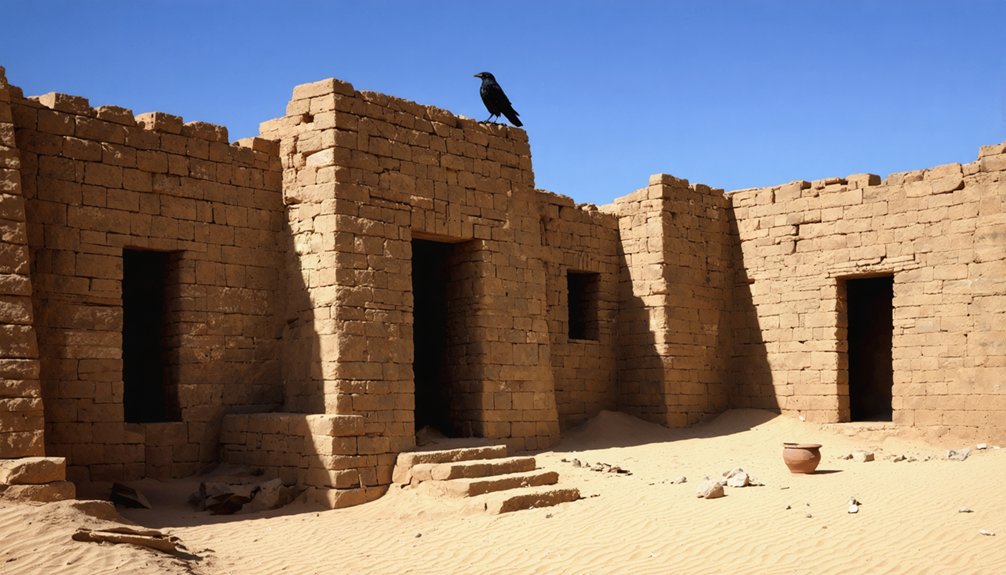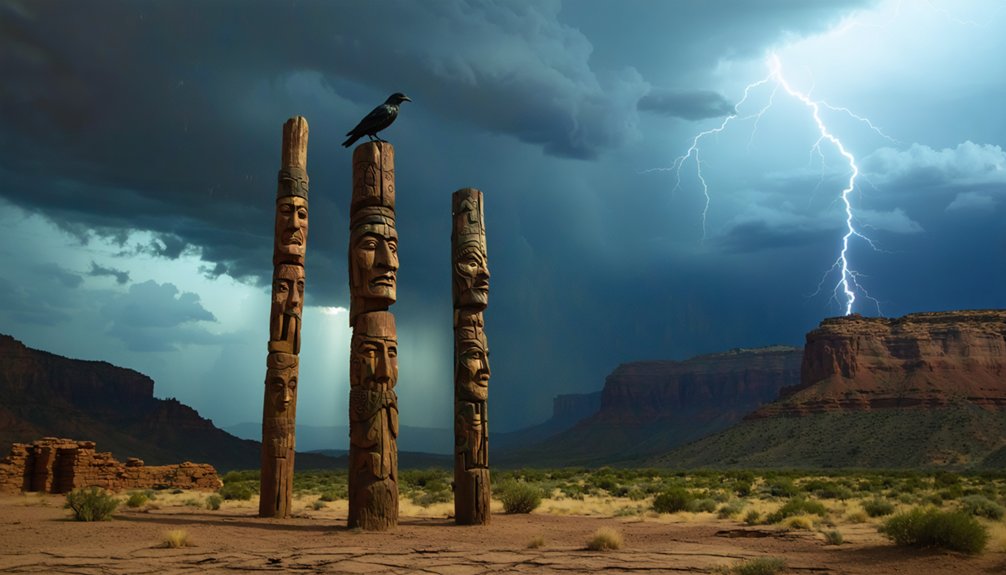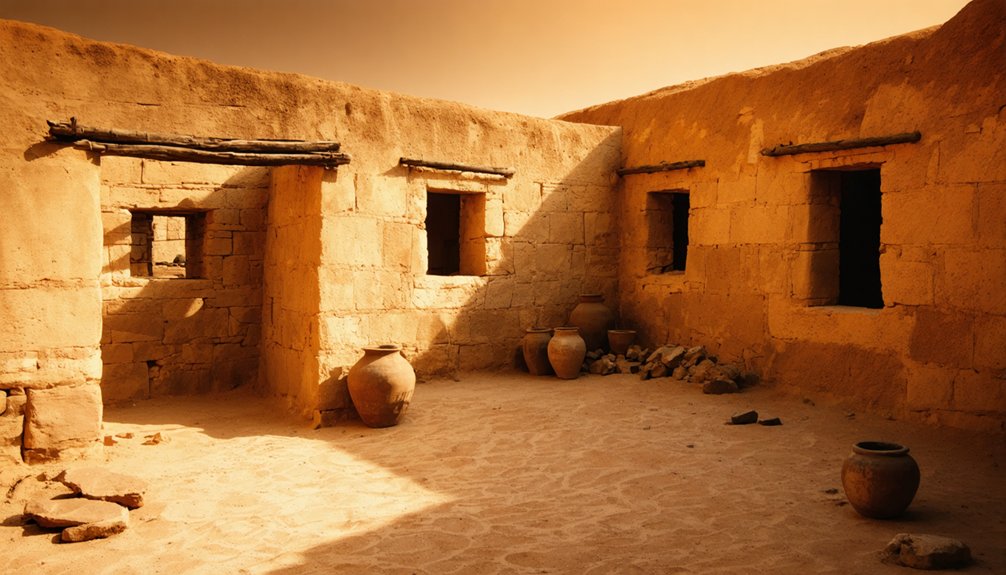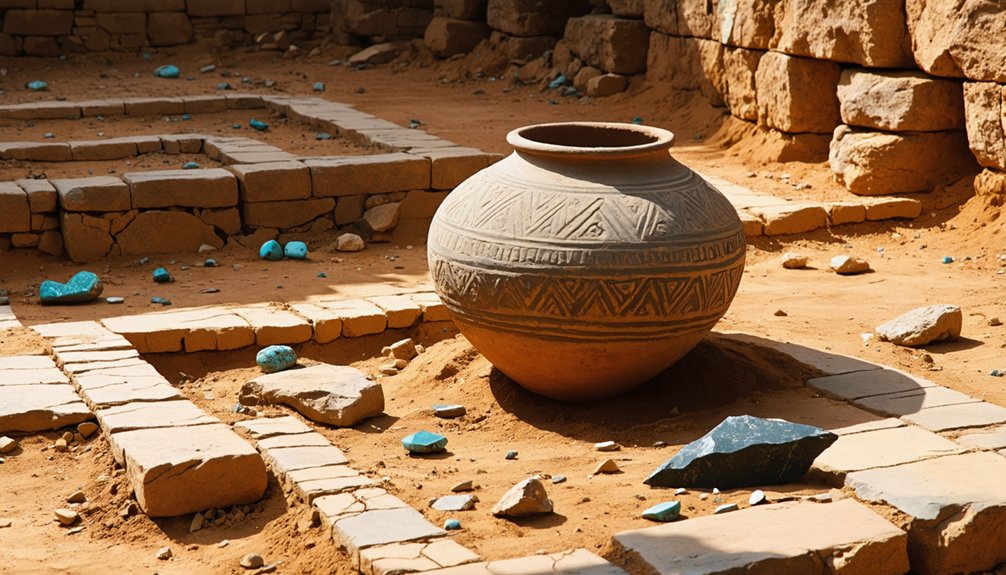
You’ll find remarkable Native American artifacts across the US at sites like Cahokia, where 120 earthen mounds reveal sophisticated pre-Columbian societies. These settlements feature astronomical alignments, intricate trade networks spanning thousands of miles, and ritual objects conveying complex cosmologies. When exploring these sites, respect preservation laws and tribal sovereignty. The copper ceremonial objects, obsidian from Mexico, and astronomical calendars you discover will transform your understanding of America’s true history.
Key Takeaways
- Many significant Native American artifacts remain hidden in plain sight at UNESCO sites like Cahokia, where 120 earthen mounds reveal advanced engineering.
- River-based trade networks transported exotic materials like copper, obsidian, and marine shells across thousands of miles between indigenous settlements.
- Ceremonial sites feature astronomical alignments that demonstrate sophisticated knowledge of celestial events through precision-engineered earthworks.
- Ritual objects with complex iconography, including carved stone pipes and engraved tablets, reveal sophisticated spiritual cosmologies.
- Archaeological preservation faces challenges from looting, with over 90% of known American Indian sites damaged despite protective legislation.
Unearthing America’s Forgotten Indigenous Metropolis

While most Americans associate ancient urban centers with Mesoamerican civilizations like the Maya and Aztec, the archaeological record reveals that North America harbored its own sophisticated metropolis at Cahokia.
You’ll find Cahokia’s significance lies in its remarkable scale and complexity. This Mississippian cultural center covered 4,000 acres with 120 earthen mounds, housing 10,000-20,000 inhabitants—rivaling medieval London.
At its heart stands the hundred-foot Monks Mound, North America’s largest prehistoric earthwork. The construction of this massive structure required workers to carry nearly 15 million loads of dirt. Indigenous urbanism manifested through sophisticated planning with neighborhoods, plazas, and causeways strategically oriented along a central Grand Plaza.
Monks Mound dominates Cahokia’s landscape, where sophisticated urban planning created an interconnected city of neighborhoods around the ceremonial Grand Plaza.
The Woodhenge calendar structure demonstrates advanced astronomical knowledge. Evidence of social stratification appears in neighborhood organization and monumental construction requiring coordinated labor. The site was recognized as a UNESCO World Heritage site in 1982, acknowledging its cultural importance.
This forgotten metropolis controlled Mississippi River trade networks while sustaining itself through advanced agricultural systems.
Ceremonial Centers: Sacred Spaces Beyond Modern Understanding
Throughout the diverse North American landscape, ceremonial centers erected by Indigenous peoples reveal sophisticated cultural networks that transcend archaeological categorization.
You’ll find these sacred spaces purposefully aligned with astronomical phenomena, demonstrating profound knowledge of celestial movements integral to sacred rituals.
At sites like Cahokia and Parowan Gap, ceremonial practices incorporated:
- Precision-engineered earthworks aligned with solstice and equinox positions
- Monumental mounds serving as both burial grounds and ceremonial platforms
- Effigy structures depicting animal forms with spiritual significance
- Rock art panels containing over 1,500 glyphs documenting cosmological knowledge
These spaces, now protected through hard-fought legal battles by descendant communities like those at Glen Cove, represent rare tangible connections to civilizations that thrived for millennia before European contact. Indigenous communities like the Ohlone, Patwin, and others have defended these sites based on their religious freedom rights under the First Amendment. Modern visitors can experience this living heritage at the Taos Pueblo in New Mexico, which has been continuously inhabited for over 1,000 years.
Their survival depends on continued recognition of their profound cultural significance.
Trade Networks That Connected Ancient North America

You’ll find evidence of sophisticated river-based exchange routes connecting ancient North American settlements through artifacts discovered hundreds of miles from their source materials.
These networks facilitated the circulation of prestige goods, including copper from the Great Lakes region, obsidian from distant volcanic sources, and marine shells from coastal areas.
The Columbia River served as a great emporium where approximately 3,000 Indigenous people gathered annually for trading salmon, dentalium shells, and other regional specialties.
Spiro, a major Mississippian ceremonial center, established continental connections evidenced by turquoise from the Southwest, mica from Appalachia, and distinctive shell engravings showing shared iconography across diverse cultural regions.
Native Americans utilized innovative transportation such as canoes and travois to move goods efficiently across vast distances, demonstrating their remarkable adaptation to diverse landscapes.
River-Based Exchange Routes
Long before European arrival, extensive river-based trade networks crisscrossed North America, creating sophisticated commercial systems that connected diverse indigenous communities across vast distances.
These river trade routes formed the backbone of indigenous commerce, with strategic locations like Celilo Falls on the Columbia River and Cahokia near the Mississippi confluence serving as critical economic hubs. Anthropologists now recognize that tribes maintained extensive governance structures that facilitated these complex trading relationships.
- Western canoes transporting one million pounds of salmon annually through Columbia River corridors
- Dentalium shells functioning as currency within complex economic systems spanning thousands of miles
- The Dalles-Celilo attracting thousands of traders from all compass directions
- River valleys connecting communities from Wisconsin to the Gulf and Atlantic to Oklahoma
You’ll find these waterways served not merely as transportation channels but as sophisticated commercial infrastructure developed through community investment and maintained through specialized knowledge systems and multi-lingual communication strategies. Archaeological evidence of Ramah chert artifacts found throughout the Maritimes, Maine, and Québec further confirms the remarkable extent of these pre-contact trading networks.
Prestige Goods Circulation
The river transportation systems expanded beyond mere physical movement of goods to facilitate complex prestige goods circulation that shaped sociopolitical hierarchies across ancient North America.
You’ll find elite goods like obsidian, turquoise, copper, and marine shells traveled through direct exchange systems, reaching far-flung destinations while maintaining their high value.
These prestige trade networks created social stratification as elites controlled access to exotic materials. The Mayan ruling class and Aztec pochteca merchants derived significant power from managing these valuable resources. Native American societies established vital trade networks that connected diverse regions across the continent. Shell beads served as common currency throughout these networks, with specific lengths assigned monetary values for thousands of years.
Similarly, Cahokia’s prominence stemmed directly from its position as a trading hub. Cultural ideas flowed alongside physical artifacts—pottery styles, basket designs, and religious practices traveled these same routes, creating shared aesthetic standards and ceremonial meanings that transcended geographical boundaries while maintaining distinct regional identities.
Spiro’s Continental Connections
While ancient trade networks crisscrossed North America in intricate patterns, Spiro Mounds emerged as perhaps the most significant continental nexus of commerce and cultural exchange during its apex between 900-1450 CE.
Strategically positioned at the Arkansas River bend, you’ll find Spiro artifacts originating from unprecedented distances, revealing trade routes spanning ocean to ocean.
Evidence of this continental reach includes:
- Conch shells from Florida’s Gulf Coast traversing 800+ miles to Oklahoma
- Green obsidian from Pachuca, Mexico—rare evidence of Mesoamerican connection
- Great Lakes copper transformed into elaborate ceremonial regalia
- Mica from Carolina mountains alongside New Mexican flint
This convergence of resources from diverse ecological zones transformed Spiro into North America’s commercial crossroads, connecting over 60 tribes across 30 language groups and influencing millions through its distribution networks.
The Art and Symbolism in Mound Builder Artifacts
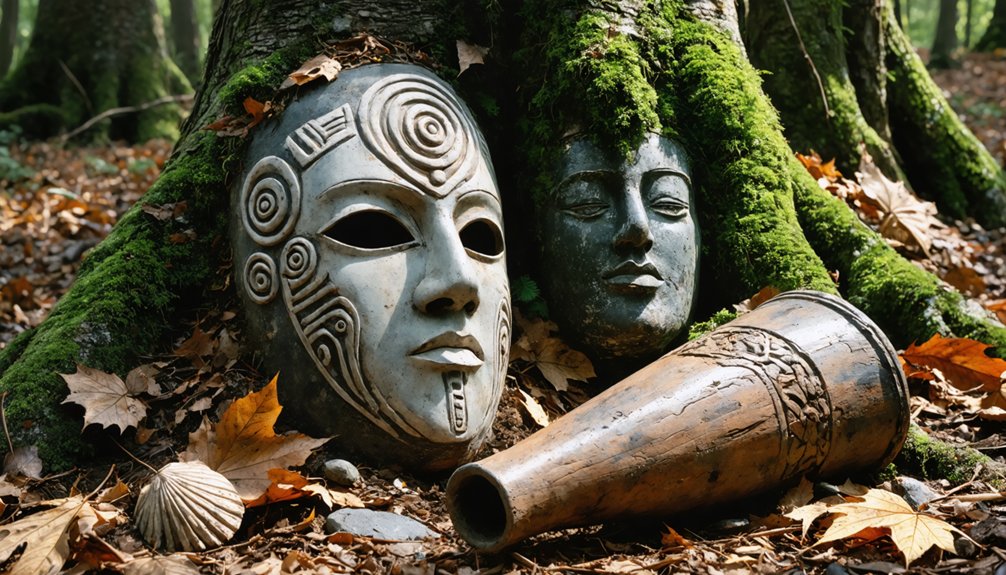
You’ll discover that Mound Builder artifacts contain complex sacred iconography linking the natural world to cosmological beliefs, including bird-man imagery and underwater panther motifs that bridged physical and spiritual domains.
The tradition of effigy vessels reflects sophisticated artistic capabilities, with ceramic forms depicting animals, humans, and mythic creatures that served both functional and ceremonial purposes.
Recent excavations have revealed ritual objects—including elaborately carved stone pipes, copper plates, and engraved tablets—that demonstrate how symbolic material culture reinforced social hierarchies and facilitated communication with supernatural forces.
Sacred Iconography Elements
Across the richly symbolic landscape of ancient North American civilizations, Mound Builder artifacts reveal a sophisticated cosmological understanding through their intricate iconography.
You’ll discover sacred symbols encoding the Four Great Primary Forces and cosmic motifs representing universal creation, with directional movement from west to east as a fundamental principle.
- Serpent imagery signifies religious ceremony and life cycles, appearing in both earthworks and portable artifacts.
- The axis mundi, represented by cedar trees or striped poles, connects the Upper, Middle, and Under worlds.
- Rattlesnake symbols embody fertility, protection, and regeneration cycles.
- The “cross in circle” motif unifies the earthly and divine domains, mapping the Mississippian cosmos.
These iconographic elements weren’t merely decorative but functioned as spiritual technology, allowing practitioners to harness cosmic power through ritual objects.
Effigy Vessel Traditions
Emerging during the Late Woodland period (550–1200 CE), effigy vessel traditions represent a sophisticated artistic and spiritual practice among Native American communities, particularly those associated with the Effigy Mound culture of the Midwest.
You’ll find these vessels exemplify a complex relationship between form and function, featuring stylized animal or human figures that mirror the shapes found in effigy mounds. The artistic techniques employed—shell-tempering, cord-marking, and punctuations—demonstrate remarkable craftsmanship while conveying deeper meanings.
Each vessel’s effigy symbolism connects to Native American cosmology, dividing the universe into Upper, Middle, and Lower Worlds. These artifacts weren’t merely decorative but served as tangible expressions of clan identity and spiritual guardianship.
The animal motifs—bears, eagles, panthers—functioned as totemic symbols within an egalitarian social structure that prioritized shared ritual experiences over hierarchical distinctions.
Ritual Objects Unveiled
While effigy vessels represent one facet of Native American artistic expression, the ritual objects of Mound Builder societies offer a broader window into their complex cosmological understanding.
These artifacts reveal a sophisticated symbolic language that connected material with spiritual spheres, establishing ritual significance through carefully chosen elements.
You’ll find their cosmological worldview encoded in:
- Cross-in-circle motifs representing the integration of earthly and divine territories
- Hand and Eye symbols functioning as portals to the Otherworld
- Copper ceremonial axes and ornaments marking elite status
- Intricately carved shell gorgets symbolizing both rank and spiritual authority
Material symbolism extends beyond decoration—specific substances like copper, shell, and catlinite were deliberately selected for their inherent properties and connection to powerful forces, reinforcing the artifact’s function as a conduit between humans and the supernatural dimension.
How Archaeological Looting Shaped Modern Preservation Laws

Archaeological looting of Native American sites has directly catalyzed the development of America’s most significant cultural preservation legislation.
Hidden Native American artifacts in the US provide a unique glimpse into the rich history and traditions of Indigenous peoples. The discovery and preservation of these items are crucial not only for understanding the past but also for fostering respect and acknowledgment of Native American cultures today. Efforts to protect these artifacts from illegal excavation are essential to ensure that their stories are not lost to time.
You’ve witnessed a progression from the 1906 Antiquities Act—created primarily to prevent commercial exploitation—to the strengthened Archaeological Resources Protection Act (1979) and NAGPRA (1990), which established meaningful penalties and repatriation requirements.
The looting consequences have been devastating: over 90% of known American Indian sites damaged, with artifacts stripped of context and sold internationally.
These preservation challenges persist despite Operation Cerberus‘s ambitious efforts, which resulted in 32 arrests but zero prison sentences.
Today’s laws reflect this tension between protection and freedom—federal and tribal lands receive protection while private landowners maintain excavation rights, creating an imperfect system where vast territories remain vulnerable to those seeking artifacts without authorization.
Astronomical Alignments in Native American Architecture
You’ll recognize sophisticated celestial site orientations in Native American architecture through strategically placed windows, chambers, and walls that align with cardinal directions and track solstice paths.
Solar calendar structures, exemplified by Chaco Canyon’s Great Houses and Pueblo Bonito’s symmetrical north-south wall, enabled communities to coordinate agricultural cycles with remarkable precision.
Moon-phase temple functions are particularly evident in the Newark Earthworks’ Octagon structure and Medicine Wheels, which demonstrate advanced understanding of lunar standstills and seasonal shifts through precisely positioned stone arrangements.
Celestial Site Orientations
Across ancient North America, indigenous settlements reveal sophisticated astronomical knowledge encoded directly into their architecture and spatial layouts.
You’ll find celestial alignments throughout major complexes like Cahokia, the Bighorn Medicine Wheel, and Hopewell earthworks, where builders precisely oriented structures to track solstices, equinoxes, and lunar standstills.
- Medicine Wheels with cairns positioned to mark heliacal risings of significant stars
- Hopewell octagonal earthworks encoding the eight major lunar standstill points
- Cahokian woodhenges with posts aligned to track seasonal solar positions
- Settlement grids intentionally offset from true cardinal directions to reflect cosmic principles
These orientations weren’t merely practical calendars but carried profound ritual significance, regulating ceremonial cycles and reinforcing the community’s place within a larger cosmic order that integrated spiritual worldviews with precise astronomical observations.
Solar Calendar Structures
Throughout the Americas, indigenous peoples encoded astronomical knowledge directly into their architectural structures, creating sophisticated solar calendars that marked critical celestial events with remarkable precision.
You’ll find these solar alignment techniques embodied in structures like Chaco Canyon’s Sun Dagger, where spiraling petroglyphs capture solstice light, and Mesa Verde’s Balcony House, where strategic openings track seasonal shifts.
Puebloan builders positioned wooden beams as gnomons casting shadows onto precisely placed basins. At Cahokia, the Woodhenge timber circle functioned as a communal observatory marking equinoxes and solstices.
Hopi structures integrated seasonal observation practices through north-facing windows in kivas, timing agricultural cycles and ceremonial events.
These calendrical systems weren’t mere scientific curiosities—they represented sophisticated technologies that synchronized community life with cosmic rhythms, embodying freedom through self-sufficiency and harmony with natural cycles.
Moon-Phase Temple Functions
While solar calendars marked diurnal patterns, Native American builders also constructed sophisticated lunar observatories that captured the moon’s complex rhythms.
These structures aligned precisely with the 18.6-year cycle of lunar standstills, serving as celestial calendars that regulated ceremonies and agricultural timing. You’ll find these engineering marvels across North America, from Cahokia’s Woodhenge to the UNESCO-recognized Octagon Earthworks.
- View corridors frame the moon’s extreme northern and southern positions
- Stone markers and post arrangements track lunar phases with mathematical precision
- Temple orientations align with specific lunar deity associations like the Maya goddess Ixchel
- Architectural elements create dramatic illumination effects during standstills
These lunar rituals weren’t merely spiritual exercises—they represented advanced astronomical knowledge that unified dispersed communities through shared cosmic understanding.
This reinforced cultural identity while maintaining precise timekeeping systems essential for survival.
Daily Life Artifacts: What Household Items Reveal About Ancient Cultures
When examining the ancient Native American settlements, household artifacts serve as critical windows into daily practices and cultural systems that defined these societies.
You’ll discover that pottery symbolism reveals sophisticated cultural beliefs – with designs depicting clouds, rain, and corn reflecting agricultural dependence and spiritual worldviews. Clay gathering from sacred sites emphasizes the fusion of utilitarian needs with cosmic understanding.
Tool craftsmanship exhibits remarkable technological adaptation across materials. Stone arrowheads demonstrate high precision standards, while bone knives served diverse household functions.
Living spaces featured practical innovations like multi-tiered bunk beds with hidden storage compartments beneath animal pelt mattresses. Personal items including medicine bags contained spiritually significant materials, while decorated drums and pipes functioned as both ritual implements and household prestige objects, representing the inseparable nature of daily life and spiritual practice.
Burial Practices and Spiritual Beliefs Preserved in Earthworks
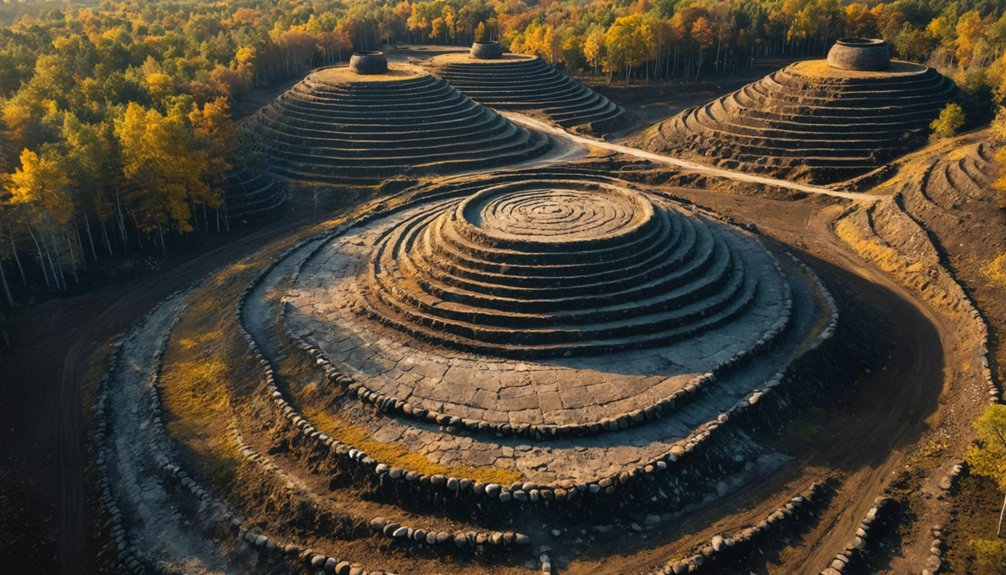
Burial earthworks provide archaeologists with remarkable physical evidence of Native American spiritual cosmologies and mortuary traditions that spanned millennia.
You’ll find these structures weren’t merely graves but complex religious expressions reflecting burial symbolism connected to cosmic order. Earthworks significance extends beyond memorialization to include ceremonial spaces where communities enacted ritual dramas of change.
- Layered construction techniques where wooden structures were ritually burned before mound-building represent cyclical concepts of death and rebirth.
- Diverse interment methods (scaffold, earth, cremation) each conveying distinct spiritual pathways to afterlife domains.
- Strategic placement of copper, mica, and obsidian grave goods symbolizing status and supernatural power.
- Communal participation in burial ceremonies creating social cohesion through shared mourning practices.
These earthworks reveal sophisticated theological systems where architecture, landscape, and ritual converged to honor ancestors and maintain cosmic balance.
Visiting Ancient Sites: Respectful Tourism and Cultural Heritage
Experiencing these ancient earthworks firsthand requires a deliberate approach that honors both their archaeological significance and living cultural importance.
Before visiting, research site jurisdiction—whether tribal, federal, or state—and contact appropriate cultural affairs offices regarding access permissions and photography restrictions.
Practice ethical tourism by strictly adhering to established paths, respecting off-limits designations of sacred areas, and never touching artifacts.
You’ll gain deeper insights through guided tours led by tribal members who provide cultural context unavailable otherwise.
Cultural sensitivity demands respecting privacy, seeking photography permission, and dressing modestly, especially during ceremonies.
Most sites manage visitor impact through limited hours, controlled numbers, and designated facilities.
Remember that many archaeological locations remain active spiritual spaces—your informed, respectful presence acknowledges this living cultural heritage.
How Climate Change Threatens Native American Archaeological Sites
While global temperatures continue to rise, Native American archaeological sites face unprecedented threats from multiple climate change vectors. These climate challenges disproportionately affect coastal and high-altitude locations where preservation strategies increasingly integrate Indigenous knowledge systems.
- Coastal sites rapidly disappear as rising sea levels accelerate erosion of earthen mounds in Louisiana and Georgia.
- Melting ice patches simultaneously reveal and endanger organic artifacts previously protected by cold preservation conditions.
- Pro-glacial lake flooding threatens multiple Gold Rush-era sites simultaneously, including Canyon City and Dyea.
- Traditional Indigenous approaches recognize cultural resources as living entities requiring holistic management.
The intersection of Western archaeological methods with Native American co-stewardship models offers promising preservation frameworks, particularly as subsistence resources shift and wildfires intensify on tribal lands with higher climate vulnerability.
Frequently Asked Questions
How Did Ancient Native Americans Engineer Mounds Without Modern Construction Technology?
Imagine this: you’re witnessing mound engineering without hydraulics! You’d see ancient tools—baskets and manual labor—organizing massive workforces, carefully layering prepared soils, and implementing architectural plans spanning generations with precision.
What Evidence Exists of Written Communication Systems Among Mound-Building Cultures?
You’ll find no confirmed indigenous writing systems but rather pictographic symbols on artifacts requiring cultural interpretations. These iconographic elements communicated meaning but don’t constitute true linguistic scripts among mound-builders.
How Did Indigenous Populations Respond to European Diseases Before Direct Contact?
The invisible enemy lurked beyond horizons. You’ll find indigenous populations developed disease resistance strategies through isolationist patterns and cultural adaptation responses including altered settlement configurations when epidemics spread through trade networks before direct European encounters.
What Forensic Techniques Reveal About the Health of Pre-Columbian Populations?
You’ll find dental analysis reveals caries patterns indicating high-carbohydrate diets, while isotopic studies confirm nutritional stress. Skeletal lesions and ancient DNA extraction further illuminate disease burdens among pre-Columbian populations, documenting their ancestral health challenges.
How Did Seasonal Migrations Impact Settlement Patterns Across Different Regions?
You’ll notice a changing tapestry of human movement when examining seasonal migration impacts. Hunter-gatherers adjusted settlement patterns according to resource availability—following game in mountains, salmon runs in rivers, and bison herds across plains.
References
- https://www.floridastateparks.org/parks-and-trails/crystal-river-archaeological-state-park
- https://www.okhistory.org/sites/spiromounds
- https://ancientnc.web.unc.edu/explore/archaeological-sites/
- https://www.wilderness.org/articles/article/10-extraordinary-native-american-cultural-sites-protected-public-lands
- https://cahokiamounds.org
- https://historicsites.nc.gov/all-sites/town-creek-indian-mound
- https://www.nps.gov/subjects/travelamericancultures/amindsites.htm
- https://dnrhistoric.illinois.gov/experience/sites/site.cahokia-mounds.html
- https://www.youtube.com/watch?v=ruWuAas8T7Y
- https://en.wikipedia.org/wiki/Cahokia