You’ll find over 1,200 historic colonial ghost towns scattered across America, with highest concentrations in Texas (550), California (346), and Kansas (308). These abandoned settlements disclose dramatic boom-bust cycles of resource extraction, from 1600s mining operations to 20th century agricultural communities. Visit preserved sites like Batsto Village, Virginia City, or Nicodemus to experience authentic colonial architecture and compelling stories of economic rise and fall. The physical remnants disclose America’s complex relationship with frontier expansion.
Key Takeaways
- Preserved colonial ghost towns like Batsto Village and Virginia City showcase historical architecture and mining heritage across America.
- Doodletown exemplifies forced abandonment with minimal remains including crumbled staircases and foundation outlines in Bear Mountain State Park.
- St. Mary’s City reveals archaeological foundations of America’s first colonial capital through careful preservation efforts.
- Texas (550), California (346), and Kansas (308) contain the highest concentrations of ghost towns along historical colonial migration routes.
- Colonial mining settlements began near Jamestown in 1608, establishing patterns of boom-and-bust resource extraction still visible today.
The Rise and Fall of America’s Colonial Mining Settlements

Beginnings of mineral extraction in colonial America marked a pivotal chapter in the nation’s economic development, one characterized by ambitious ventures, significant setbacks, and eventual industrial establishment.
When you examine colonial mining history, you’ll find it began near Jamestown in 1608, where 150 skilled ironworkers arrived by 1620 to establish operations. Settlement dynamics shifted dramatically after the 1622 Indian massacre halted production until 1715.
Despite these challenges, mining gradually expanded beyond Virginia. Connecticut initiated copper mining in 1709, while New Jersey’s Schuyler Mine became historically significant. The Revolutionary War created unusual economic stimulus for domestic mining operations as supply lines from England were severed.
Colonial mineral extraction spread strategically northward, establishing crucial copper operations in Connecticut and New Jersey despite ongoing challenges.
Silver-lead operations emerged in Missouri by 1720, and Massachusetts joined in 1765. Early settlers faced significant competition from foreign production, making most mining ventures unprofitable during the colonial period. Throughout this evolution, settlements faced indigenous resistance and logistical hurdles, creating the boom-and-bust cycle that would later define America’s mining landscape.
Nicodemus: America’s Last Surviving Black Frontier Settlement
Five remarkable features distinguish Nicodemus, Kansas as America’s most historically significant black frontier settlement—its deliberate founding, extraordinary perseverance, unique cultural heritage, remarkable preservation, and continued existence.
Established in 1877 when 300 formerly enslaved African Americans arrived from Kentucky, Nicodemus history represents a bold experiment in freedom during the post-Reconstruction era. The town company, formed by W.H. Smith and W.R. Hill, created this intentional Black settlement as a haven from Southern oppression.
Despite initial hardships—living in dugouts, facing severe resource scarcity, and losing many early settlers—the community persevered, growing to 550 residents by 1885. Reverend Simon Roundtree made history as the first settler of Nicodemus on June 18, 1877.
The town’s eventual decline began when the railroad bypassed Nicodemus in 1888, orchestrated by the same Hill who helped found it, leading to business relocations and dwindling population. The Great Depression and subsequent Dust Bowl further devastated the already struggling community, causing many families to abandon their homesteads.
Military Outposts Turned Ghost Towns: Fort Jefferson’s Legacy

Situated seventy miles west of Key West in the azure waters of the Gulf of Mexico, Fort Jefferson stands as one of America’s most remarkable abandoned military outposts—a massive brick fortress that evolved from strategic naval base to Civil War prison before ultimately becoming a ghost town.
This colossal structure—comprising 16 million handmade bricks—represents the apex of America’s coastal defense ambitions following the War of 1812.
You’ll find ghostly remnants of military heritage throughout its six-sided design, featuring nearly 2,000 arches that once housed Union troops, Confederate prisoners, and Dr. Samuel Mudd.
Despite three decades of construction, the fort was never completed due to foundation issues.
The hexagonal design allowed the fort to house an impressive 420 cannons along its walls, though it never reached full capacity.
The fort experienced a devastating yellow fever epidemic in 1867, during which Dr. Mudd provided critical medical care to soldiers and prisoners alike.
After serving as a quarantine station until 1900, this engineering marvel was abandoned, its strategic importance surrendered to the relentless sea and passage of time.
Preserved Colonial Structures That Transport Visitors Back in Time
While Fort Jefferson stands as a maritime tribute to military abandonment, the American landscape harbors numerous colonial structures that remain frozen in time, offering a tangible connection to our nation’s formative years.
At Batsto Village, you’ll discover pristine colonial architecture from 1766, including iron works facilities that once supplied the Continental Army. The village’s historical preservation efforts showcase industrial innovation during America’s birth. After the decline of iron production, the village successfully transitioned to glassblowing operations in the 1800s.
Similarly, Virginia City’s wooden sidewalks and preserved saloons transport you to the 1860s silver rush era without sanitizing history.
For unvarnished authenticity, Grafton, Utah presents Mormon frontier life through untouched structures and a haunting cemetery.
Meanwhile, Bodie, California‘s “arrested decay” approach freezes the gold mining boom moment exactly as residents left it—personal items still waiting on tables for owners who never returned. Visitors are warned about the supposed curse that befalls anyone who takes souvenirs from the site.
Doodletown: The Forgotten Dutch Settlement of New York
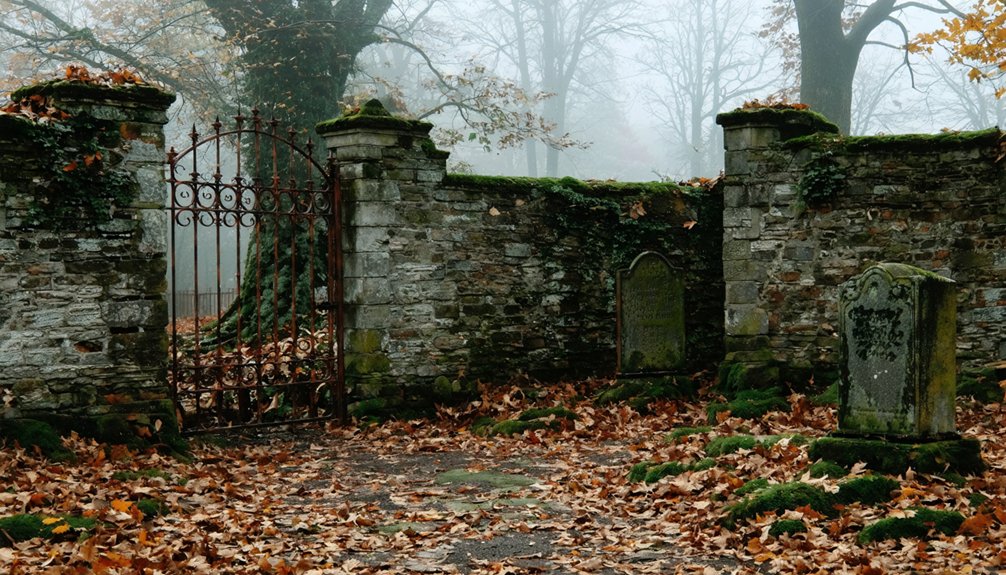
While hiking through Bear Mountain State Park today, you’ll encounter the scattered foundations of Doodletown, a once-thriving Dutch settlement established in the 1760s that flourished until government acquisition through eminent domain forced its abandonment in 1965.
The transformation from colonial community to ghost town presents a stark example of how preservation efforts paradoxically erased human habitation while maintaining the area as undeveloped parkland. The area served as an important crossroads for soldiers during the American Revolutionary War.
Unlike other historical sites where structures remain intact, Doodletown’s preservation manifests primarily through absence—crumbled staircases and stone foundations serving as the sole physical remnants of its colonial Dutch heritage.
Dutch Settlement Origins
Although the name “Doodletown” might evoke images of childish drawings, this forgotten settlement actually derives its name from a Dutch phrase meaning “dead valley”—an ironic designation for what was once a thriving colonial outpost.
When you explore Doodletown‘s Dutch Heritage, you’ll uncover layers of settlement patterns reflecting broader colonial expansion. The area, originally home to Algonquin/Lenape peoples, became part of Dutch territorial ambitions in the 1620s through the Dutch West India Company‘s fur trading ventures. Dutch settlers frequently sought to establish land deeds with Native peoples despite fundamentally different concepts of property ownership.
These early settlers sought freedom from Manhattan’s constraints, gradually establishing permanent communities. Even after English takeover in 1664, Dutch influence persisted in distinctive sandstone architecture and place names.
The settlement served as an important node in colonial networks, maintaining Dutch administrative practices and cultural traditions while functioning within evolving political realities.
Bear Mountain Transformation
Despite its centuries of Dutch heritage and resilient community life, Doodletown’s alteration began in earnest with the rise of Bear Mountain Park, marking one of America’s most systematic examples of state-sponsored community dissolution.
You’ll find the economic change was brutal—families who once thrived through mining, logging and farming were gradually squeezed out as the Palisades Interstate Park Commission acquired properties throughout the 1920s-1960s.
By 1964, residents faced a stark choice: accept buyout terms or face condemnation proceedings.
Where approximately 300 people once lived, only foundations and crumbling macadam roads remain.
The promised ski resort—the primary justification for seizing private property—never materialized.
Instead, Bear Mountain’s development obliterated a 200-year-old community through calculated eminent domain tactics, altering homes into hiking trails and interpretive signs.
Preservation Versus Abandonment
In the decades following Doodletown’s forced abandonment, a stark dichotomy emerged between preservation and erasure that characterizes the site’s current state.
You’ll find the preservation challenges evident in the minimal remains—crumbled staircases and foundation outlines—that have been left to integrate with the surrounding nature rather than undergo formal restoration.
The abandonment consequences are profound: by 1965, eminent domain had emptied this once-thriving Dutch settlement of its last residents, transforming a community with 70 homes into an unmarked wilderness trail.
While Bear Mountain State Park now encompasses the area, allowing you to explore this colonial ghost town, the site exemplifies the tension between public land use and private property rights.
Doodletown stands as a poignant reminder of how quickly human settlements can disappear when preservation isn’t prioritized.
How Natural Disasters Shaped the Fate of Colonial Towns

While colonial settlements faced numerous challenges in establishing themselves across the American frontier, natural disasters frequently delivered the fatal blow that transformed once-thriving communities into abandoned ghost towns.
Nature’s fury often delivered the final, decisive strike that transformed prosperous settlements into forgotten ruins.
You’ll find that floods along major rivers like the Mississippi rendered towns economically unviable as repeated inundation eroded foundations, sometimes forcing relocation to higher ground, as witnessed in Valmeyer, Illinois. The lack of disaster resilience and inadequate urban planning amplified these effects.
Hurricanes devastated coastal settlements through storm surges and flooding, while wildfires consumed wood-built towns, particularly in California mining communities.
Earthquakes and landslides created unstable ground conditions that made rebuilding impossible. The Galveston Hurricane of 1900 demonstrates how a single catastrophic event could permanently alter a community’s trajectory, drowning hundreds and decimating infrastructure.
From Bustling Communities to Abandoned Landscapes: Economic Factors
You’ll discover that colonial ghost towns often emerged during intense resource extraction periods, only to collapse when those resources were depleted.
The boom-bust cycle typically began with rapid population growth and economic expansion around mining, timber, or other valuable commodities, followed by precipitous decline once these resources became exhausted or unprofitable.
Manufacturing centers faced similar fates when industrial bases relocated or technological changes rendered local production obsolete, transforming once-thriving communities into abandoned landscapes that now serve as historical artifacts of economic vulnerability.
Resource Boom-Bust Cycles
Resource boom-bust cycles fundamentally shaped the fate of countless colonial settlements across America, transforming once-thriving communities into haunting ghost towns through predictable yet devastating economic patterns.
You’ll notice these ghost town economics followed remarkably consistent trajectories. When gold, silver, or coal resources depleted, communities experienced immediate economic collapse, with population exodus occurring at shocking speed.
Towns like Tombstone and Leadville illustrate how single-resource dependence created extreme vulnerability. Within these resource cycles, boomtowns first experienced explosive service industry growth—establishing banks, stores, saloons, and churches—before abandonment when extraction ceased.
The consequences were severe: infrastructure became stranded assets, buildings deteriorated rapidly, and transient labor forces dispersed to seek opportunities elsewhere.
Even substantial brick structures in places like Cripple Creek couldn’t prevent the inevitable abandonment when the economic foundation collapsed.
Manufacturing Base Collapse
Unlike the boom-bust cycles of resource extraction, the collapse of America’s manufacturing base has created a more modern category of colonial ghost towns, transforming once-thriving industrial communities into desolate landscapes of abandoned factories and emptied neighborhoods.
As you explore America’s Rust Belt and industrial South, you’ll witness the devastating aftermath of manufacturing decline. Towns like Buffalo, Gary, and Detroit suffered catastrophic job loss when globalization relocated production overseas. These communities, often dependent on single employers, experienced rapid exodus when factories closed abruptly.
The combination of automation, transportation shifts, and environmental degradation further accelerated their demise. Rail system changes particularly impacted industrial towns—when lines closed, supply chains collapsed.
Meanwhile, environmental contamination from decades of industrial activity created health hazards, triggering evacuations and preventing economic redevelopment, cementing these towns’ ghost status in America’s post-industrial landscape.
Ghost Towns as Living Museums: Eckley and Beyond
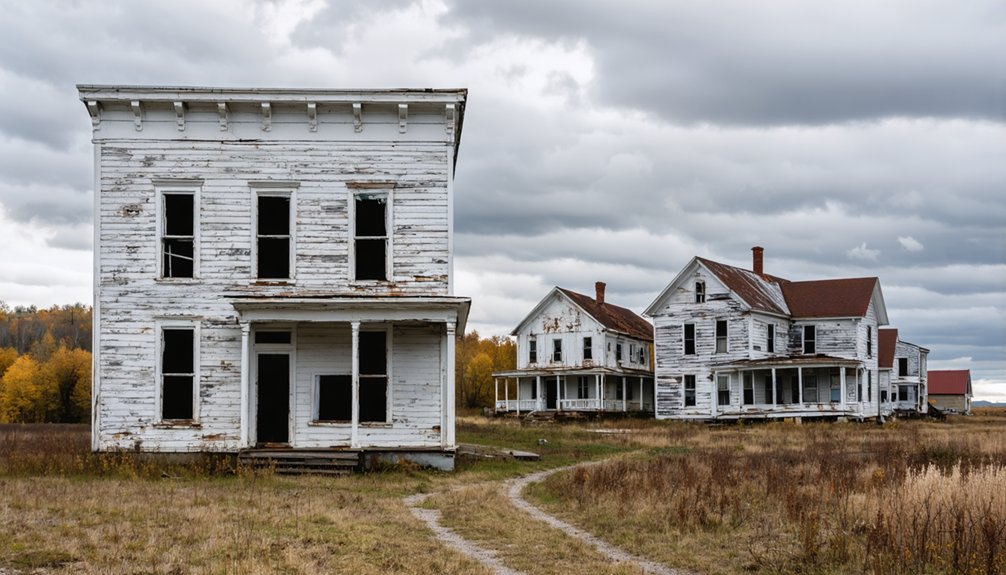
While traditional preservation efforts often focus solely on architectural remains, Eckley Miners’ Village represents a more dynamic approach to heritage conservation as a living museum that breathes life into America’s colonial industrial past.
You’ll discover an authentic mining heritage where approximately 20 residents—many descended from original miners—maintain community continuity amid Victorian-era architecture. This immersive experience offers cultural preservation through annual Civil War reenactments and historical events that animate the former “patch town.”
Unlike static museums, Eckley balances architectural authenticity with living history, requiring residents to conceal modern elements behind period-appropriate structures.
The town’s mining legacy was saved when Paramount Pictures filmed “The Molly Maguires” here in 1970, transforming what could have been demolished into a model for interpreting immigrant labor histories in America’s industrial landscapes.
Mapping the Geographic Distribution of Colonial Ghost Towns
You’ll notice distinct patterns when examining the geographic distribution of colonial ghost towns across America’s eastern seaboard, with notable concentrations forming along historical migration routes.
Colonial abandonment exhibits different characteristics between coastal settlements, which often evolved into modern cities, and inland communities that frequently succumbed to isolation or resource depletion.
These geographic patterns reveal valuable insights about colonial development trajectories, settlement sustainability factors, and the demographic shifts that shaped early American population distribution.
Regional Settlement Patterns Revealed
Across the American landscape, the geographic distribution of colonial ghost towns reveals distinctive regional settlement patterns that illuminate our nation’s developmental history.
You’ll find the densest concentration in Texas, with approximately 550 abandoned settlements reflecting significant regional economic shifts from frontier development to resource depletion.
The Northeast’s ghost towns tell stories of early industrial decline, while Midwestern abandoned communities demonstrate agricultural settlement legacy analysis, particularly following the Dust Bowl’s environmental devastation.
Western states mainly showcase mining boom-and-bust cycles, with many towns overlaying earlier colonial outposts.
This distribution isn’t random—it’s testimony to America’s development through resource extraction, transportation evolution, and economic centralization.
The abandoned settlements create a physical record of how your ancestors responded to changing fortunes and strategic priorities across centuries of national expansion.
Colonial Migration Through Ruins
Mapping the geographic distribution of colonial ghost towns reveals striking settlement patterns that document America’s migratory history through physical remnants rather than mere historical records.
As you explore these historical sites, you’ll notice the colonial migration pathways etched across Texas (550 towns), California (346), and Kansas (308).
The historical significance of these abandoned settlements becomes evident when examining county-level concentrations.
Wilson County, Texas and Kern County, California (113 sites) showcase how resource economies shaped colonial development.
While mining operations drove western settlement, the agricultural collapse during the Dust Bowl devastated Great Plains communities.
These ruins tell a complex story of American expansion between 1880-1940, from Texas’ oil boom following the Spindletop discovery to California’s railroad-driven development—tangible evidence of our nation’s economic and migratory evolution.
Coastal vs. Inland Abandonment
The geographic distribution of colonial ghost towns reveals distinct abandonment patterns between coastal and inland settlements, each shaped by unique environmental, economic, and historical forces.
You’ll find coastal dynamics exemplified in locations like Fort Jefferson in Florida, where hurricane damage—not economic factors—prompted abandonment in 1906. Similarly, Vanport, Oregon’s erasure displaced 18,000 residents, while Kennett, California now lies underwater.
Inland decline follows different trajectories. Mining operations drove ghost town creation throughout Colorado and California between 1880-1940. The Dust Bowl decimated Great Plains farming communities, while industrial contamination claimed Centralia, Pennsylvania and Times Beach, Missouri.
Texas leads with 550 documented ghost towns, while eastern seaboard states typically contain fewer than 240 each—reflecting regional economic histories and resource accessibility patterns.
Hidden Architectural Treasures in America’s Abandoned Settlements
While exploring America’s colonial past, you’ll discover that many abandoned settlements contain remarkable architectural treasures that have survived centuries of neglect and environmental challenges.
As you delve deeper into this fascinating history, consider visiting some of the historic colonial sites in Virginia, where the essence of early American life is beautifully preserved. These locations provide a unique window into the past, allowing you to walk through pathways once tread by prominent figures in history. Engaging with the rich stories of these sites can deepen your understanding of the cultural and architectural influences that shaped the nation.
At St. Mary’s City, Maryland, archaeological excavations reveal foundations of Maryland’s first colonial capital, while Marblehead showcases over 200 colonial-era homes along winding streets that maintain authentic colonial atmosphere.
The architectural preservation in Historic Deerfield presents meticulously restored 18th-century homes housing world-class decorative arts collections.
Newport demonstrates remarkable historical significance with 300+ colonial houses, many saved by the Newport Preservation Foundation‘s intervention.
Even Popham Colony, though occupied briefly in 1607, yields archaeological evidence of Fort St. George’s original layout.
These sites represent America’s determination to preserve architectural heritage that might otherwise vanish—windows into colonial life’s physical manifestations despite centuries of abandonment.
Frequently Asked Questions
What Safety Precautions Should Visitors Take When Exploring Ghost Towns?
Wear safety gear, maintain wildlife awareness, research sites thoroughly, inform others of your itinerary, follow designated paths, respect posted warnings, carry first-aid supplies, and never remove artifacts from these historically significant locations.
Are There Overnight Accommodation Options Within Colonial Ghost Towns?
You’ll find historic lodging in Colonial Williamsburg’s 18th-century houses, while authentic ghost town inns exist in Gold Point and St. Elmo, offering immersive experiences that balance historical authenticity with essential modern comforts.
How Do Ghost Towns Handle Preservation During Extreme Weather Seasons?
Ghost towns employ arrested decay preservation techniques, protecting structures against weather impacts through seasonal monitoring, drainage improvements, and foundation stabilization. You’ll notice historically appropriate materials maintaining authenticity while preventing environmental deterioration.
Which Ghost Towns Are Accessible for Visitors With Mobility Challenges?
Virginia City offers the most accessible routes for mobility-challenged visitors, with paved streets and accessible lodging options. Bodie and Bannack provide limited visitor amenities including accessible restrooms and designated parking areas.
What Archaeological Artifacts Have Been Discovered in These Settlements Recently?
In Sunrise, Wyoming, you’ll find 16,000-year-old projectile points among 200 recent discoveries. Roanoke’s excavations revealed Elizabethan artifacts while Monson Center preserves colonial foundations with significant archaeological value for those exploring America’s forgotten past.
References
- https://devblog.batchgeo.com/ghost-towns/
- https://nicenews.com/culture/ghost-towns-across-america/
- https://whakestudios.com/us-ghost-towns/
- https://albiongould.com/ghost-towns-to-visit-in-the-states/
- https://www.geotab.com/ghost-towns/
- https://savingplaces.org/guides/ghost-towns-on-route-66
- https://en.wikipedia.org/wiki/Lists_of_ghost_towns_in_the_United_States
- https://www.atlasobscura.com/lists/americas-best-preserved-ghost-towns
- https://www.legendsofamerica.com/we-mininghistory/
- https://www.identecsolutions.com/news/mining-in-us-70-centuries-of-history