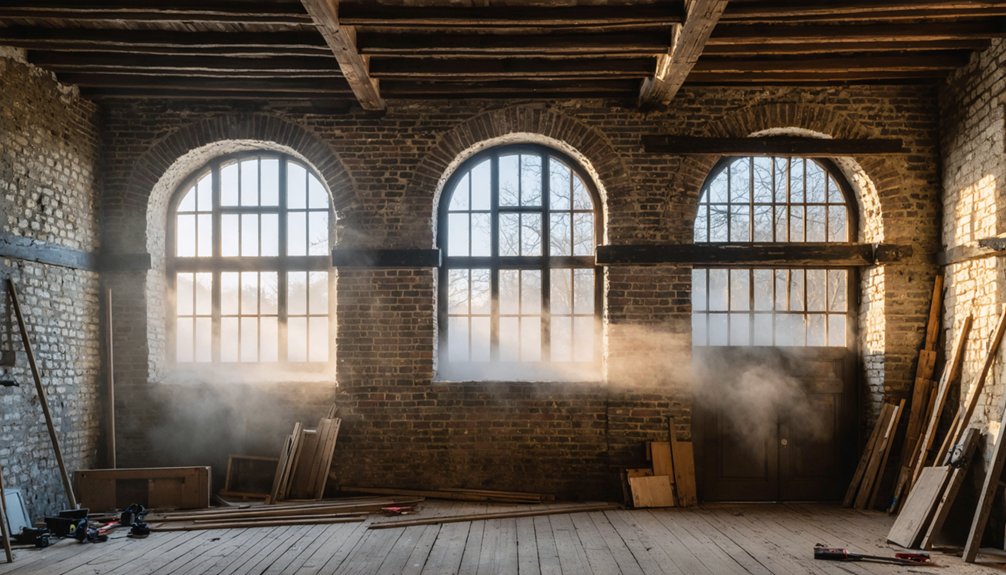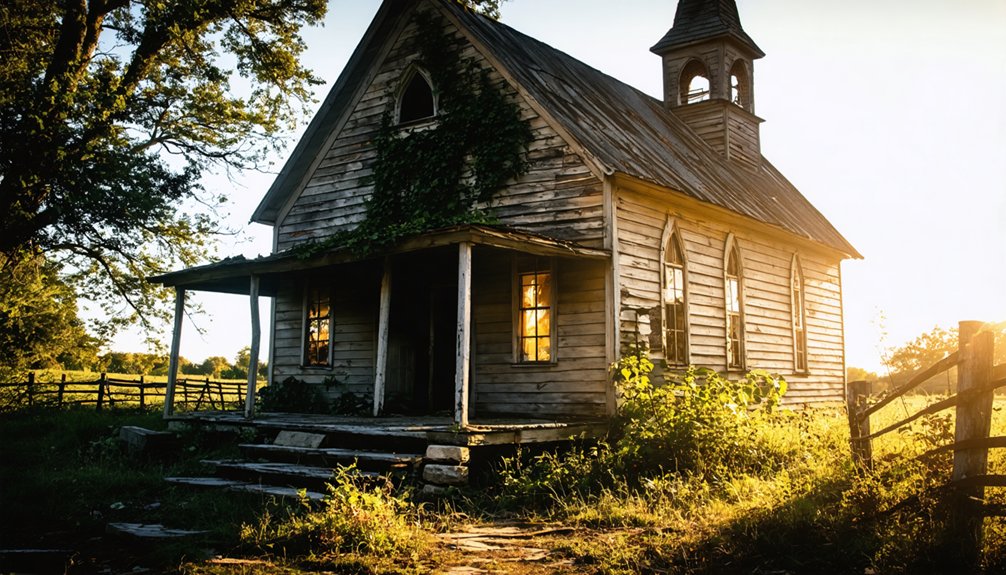
To explore colonial ruins properly, you’ll need sturdy boots, protective clothing, and safety equipment including gloves and a respirator. Research sites through historical records, obtain necessary permits, and understand architectural styles to appreciate their significance. Assess structural integrity before entering any site and photograph during golden hour for ideal lighting. Always respect site preservation laws and monitor weather conditions for the safest exploration experience. These fundamentals will set the foundation for your historical adventures.
Key Takeaways
- Wear protective gear including sturdy boots, cut-resistant gloves, and safety glasses to prevent injuries during exploration.
- Research sites using archival materials, archaeological reports, and local knowledge while securing necessary legal permits.
- Assess structural integrity by identifying architectural styles and watching for hazards like unstable floors or potential roof collapse.
- Capture site details with wide-angle to close-up photography during golden hour for enhanced textures and architectural features.
- Plan visits during winter months for stable weather conditions, and explore during early mornings or late afternoons for comfort.
Essential Equipment for Colonial Ruin Exploration
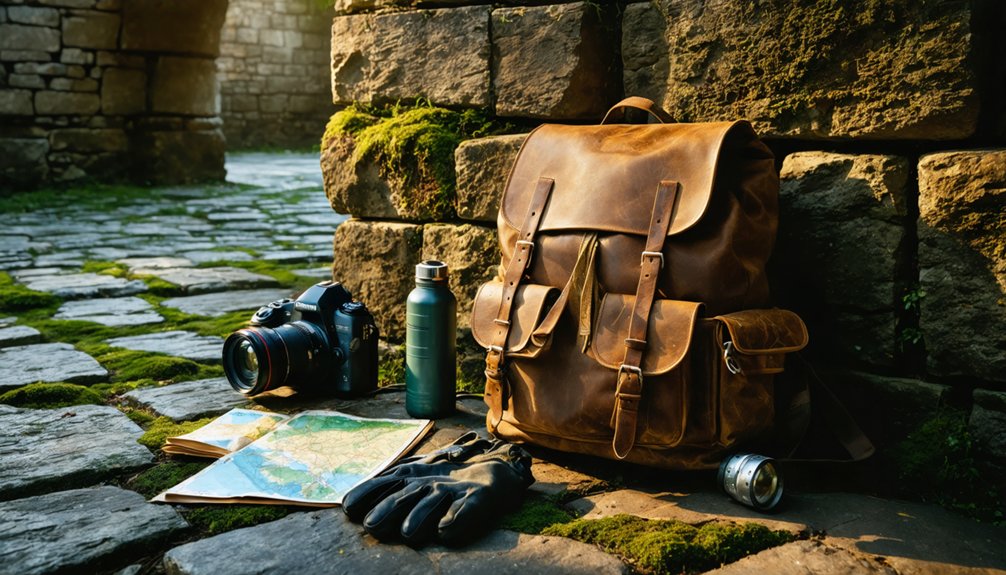
Preparedness forms the cornerstone of safe and productive colonial ruin exploration. Your gear recommendations should prioritize protection: sturdy boots with ankle support, cut-resistant gloves, safety glasses, and appropriate respiratory protection against potential colonial-era contaminants.
Proper gear—from reinforced footwear to respiratory protection—transforms a dangerous colonial expedition into a calculated adventure.
Essential tools include multiple lighting sources—both handheld flashlights and head torches—with backup batteries to navigate shadowy corridors and unlit chambers. Navigation equipment like offline maps, compasses, and fully-charged communication devices guarantee you’ll maintain orientation within complex structures. Consider downloading offline maps in advance for areas with poor signal coverage.
Always carry a compact first aid kit with emergency supplies, plus a durable, waterproof backpack to organize your equipment. A high-quality 3M respirator is recommended for protection when exploring areas with mold, asbestos, or other airborne hazards common in colonial structures. A multi-tool proves invaluable for minor obstacles, while carabiners secure small items during challenging traverses.
Document your discoveries with a camera while staying energized with water and high-energy snacks.
Researching Historical Sites Before Your Visit
Before commencing any exploration of colonial ruins, thorough research serves as the intellectual foundation for a meaningful and contextually rich experience.
Begin by examining archival materials—colonial records, maps, and photographs—which provide concrete evidence of a site’s significance. Cross-reference these primary documents with archaeological reports that reveal physical evidence through artifacts and structural remains.
Employ ethnohistorical methods to bridge documented history with Indigenous perspectives, acknowledging that colonial archives often present incomplete narratives. The direct historical approach can help you work backward from known ethnographic data to understand the cultural context of ruins you’ll visit. This methodology was particularly influential in Pueblo Southwest studies, where connections between past and present cultures offered valuable insights.
Critical evaluation of secondary sources will guide your interpretation beyond physical structures to recognize the archival significance of sites as “colonial debris”—fragments reflecting complex historical disruptions and enduring impacts. For specialized assistance with historical research methods, consider consulting Doris Wagner at the University of Alberta, who provides expert guidance for historical investigations.
Understanding Architectural Styles of Colonial Structures
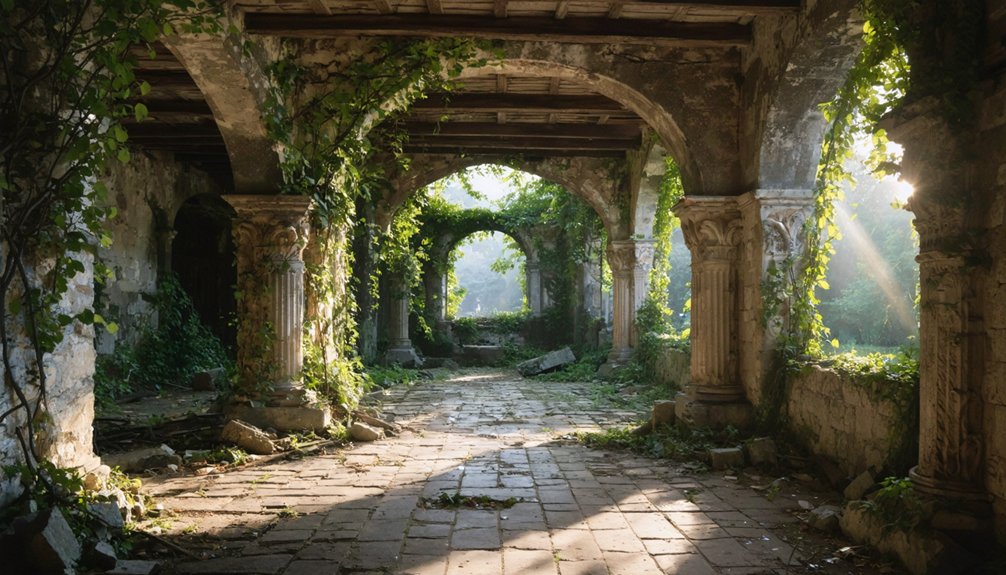
When observing colonial ruins, the ability to identify architectural styles serves as an essential interpretive tool that connects physical structures to their historical context. Look for symmetrical facades, steeply pitched roofs, and central entrances—hallmarks of various colonial styles that emerged as European designs adapted to local materials and climates.
You’ll distinguish regional variations by examining specific architectural details: New England structures typically feature wood clapboard and central chimneys, while Southern colonials showcase perimeter chimneys and elaborate entrances. Authentic colonial roof designs maintain a slope between 7:12 and 10:12 pitch.
Dutch Colonial Revival buildings are identifiable by their distinctive gambrel roofs. Notice classical elements like columns, pediments, and decorative millwork that reflect the settlers’ cultural priorities. The Colonial Revival style gained significant popular momentum during the Philadelphia Centennial of 1876, marking a renewed interest in America’s architectural heritage.
Multi-paned windows, often with shutters, and the predominant building materials—whether brick, stone, or wood—offer further clues to a structure’s origin and evolution.
Safety Precautions for Exploring Abandoned Buildings
You’ll need proper protective gear including sturdy boots, gloves, dust masks, and headlamps to shield yourself from sharp objects, airborne particles, and navigate dark corners of colonial ruins.
Before entering any abandoned structure, conduct a thorough assessment of potential structural weaknesses, particularly focusing on water-damaged floors, unstable ceilings, and compromised staircases.
Test suspicious surfaces with a walking stick before applying your full weight, and maintain constant vigilance for signs of imminent collapse such as sagging ceilings, cracked support beams, or floors that feel spongy underfoot. Always explore with a companion rather than venturing alone to ensure someone can seek help if accidents occur. Inform a trusted person about your exploration plans including location details and expected return time in case of emergencies.
Proper Protective Gear
Entering abandoned colonial structures without proper protective equipment puts explorers at significant risk of injury or illness.
While safety regulations may seem restrictive, proper protective gear enables rather than hinders authentic exploration experiences.
Your essential kit should include sturdy boots with thick soles to protect against nails and broken glass, along with water-resistant properties for damp environments.
Wear long pants and sleeves to shield skin from cuts and toxin exposure. Quality gloves are non-negotiable when touching potentially contaminated surfaces.
Respiratory protection is vital—use N95 masks for basic exploration or upgrade to half-face respirators with P100 filters when asbestos or lead paint might be present. Carrying a quality multi-tool will allow you to cut through obstacles, perform emergency repairs, or assist with first aid if needed.
Don’t overlook eye protection; safety goggles prevent debris injuries and complement your respiratory gear for thorough protection. A headlamp provides hands-free illumination that is essential when navigating dark corridors and stairwells.
Structural Stability Assessment
Proper protective gear alone can’t safeguard explorers in structurally compromised colonial buildings. Before entry, conduct a systematic structural integrity evaluation by performing a thorough exterior inspection.
Look for critical warning signs: diagonal cracks wider than 1/16 inch, wall offsets exceeding 1/8 inch, and deteriorated mortar joints.
Assess load bearing analysis through non-destructive testing methods when possible. Use a rebound hammer to estimate concrete strength or employ ultrasonic pulse velocity testing to detect hidden flaws.
Document any evidence of unauthorized modifications or element removal that might compromise stability.
Monitor for environmental damage indicators—water intrusion, vegetation growth, or foundation settlement—which often predict imminent failure.
Identify hazards like unstable floors, roof collapse potential, or unsecured openings before proceeding through the structure.
Never enter if you observe significant leaning or hear unusual creaking sounds.
Photography Tips for Documenting Historic Ruins
When photographing colonial ruins, you’ll need quality equipment including a DSLR camera with wide-angle and 50mm lenses to capture authentic architectural details at 300 ppi resolution.
Position yourself with the sun at your back to create ideal lighting conditions that reveal textures through deliberate shadow management, highlighting structural features without obscuring important elements.
Document the passage of time by systematically progressing from establishing wide shots to detailed close-ups of weathering patterns, construction materials, and architectural modifications that tell the complete story of the site’s transformation through history.
Equipment for Authenticity
The careful selection of photographic equipment stands as the foundation for authentic documentation of colonial ruins. Opt for DSLR or mirrorless cameras with manual controls that capture fine historical details with precision, ensuring historical accuracy in your documentation.
Pair your camera with wide-angle lenses for extensive site views and macro lenses for textural details and inscriptions. Support equipment proves equally essential. A sturdy tripod with leveling tools maintains perspective integrity, while remote releases eliminate camera shake during longer exposures.
Modern equipment innovations like GPS-enabled cameras allow for precise geotagging, enhancing the spatial context of your images. Always maintain a thorough photo log recording metadata, camera settings, and contextual notes.
This methodical approach creates a valuable archive that adheres to scholarly standards while preserving freedom in your documentation style.
Light and Shadows
Light manipulation stands at the heart of successful colonial ruins photography, transforming ordinary documentation into evocative historical records.
Understanding light dynamics helps you capture the authentic essence of these historical structures while enhancing their architectural details through deliberate shadow play.
- Shoot during golden hour when low sun angles create natural shadows that accentuate stonework textures and historical details.
- Use graduated ND filters to control overexposed skies, positioning the grey end over bright areas while preserving foreground detail.
- Apply light painting techniques during 15-30 second exposures to eliminate harsh shadows using portable equipment like Lowel GL1 or Yonguo Speedlight.
- Capitalize on twilight periods when ambient exterior light balances with interior illumination, capturing bracketed exposures at 0 EV, -2 EV, and +2 EV.
Capturing Time’s Passage
Documenting colonial ruins effectively requires meticulous preparation and technical skill to capture the layered narratives embedded in weathered stones and crumbling facades.
When photographing these historical sites, incorporate time lapse techniques to illustrate gradual changes in light throughout the day, revealing different architectural details as shadows shift across ancient surfaces.
Focus on contrasting preserved and deteriorated sections within a single frame to convey historical narratives visually. Document inscriptions and carvings with close-up shots including scale references for context.
Shoot in RAW format to preserve maximum data for post-processing, essential for archival documentation.
Remember to photograph both intact structures and evidence of decay, creating a thorough visual record that serves preservation efforts while respecting site regulations.
These images become valuable testimonies to time’s passage and our architectural heritage.
Reading the Landscape for Hidden Settlement Clues
When examining colonial landscapes, experienced archaeologists understand that every contour, soil variation, and vegetation pattern potentially conceals valuable settlement information.
To experienced archaeological eyes, colonial landscapes reveal their secrets through every subtle terrain shift and plant variation.
You’ll need to identify key indicators that reveal past land use and settlement patterns. Colonial communities strategically positioned themselves near waterways for trade while adapting to local environmental conditions.
- Analyze topographical features for evidence of modified land – terracing, drainage systems, and field boundaries indicate deliberate alterations.
- Examine soil composition through sampling – different soil layers reveal agricultural practices and construction activities.
- Study vegetation patterns – certain plants mark former garden locations or disturbed soil from building foundations.
- Look for linear features in the landscape – remnants of roads, fence lines, or property boundaries often persist subtly for centuries.
Legal Considerations and Permissions for Site Access
Before undertaking any exploration of colonial ruins, you must navigate a complex framework of federal, state, and tribal regulations designed to protect archaeological resources.
The Antiquities Act and Archaeological Resources Protection Act (ARPA) prohibit unauthorized excavation on federal lands, with violations carrying serious penalties including fines and imprisonment.
You’ll need to secure legal permits through qualified institutions like universities or museums when accessing sites on public or tribal lands.
The process requires coordination with federal land managers, SHPOs, and tribal authorities under Section 106 of the National Historic Preservation Act.
Archaeological ethics demand respecting site integrity and confidentiality of sensitive locations.
Remember that state-specific regulations, like Wyoming’s protection of prehistoric relics, create additional requirements you must satisfy before your exploration can legally proceed.
Preserving and Respecting Colonial Archaeological Sites
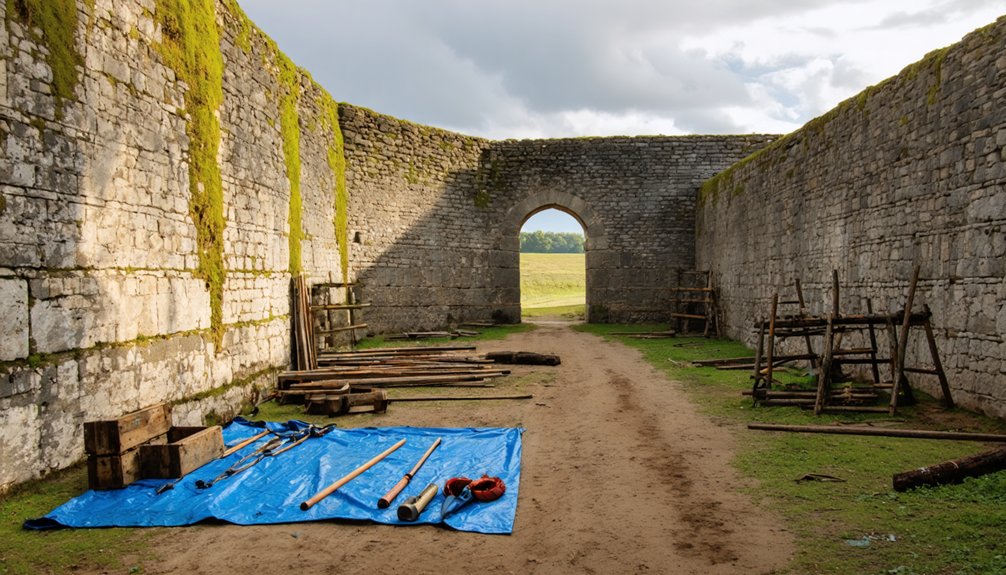
Preservation of colonial archaeological sites requires a sophisticated approach that balances physical stabilization with cultural respect.
Modern conservation techniques employ structural bracing, controlled reburial, and microclimate management to protect fragile ruins from environmental degradation.
When exploring these historic treasures, you’ll maximize both your experience and the site’s longevity by practicing responsible stewardship.
- Adhere strictly to established pathways and barriers, preventing soil compaction that destabilizes foundations
- Photograph rather than touch fragile surfaces, as oils from fingertips accelerate deterioration
- Report any observed damage or looting to site authorities immediately
- Engage with local community perspectives, recognizing that colonial sites often carry complex historical significance
Your conscientious exploration contributes to sustainable archaeological conservation while respecting indigenous stakeholders whose heritage these sites may represent.
Best Seasons and Weather Conditions for Ruin Exploration
Selecting the ideal time to explore colonial ruins requires careful consideration of seasonal variations that greatly impact both comfort and preservation concerns.
Winter months (December-February) offer prime conditions with temperatures in the low 80s°F and minimal rainfall, providing stable environments for best visiting experiences and extended daylight hours for photography.
Spring delivers balanced weather with decreasing precipitation, while summer brings predictable afternoon showers that quickly clear.
Fall, particularly September, presents higher rainfall risks and potential tropical storms affecting accessibility.
Consider regional variations—coastal ruins benefit from ocean breezes, while inland sites experience greater temperature fluctuations.
Seasonal trends indicate early mornings and late afternoons enhance exploration with cooler temperatures and softer lighting.
For safety and comfort, monitor UV indexes year-round and maintain proper hydration regardless of when you visit.
Frequently Asked Questions
How Can I Identify Colonial Food Storage Areas in Ruins?
Look for cellars, storage pits, and buried jars that indicate food preservation practices. You’ll identify colonial storage areas by examining architectural features like stone-lined vaults and cellar floors with round depressions.
What Colonial Preservation Tools Might I Find at Abandoned Sites?
You’ll rarely find modern historic artifacts at abandoned sites. Instead, look for remnants of traditional preservation techniques: lime mortar buckets, wooden braces, drainage systems, and early documentation tools used by previous conservationists.
Exploring ghost towns across the United States can reveal a wealth of history and insight into the challenges faced by earlier communities. As you wander through these deserted landscapes, you may uncover stories of resilience and adaptation that shaped their development. Each site serves as a testament to the passage of time and the evolving relationship between people and their environments.
Can Fermentation Vessels Be Distinguished From Other Pottery Remains?
Yes, you’ll recognize fermentation vessels by their distinctive shapes, surface modifications, and residue biomarkers. Pottery analysis reveals characteristic features like narrow necks, pressure-resistant walls, and temper inclusions specific to fermentation techniques.
How Did Colonial Smokehouse Structures Differ From Other Outbuildings?
You’ll recognize colonial smokehouses by their square design with pyramidal roofs, windowless construction, close-studded framing, central fireboxes, and meat-hanging rafters—all specifically engineered for preservation methods unlike other functional outbuildings.
What Root Cellar Remnants Indicate Preservation Techniques Used at the Site?
You’ll identify preservation techniques through subfloor pits maintaining 35-40°F temperatures, storage vessel remnants, metal hanging hooks, and hillside root cellar construction that utilized natural earth burial techniques for temperature regulation.
References
- https://pocahontastimes.com/colonial-style-food-preservation/
- https://www.discoverconcordma.com/articles/410-preserving-food-for-a-colonial-winter
- https://www.archaeological.org/pdfs/sitepreservation/N_S-P_Article_Dec_2009.pdf
- https://www.washingtoncrossingpark.org/preserving-harvest/
- https://www.musee-mccord-stewart.ca/en/blog/pickling-preserving/
- https://ucanr.edu/program/uc-master-food-preserver-program/article/preserving-revolution-food-traditions-fed-new
- https://www.madgetech.com/posts/blogs/7-ancient-methods-of-food-preservation/
- https://nchfp.uga.edu/resources/entry/historical-origins-of-food-preservation
- https://urbexhub.com/urbex-essentials-equipment-you-need-for-urban-exploration/
- https://www.youtube.com/watch?v=NFJZxhJfIQU