You’ll find remarkable Native American settlements across the US, from Crystal River’s 1,600-year ceremonial center to Cahokia’s urban metropolis of 20,000 residents. Explore the geometric precision of Hopewell earthworks in Ohio, Spiro Mounds’ extensive trade networks in Oklahoma, and Ancestral Puebloan cliff dwellings in the Southwest. These sites showcase sophisticated architectural, astronomical, and social achievements of Indigenous civilizations. The landscapes reveal stories that challenge conventional historical narratives.
Key Takeaways
- Cahokia in Illinois was America’s first city, housing 10,000-20,000 residents with sophisticated urban planning and massive earthworks.
- Hopewell Culture Earthworks feature precise geometric shapes aligned with solar and lunar cycles, demonstrating advanced astronomical knowledge.
- Cliff dwellings built by Ancestral Puebloans between 500-1300 CE showcase ingenious multi-story stone architecture with defensive advantages.
- Crystal River archaeological site (500 BC-1000 AD) features six distinctive mounds and evidence of extensive trade networks across North America.
- Climate change threatens these historic sites through rising sea levels and erosion, requiring innovative preservation strategies and Indigenous knowledge integration.
The Ceremonial Center at Crystal River: A 1,600-Year Legacy

Nestled along the Gulf Coast of Florida, the Crystal River archaeological site stands as one of the most remarkable pre-Columbian settlements in North America, with an occupation spanning approximately 1,600 years from 500 BC to 1000 AD.
This enduring ceremonial center features six distinctive mounds—including burial and platform varieties—arranged around a substantial shell midden.
You’ll find evidence of complex burial customs that evolved through multiple cultural periods including Deptford and Weeden Island.
As part of the Hopewellian Interaction Sphere, inhabitants established far-reaching trade networks extending to the Midwest.
The ceremonial practices conducted here attracted thousands of visitors annually, with oral traditions suggesting the mounds served as sacred connections to the afterlife.
The site’s plaza area could accommodate 7,000 to 10,000 people for various social events, religious ceremonies, and trading activities.
Today, visitors can climb to the top of the largest mound for a scenic view of this National Historic Landmark.
Spiro Mounds: Trading Hub of the Ancient Southeast
Located seven miles outside present-day Spiro, Oklahoma, the Spiro Mounds archaeological site stands as one of North America’s most significant Mississippian trading centers, spanning 150 acres and featuring 12 distinctive mounds.
One can only imagine the stories hidden within the layers of earth at abandoned military sites across America, remnants of a past that shaped the nation. These locations often offer a unique glimpse into historical events, providing insight into military strategies and community impacts. Exploring such sites can deepen our understanding of the country’s evolution and the complex narratives tied to them.
Occupied from around 800 CE until 1450 CE, this remarkable complex operated as a pilgrimage destination rather than a residential center.
During its six-century lifespan, Spiro Mounds served as a sacred pilgrimage site rather than a population hub.
You’ll find evidence of extensive trade routes connecting the Atlantic to the Pacific and the Midwest to central Mexico.
Artifacts reveal sophisticated cultural exchange networks—green obsidian from Pachuca, copper from the Great Lakes, and conch shells from the Gulf Coast.
Unlike other ceremonial centers, Spiro wasn’t palisaded, yet its elites controlled regional commerce for centuries.
Craig Mound alone contained 90% of all known engraved shell and ritual artifacts from Mississippian sites, demonstrating Spiro’s unparalleled importance in pre-Columbian America.
The site was devastated in 1936 when the Pocola Mining Company dynamited parts of Craig Mound, destroying countless irreplaceable artifacts.
The 2011 Smithsonian publication documents over 20,000 artifacts recovered from the Craig Mound, many of which are now housed at the Sam Noble Oklahoma Museum of Natural History.
Cahokia: The Forgotten Metropolis of Pre-Columbian America
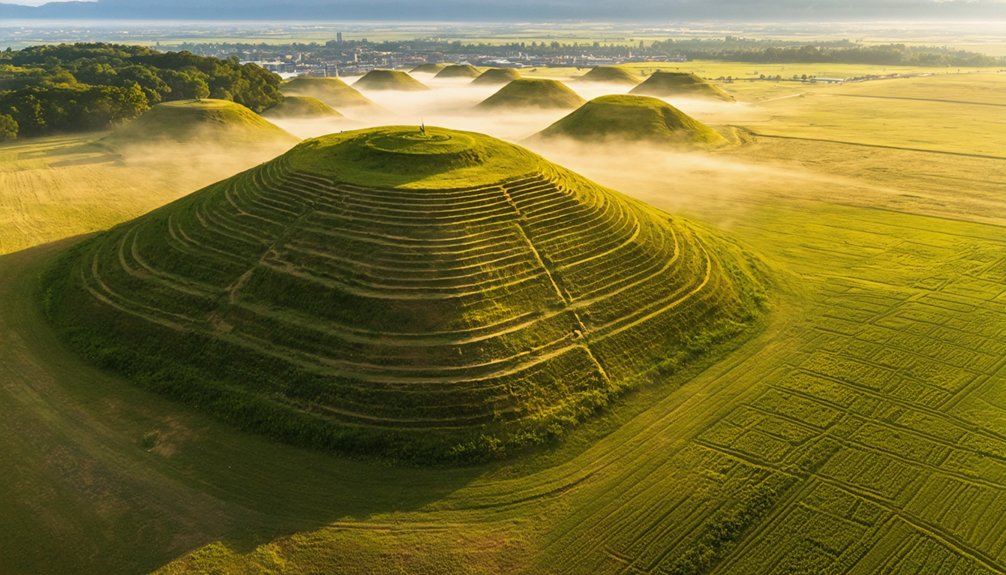
Rising dramatically from the Mississippi River floodplain in present-day Collinsville, Illinois, Cahokia stands as North America’s most impressive pre-Columbian urban center.
This forgotten metropolis once housed 10,000-20,000 residents, rivaling London’s population during the 11th-12th centuries. Cahokia’s population dynamics reveal a sophisticated society with distinct social classes evidenced by elite burial sites and ceremonial structures atop massive earthen mounds. The city was constructed with an ordered grid system oriented precisely to cardinal directions, demonstrating advanced urban planning capabilities.
- The 100-foot-tall Monks Mound, covering 15 acres, served as the epicenter of political and spiritual power.
- Agricultural surpluses from fertile floodplains enabled residents to build an urban center spanning five square miles.
- Cahokia’s trade networks connected cultures across the Eastern United States via river systems, exchanging goods and ideas.
You’ll find evidence of astronomical alignments throughout the city’s layout, suggesting inhabitants maintained deep connections with celestial movements that guided their cultural practices. The site’s gradual abandonment around 1350 CE has been linked to environmental degradation that made sustaining such a large population increasingly difficult.
Geometric Wonders: The Hopewell Culture Earthworks
You’ll discover remarkable precision in Hopewell Culture Earthworks, where perfect circles, squares, and octagons were constructed with extraordinary mathematical accuracy despite their builders having no written language or modern surveying tools.
These monumental ceremonial structures align with solar and lunar cycles, demonstrating sophisticated astronomical knowledge that guided their spiritual and ritual practices.
The earthworks weren’t isolated monuments but formed an interconnected ceremonial landscape spanning across present-day Ohio, creating a complex network where distant communities gathered for important social, religious, and trade activities. Eight significant archaeological sites are currently nominated for UNESCO World Heritage status, highlighting their exceptional cultural value. These sites maintained their cultural importance for approximately 400 years as ceremonial centers with significant archaeological findings.
Ceremonial Architecture Precision
Among the most remarkable features of Hopewell Culture earthworks is the extraordinary geometric precision achieved by their builders, who constructed massive squares, circles, and octagons with astonishing mathematical accuracy across wide geographic regions.
These non-hierarchical societies built earthen walls 4-8 feet tall that defined ceremonial significance through architectural precision, incorporating sophisticated astronomical alignments with lunar and solar cycles. These impressive structures were constructed by egalitarian societies that based their economy on foraging, fishing, and small-scale farming. Recently recognized as the largest geometric earthen complex known worldwide, these sites demonstrate unprecedented cultural achievements without urban development or complex social hierarchies.
- You’ll stand where ancient peoples gathered in freedom, on ground that has remained structurally intact for over 2,000 years
- You’re witnessing the culmination of generations of knowledge, encoded in walls that track the 18.6-year lunar cycle
- You’re experiencing sacred spaces designed by societies who valued connection without centralized authority
The monumental structures represent a sophisticated understanding of mathematics, astronomy, and landscape architecture unparalleled in North America during this period.
Complex Network Formation
While stretching across the ancient landscapes of Ohio, the Hopewell culture earthworks formed an intricate network of geometric marvels that reveal sophisticated engineering principles maintained over centuries.
You’ll find remarkable consistency across complexes like Seip, Baum, and Liberty, each featuring identical 1,080-foot squares and perfectly aligned circles that demonstrate standardized measurement systems.
These structures weren’t built in isolation but functioned as interconnected ceremonial centers, creating network dynamics that facilitated pilgrimages and cultural exchanges across vast distances.
The precision of their astronomical alignments—like Newark’s Octagon tracking the 18.6-year lunar cycle—enabled synchronized gatherings timed with celestial events.
This coordination of massive construction projects, requiring millions of basket-loads of earth, reflects sophisticated social organization where ceremonial significance transcended mere architecture, binding communities through shared cosmic understanding.
Cliff Dwellings and Desert Settlements of the Southwest
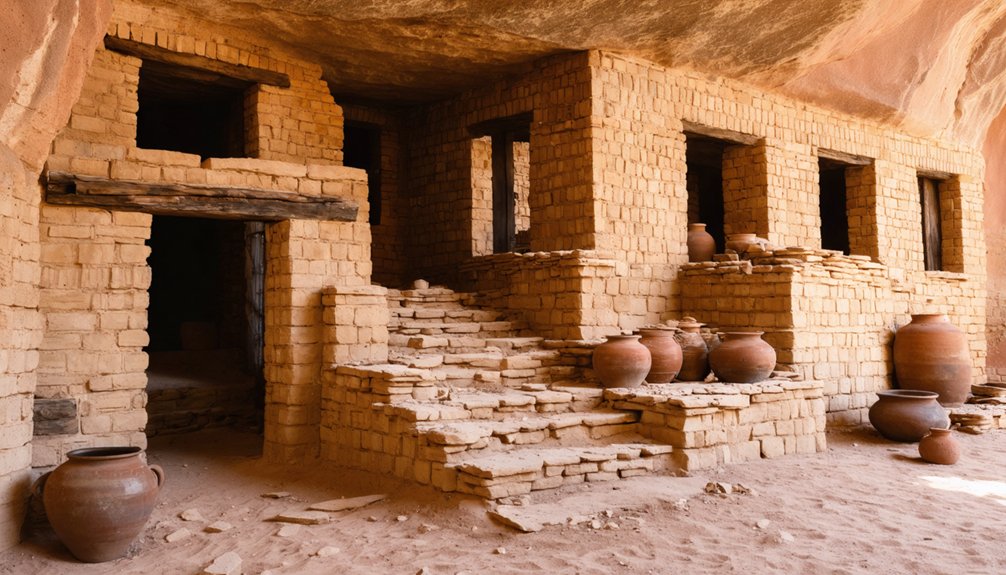
The ancient cliff dwellings of the American Southwest stand as remarkable symbols of Native American architectural ingenuity and adaptation to harsh desert environments. When you visit these settlements, you’ll witness the sophisticated cliff architecture developed by the Ancestral Puebloans between 500-1300 CE.
These multi-story stone structures were strategically built into cliff alcoves, providing natural defensive advantages during a time of increasing conflict and resource competition.
- Standing in a kiva, you’ll feel the spiritual heartbeat that unified these complex communities.
- Tracing your fingers along hand-cut stone walls reveals generations of human determination against environmental hardship.
- Climbing through doorways that haven’t welcomed daily life for 700 years connects you with those who sought freedom in these vertical sanctuaries.
Tracing the Earliest Americans: Paleo-Indian Archaeological Evidence
Countless clues scattered across North America tell the story of the first humans who arrived on this continent as early as 25,000 years ago. Recent discoveries at sites like Buttermilk Creek and Meadowcroft Rockshelter have pushed back timelines of Paleo-Indian migration to at least 19,400 BP, challenging previous assumptions.
You’ll find evidence of distinctive Clovis technology at remarkable sites like Bull Brook in Massachusetts—spanning the size of four football fields with over 6,000 artifacts arranged in a circular pattern. The lanceolate projectile points with characteristic fluting represent sophisticated hunting strategies.
Sites like Shoop in Pennsylvania reveal how these early Americans traveled extensively, using stone sourced 250 miles away and positioning settlements along game migration routes. These strategic placement patterns demonstrate how early inhabitants maximized their survival through calculated resource management.
Preservation Challenges and Future Research Directions
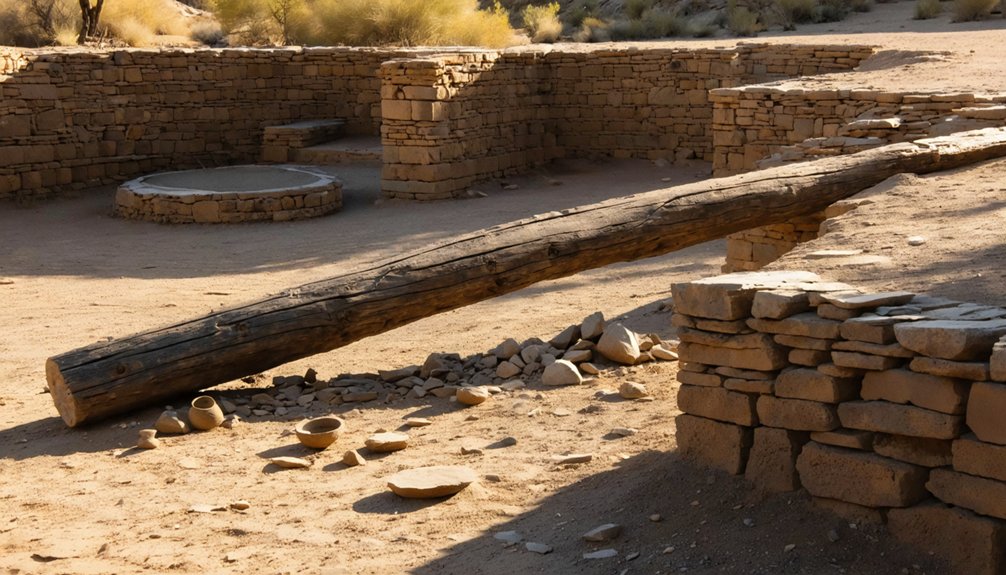
You’ll find that climate change presents escalating threats to Native American archaeological sites through rising sea levels, increased erosion, and extreme weather events that require targeted preservation strategies.
Integrating Indigenous Traditional Ecological Knowledge with modern conservation techniques offers promising approaches for developing culturally appropriate preservation methods that honor ancestral connections to these sites.
These collaborative efforts represent a vital evolution in archaeological practice, acknowledging both the scientific value of these sites and their ongoing spiritual and cultural significance to descendant communities.
Climate Threats Mitigation
As climate change accelerates across North America, Native American settlement remnants face unprecedented preservation challenges that require innovative mitigation strategies and coordinated research efforts.
You’ll find archaeological site protection increasingly relies on both traditional knowledge and cutting-edge climate adaptation strategies, including the planting of salt-tolerant vegetation to buffer coastal sites against erosion and the use of remote sensing technologies to monitor vulnerable locations before irreversible damage occurs.
- The ancient walls that have withstood centuries now crumble under unprecedented storms, taking with them irreplaceable cultural knowledge.
- Sacred coastal sites silently disappearing beneath rising waters, erasing tangible connections to ancestral traditions.
- Artifacts emerging from melting ice patches offer fleeting glimpses into the past before deteriorating, creating a bittersweet race against time.
Indigenous Knowledge Integration
Indigenous knowledge integration represents one of the most critical yet challenging aspects of preserving Native American settlement remnants throughout the United States.
You’ll find federal agencies historically failed to recognize indigenous perspectives that don’t separate “natural” from “cultural” resources, creating procedural labyrinths that hinder sacred site protection.
The Traditional Cultural Landscape approach offers a solution by integrating environmental science with traditional knowledge, correcting the over-emphasis on archaeological materials that obscures cultural context.
You’re witnessing a shift toward cultural integration as evidenced by the 2023 White House Tribal Nations Summit, which identified consultation, co-stewardship, and accountability as essential priorities.
Despite progress, urbanization continues encroaching on sacred places, while physical and legal barriers restrict Indigenous community access to sites central to their spiritual traditions.
Frequently Asked Questions
How Did Native Americans Construct Mounds Without Modern Tools?
Dirt piled high, hands worked in unison—you’d see ancient labor organization at work. Native Americans constructed mounds using wooden digging sticks, woven baskets for transport, and methodical compacting techniques repeated across generations.
What Technologies Were Used for Dating These Ancient Settlement Sites?
You’ll find archaeologists employ radiocarbon dating to analyze organic remains, dendrochronology techniques for wooden artifacts, obsidian hydration for volcanic tools, and stratigraphic analysis to establish settlement timelines and cultural sequences.
Are Contemporary Indigenous Tribes Involved in Site Management?
Yes, you’ll find tribal involvement deeply embedded in site management today. Native communities lead, direct, and collaborate on cultural preservation efforts through co-management frameworks, formal partnerships, and ethnographic participation—reclaiming their ancestral heritage.
What Personal Artifacts Reveal Daily Life in These Settlements?
You’ll find ceramic analysis reveals cooking vessels, storage containers, and ritual objects. Tool identification exposes hunting implements, sewing kits, and food processing tools that show how people actually lived day-to-day in these settlements.
How Did Climate Changes Affect These Ancient Settlement Patterns?
You’ll find climate adaptation drove settlement relocation when droughts forced communities to abandon highlands for river valleys, while cooling periods affected agriculture, compelling Native Americans to develop flexible subsistence strategies near diverse ecosystems.
References
- https://www.floridastateparks.org/parks-and-trails/crystal-river-archaeological-state-park
- https://www.okhistory.org/sites/spiromounds
- https://www.thearchcons.org/regions-east/
- https://www.wilderness.org/articles/article/10-extraordinary-native-american-cultural-sites-protected-public-lands
- https://cahokiamounds.org
- https://historicsites.nc.gov/all-sites/town-creek-indian-mound
- https://www.nps.gov/subjects/travelamericancultures/amindsites.htm
- https://www.americanheritage.com/content/crystal-river-archaeological-state-park
- https://www.trailoffloridasindianheritage.org/crystal-river-archaeological-park/
- https://www.citrushillsinfo.com/post/the-mystery-of-the-crystal-river-archaeological-mound-history-and-theories