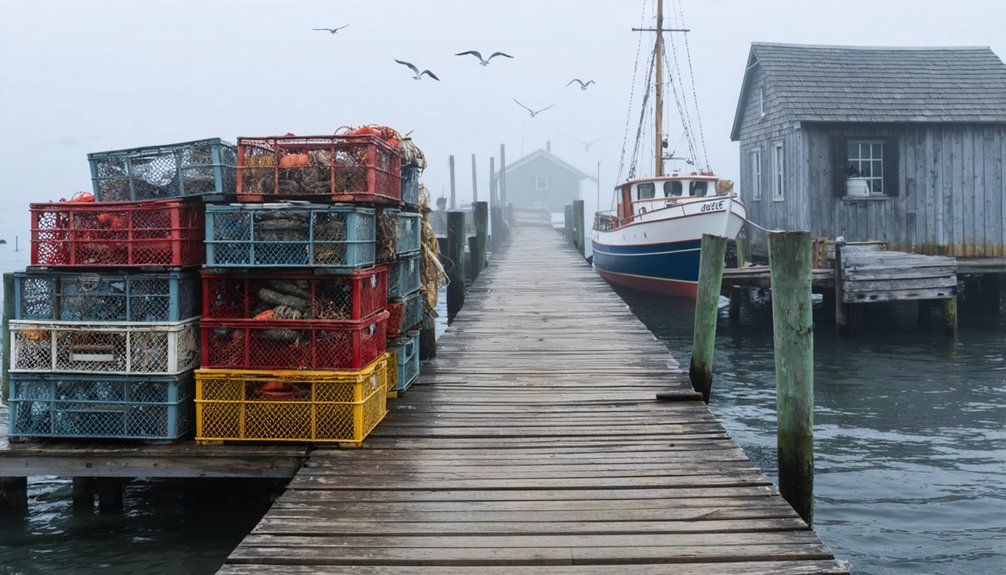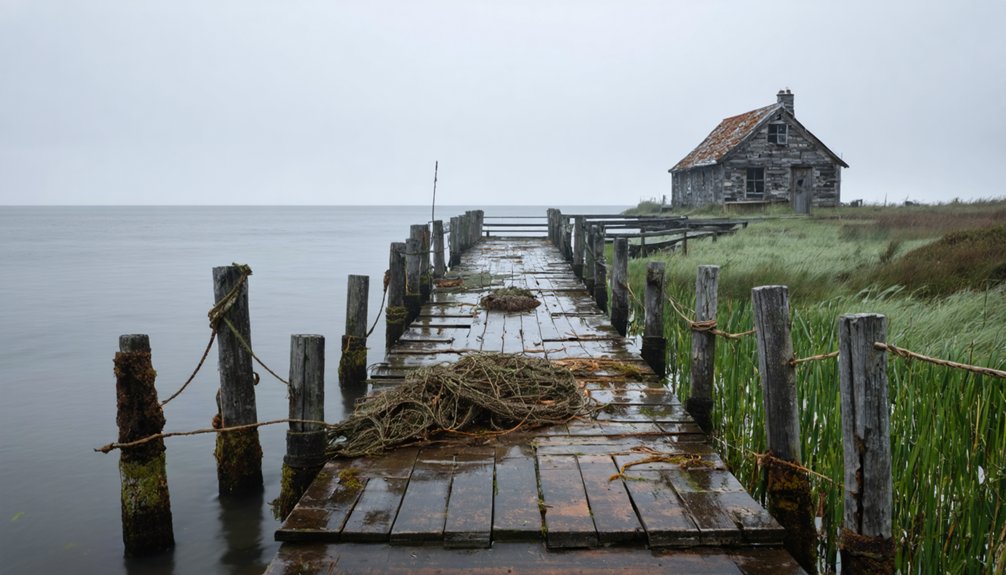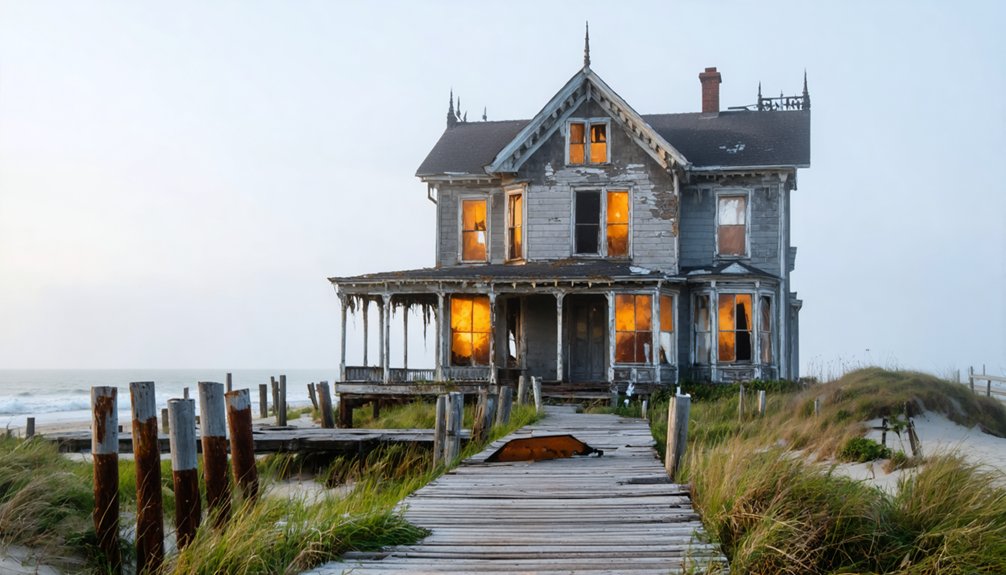
America’s coastlines are dotted with abandoned settlements that tell stories of economic booms and environmental busts. You’ll find former fishing villages, port towns, and industrial hubs that once thrived but succumbed to resource depletion, natural disasters, or changing transportation routes. From Cape Charles, Virginia to Bombay Beach, California, these ghost towns feature distinctive remnants like weathered piers and empty processing facilities. Their silent structures offer profound insights into the fragility of coastal development and maritime heritage.
Key Takeaways
- Coastal ghost towns like Dogtown (Massachusetts) and Terlingua (Texas) offer glimpses into once-thriving maritime communities that faced economic decline.
- These settlements typically feature distinctive remnants such as abandoned piers, harbors, and processing facilities that signify their seafaring past.
- Notable coastal ghost towns include Cape Charles (Virginia), Bodie (California), and Port Royal (South Carolina), each with unique historical significance.
- Economic factors like resource depletion, transportation shifts, and industrial changes contributed significantly to these towns’ abandonment.
- Environmental vulnerabilities and natural disasters accelerated many coastal towns’ decline, as evidenced by Bombay Beach’s population drop from 991 to 231.
The Rise and Fall of America’s Forgotten Shorelines
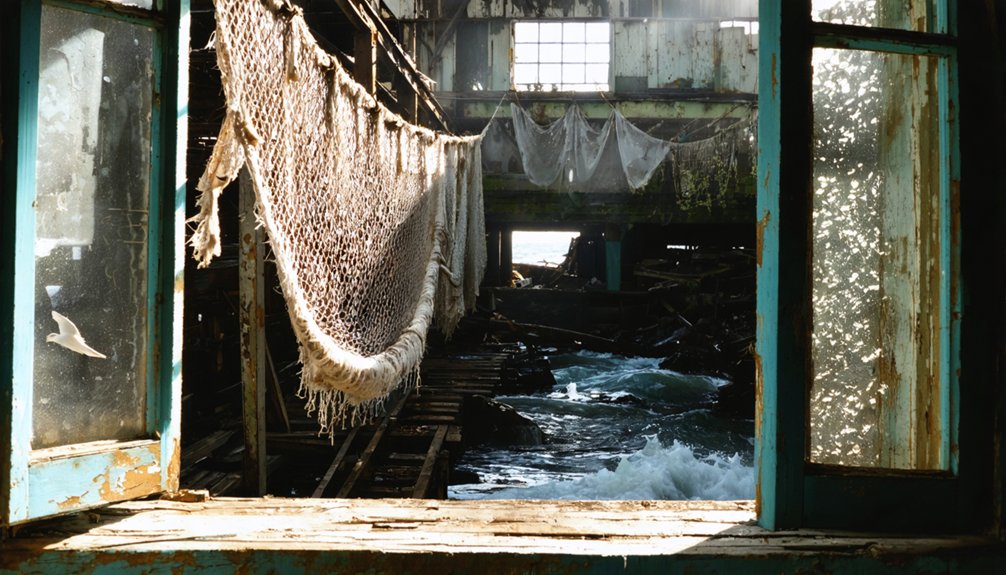
How quickly the tides of fortune can shift along America’s vast coastlines.
Once-thriving communities like Dogtown, Massachusetts and Terlingua, Texas transformed from bustling centers of commerce into silent remnants of ambition.
These settlements boomed during the resource extraction era of the late 19th century, when gold, mercury, and fish stocks promised prosperity.
America’s coastal frontiers gleamed with potential as extractive industries promised unending wealth from the nation’s natural bounty.
Their decline reflects broader economic sustainability challenges that coastal communities faced.
When resources depleted and industries shifted, the economic foundations crumbled.
Railroad closures, changing shipping routes, and environmental disasters accelerated abandonment.
Fort Jefferson in Florida suffered abandonment partly due to devastating hurricanes that repeatedly damaged its massive brick structure.
The story of North Brother Island exemplifies this pattern, as it was once an important quarantine facility that became obsolete as medical practices evolved.
Urban migration patterns emerged as younger generations sought opportunities elsewhere, leaving these towns to slowly fade into obscurity.
What remains today are weathered monuments to America’s complex relationship with its resources—places where nature gradually reclaims what humanity briefly borrowed.
What Defines a Coastal Ghost Town?
You’ll find that coastal ghost towns aren’t simply abandoned places, but settlements where maritime industries once thrived before experiencing dramatic population decline or complete desertion.
Unlike their inland counterparts, these maritime settlements feature distinctive remnants of piers, harbors, and processing facilities that speak directly to their seafaring past.
Their definition encompasses a spectrum from fully vacated municipalities to communities with a handful of residents, where the original economic foundations—fishing, shipping, or resource extraction—have fundamentally collapsed. Many coastal ghost towns emerged when transportation issues caused economic devastation after shipping routes changed. Florida has numerous unrecognizable coastal ghost towns that are often hidden within modern developments, their histories erased by time and progress.
Definition Essentials
While many abandoned settlements dot the American landscape, coastal ghost towns represent a distinct category defined by specific characteristics and historical patterns.
You’ll recognize these remnants of coastal heritage by their proximity to shorelines, bays, or estuaries where maritime industries once thrived. A true coastal ghost town must have experienced significant population decline from its peak, with its original economic purpose—typically fishing, logging, or trade—now ceased or dramatically diminished.
These sites maintain physical evidence of their former existence through deteriorating piers, warehouses, or foundations that whisper stories of bustling activity. Environmental factors like erosion and storms often accelerate their decay, creating melancholic yet compelling destinations for ghost town tourism. Many such towns were established during mining rushes in the 19th century, following patterns similar to Arizona’s inland ghost towns.
Among these evocative locations, colonial era ghost town exploration offers a unique glimpse into history, showcasing the remnants of early settlers and their struggles. Visitors can wander through overgrown paths and crumbling structures, piecing together the lives that once flourished in these now-silent places. Each site tells its own story, adding layers to our understanding of the past and the forces that shaped these fading landscapes.
The settlements’ isolation, often on peninsulas or islands, contributed both to their initial development and eventual abandonment when economic conditions shifted. These coastal communities frequently become abandoned when natural resources are depleted, forcing residents to relocate in search of new economic opportunities.
Abandonment vs. Decline
Distinguishing between abandonment and decline requires nuanced population metrics that go beyond simple population counts when categorizing coastal settlements as ghost towns.
You’ll find communities with fewer than 100 residents that still maintain their identity, while others with 500 people might be considered “ghost towns” due to collapsed economic influences.
Census data reveals stark patterns: many coastal areas in South Carolina, Georgia, and Louisiana have experienced 30-70% population losses since the 1980s.
This exodus typically follows a predictable sequence – primary industries falter, businesses close incrementally, and community institutions disappear.
Physical indicators include vacant buildings, deteriorating infrastructure, and abandoned docks, while social fragmentation intensifies as the population ages and services vanish.
Natural disasters and climate change often accelerate this progression from decline to abandonment.
Some coastal ghost towns, like Quindaro, have historical significance as Underground Railroad stops that provide valuable insights into American history.
Many of these coastal towns have extensive infrastructure designed for much larger populations, creating an eerie disconnect between available utilities and the small number of remaining residents.
Location-Specific Characteristics
Coastal ghost towns exhibit distinctive physical and sociological characteristics that transcend mere population statistics, with each abandoned settlement reflecting the unique interplay of environmental pressures and economic collapse specific to maritime contexts.
You’ll find these locations defined by their geographical isolation alongside crumbling infrastructure, where natural forces accelerate deterioration of once-vibrant communities. Bombay Beach exemplifies this pattern, with its population declining from 991 in 1990 to just 231 in 2020 due to severe environmental issues.
- Environmental vulnerability – Deteriorating marinas, flooded foundations, and hurricane-damaged structures showcase nature’s reclamation
- Economic abandonment markers – High vacancy rates, collapsed real estate values, and minimal new construction permits
- Architectural remnants – Corroded metal, disintegrating concrete, and preserved ruins now serve as both historical artifacts and contemporary tourism draws
These places exist in suspended animation—neither fully alive nor completely dead—preserved by both neglect and selective cultural significance. Many coastal ghost towns experience rental vacancy rates significantly higher than the national average, similar to Augusta’s concerning 8.9% figure.
Notable Abandoned Coastal Settlements Across the US
Along America’s coastlines, you’ll encounter military ruins like Fort Jefferson in the Dry Tortugas and Civil War-era coastal defenses in Charleston Harbor that stand as weathered sentinels of past conflicts.
These abandoned fortifications, built to protect strategic maritime positions, now serve as archaeological treasures where salt-laden winds slowly reclaim concrete casemates and brick walls.
Former bustling port towns such as Alviso in California and Cedar Key in Florida represent commercial hubs that declined when shipping routes changed, leaving behind rotting wharves and empty warehouses as indicators of economic transformation.
Forts and Defensive Ruins
Throughout American history, military fortifications have stood as sentinels along the nation’s coastlines, only to be gradually abandoned as strategic priorities shifted and technologies advanced.
These defensive ruins offer fascinating glimpses into America’s military past, with fort architecture evolving from simple earthworks to sophisticated masonry structures of the Third System period.
From New England to the Gulf Coast, these abandoned coastal defenses preserve the historical significance of America’s maritime boundaries:
- Northeastern ruins like Fort Tyler (NY) and Fort Massachusetts (ME) showcase how vulnerable coastal positions were eventually deemed militarily obsolete.
- Southeastern strongholds including Fort Macon (NC) and Fort Jefferson (FL) demonstrate ambitious defensive networks left to decay.
- Colonial-era remnants such as Fort St. Philip (LA) reveal America’s earliest attempts at coastal security.
Port Town Remnants
While the remnants of military fortifications preserve America’s defensive past, abandoned port towns tell an equally compelling story of maritime commerce, prosperity, and eventual decline.
You’ll find Cahawba, Alabama—once the state’s capital and a thriving river port—now reduced to archaeological ruins after recurring floods and Civil War disruptions severed its commercial lifelines.
Hopefield, Arkansas exemplifies the fragility of river-based maritime commerce. This Mississippi River ferry terminus flourished until nature and progress conspired against it—floods, disease, and railroad rerouting gradually erased its economic purpose by the 1910s.
When its ferry sank in 1917, the town’s fate was sealed.
These port town remnants reveal how technological shifts and environmental forces reshaped America’s commercial geography, leaving behind ghostly markers of once-bustling trade centers along our waterways.
Economic Forces Behind Maritime Ghost Towns
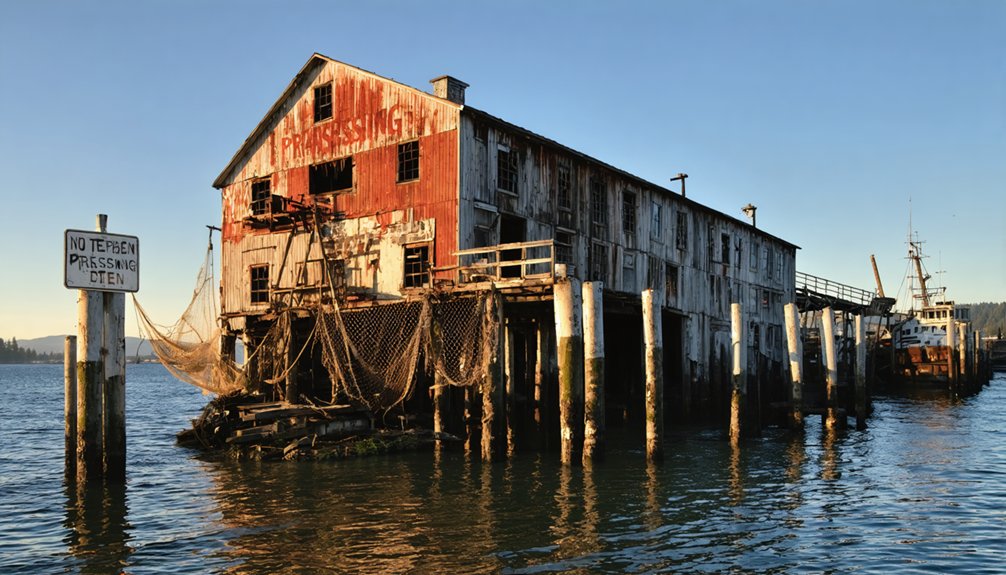
The economic collapse of maritime ghost towns along America’s coastlines reveals a complex interplay of market forces, resource limitations, and industrial shifts that transformed once-thriving communities into abandoned landscapes.
These settlements often suffered from economic monocultures, where dependence on single industries—fishing, shipping, or resource extraction—left them vulnerable when those sectors declined. Labor mobility accelerated their downfall, as workers readily abandoned failing towns for more promising opportunities elsewhere.
- Resource depletion triggered boom-bust cycles, with rapid growth during resource discovery followed by equally swift abandonment.
- Lack of economic diversification prevented communities from developing alternative industries when primary sectors failed.
- Transportation technology advances and shifting trade routes rendered many coastal ports economically irrelevant, cutting off their commercial lifeblood.
Environmental Factors in Coastal Town Abandonment
Environmental threats to America’s coastlines have transformed vibrant seaside communities into desolate ghost towns, as rising seas, intensifying storms, and accelerated erosion make once-thriving areas uninhabitable.
You’ll find over $1 trillion in coastal properties endangered as sea levels are projected to rise 0.25-0.3 meters by 2050, while Louisiana has already lost 2,000 square miles of protective wetlands.
These environmental challenges extend beyond physical destruction. Stormwater runoff contaminates estuaries with phosphates and nitrates, creating dead zones that devastate local fishing economies.
As properties become legally “abandoned” to the sea, owners face hazardous-waste regulations and cleanup liabilities. Without coordinated government policies addressing coastal resilience, communities face abandonment as storms intensify and recovery becomes financially untenable, leaving behind empty structures as silent monuments to climate change’s relentless advance.
Preserving Maritime History: Conservation Efforts Today
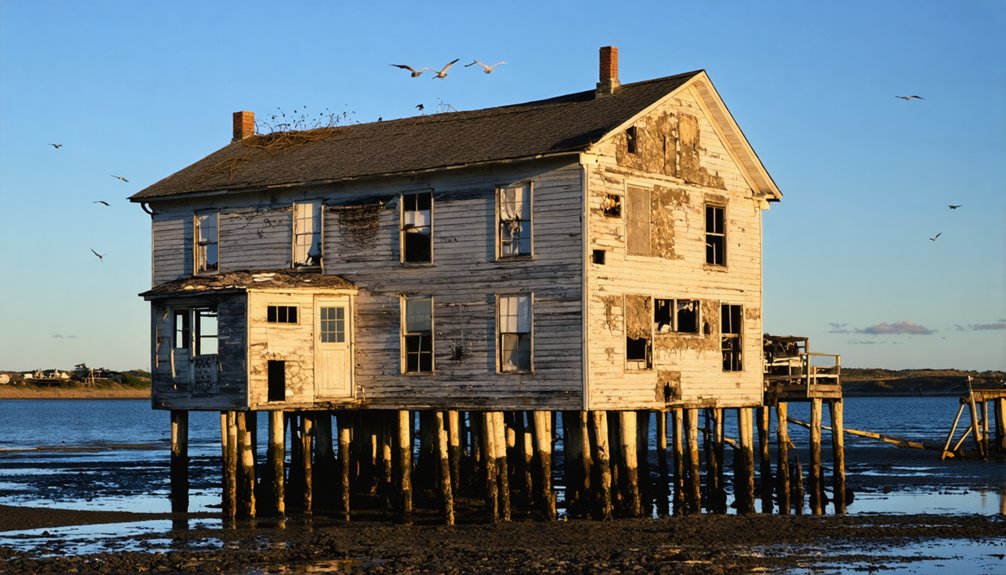
As coastal communities face abandonment due to environmental pressures, preservation efforts have emerged to safeguard America’s rich maritime heritage before it’s lost forever.
Today’s conservation initiatives operate through a framework of maritime grants, institutional collaboration, and preservation ethics that prioritize authenticity. You’ll find NOAA’s marine sanctuaries protecting underwater treasures while the National Maritime Heritage Preservation Grant program provides critical funding for historic vessels and archeological sites.
Modern maritime preservation weaves funding, expertise, and ethical standards into a safety net for our nation’s endangered coastal heritage.
- Grants ranging from $50,000 to $750,000 support preservation projects requiring one-to-one non-federal matching funds
- The Secretary of Interior’s Standards guide maritime preservation with emphasis on retaining historic form and authenticity
- Marine sanctuaries like the Monitor and the “Ghost Fleet” offer protection for shipwrecks and submerged cultural heritage
These efforts preserve not just structures but the cultural narratives they embody.
Exploring These Haunting Coastal Ruins: Visitor’s Guide
Visiting America’s coastal ghost towns presents a unique set of challenges and rewards for history enthusiasts and adventurous travelers alike. Access typically requires strategic planning: some sites like St. Elmo demand ferry transport, while Ferguson’s submerged ruins necessitate kayaking.
Visitor preparedness is critical—pack water, food, and first aid supplies, as amenities are scarce and cell service unreliable.
For best exploration, time your visit during spring or fall when weather conditions are favorable and insect populations diminish. Always check tide charts and obtain necessary permits for protected areas. Remember that many structures are unstable; admire from a safe distance.
Local visitor centers provide invaluable exploration tips, including self-guided tour maps and safety information. Respect these fragile historical sites by observing regulations against artifact removal and wildlife disturbance.
Cultural Legacy of America’s Deserted Seaside Communities
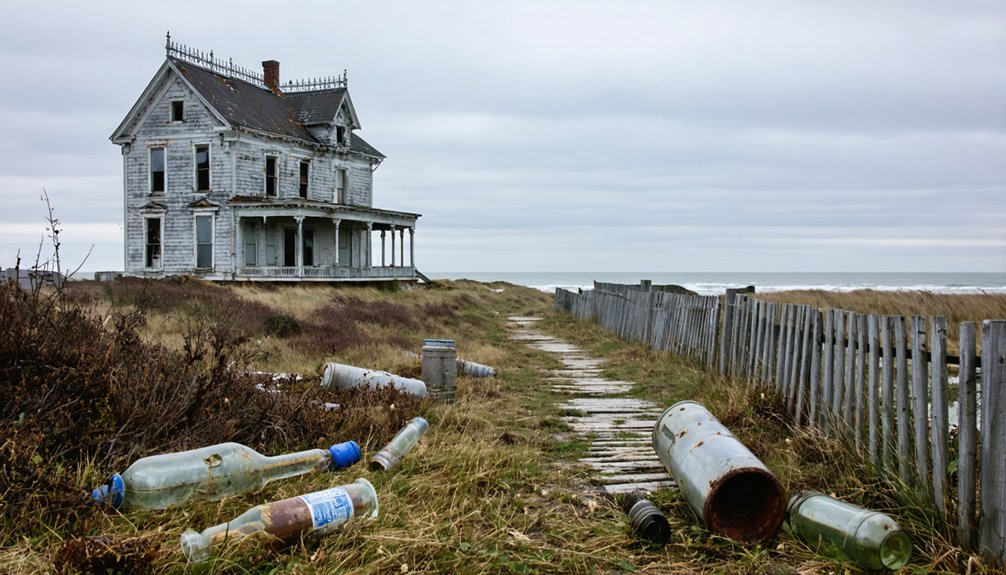
America’s deserted seaside communities represent far more than mere abandoned architecture; they embody complex historical narratives that illuminate the nation’s evolving relationship with its coastlines.
These haunting remnants of Atlantic City’s boardwalk opulence, Gilchrist’s humble stilt houses, and Cape Lookout’s maritime heritage preserve powerful cultural nostalgia that connects you to America’s coastal past.
When you explore these forgotten places, you’ll encounter:
- Silent witnesses to economic cycles – from Atlantic City’s luxury hotels to failed casino revival attempts
- Physical reminders of nature’s dominance – foundations scattered along Texas shores where thriving communities once stood
- Architectural significance in weathered structures – silver-bleached cottages and lighthouses still standing despite decades of abandonment
These abandoned settlements offer profound lessons about human resilience, environmental forces, and the impermanence of coastal development throughout American history.
Frequently Asked Questions
Are There Any Underwater Ghost Towns Visible to Divers?
Yes, you’ll discover multiple underwater ghost towns during your exploration. Diver experiences at Summersville Lake, Lake Buchanan, and Fontana Lake reveal building foundations, roads, and cultural artifacts with exceptional visibility.
What Paranormal Activities Have Been Reported in Coastal Ghost Towns?
Over 70% of coastal ghost towns report paranormal activity. You’ll encounter haunted legends including floating orbs in Batsto Village’s cemetery, spectral sightings of Civil War soldiers at Harper’s Ferry, and phantom voices in abandoned waterfront structures.
Can Visitors Legally Collect Artifacts From Abandoned Coastal Sites?
No, you can’t legally collect artifacts from abandoned coastal sites. Federal and state legal regulations strictly protect these items for artifact preservation, even on seemingly unmonitored properties.
How Have Indigenous Communities Reclaimed Abandoned Coastal Settlements?
You’d think abandoned sites were just rotting away, but they’re actually centers of indigenous revitalization. Through partnerships and funding, tribes have reclaimed ancestral coastal lands, integrating cultural heritage into ecological restoration projects.
Which Coastal Ghost Towns Are Most Threatened by Rising Sea Levels?
You’ll find Isle de Jean Charles, Newtok, Bayou La Batre, Port Royal, and Holland Island most imperiled. These abandoned settlements face catastrophic coastal erosion, with some losing up to 98% of their original landmass.
References
- https://www.christywanders.com/2024/08/top-ghost-towns-for-history-buffs.html
- https://www.geotab.com/ghost-towns/
- https://devblog.batchgeo.com/ghost-towns/
- https://whakestudios.com/us-ghost-towns/
- https://albiongould.com/ghost-towns-to-visit-in-the-states/
- https://en.wikipedia.org/wiki/Lists_of_ghost_towns_in_the_United_States
- https://www.atlasobscura.com/lists/americas-best-preserved-ghost-towns
- https://www.ghosttowns.com
- https://www.explore.com/travel/25-ghost-towns-around-us-and-history-behind-them/
- https://freepages.rootsweb.com/~gtusa/history/sitemap.htm