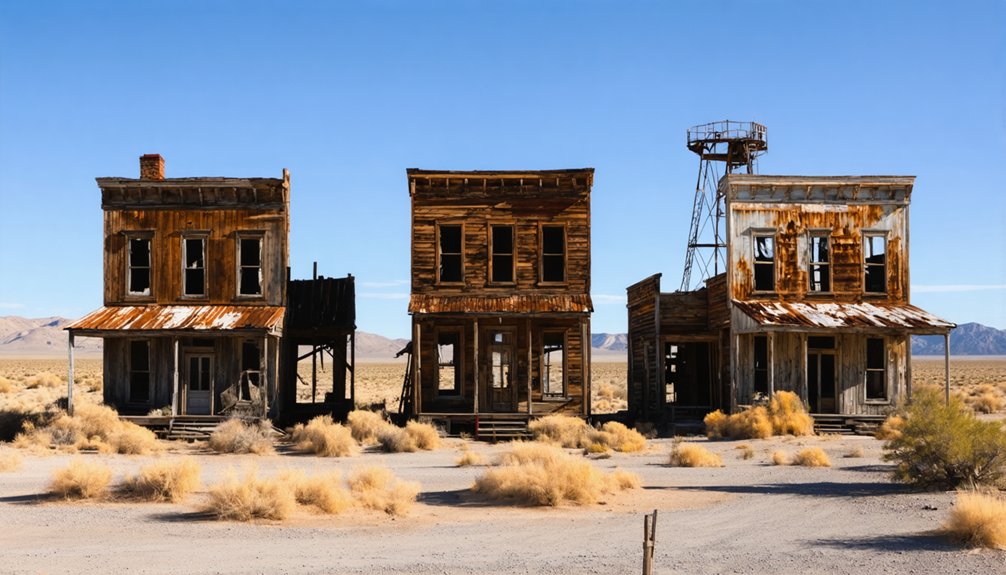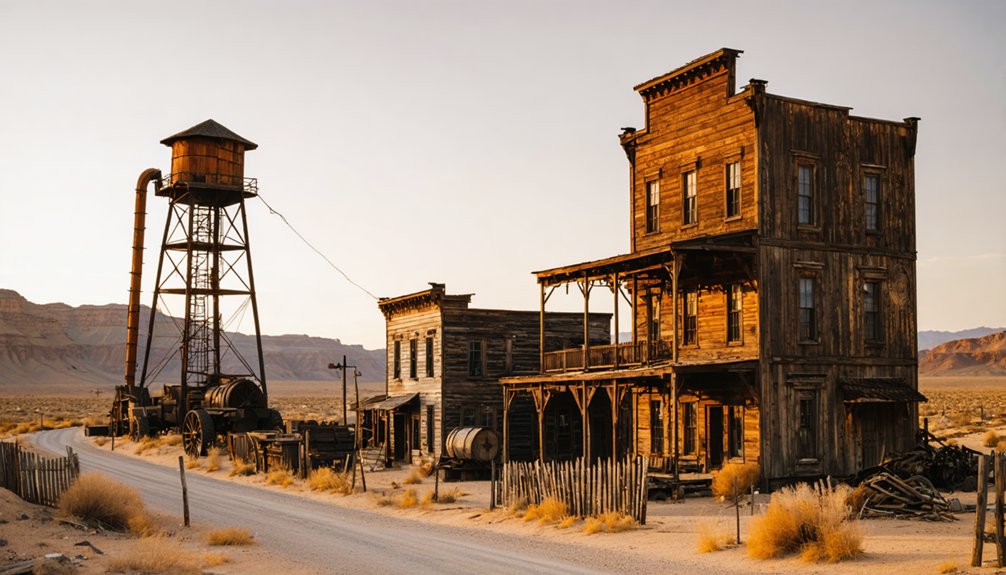
Nevada’s mining towns emerged rapidly after James Marshall’s 1848 gold discovery, with the 1859 Comstock Lode transforming Virginia City into a 25,000-resident metropolis. You’ll find these settlements created $700 million in wealth that funded the Union during the Civil War and built San Francisco’s infrastructure. These boom-to-bust communities fostered technological innovations like square-set timbering while supporting vibrant cultural scenes despite harsh working conditions. Their economic legacy continues to shape Nevada’s identity today.
Key Takeaways
- Virginia City emerged from the 1859 Comstock Lode discovery, transforming into a 25,000-resident metropolis that generated $700 million in precious metals.
- Mining towns experienced dramatic boom-to-bust economic cycles, with populations surging from hundreds to thousands following new mineral discoveries.
- Nevada’s mining wealth funded Union currency during the Civil War and drove significant infrastructure development across the American West.
- Mining communities balanced harsh working conditions with vibrant social connections through saloons, opera houses, baseball games, and cultural events.
- The environmental legacy of Nevada’s mining towns includes disrupted water systems, mercury contamination, and habitat destruction that persists today.
The Birth of Nevada’s Mining Frontier (1849-1860)
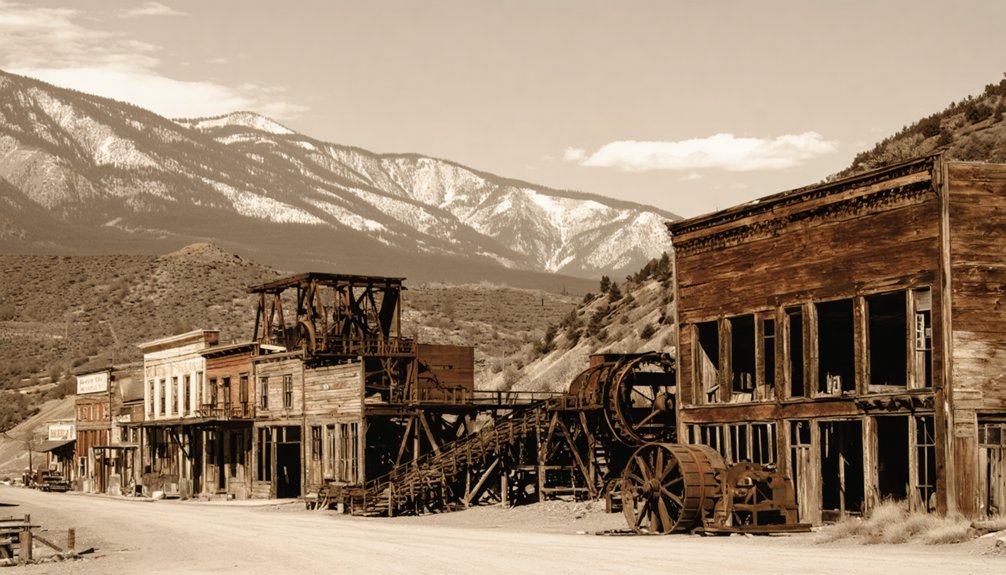
As the echoes of James Marshall’s momentous gold discovery at Sutter’s Mill in 1848 reverberated across the western frontier, Nevada’s mining history began to take shape in the shadow of California’s more famous Gold Rush.
Mormon ’49ers first discovered placer gold near the Carson River, initiating Nevada’s modern mining history. These fortune-seekers established rudimentary mining settlements of tents and simple huts during the winters of 1849-1850.
You’ll find that early mining activities focused on placer mining in streams around present-day Dayton. As California deposits dwindled, experienced Forty-niners migrated eastward, bringing their knowledge to Nevada’s untapped resources. Similar to Nevada City in California where gold was discovered along Deer Creek in 1849, Nevada’s rich mineral deposits attracted thousands seeking their fortune.
This itinerant population created a volatile frontier where mining camps quickly evolved into towns, laying groundwork for the territory’s economic foundation and eventual statehood. Long before modern prospectors arrived, American Indians had been utilizing mineral resources for tools and decorative items for over 10,000 years.
As these settlers expanded their reach, many were unaware of the hidden artifacts from Native American history that lay beneath the surface. These remnants offered a glimpse into the rich cultural practices and beliefs of the indigenous peoples who had inhabited these lands long before any mining operations began. Protecting these treasures became crucial as the push for economic development threatened to erase the legacy of the original inhabitants.
Silver Fever: The Comstock Lode and Its Legacy
You’ll find Virginia City transformed from a barren hillside into a bustling metropolis of 25,000 residents almost overnight following the Comstock’s 1859 silver strike.
This remarkable urban evolution created Nevada’s economic powerhouse, with the $700 million in precious metals extracted fueling development across the American West. The innovative square set timbering technique invented by Philip Deidesheimer revolutionized mining safety and allowed for efficient extraction of the massive ore bodies. The discovery site’s name honors Henry Tompkins Comstock, who secured interests in early claims through questionable means.
Virginia City’s concentrated wealth didn’t merely reshape Nevada’s landscape but fundamentally altered national finance, as Comstock silver strengthened Union currency during the Civil War and later funded transcontinental infrastructure projects.
Instant Urban Transformation
When silver ore was discovered in Nevada’s Virginia Range in 1859, it triggered one of the most dramatic urban transformations in American history.
You’re witnessing an unprecedented phenomenon: wilderness becoming metropolis almost overnight as mining entrepreneurship drove urban expansion at breakneck speed.
- Remote canyons transformed into bustling settlements within weeks of silver discoveries
- Surface diggings quickly gave way to sophisticated underground operations requiring massive infrastructure
- The Bonanza Firm’s corporate consolidation brought efficiency and capital for sustained development
- Technological innovations like square-set timbering and steam pumps enabled deeper extraction
- Over 200 ore mills constructed during the 1860s-1870s—many before railroad access—demonstrated the urgency of industrial development
This instant urbanization wasn’t merely about building towns; it represented America’s capacity to rapidly mobilize capital, technology, and human resources when freedom and opportunity beckoned. The mines of the Comstock Lode became renowned for their significant silver discovery and impressively deep mining shafts that showcased advanced engineering. Virginia City exemplified this urban explosion, growing to house 25,000 residents by the mid-1870s and earning its reputation as a “fathomless treasure house.”
Virginia City’s Economic Impact
The silver-rich Comstock Lode transformed Virginia City into an economic powerhouse that reshaped not just Nevada’s destiny but America’s financial landscape.
When you examine the staggering figures—over $400 million in precious metals extracted—you’ll understand how this mining wealth funded the Union during the Civil War and strengthened the national treasury.
The economic transformation extended to San Francisco, as Comstock profits flowed westward. The Bank of California’s dominance and William Sharon’s Virginia and Truckee Railroad investment in 1869 created essential infrastructure connecting this boomtown to wider markets.
With a peak population of 25,000, Virginia City’s 110 saloons and numerous theaters reflected unprecedented prosperity. The annual metal production reached its highest point at $38.57 million in 1876. Among the mining tycoons who amassed fortunes were the Bonanza Kings, including John Mackay, who became influential figures in American business. This wealth ultimately funded educational institutions like the University of Nevada’s School of Mines, leaving a legacy that transcended the silver’s eventual depletion.
Boom to Bust: The Economic Cycle of Nevada Mining Towns
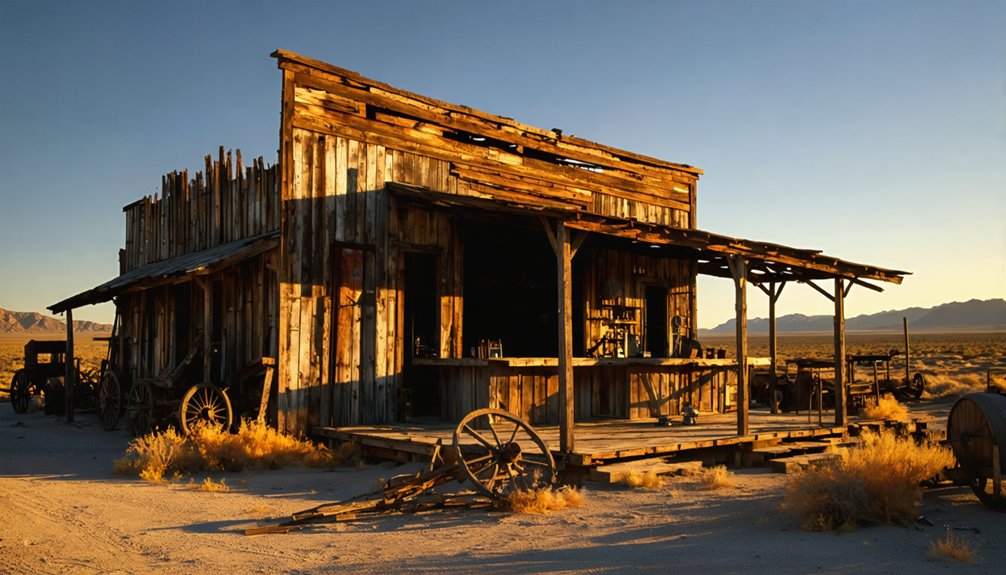
Nevada’s mining towns exemplify one of America’s most dramatic boom-to-bust economic cycles, characterized by meteoric rises followed by precipitous declines that reshaped the state’s landscape.
You’ll find these economic fluctuations were driven by resource depletion, market forces, and corporate consolidations that transformed individual prospecting into industrial operations.
- Populations could surge from hundreds to tens of thousands within months when new deposits were discovered.
- The Comstock Lode’s exhaustion in the 1880s triggered a statewide mining decline lasting two decades.
- Labor conflicts emerged as corporations consolidated power over mining operations.
- The silver price collapse of the 1890s devastated communities dependent on single resources.
- Many thriving communities transformed into ghost towns within years once ore bodies were depleted.
Virginia City exemplified the height of mining prosperity with its massive silver deposits creating unprecedented wealth before the inevitable decline set in.
The financial panic of 1907 severely impacted Southern Nevada’s mining industry, pushing many operations into a prolonged recession and accelerating the abandonment of once-bustling towns.
Evolution of Mining Technologies in the Silver State
Evolving dramatically over the past century and a half, mining technologies in Nevada represent not merely technical innovations but profound transformations in how humans have extracted wealth from the earth.
The technology timeline begins with pan amalgamation and chemical lixiviation in early silver processing, advancing through cyanidation and flotation methods that revolutionized mineral recovery efficiency.
You’ll find Nevada’s mining innovations most dramatically illustrated in the 1960s-70s shift from underground to open-pit operations.
The introduction of heap leaching in the Carlin Trend transformed previously uneconomical microscopic gold deposits into America’s richest resource. This change required massive earth-moving equipment and new processing techniques, fundamentally altering the industry’s scale and approach.
The Cortez district exemplifies this evolution, where successive technologies tell the story of Nevada’s remarkable mining adaptation through time.
Daily Life in Nevada’s Mining Communities
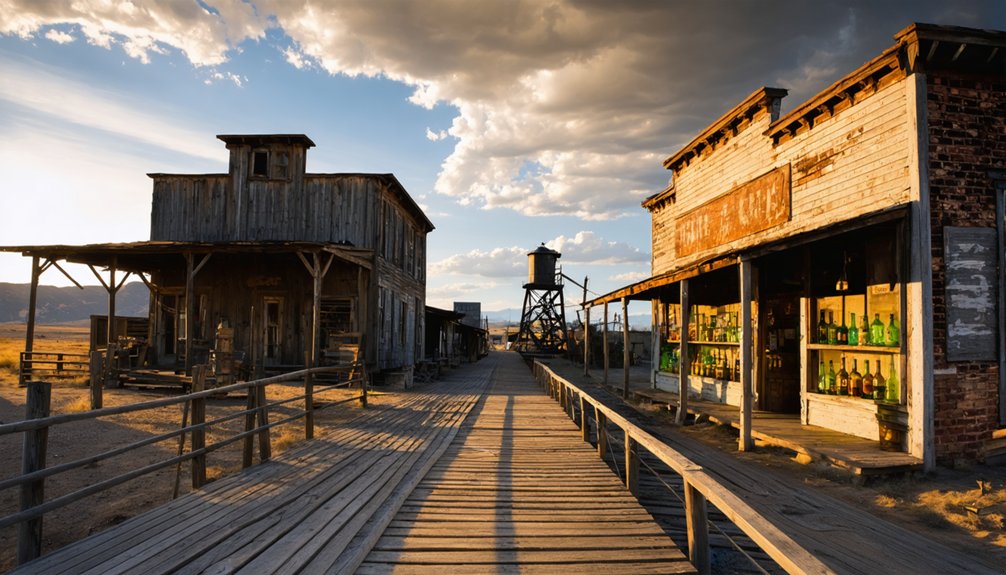
Daily life in Nevada’s mining communities revolved around harsh realities tempered by vibrant social connections, creating cultural enclaves where work and leisure existed in delicate balance.
You’d endure extreme conditions working 3,000 feet underground in 100-degree heat, then emerge to find refuge in one of Virginia City’s 100+ saloons where miner’s camaraderie fostered resilient bonds.
These boomtowns weren’t merely work camps but complete societies with:
- Opera houses and baseball games serving as cultural touchstones
- Modern amenities including electricity and indoor plumbing in developed settlements
- Social rituals centered around saloons, pool halls and entertainment venues
- Robust commercial districts with diverse services from banks to newspapers
- Community institutions like schools and hospitals supporting family life
Ethnic Diversity and Cultural Exchange in Mining Settlements
While mining operations carved wealth from Nevada’s mountains, they simultaneously excavated complex social landscapes where diverse ethnic communities forged distinct cultural territories within the state’s boomtowns.
You’d find Irish, Cornish, and Central European neighborhoods taking shape by the mid-1870s in places like Nye County, where informal yet pronounced ethnic segregation defined community boundaries.
Cultural interactions occurred across these divides—Black residents in Virginia City lived relatively integrated compared to other groups, while Native Americans participated in mining economies despite exclusion from formal mining positions.
Saloons functioned as social crossroads where ethnic tensions sometimes erupted into violence. Chinese immigrants and other Asian populations faced particular hostility, often becoming targets of collective aggression.
Despite these divisions, mining towns like Virginia City boasted remarkable diversity, with nearly 60% of some populations being foreign-born by 1880.
Transportation Networks and Their Impact on Mining Development
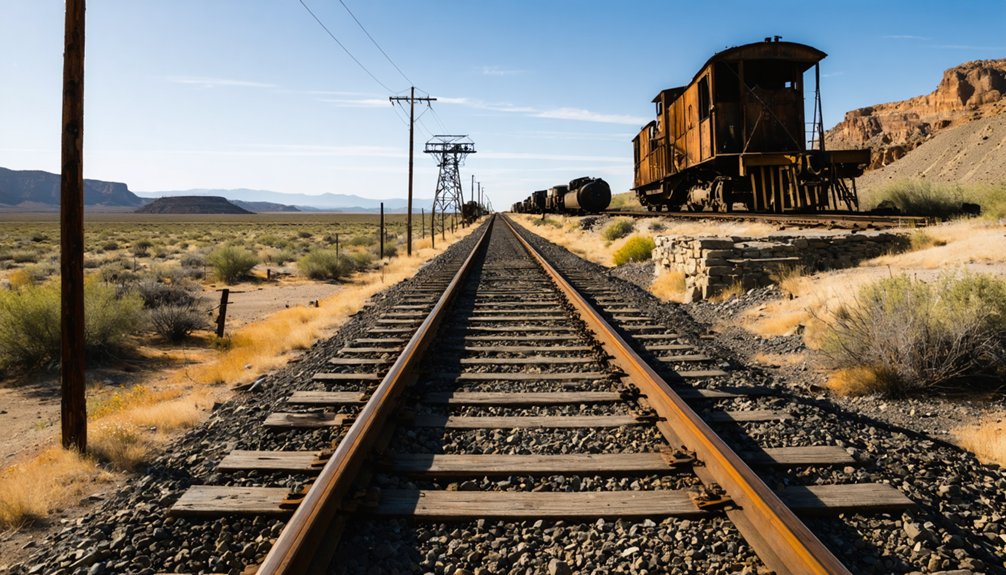
The web of transportation arteries that connected Nevada’s isolated mining communities fundamentally shaped the state’s economic development and settlement patterns throughout the nineteenth and early twentieth centuries.
You’ll find that mining infrastructure and transportation innovations developed symbiotically—neither could exist without the other. Railroad networks like the Virginia and Truckee and Nevada Northern Railway transformed ore extraction from isolated endeavors into industrialized operations.
The mining-transportation symbiosis reshaped Nevada’s frontier, with railways converting remote prospects into organized industrial enterprises.
- Las Vegas emerged as a natural freighting crossroads for scattered mining camps.
- Railroads carried ore from mines to processing facilities before widespread automobile access.
- The Goldfield-Bullfrog Railroad specifically serviced gold and silver production communities.
- Strategic positioning of Reno and Carson City supported transcontinental logistics.
- Steptoe Valley Mining & Smelter Company in McGill built railroad connections for copper processing.
Ghost Towns: Preservation of Nevada’s Mining Heritage
Nevada’s abandoned mining settlements stand as tangible monuments to the state’s boom-and-bust heritage, with preservation efforts now transforming these once-forgotten places into valuable historical assets.
You’ll find active preservation societies working tirelessly on ghost town preservation, like Goldfield Historical Society securing grants to restore landmarks including the iconic Goldfield Hotel and Tom Kelly’s Bottle House.
Visit Berlin-Ichthyosaur State Park to experience both mining ruins and paleontological treasures, or explore Belmont’s historic jail and silver boomtown remnants.
Many sites offer self-guided walking tours with maps from local visitor centers. Through restoration projects at places like the Sutro Tunnel Site, volunteers maintain authenticity while making these cultural heritage sites accessible, ensuring Nevada’s mining legacy endures through educational programs and community engagement.
Environmental Consequences of Historical Mining Operations
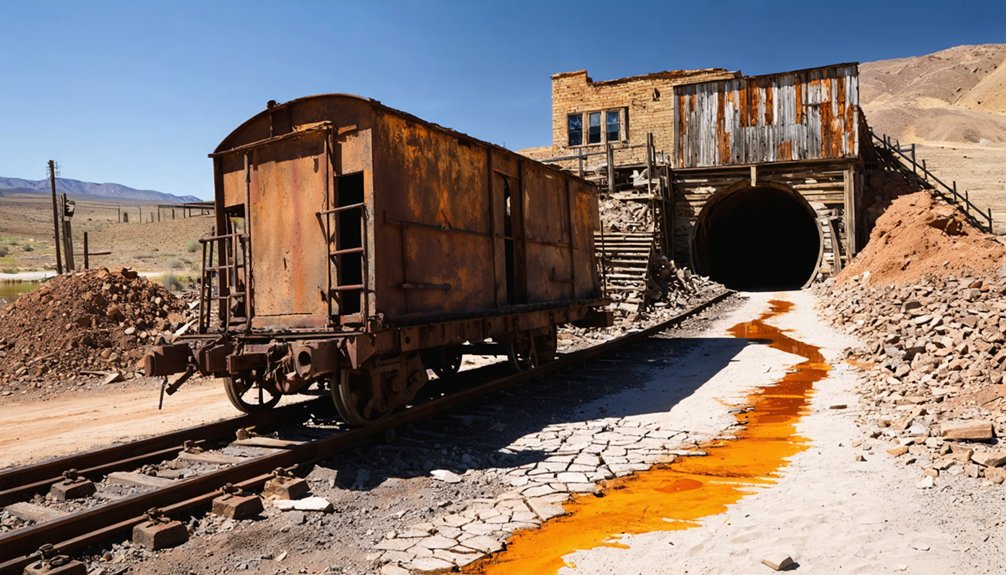
You’ll find the environmental legacy of Nevada’s historic mining towns particularly evident in their disrupted water systems, where cyanide from gold extraction and acid mine drainage continue to contaminate groundwater and surface waters.
Mill tailings deposited in vulnerable locations represent significant sources of ongoing pollution, with contaminants leaching into waterways decades after operations ceased.
The environmental impact extends beyond water, as mining activities fundamentally altered landscapes through deforestation, habitat destruction, and persistent air quality degradation from particulate matter and toxic emissions.
Water Systems Disrupted
While extracting vast mineral wealth from Nevada’s mountains, mining operations fundamentally altered the region’s hydrological systems through extensive water diversion projects that greatly reshaped natural landscapes.
You’ll find the impact of these changes still visible today, as mining companies prioritized industrial needs over ecological sustainability. The Virginia Gold Hill Water Company’s delivery of over two million gallons daily from Hobart Creek exemplifies the scale of water scarcity created by mining infrastructure.
- Hydraulic mining washed away entire hillsides, clogging waterways with sediment.
- Natural streams were redirected through dams and flumes, bypassing original channels.
- Aquatic ecosystems collapsed as sedimentation smothered fish spawning grounds.
- Water tables dropped considerably, affecting downstream communities.
- Some regions experienced desertification from loss of reliable water sources.
Toxic Legacy Persists
Despite the booms and busts of Nevada’s mining heyday having long passed, a toxic environmental legacy continues to haunt the landscape where extraction once dominated.
You’ll find an estimated 14 million pounds of mercury spread throughout the lower Carson River watershed—remnants of the Comstock era that still contaminate fish consumed by vulnerable populations like young mothers and children.
When you explore historic mining areas, you’re potentially exposed to crushed minerals containing arsenic, lead, and asbestos that were distributed across trails and roadways.
This toxic exposure extends beyond abandoned mine sites through acid drainage and massive tailings piles leaching contaminants into waterways.
With Sierra Nevada providing 60% of California’s drinking water, these pollutants threaten public health far beyond Nevada’s borders, creating environmental consequences that have outlived the industry that caused them.
The Enduring Economic Impact of Mining on Nevada’s Development
Since the establishment of Nevada’s earliest mining settlements, the state’s economic foundation has been inextricably linked to mineral extraction, creating a financial legacy that continues to shape its modern economy.
In 2023, mining generated $9.5 billion in commodity value with gold and silver accounting for 83% of this wealth. You’ll find mining’s impact extends far beyond extraction sites, supporting economic diversification through multiplier effects.
- Direct employment of 14,683 Nevadans earning $1.6 billion in wages
- Total economic output exceeding $8.4 billion annually
- Regional prosperity in areas like Elko, where mining supports 10,966 jobs
- Tax revenues funding critical public infrastructure and services
- Emerging opportunities in lithium mining supporting mining sustainability
These economic benefits demonstrate how mineral wealth continues as Nevada’s cornerstone despite historical boom-and-bust cycles.
Frequently Asked Questions
How Did Mining Towns Handle Water Scarcity in Nevada’s Desert Climate?
You’d witness desert mining towns engineering elaborate pipelines and pressurized systems, employing water conservation through recycling techniques and strategic irrigation networks while purchasing water rights to overcome Nevada’s harsh, arid conditions.
What Were Common Causes of Death in Nevada Mining Communities?
You’d face death from silicosis and respiratory diseases, workplace accidents in mine shafts, disease outbreaks from overcrowded conditions, environmental hazards, and violence in Nevada’s unforgiving mining communities.
How Did Mining Towns Address Crime and Establish Law Enforcement?
You’d find mining towns tackling crime through private police forces, distant sheriffs, and community justice systems. Law enforcement evolved from improvised arrangements to formal structures as settlements matured, with crime prevention remaining perpetually challenging.
What Role Did Women Entrepreneurs Play in Nevada Mining Economies?
Like Athena wielding wisdom, you’ll find women’s business ventures transformed Nevada mining economies. They owned 55% of businesses, controlled 67% of hospitality sectors, and created economic stability through diverse entrepreneurial networks and community infrastructure.
How Did Native American Tribes Interact With Expanding Mining Communities?
Native Americans shared environmental knowledge with miners while experiencing resource conflicts. You’ll find they adapted through cultural exchanges, often working within mining economies while struggling to preserve their traditional ways.
References
- https://www.legendsofamerica.com/nv-goldpoint/
- https://en.wikipedia.org/wiki/History_of_Nevada
- https://westernmininghistory.com/state/nevada/
- https://virginiacitymt.com/Preservation/Area-History
- https://nbmg.unr.edu/mining/MiningHistory.html
- https://savingplaces.org/stories/explore-wild-west-mining-history-in-nevada-ghost-towns
- https://nevadamining.org/new-history-page/
- https://www.pbslearningmedia.org/resource/nevada-ghost-towns-video-gallery/outdoor-nevada/
- https://www.clarkcountynv.gov/adobe/assets/urn:aaid:aem:1885026b-ec70-4a66-b176-cac868ab2cc7/original/as/history-timeline.pdf
- https://www.mininghistoryassociation.org/Tonopah.htm