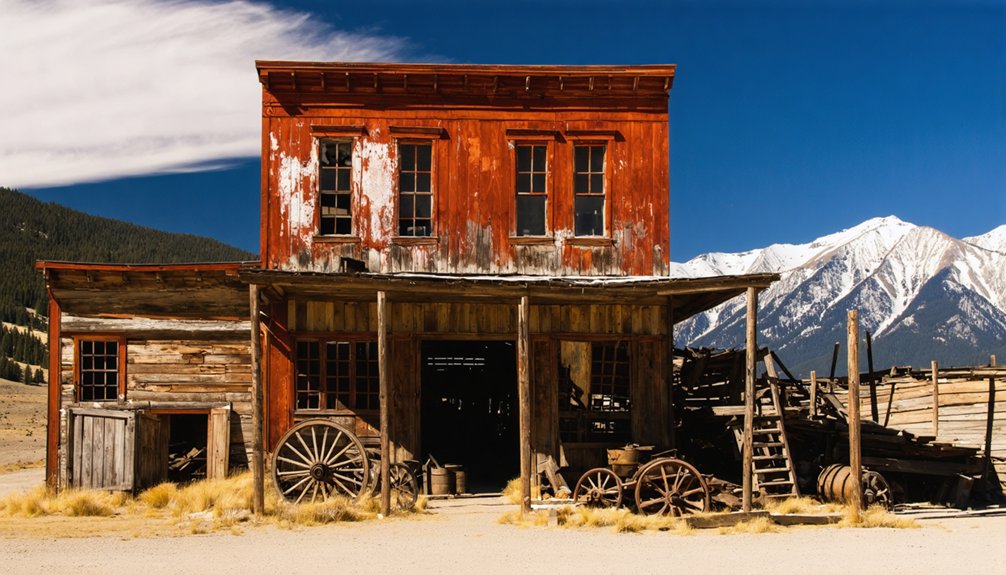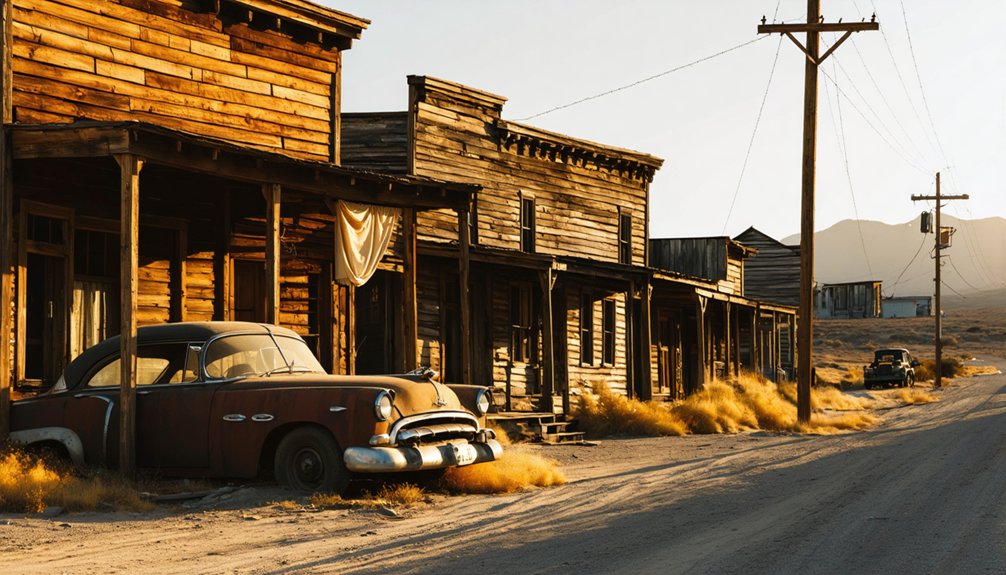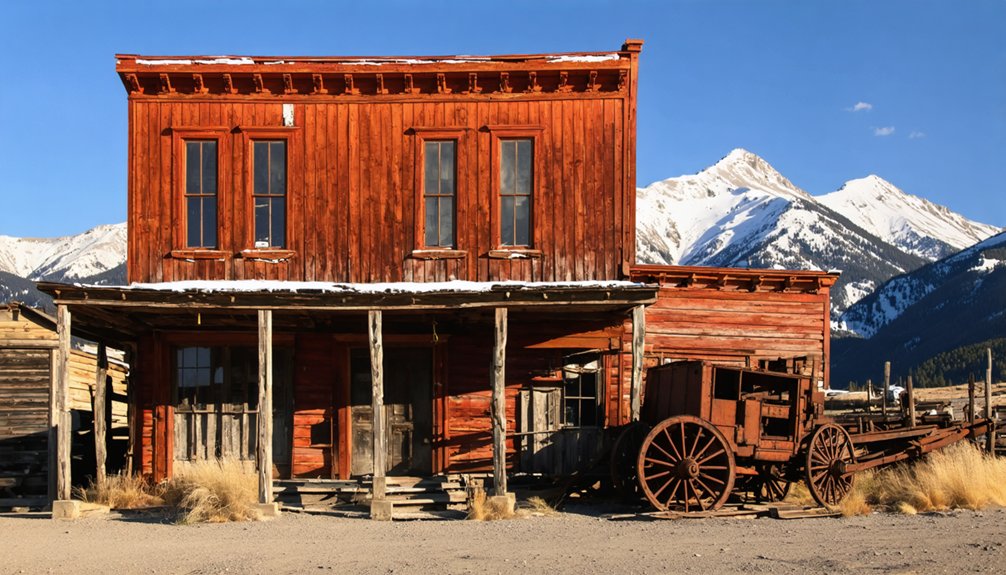
Montana’s silver mining towns offer windows into the 1890s frontier life. You’ll discover Granite’s impressive twenty-stamp mill, Garnet’s well-preserved mercantiles, and Marysville’s Drumlummon Mine that yielded $15 million during its peak. These ghost towns showcase authentic structures where miners once sought fortune after significant silver strikes began in the 1860s. Pack water, wear sturdy shoes, and stay on marked paths to safely explore these protected historical treasures.
Key Takeaways
- Montana’s silver mining towns like Granite, Garnet, and Marysville provide unique historical insights into the state’s 19th-century mining boom.
- Silver mining peaked around 1892 with 19 million troy ounces before collapsing in 1893, leaving behind well-preserved ghost towns.
- Garnet ghost town offers the best-preserved structures, with over 25 buildings showcasing original artifacts from 1890s mining life.
- When visiting mining towns, check official websites, bring navigation tools, and pack emergency supplies due to remote locations.
- Stay on marked paths, avoid unstable structures, and respect legal protections prohibiting artifact removal at these historic sites.
The Rise and Boom of Montana’s Silver Industry

Montana’s silver mining saga began with a series of pivotal discoveries in the 1850s, initially overshadowed by gold fever near Deer Lodge.
The landscape transformed after 1862 when significant silver strikes occurred near Bannack, Virginia City, and Helena, establishing foundations for bustling mining communities.
The industry’s trajectory changed dramatically when Thomas Cruse filed the Drumlummon claim in 1876, creating Marysville and attracting international investment.
You’ll find the boom’s peak coincided with favorable mining legislation like the Bland-Allison Act of 1878, which required government purchase of millions in silver monthly.
With railroad expansion in the 1880s and improved milling processes, Montana briefly surpassed Colorado in production, reaching its zenith in 1892 with 19 million troy ounces before the 1893 market collapse.
One of the most remarkable success stories was the Granite Mountain Mining Company, which discovered an exceptionally rich lode in 1882 yielding an astounding 1,700 ounces of silver per ton.
The Drumlummon mine, under competent management after being purchased for $1.63 million in 1882, produced nearly 500,000 tons of ore worth $9.2 million by 1891.
Granite: The Silver Giant That Shaped the West
While neighboring mining towns fought for prominence in Montana’s silver rush, Granite emerged as the undisputed titan of the industry after Hector Horton’s initial silver discovery in 1865.
The operation truly transformed after Charles McLure’s 1880 discovery of ruby silver grading 2,000 ounces per ton, leading to $10 million in investment capital.
When you visit today, you’ll walk where America’s richest silver producer once thrived, generating $33 million in silver between 1882-1893.
The economic impact extended beyond Montana, even funding St. Louis’ Eads Bridge. At its peak, Granite mining supported 3,000 residents with company housing for just $2.50 monthly. The town’s prosperity was dramatically showcased through its impressive twenty-stamp mill that began operations in 1885.
Though the 1893 Sherman Act repeal devastated operations and a 1958 fire claimed remaining structures, “Montana’s Silver Queen” stands preserved, a symbol of western mining ingenuity. The iconic Miners Union Hall remains partially standing as a testament to the area’s rich mining heritage.
Garnet: A Perfectly Preserved Slice of Mining Life

Unlike its flashier counterparts in Montana’s mining history, Garnet stands today as perhaps the state’s best-preserved ghost town, offering you a genuine glimpse into 1890s mining life.
Originally named Mitchell, Garnet’s history blossomed after Sam Ritchey’s Nancy Hanks mine discovery sparked a boom that swelled the population to nearly 1,000 by 1898.
You’ll discover how mining techniques evolved from simple placer operations to sophisticated hard rock extraction using stamp mills.
The town thrived until 1905, when declining yields began emptying the settlement. A devastating 1912 fire accelerated its abandonment.
Thanks to preservation efforts by the Bureau of Land Management, you can now wander among 25+ surviving structures, many containing original artifacts—a rare window into Montana’s mining heritage.
What makes Garnet particularly special is that it developed as a family-oriented community, complete with a schoolhouse serving over 40 students and regular social gatherings like dinner parties and dances.
The 1893 repeal of the Sherman Silver Purchase Act caused an economic panic in mining communities, driving many unemployed silver miners to seek opportunity in Garnet’s gold fields.
Marysville: From Irish Discovery to Mining Powerhouse
When Irish immigrant Thomas Cruse discovered a rich gold vein along Silver Creek in 1876, he unknowingly set the stage for what would become one of Montana’s most productive mining settlements.
The Irish immigrant influence shaped Marysville’s rapid expansion, with Cruse’s Drumlummon Mine yielding a staggering $15 million during its peak years.
You’ll find a town that once bustled with 5,500 residents, serviced by two railroads, 26 bars, and seven hotels.
Marysville’s mining legacy is impressive—producing over 1 million ounces of gold and silver combined, driving both territorial economy and international investment.
Though the population dwindled to around 80 today, preservation efforts since the 1980s have maintained buildings dating from 1880-1920s.
Named after Mary Ralston, the first female resident, the town quickly established itself as a significant mining community in Montana’s history.
The historic Masonic Lodge built in 1898 stands as one of the key preserved structures showcasing the town’s architectural heritage.
The 2014 opening of the Marysville Museum guarantees this remarkable chapter in Montana’s mining history endures.
Essential Tips for Ghost Town Explorers

Visiting Montana’s historic silver mining ghost towns requires thoughtful preparation to guarantee both your safety and the preservation of these irreplaceable historical sites. Before setting out, check official websites for current conditions and review recent visitor reports for any safety concerns.
If you’re looking for a unique adventure, consider exploring ghost towns in Nevada. These abandoned locations offer a glimpse into the past and provide fascinating stories waiting to be uncovered. Remember to respect the remnants of history while immersing yourself in the haunting beauty of these forgotten places.
Always carry essential navigation tools like detailed maps or GPS devices, as cell service is typically nonexistent in remote locations. Pack plenty of water, emergency supplies, and wear sturdy footwear suited for uneven terrain. Stay on marked paths and never enter unstable structures. Ensure your vehicle is properly equipped for traversing the often rough and unpredictable dirt roads leading to these remote locations.
Be prepared with maps, water and proper gear—these ghost towns offer no modern amenities and many structural hazards.
Remember that these sites operate under strict legal protections—avoid removing artifacts or disturbing the environment. Seek out locations with interpretive centers that enhance the educational experience through expert information and context. Travel with companions whenever possible, and always inform someone of your itinerary.
These safety precautions assure you’ll enjoy Montana’s silver mining heritage while respecting its historical significance.
Frequently Asked Questions
What Indigenous Tribes Occupied Mining Areas Before European Settlers Arrived?
Before cowboys arrived, you’d find tribal history of Crow, Blackfeet, Bannock, Shoshone, Cheyenne, Kootenai, and Salish peoples. They maintained vibrant indigenous culture throughout Montana’s later silver mining regions.
How Did Silver Mining Impact Environmental Conditions in Montana?
Silver mining devastated Montana’s environment through acid mine drainage and pollution effects on waterways. You’ll find habitat destruction left a toxic legacy requiring over $1 billion in cleanup efforts continuing today.
Were Women Involved in Montana’s Silver Mining Operations?
Yes, women were deeply involved in Montana’s silver mining operations. You’ll find they worked as mine owners, investors, prospectors, and in essential support roles, challenging traditional gender roles while building Montana’s mining economy.
What Geological Formations Made Montana Rich in Silver Deposits?
Montana’s silver riches came from Butte’s ascending hot water fissures, Revett Formation’s stratabound deposits, and Tobacco Root Mountains’ intrusion systems. You’ll find the richest zones occurred within 1,000 feet of the surface.
How Dangerous Were Silver Mining Operations Compared to Other Industries?
Like walking into death’s dark embrace, Montana’s silver mining was brutally dangerous. You’d face worse safety hazards and labor conditions than most industries, with explosions, cave-ins, and poisonous gases claiming countless lives.
References
- https://westernmininghistory.com/1493/the-top-ten-historic-mining-towns-you-should-visit-today/
- https://www.youtube.com/watch?v=GJiYh6Ak0sE
- https://www.greatfallstribune.com/story/life/my-montana/2018/06/28/these-12-best-ghost-towns-see-montana/736153002/
- https://roadtrippers.com/magazine/digging-into-montana-mining-history-in-big-sky-country/
- https://en.wikipedia.org/wiki/List_of_ghost_towns_in_Montana
- https://visitmt.com/things-to-do/ghost-towns
- https://fwp.mt.gov/stateparks/granite-ghost-town
- https://grokipedia.com/page/List_of_ghost_towns_in_Montana
- https://www.legendsofamerica.com/mt-granite/
- https://archiveswest.orbiscascade.org/ark:/80444/xv28731