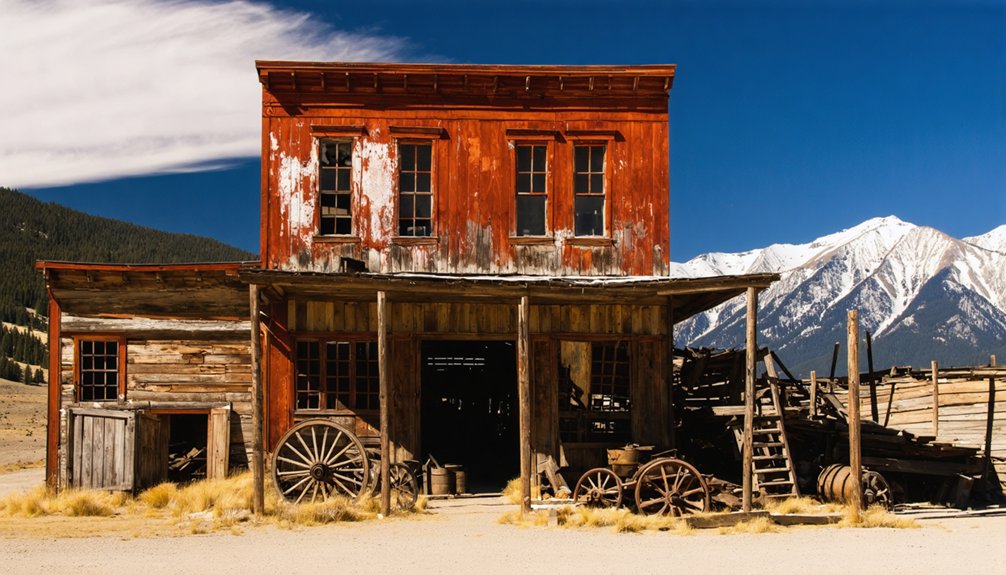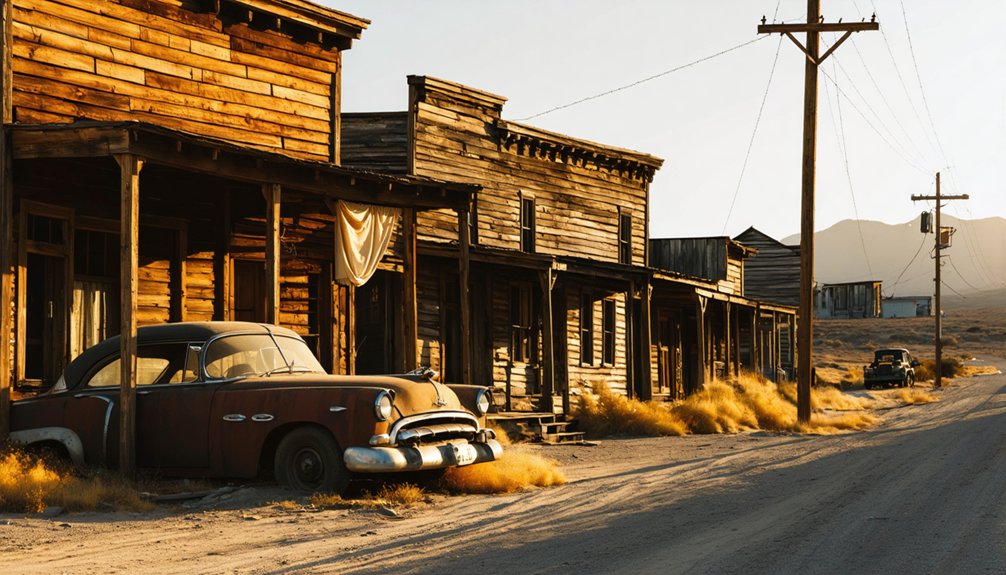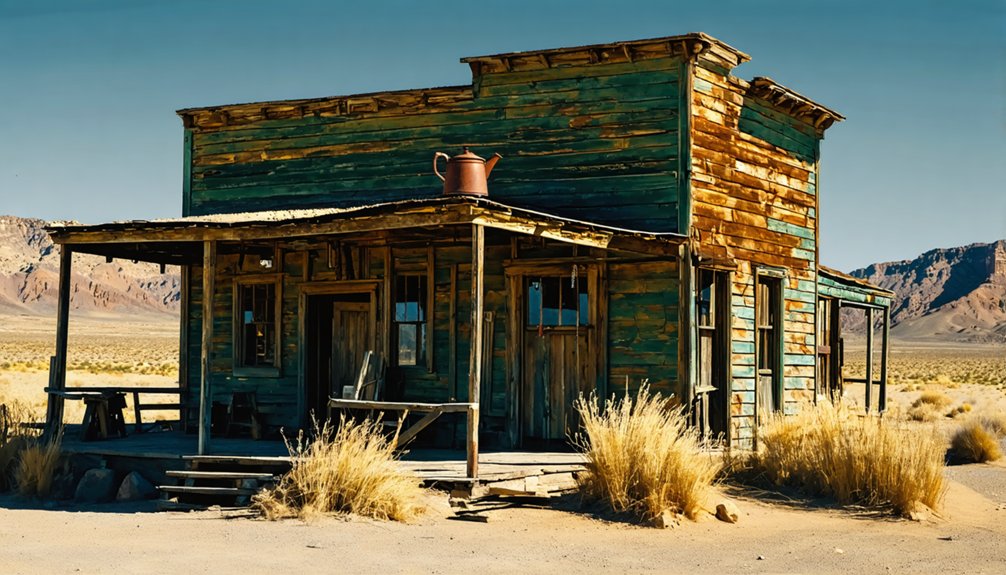
Utah’s ghost towns offer fascinating windows into the state’s mining past. You’ll discover remarkably preserved sites like Silver Reef with its beehive kilns, Grafton’s photogenic adobe buildings, and Ophir’s authentic mining artifacts. Each abandoned settlement tells unique stories—from Frisco’s lawless silver empire to Sego’s immigrant coal community. Visit during spring or fall with sturdy shoes and respect for historical preservation. The silent remnants await your exploration beyond the well-traveled path.
Key Takeaways
- Silver Reef features a restored Wells Fargo Express building and remains of beehive-shaped kilns from its silver mining heyday.
- Grafton offers well-preserved adobe structures including a schoolhouse and cemetery dating to 1862, famously featured in “Butch Cassidy.”
- Ophir maintains original mining artifacts alongside preserved structures like its historic schoolhouse and post office.
- Visit in spring or fall for comfortable temperatures, early mornings for better photography, and weekdays to avoid crowds.
- Bring sturdy shoes, water, maps, stay on established paths, and never remove artifacts to support preservation efforts.
The Silver Legacy of Silver Reef: Utah’s Desert Mining Marvel
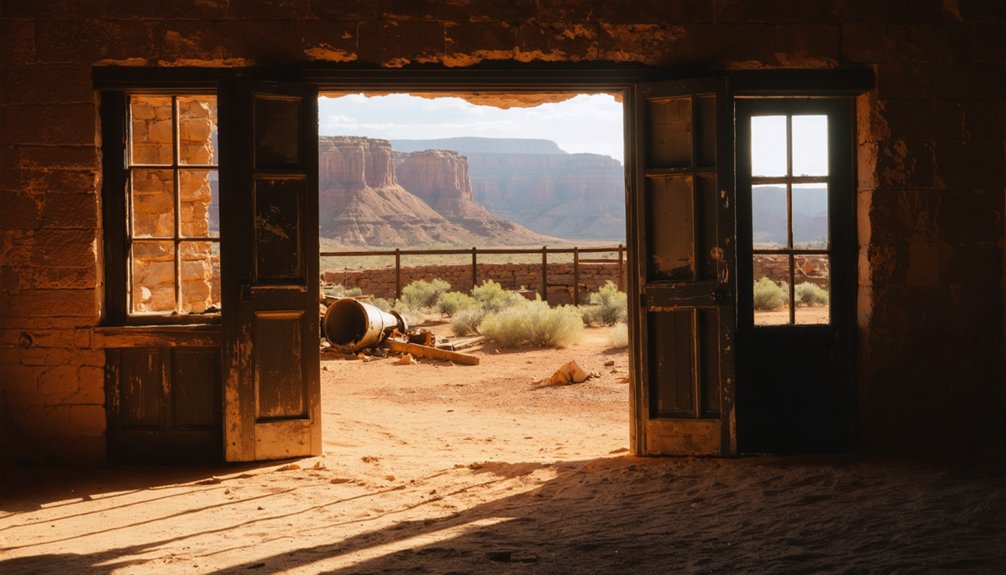
While many ghost towns scatter Utah’s landscape, few possess the remarkable legacy of Silver Reef, a desert mining marvel that emerged from an unlikely geological anomaly.
You’ll discover the world’s only commercial silver mining operation in sandstone here, producing over 7.5 million ounces through 400 mine openings between 1875-1884.
When you visit this ghost town today, the restored Wells Fargo Express building stands as a monument to the once-thriving community of 2,000 residents whose fortunes rose and fell with silver prices. The town experienced a brief mining resurgence in 1916 when the Silver Reef Consolidated Mining Company resumed operations in the area.
Unlike conventional mining sites, Silver Reef’s shallow mines rarely exceeded 350 feet deep. The booming economy once supported nine grocery stores and numerous other businesses along its mile-long main street.
The miners of Silver Reef worked close to daylight, with shafts burrowing barely 350 feet into the desert sandstone.
Despite its brief heyday, the district generated approximately $25 million in ore—an extraordinary sum that couldn’t prevent its rapid abandonment when silver prices plummeted and water flooded the mines.
Grafton: Where Pioneer Life and Hollywood History Converge
Unlike Silver Reef’s glittering history of mineral wealth, Grafton stands as a symbol of agricultural persistence amid nature’s harshest challenges.
When you visit this riverside settlement, you’ll walk where five Mormon families first established their cotton-growing community in 1859.
Pioneer struggles defined Grafton’s existence—residents repeatedly rebuilt after devastating flood challenges, including “The Great Flood” of 1862 that forced complete relocation.
The town’s architectural heritage remains impressively intact, with the two-story adobe schoolhouse and 1877 John Wood Home still standing as monuments to community resilience.
The cemetery established in 1862 contains graves of early settlers and victims of the Black Hawk War, illustrating the dangers pioneers faced on the frontier.
Though the last residents departed in 1944 after decades of battling Virgin River floods and Native American conflicts, Grafton’s legacy lives on as the most photographed ghost town in the American West, immortalized in numerous Hollywood productions including the iconic 1969 film Butch Cassidy and the Sundance Kid which won four Academy Awards.
Ophir’s Outdoor Museum: a Living Glimpse Into Mining Heritage
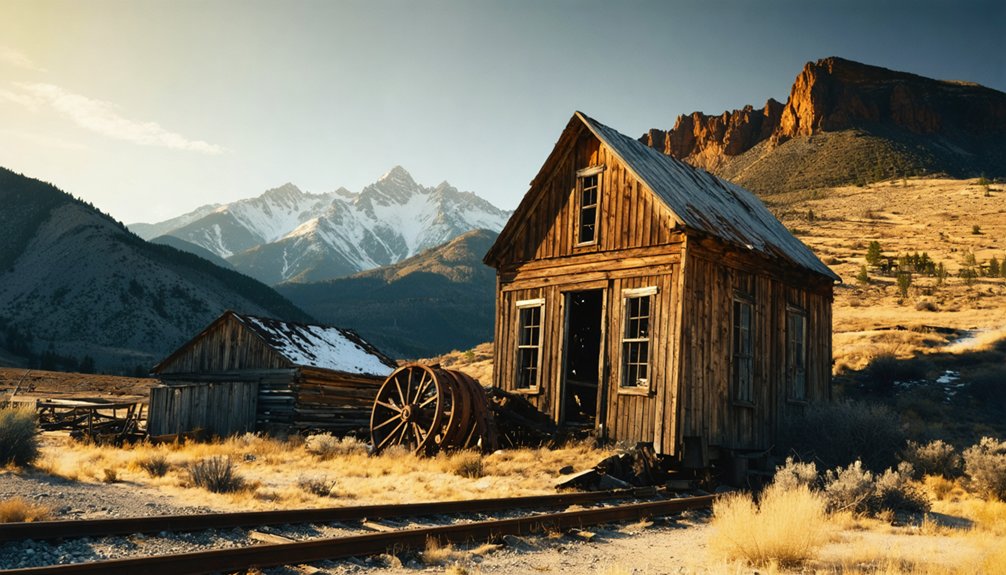
Nestled in the rugged embrace of the Oquirrh Mountains, Ophir stands as a remarkable outdoor museum chronicling Utah’s mining legacy. Founded in 1870 after soldiers discovered valuable mineral deposits, this once-thriving boomtown of 6,000 has transformed into a living representation of the state’s extraction history.
You’ll walk through preserved structures that showcase Ophir’s heritage—a reconstructed schoolhouse, post office, and various homes maintained by dedicated volunteers. The train car visitor center serves as your gateway to mining landmarks that once yielded $13 million in ore during their heyday. Many of these historical buildings include original mining artifacts on display, giving visitors an authentic glimpse into the past.
Though officially disincorporated in 2016 with fewer than 40 residents remaining, Ophir’s cultural significance endures. The Utah Adventure Family organization has recognized Ophir as a historical site worth preserving for future generations. When you explore this scenic canyon, you’re not just visiting a ghost town—you’re experiencing a carefully preserved chapter of American frontier resilience.
The Infamous Rise and Fall of Frisco’s Silver Empire
Deep in the San Francisco Mountains of Utah, the story of Frisco unfolds as one of America’s most dramatic mining sagas.
You’ll find its origins in the 1875 discovery of the Horn Silver Mine, which sparked Frisco’s rise to prominence with ore yielding up to 200 ounces of silver per ton.
At its peak, Frisco boasted 6,000 residents, two smelters, and railroad connections shipping 150 tons daily.
The mine generated over $20 million by 1885, ranking among America’s top eight producers.
The town’s notorious reputation for lawlessness required Marshal Pearson to implement a shoot-on-sight policy due to rampant crime and frequent murders.
Frisco’s decline began abruptly on February 12, 1885, when a catastrophic cave-in collapsed tunnels to the seventh level.
Though no lives were lost, the disaster permanently sealed the richest deposits.
Despite continued operations, the town never recovered its former glory.
Five impressive beehive charcoal kilns were constructed to support the extensive smelting operations that processed the rich silver ore.
Sego: Coal Mining Memories Among the Book Cliffs
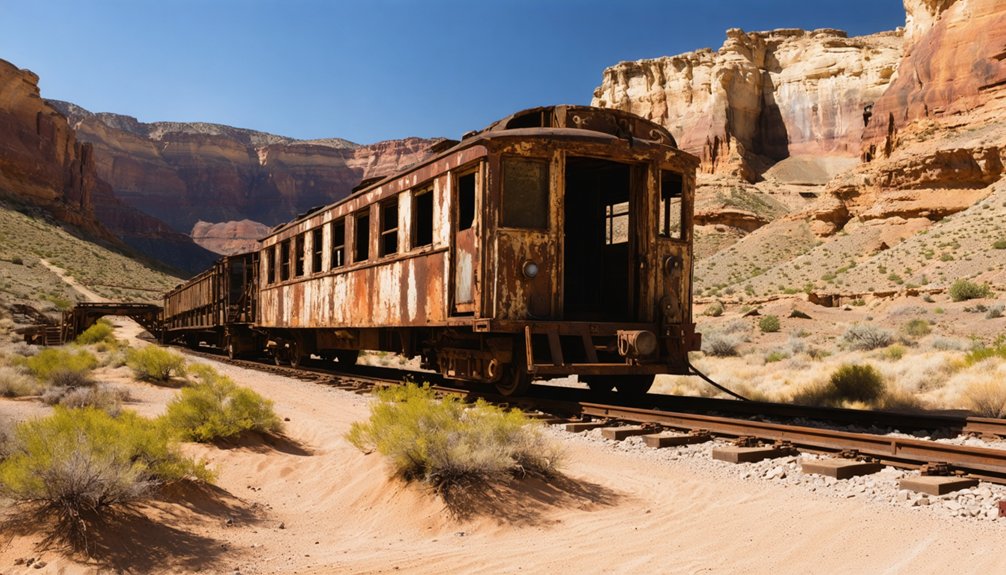
Among the rugged Book Cliffs of eastern Utah, Sego’s story begins with rancher Henry Ballard’s early 1900s discovery of a rich anthracite coal seam. This finding transformed the landscape as Ballard built a railroad spur to Thompson Springs, initiating Sego’s coal community history.
When B.F. Bauer purchased the property in 1911, he established the American Fuel Company, developing extensive infrastructure and renaming the settlement Neslin. By 1928, Sego became Utah’s busiest coal camp, producing 1,500 tons daily with 150 miners of diverse backgrounds. The area was home to a vibrant blend of Italian and Greek immigrants who maintained their cultural traditions throughout the town’s existence. Visitors today can still see the remains of the American Fuel Company Store among the deteriorating structures.
The town’s prosperity wouldn’t last. Following ownership changes, union formation, and economic challenges, a devastating tipple fire in 1949 accelerated Sego’s decline.
When railroads switched from coal to diesel, demand evaporated, and recurring flash floods ultimately sealed the town’s fate.
Old Iron Town: Industrial Ruins in Dixie National Forest
While coal mining defined Sego’s brief industrial era, another resource-driven settlement left its mark in Utah’s southwest corner.
Old Iron Town, originally established as Iron City in 1868, represents a critical chapter in Mormon industrial heritage. You’ll find this well-preserved ghost town about 25 miles west of Cedar City in Dixie National Forest.
Founded under Brigham Young’s direction, the settlement once produced up to seven tons of pig iron daily, supplying the Utah Western Railroad and the St. George LDS temple.
Iron flowed from Young’s industrial vision, feeding both railroad ambitions and sacred temple construction in Utah’s frontier economy.
The town’s most distinctive feature—a beehive-shaped charcoal kiln—stands remarkably intact amid foundry ruins and an Arastra grinding stone.
Two interpretive quarter-mile trails guide you through the remnants of this 97-person community that flourished briefly before economic pressures forced its abandonment by the 1880s, creating Utah’s first ghost town.
Visiting Utah Ghost Towns: Best Times and Essential Preparation Tips
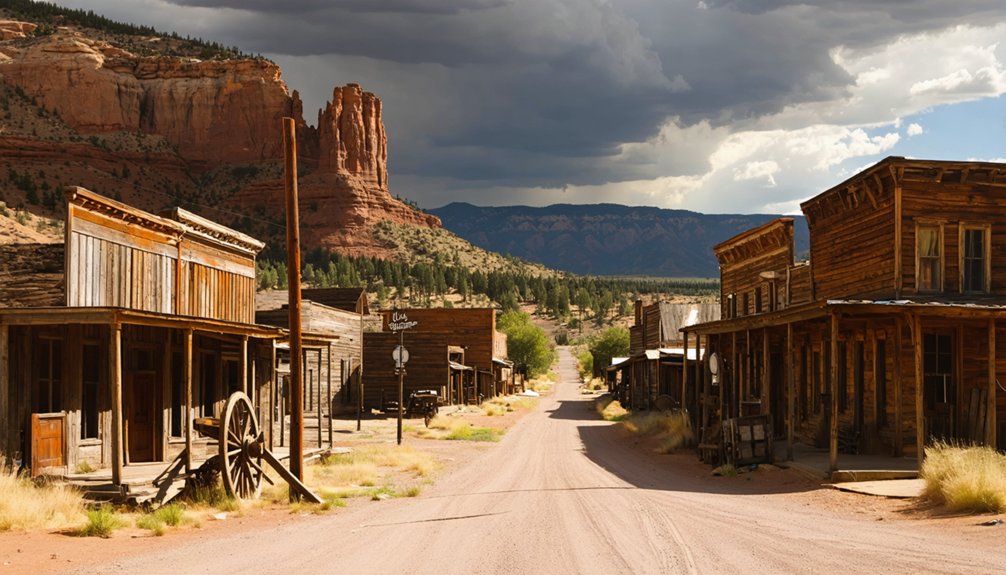
To make the most of your ghost town adventures in Utah, planning your visit during ideal seasons is essential. Spring and fall offer prime timing with comfortable temperatures, while weekday visits reduce crowds at popular sites like Grafton. Early mornings provide superior lighting for photography and cooler conditions.
Your essential gear should include sturdy closed-toe shoes, ample water, sun protection, and detailed maps or GPS coordinates—cellular coverage is unreliable in remote locations. Pack basic first aid supplies and respect preservation efforts by never removing artifacts.
Many sites lack amenities, so prepare for self-sufficiency. For enriched experiences, research sites beforehand and visit towns with interpretive signage. Consider combining ghost town explorations with trips to nearby national parks for well-rounded itineraries.
Photography and Preservation: Capturing History Responsibly
Photography at Utah’s ghost towns requires ethical awareness, as your documentation both preserves fragile history and risks its disturbance.
You’ll discover that golden hour lighting dramatically showcases weathered buildings, casting long shadows that emphasize architectural textures and historical features.
When capturing these abandoned settlements, your photographs serve as historical records—documenting decaying structures and artifacts that mightn’t survive future decades of Utah’s harsh desert climate.
Photography Ethics Matter
As ghost towns continue to capture the imagination of visitors and photographers alike, ethical considerations must guide our interactions with these fragile historical sites.
When documenting Utah’s abandoned settlements, you’re not just taking pictures—you’re becoming a steward of history.
Always verify property ownership before entering sites and respect posted signage. Your artistic vision doesn’t override private property rights.
Once on-site, stay on established paths and never remove artifacts, no matter how small or seemingly insignificant.
Consider the implications of responsible sharing before posting your images online. Avoid disclosing precise locations of vulnerable sites or posting photographs that might encourage damaging behaviors.
Your restraint helps preserve these irreplaceable windows into the past for future generations to discover and appreciate on their own terms.
Preservation Through Documentation
Beyond capturing beautiful imagery, properly documenting Utah’s ghost towns serves as a critical preservation tool that extends their cultural legacy.
old west architectural styles explained provide insight into the construction techniques and materials used in these historic sites. By studying these styles, enthusiasts and preservationists can better appreciate the unique character of each ghost town. Such understanding can also guide restoration efforts, ensuring that future generations experience these remnants of history as they were intended.
Your documentation strategies should align with UTSHPO and BLM standards, which require thorough pedestrian surveys and standardized Utah Archaeological Site Forms.
When you encounter artifacts during exploration, leave them in their original locations while carefully recording their presence through notes, maps, and photographs.
This documentation creates valuable records for researchers and preservationists while meeting preservation standards. Museums and interpretive panels further supplement these efforts by providing visual education about original building conditions and boom-time operations.
Remember that your thorough documentation supports more than just personal knowledge—it contributes to National Register listings, local preservation initiatives, and adaptive reuse projects that guarantee these historical treasures remain for future generations.
Light and Shadows
Four distinct lighting techniques transform ordinary ghost town photography into evocative historical documentation. Golden hour casts dramatic light across weathered structures, while black-and-white processing emphasizes textural details in cracked adobe and splintered wood.
Long-exposure at dusk creates ethereal effects as clouds move while buildings remain fixed. Even harsh midday light offers stark shadow play when properly composed.
When framing your shots, doorways and window frames provide natural composition elements. Through strategic light manipulation, you’ll capture Utah’s abandoned narrative—whether shooting through window lattices or illuminating forgotten corners with carefully placed flashlights.
Window reflections add depth to your visual storytelling.
Always respect these fragile historic sites by avoiding staged props or artifact manipulation. Seek permission before flying drones, and research location requirements beforehand.
Your responsible documentation preserves these silent testimonies to frontier life.
Frequently Asked Questions
Are Any Utah Ghost Towns Accessible for Visitors With Mobility Limitations?
You’ll find limited accessibility at Utah ghost towns. Eureka and Park City offer some visitor facilities with accessible trails, while most historic sites lack wheelchair-friendly infrastructure due to their rugged, preserved terrain.
What Wildlife Hazards Should Visitors Watch for in These Remote Areas?
You’ll find freedom in the wilderness until a mountain lion finds you! Practice wildlife safety by watching for rattlesnakes, bears, coyotes, and venomous spiders. Hazard awareness extends to abandoned mines harboring bats.
Is Ghost Hunting or Paranormal Investigation Permitted at These Locations?
Ghost hunting regulations require you to obtain property owner permission first. You’ll need to respect paranormal investigation ethics by avoiding trespassing—even abandoned sites have legal owners with enforceable rights.
Do Any Ghost Towns Have Overnight Camping or Lodging Options Nearby?
Like a beacon in the desert, you’ll find nearby camping and lodging options at several ghost towns. The Ghost Town Cabin Get-A-Way offers full amenities, while Fremont Indian State Park has camping regulations that support freedom seekers.
Are There Guided Tours Available With Historical Interpretation Services?
Yes, you’ll find guided tours with historical interpretation services in St. George (Thursday-Saturday at 7PM and 9:30PM), Salt Lake City’s Haunted Old Town Tour, and Harry Potter’s Zion Ghost Tour offering professional historical narratives.
References
- https://www.utahlifemag.com/blog/post/4-ghost-towns
- https://www.utahsadventurefamily.com/5-ghost-towns-in-utah-for-families/
- https://www.visitutah.com/things-to-do/history-culture/ghost-towns
- https://www.ksl.com/article/51308628/restored-utah-ghost-towns-that-should-be-on-your-summer-travel-bucket-list
- https://www.atlasobscura.com/things-to-do/utah/ghost-towns
- https://en.wikipedia.org/wiki/List_of_ghost_towns_in_Utah
- https://wchsutah.org/mining/harrisburg-mining-district2.pdf
- https://westernmininghistory.com/towns/utah/silver-reef/
- https://www.legendsofamerica.com/ut-silverreef/
- https://www.youtube.com/watch?v=IwI2R7TMWLA