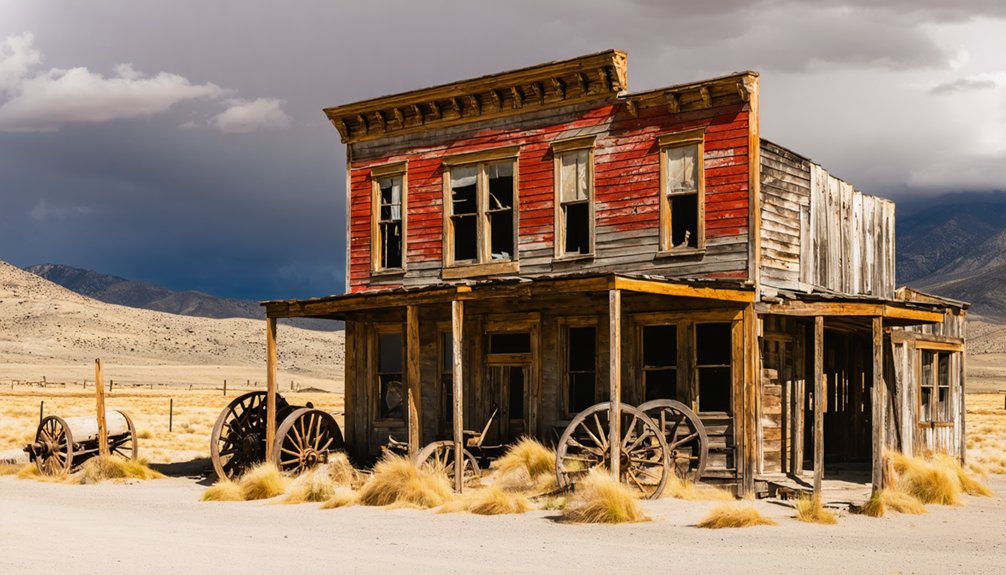
You’ll find over 3,800 documented ghost towns across the American West, with Texas leading at 511 abandoned settlements. Most emerged between 1849-1940 during mining booms, particularly after California’s Gold Rush brought 300,000 people westward. Railroad development between 1860-1900 determined which towns survived, as communities without rail connections often faced abandonment. Famous preserved sites like Bodie, California and Bannack, Montana showcase this dramatic boom-and-bust history that continues shaping western landscapes today.
Key Takeaways
- Western states lead the U.S. in ghost towns, with Texas having 511, California 346, and Arizona 131 abandoned settlements.
- Mining booms created explosive growth followed by abandonment when ore deposits depleted, like Bannack, Montana’s 10,000 peak population.
- The California Gold Rush of 1849 brought 300,000 people west, creating numerous towns that later became ghost towns.
- Railroad development between 1860-1900 determined town survival; settlements without rail connections often became abandoned.
- Famous preserved ghost towns include Bodie, California with 100+ structures and St. Elmo, Colorado as America’s best-preserved example.
Western States Lead the Nation in Ghost Town Numbers
Across America’s landscape, Western states dominate the nation’s ghost town statistics with striking numbers that reflect their unique historical development.
You’ll find Texas leading with 511 abandoned settlements, while California follows closely with 346 sites. These aren’t just urban legends—they’re documented remnants of America’s expansion era.
Kansas contributes 308 ghost towns, primarily from failed agricultural communities, while Arizona adds 131 sites born from mining booms.
Nevada and Montana each claim 106 abandoned settlements, proof of their mineral extraction heritage.
Historical preservation efforts now protect many Western ghost towns, transforming them from forgotten ruins into cultural landmarks.
Colorado’s 99 sites and Utah’s 136 locations demonstrate how quickly boomtowns turned to bust, leaving behind tangible evidence of pioneers who sought fortune and freedom across the frontier. Many of these communities experienced population decline that left once-thriving settlements completely abandoned. Wyoming contains 33 ghost towns that reflect Old West history, with South Pass City standing as one of the best-preserved examples.
Mining Booms and Busts Created Thousands of Abandoned Towns
You’ll find that mining discoveries triggered explosive population growth across the American West, with towns like Bannack, Montana swelling to 10,000 residents after its 1862 gold strike and Butte reaching over 100,000 inhabitants during World War I’s copper boom.
These settlements developed extensive infrastructure including railroads, hotels, saloons, and post offices to support their rapidly expanding communities. Mining operations extracted valuable resources including gold, silver, copper, and borax from locations like Death Valley during the early 20th century.
When ore deposits depleted or proved unprofitable, however, economic collapse followed swiftly—leaving behind thousands of abandoned settlements like Rhyolite, Nevada and Kennecott, Alaska as evidence of the boom-and-bust cycle that defined western mining. Towns like Spokane near Custer experienced this pattern, reaching peak prosperity in 1927 before complete abandonment by 1940.
Gold Rush Ghost Towns
When the California Gold Rush erupted in 1849, it triggered a massive migration of approximately 300,000 people from across the United States and abroad, establishing countless settlements that would later become some of America’s most famous ghost towns.
You’ll find striking examples like Bodie, now a National Historic Landmark preserved in “arrested decay,” and Portuguese Flat, which emerged and faded rapidly as miners chased elusive fortunes.
The gold rush created boom-and-bust cycles that defined the American West.
Towns like Goldfield, Nevada, briefly became the state’s largest city after its 1902 founding, while others disappeared within years when ore ran out. Many settlements like Calico, California thrived during the silver rush before eventually being abandoned as mining operations became unprofitable. The majority of these mining towns date from 1880-1940 during the period of westward expansion and industrialization.
Today, you can explore this mining heritage at preserved sites that showcase the dramatic rise and fall of frontier communities built on golden dreams.
Silver Mining Abandonment
While gold captured most of the headlines, silver mining created equally dramatic boom-and-bust cycles that left behind thousands of abandoned settlements across the American West.
You’ll discover these silver lodes produced extraordinary wealth before economic collapse forced entire communities to vanish overnight.
These ghost towns showcase remarkable mining heritage:
- Silver Reef, Utah – The first sandstone location to yield silver, becoming southern Utah’s most populous place during the 1870s-1880s boom before abandonment.
- Calico, California – California’s largest silver strike in 1881 generated over $20 million from 500+ mines before silver prices collapsed in the mid-1890s.
- Frisco, Utah – Known for lawlessness and crime, this notorious mining town declined after a major mine collapse in 1885.
At its peak, Calico’s population reached over 3,000 residents during the 1890s mining boom. Today, you can explore restored buildings, museums, and historic cemeteries that preserve these dramatic stories. Many of these abandoned settlements have attracted Hollywood films, showcasing their cinematic appeal and bringing their forgotten histories to modern audiences.
Railroad Development and Economic Shifts Shaped Settlement Patterns
You’ll find that railroad development fundamentally altered western settlement patterns between 1860 and 1900, as communities that secured rail connections thrived while those bypassed by tracks often withered into ghost towns.
The completion of four transcontinental railroads by 1900 created new economic centers around rail hubs, but simultaneously doomed established settlements that couldn’t adapt to changed transportation routes. Railroad construction costs ranged from $45,000 to $60,000 per mile, making companies highly selective about routes and forcing many existing towns to compete desperately for inclusion in the expanding networks.
Mining booms initially spawned thousands of towns across the West, yet many of these communities couldn’t survive the economic shifts that occurred when rail networks redirected commerce through more strategically located areas. The transcontinental railroad reduced freight costs to one-tenth of previous wagon transport, making rail-connected settlements dramatically more competitive than isolated communities.
Railroad Bypasses Caused Abandonment
- Lost traveler traffic – Small towns that depended on railroad stops for visitors and commerce saw their economies collapse overnight.
- Supply chain disruption – Farmers began purchasing goods from towns with railway stations where costs were remarkably lower.
- Economic isolation – Communities without rail access couldn’t compete economically and gradually emptied as residents relocated to connected areas.
Mining Booms Created Towns
Railroad bypasses weren’t the only force that created and destroyed entire communities across the American frontier.
You’ll find ghost town origins traced directly to mining discoveries that sparked massive population surges. When gold appeared at Sutter’s Mill in 1848, California’s rush began. Nevada’s Comstock Lode created Virginia City with 25,000 residents by 1859. Rhyolite exploded to 10,000 citizens within two years after Bullfrog’s 1904 gold strike.
These mining legacy communities developed sophisticated infrastructure as prosperity grew. Crested Butte built hotels, saloons, schools, and city halls following coal discoveries.
Railroad connections transformed temporary camps into economic hubs, while diverse immigrant labor created permanent settlements. Towns like Butte, Montana sustained growth into thriving cities, proving mining booms could generate lasting communities.
Economic Downturns Ended Communities
While mining booms created thriving communities, economic downturns and railroad development ultimately determined which settlements survived and which became ghost towns.
You’ll find that economic collapse struck hardest when multiple factors converged, creating a perfect storm for community decline.
The data reveals three critical patterns that sealed many towns’ fates:
- Railroad proximity determined survival – Towns 5-10 km from rail lines faced closure rates considerably higher than directly connected settlements.
- Mining dependence created vulnerability – Communities relying solely on extractive industries couldn’t adapt when corporations abandoned operations post-1880s.
- Infrastructure investment separated winners from losers – Survivors diversified their economies and maintained connections to broader markets.
Towns that couldn’t pivot beyond single industries found themselves isolated, unable to compete with better-connected rivals for residents and commerce.
Famous Ghost Towns That Draw Visitors Today
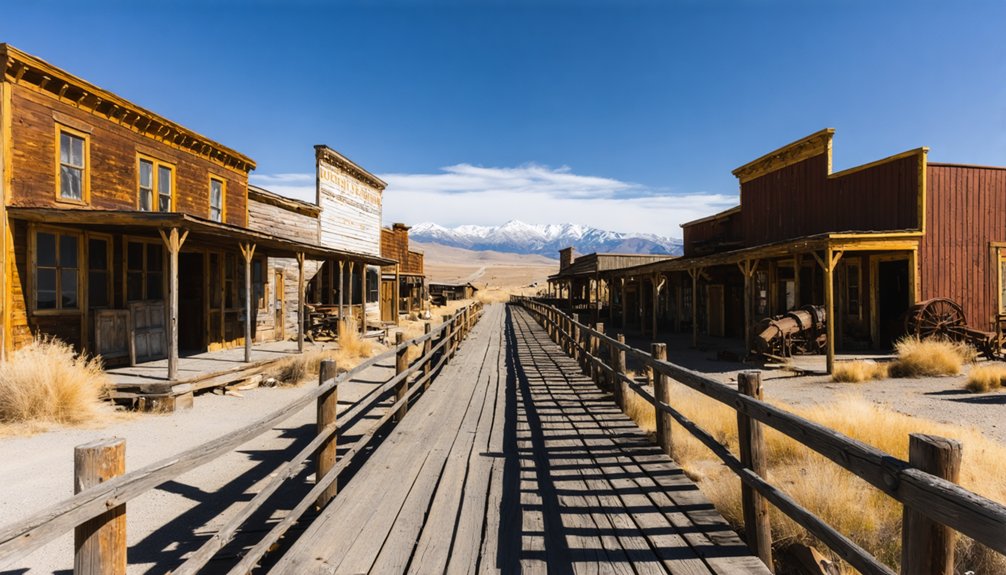
Today’s most enchanting ghost towns transform abandoned mining settlements into preserved windows to America’s frontier past.
You’ll discover Bodie, California‘s “arrested decay” preserving over 100 structures from its 10,000-resident peak, complete with saloons and Standard Mill tours.
Montana’s Bannack offers historical significance as the state’s original capital, where you can explore Sheriff Henry Plummer’s lawless legacy among 60 remaining buildings.
St. Elmo, Colorado stands as America’s best-preserved ghost town, featuring haunted attractions in its hotel and general store.
Wyoming’s South Pass City provides Wild West activities near the Continental Divide, while California’s Calico delivers mine tours and western entertainment.
These destinations let you experience authentic frontier life through self-guided exploration, ghost tours, and preserved mining operations.
Texas Dominates With Over 500 Ghost Towns Statewide
Across America’s vast landscape of abandoned settlements, Texas stands alone with an extraordinary concentration of ghost towns that dwarfs every other state. Geotab’s national compilation documents 511 ghost towns in Texas****—the highest count nationwide from their mapping of 3,800 sites across America.
You’ll discover these abandoned communities aren’t randomly scattered. Wilson County leads with 31 ghost towns, while areas around New Braunfels contain 25 within just 25 miles. Railroad bypasses, oil field depletion, and agricultural collapse created this vast graveyard of dreams.
Key patterns you’ll notice:
- Geographic clustering follows historic rail lines and resource boom areas
- Preservation states range from completely barren sites to semi-abandoned communities with architectural remnants
- Cultural significance varies—some sites offer heritage tourism while others remain unmarked
This ghost town preservation challenge reflects Texas’s complex settlement history and economic transformation.
Modern Ghost Towns Continue Emerging Across Rural America

Although historic ghost towns capture our imagination with tales of gold rush busts and railroad abandonment, America’s ghost town phenomenon continues evolving in real time across modern rural communities.
You’ll find vacancy trends revealing stark realities: Montgomery, Alabama ZIP codes show 16-19% vacant homes, while zombie properties proliferate as owners abandon pre-foreclosure homes.
Population shifts drive these modern transformations, with major cities like San Francisco losing 7.4% of residents between 2020-2023, and St. Louis experiencing 6.6% decline alongside 22% fewer building permits.
Major cities hemorrhage residents as building activity plummets, revealing the economic forces reshaping America’s urban landscape in real time.
Rural towns face similar pressures as nearly 300,000 residents fled Illinois in 2023.
Over 3,800 mapped ghost towns now exist nationwide, demonstrating how economic downturns create contemporary abandoned communities across America’s changing landscape.
Frequently Asked Questions
What Legal Issues Exist When Visiting Abandoned Ghost Towns?
You’ll face trespassing laws with fines up to $2,000 and potential jail time when entering private property without permission. Liability concerns include civil lawsuits for damages and financial responsibility for any harm you cause.
How Do Property Owners Handle Ghost Town Land and Buildings?
You’ll find property owners exercise complete property rights through strategic land management, conducting title searches, environmental assessments, and historic preservation compliance while balancing restoration costs with heritage conservation for investment returns.
What Safety Hazards Should Visitors Expect in Ghost Towns?
You’ll face structural instability from collapsing buildings, hidden mine shafts, toxic contamination from old mining operations, oxygen-deficient spaces, wildlife encounters including rattlesnakes, and remote locations where emergency response is delayed or impossible.
Can People Legally Metal Detect or Collect Artifacts in Ghost Towns?
You’ll face strict metal detecting laws and artifact collection guidelines at most ghost towns. You’re legally prohibited on federal lands, historic sites, and private property without written permission—violations risk felony charges.
How Are Ghost Towns Different From Regular Abandoned Buildings?
Unlike single abandoned buildings, you’ll find ghost towns possess entire community infrastructure, cultural significance tied to regional economic cycles, and historical preservation value from their collective settlement patterns and municipal-scale abandonment stories.
Exploring abandoned places in California reveals the remnants of once-thriving communities, showcasing the architectural styles and social fabric of different eras. Each site holds stories of dreams interrupted and fortunes lost, making them fascinating destinations for photographers and urban explorers alike. As you wander through these forgotten spaces, you’ll uncover a unique blend of history and nature reclaiming what was once man-made.
References
- https://www.loveexploring.com/gallerylist/188219/the-us-state-with-the-most-ghost-towns-revealed
- https://themortgagepoint.com/2024/10/25/americas-new-ghost-towns/
- https://devblog.batchgeo.com/ghost-towns/
- https://literaryfictions.com/articles/ghost-towns-in-the-american-west/
- https://www.geotab.com/ghost-towns/
- https://www.youtube.com/watch?v=aTbMdOZRZO4&vl=en
- https://www.texasstandard.org/stories/texas-population-boom-ghost-towns-rural-urban-suburban-shift/
- https://kkyr.com/ghost-towns-of-america-texas-has-the-most/
- https://en.wikipedia.org/wiki/Lists_of_ghost_towns_in_the_United_States
- https://247wallst.com/special-report/2018/11/02/30-american-ghost-towns-3/