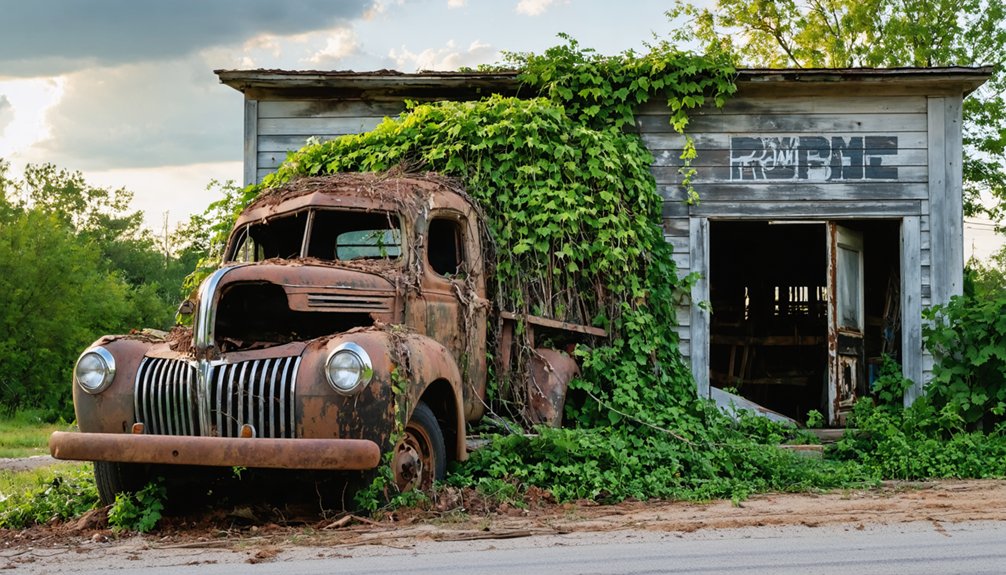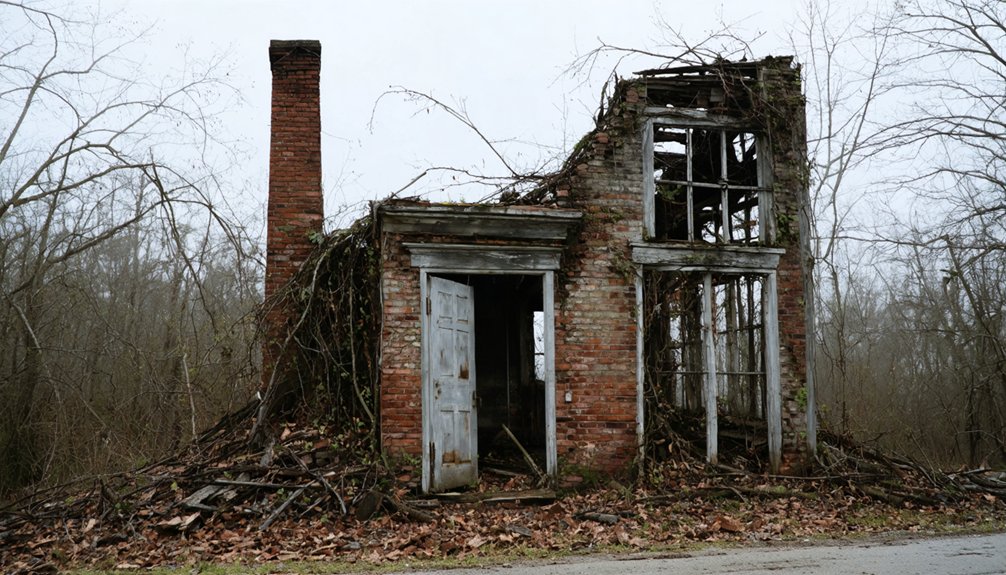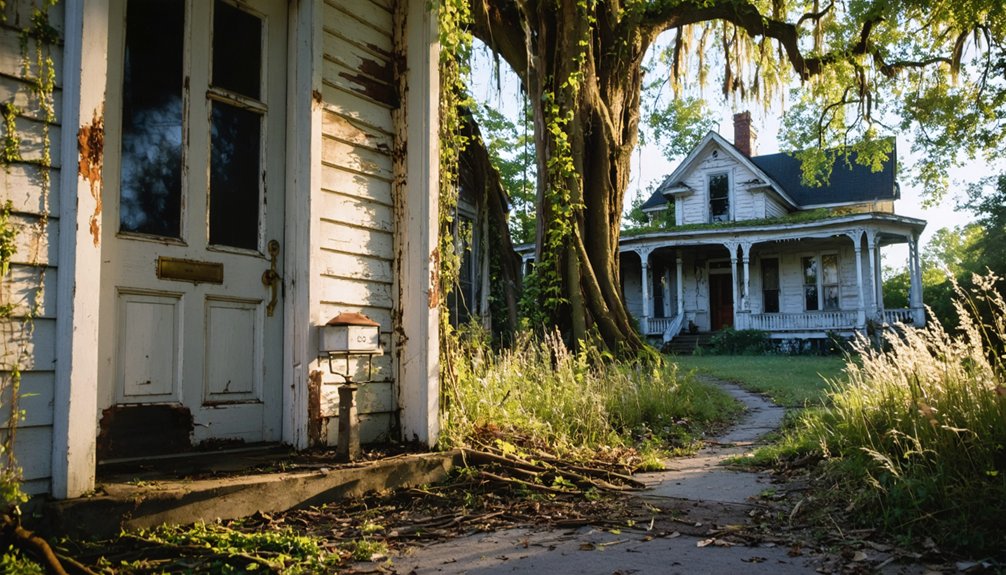
You’ll find Alabama’s most famous ghost towns include Old Cahawba, the state’s first capital abandoned after flooding and political relocation in 1826; Arcola, a French Bonapartist settlement from the 1820s now reduced to a single plantation house; Bellefonte, which lost its county seat status and was completely abandoned by the 1920s; and Spectre, the fictional movie set from Tim Burton’s “Big Fish” that’s authentically decaying on Jackson Lake Island. Each site tells Alabama’s complex story of ambition meeting harsh reality.
Key Takeaways
- Old Cahawba was Alabama’s first state capital (1820-1826) and later a major cotton distribution center with over 3,000 residents.
- Arcola was founded by French Bonapartists in the 1820s as part of the Vine and Olive Colony settlement.
- Bellefonte lost its county seat status in 1859 and was completely abandoned by the 1920s, leaving only ruins.
- Claiborne grew to 5,000-6,000 residents before yellow fever epidemics and Civil War devastation caused its decline.
- Spectre is a fictional ghost town created for Tim Burton’s “Big Fish” that visitors can still explore today.
Arcola: From French Glory to River Landing Ruins
While most Alabama ghost towns succumbed to economic collapse or natural disasters, Arcola’s demise followed a more unusual path—absorption into the very plantation system that replaced its founders’ utopian dreams.
You’ll find Arcola’s origins in the early 1820s when former French Bonapartists established this French Settlement as part of their ambitious Vine and Olive Colony. They named it after Napoleon’s victory at the Battle of Arcola, with Frederic Ravesies becoming the first settler at what’s now Hatch Plantation.
Located on the Black Warrior River’s south bank, Arcola thrived through River Trade during the 1820s-1830s. The settlement served as a vital River Landing in the 1830s, facilitating commerce and transportation along the waterway.
However, American settlers gradually purchased French land grants, transforming the communal village into adjoining plantations. By the 1850s, the original French community had vanished, leaving only the Alfred Hatch Place as architectural evidence of this unique settlement experiment. Alfred Parker Hatch constructed his impressive Plantation House in 1856, which became the centerpiece of a sprawling 3,000-acre estate.
Bellefonte: The County Seat That Never Rose Again
However, Bellefonte history reveals fatal decisions: rejecting railroad access, suffering Civil War devastation, and losing the county seat to Scottsboro in 1859. By the 1920s, the entire town was abandoned, leaving only a chimney from a former inn and the Old Bellefonte Cemetery as reminders of this once-thriving community that peaked at around 100 residents in 1883. Today, the ghost town sits near the Bellefonte Nuclear Generating Station, creating an intriguing contrast between Alabama’s abandoned past and its modern energy infrastructure.
Old Cahawba: Alabama’s Lost First Capital
Political controversy drove the legislature elsewhere in 1826, but Cahawba didn’t die immediately.
You’d have witnessed cotton commerce revive the town, with railroad arrival in 1859 boosting population past 3,000. The town became a key distribution center for cotton in the Black Belt, with wealthy planters constructing impressive two-story mansions throughout the area.
The Civil War brought Confederate prison operations, yet flooding and economic decline sealed Cahawba’s fate. The devastating February 1865 flood struck the final blow to the struggling community.
Today’s Cahawba history reveals archaeological significance through preserved Mississippian mounds and colonial ruins at Old Cahawba Archaeological Park.
Spectre: Hollywood’s Haunting Legacy Near Montgomery
Unlike Cahawba’s century-long decline, Alabama’s most famous ghost town died before it ever lived.
A fictional town’s deliberate decay offers visitors authentic haunting atmosphere that real ghost towns spent decades creating naturally.
Spectre history begins in 2003 when Hollywood constructed this fictional town on Jackson Lake Island for Tim Burton’s “Big Fish.” Built as movie facades in six months, the set was designed to decay.
Today’s visitor experiences reveal nature reclaiming Hollywood’s creation. You’ll find:
- Weathered church steeples and sagging house facades scattered across the island
- Iconic shoes still strung between artificial trees, now moss-covered and surreal
- Flood-damaged structures creating an authentically haunting atmosphere
Located twenty minutes from Montgomery, this privately-owned attraction charges modest entry fees. Free-roaming goats now wander the abandoned streets, adding an unexpected element to the surreal landscape.
You’ll encounter unstable structures, collapsed roofs, and flooding risks—reminders that Spectre’s abandonment wasn’t historical necessity but deliberate artistic vision. A devastating fire incident destroyed the town’s commercial district, further contributing to the authentic ruins atmosphere that draws film enthusiasts and urban explorers alike.
Blakeley: Civil War Fortress Reclaimed by Nature
You’ll discover Historic Blakeley State Park‘s 2,100 acres preserve Alabama’s largest Civil War battlefield, where Confederate earthworks built in 1865 still wind through Baldwin County forests.
The park’s boyaux fortification ruins mark where 16,000 Union troops overwhelmed Confederate defenses on April 9, 1865, in the war’s final major Western Theater battle. Fort Blakeley was defended by approximately 2,500 men under Brig. Gen. St. John R. Liddell’s command.
Nature has steadily reclaimed this Civil War fortress over 160 years, transforming military earthworks into moss-covered mounds beneath towering pines and hardwoods. The Confederate defenses included buried land mines that continued to pose dangers to federal soldiers even after the battle ended.
Historic Blakeley Park Features
Your exploration reveals three compelling historic features:
- Jury Oak shelter – where early court proceedings convened beneath ancient branches
- Seay Pavilion – commemorating the town’s governmental legacy
- Old House Site – marked by a landmark live oak tree
This Civil War Heritage site operates as a Class A battlefield, offering guided tours and educational programming that illuminate Alabama’s complex past.
Boyaux Fortification Ruins
Nine massive earthen redoubts stretch across Historic Blakeley State Park‘s bluffs, marking where Confederate defenders made their final stand in what became the Civil War’s last major battle.
You’ll discover these interconnected fortifications represent sophisticated boyaux archaeology, revealing how 3,000 Confederate troops held defensive lines against 16,000 Union forces during April 1865’s decisive siege.
Walking the preserved trenches, you’re exploring military history that culminated on April 9—the same day Lee surrendered at Appomattox.
The earthworks showcase remarkable preservation since masonry fortifications elsewhere crumbled while these dirt ramparts endured.
You’ll find rifle pits, abatis obstacles, and Union siege approaches within 1,000 yards of Confederate positions.
These surviving fortifications offer unprecedented insights into Civil War defensive construction techniques and battlefield archaeology spanning America’s final major engagement.
Nature Reclaims Civil War
Confederate earthworks once thundered with artillery fire, towering pines and hardwoods now create cathedral-like canopies over America’s best-preserved Civil War battlefield.
You’ll discover nature’s powerful reclamation of Fort Blakeley, where 16,000 Union troops overwhelmed Confederate defenses on April 9, 1865—the same day Lee surrendered at Appomattox.
Historic Blakeley State Park’s 2,100 acres preserve this dramatic transformation:
- Moss-draped trenches wind through dense woodland where soldiers once fought hand-to-hand
- Wildflower meadows bloom across former artillery positions that held 40 Confederate cannons
- Ancient oak trees root deep into earthworks built by enslaved men and Confederate soldiers
You’re walking through both a ghost town and battlefield, where nature reclamation has created Alabama’s largest National Register Historic Site, protecting centuries of history from Archaic peoples through America’s bloodiest conflict.
Claiborne: The River Bluff Giant Felled by Disease
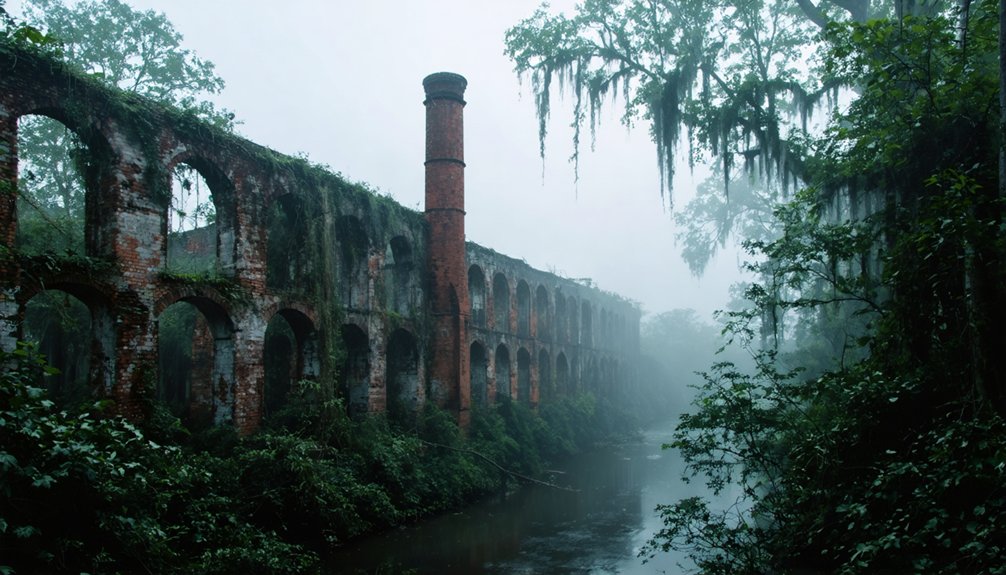
When General Ferdinand Claiborne established Fort Claiborne in 1813 during the Creek War, he couldn’t have envisioned the thriving metropolis that would rise from his simple stockade on the Alabama River bluff.
By the 1820s, you’d find yourself in one of Alabama’s largest cities with 5,000-6,000 residents bustling around cotton gins and steamboat landings. The town attracted diverse settlers, including a Jewish community that established Alabama’s early Jewish heritage by acquiring cemetery land in 1843 and requesting a Sefer Torah by 1846.
However, yellow fever and cholera epidemics devastated the population. Civil War occupation and post-war railroad bypasses sealed Claiborne’s fate.
Disease, war, and progress conspired against Claiborne, transforming Alabama’s once-bustling river port into a forgotten relic of antebellum prosperity.
Today, you’ll discover only overgrown ruins and three historic cemeteries marking this once-mighty river port.
Exploring What Remains: Visiting Alabama’s Abandoned Places
Although many of Alabama’s ghost towns have vanished completely, several sites preserve enough remnants for modern explorers to walk through centuries of forgotten history.
Historical preservation efforts have transformed these locations into accessible destinations for abandoned exploration.
Old Cahawba Archaeological Park offers the most thorough experience, where you’ll discover:
- Grid streets cutting through dense forest – original city blocks now reclaimed by jungle-like vegetation
- Earthen mounds and defensive walls – remnants from 11th-16th century Mississippian culture tribes
- Capitol Street foundations – scattered pottery shards marking Alabama’s first state capital from 1819
St. Stephens Historical Site provides another exceptional opportunity, featuring preserved street signs and faux home-fronts from the 1789 Spanish fort settlement.
These archaeological sites offer tangible connections to Alabama’s territorial past.
The Rise and Fall Patterns of Alabama’s Ghost Towns
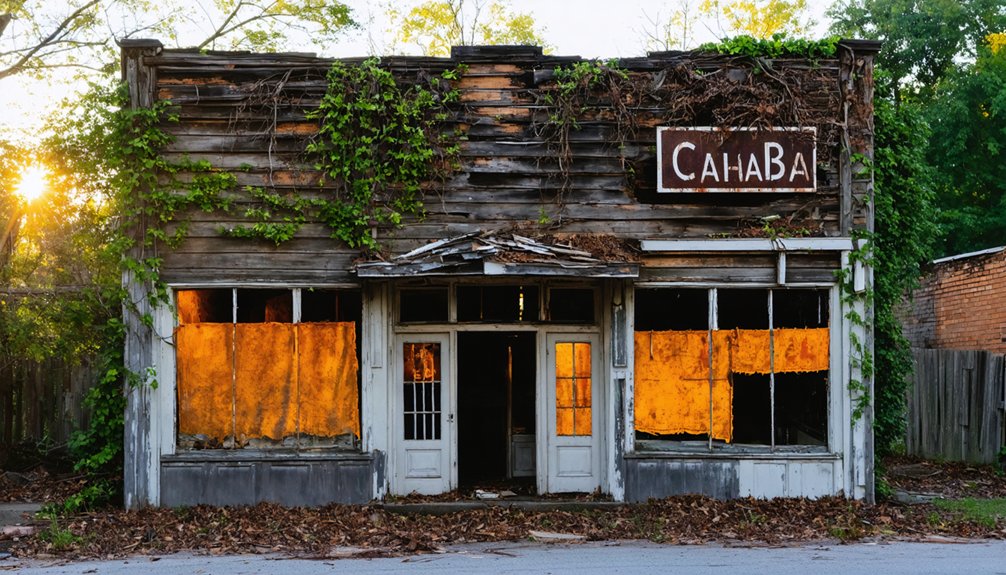
You’ll notice Alabama’s ghost towns followed predictable cycles of growth and decline across the 19th and early 20th centuries.
Economic boom catalysts like river commerce, railroad development, mining operations, and military activity initially drew settlers to establish thriving communities that could reach populations of several thousand residents.
However, these same towns couldn’t survive when flooding destroyed infrastructure, natural resources were exhausted, transportation routes shifted, or government functions relocated to more viable locations.
Economic Boom Catalysts
Alabama’s ghost towns emerged from three distinct economic catalysts that created rapid population booms followed by equally dramatic collapses.
You’ll find these ghost town dynamics consistently shaped settlement patterns across the state, where prosperity and abandonment often occurred within decades.
The primary economic catalysts were:
- Political designation – Capital and county seat status triggered land speculation, with prices jumping from $1.25 per acre to hundreds of dollars during boom periods like Cahawba’s 1819-1820s surge.
- Transportation hubs – River ports and railroad connections concentrated commerce, creating rapid expansion when steamboat landings or rail spurs arrived.
- Commodity extraction – Cotton, coal, iron, and timber booms generated purpose-built towns with company housing and infrastructure, but left communities vulnerable when markets collapsed or resources depleted.
Decline and Abandonment
Once these economic booms peaked, Alabama’s boomtowns faced inevitable decline through four interconnected forces that systematically dismantled their foundations.
Environmental disasters struck first—repeated flooding destroyed Old Cahawba’s buildings while epidemics like malaria and yellow fever decimated populations.
Political shifts followed as communities lost county seat status and government relocated essential services elsewhere.
Transportation changes proved devastating when railroads bypassed existing towns, redirecting commerce to new routes.
Finally, economic contraction hit through market collapse and industry closures that eliminated employment opportunities.
These abandonment reasons created distinctive ghost town characteristics you’ll recognize today: crumbling courthouse foundations, overgrown cemetery plots, and scattered brick chimneys marking former homesteads.
The interconnected nature of decline meant once one pillar collapsed, others quickly followed, transforming thriving communities into Alabama’s haunting archaeological landscapes.
Frequently Asked Questions
Are There Any Other Ghost Towns in Alabama Besides These Six?
You’ll find other notable ghost towns throughout Alabama, including Cahawba, the first state capital, and Bellefonte with significant historical significance. These settlements hold documented stories spanning Alabama’s territorial period through industrial decline.
In addition to Cahawba and Bellefonte, there are other historic ghost towns in Alabama that offer unique insights into the past. Places like Greensboro and Verbena allow visitors to explore remnants of the state’s rich history, showcasing the architectural styles and cultural influences of their time. Each site tells a story, inviting exploration and reflection on how these towns have shaped the identity of Alabama today.
Additionally, visitors can experience various historic festivals in Alabama ghost towns that celebrate the heritage of these unique locations. These events often feature traditional music, craft exhibits, and local cuisine, bringing the towns’ histories to life. Attendees can immerse themselves in the vibrant culture that once thrived in these now-silent communities, making for a memorable experience.
What Safety Precautions Should Visitors Take When Exploring These Abandoned Sites?
You’ll need exploration safety gear including sturdy boots, flashlights, and first-aid supplies. Get owner permission first, watch for structural hazards like rotten floorboards, and practice essential abandoned site precautions by traveling in groups.
Can You Camp Overnight at Any of These Ghost Town Locations?
You can’t camp overnight at most Alabama ghost towns due to camping regulations protecting archaeological sites. Old Cahawba prohibits overnight stays, though you may request special overnight permits for research purposes only.
Which Ghost Town Has the Most Preserved Buildings Still Standing Today?
Cahawba offers you the most preserved architecture among Alabama’s ghost towns. You’ll find the intact Barker-Kirkpatrick House, St. Luke’s Church, scattered structures throughout Old Cahawba Archaeological Park, plus Fambro House ruins maintaining significant historical significance.
Are Guided Tours Available for Any of These Alabama Ghost Towns?
You’ll discover guided explorations at Old Cahawba and Historic Blakeley Park offer scheduled tours with historical insights. Self-guided options exist, though some forgotten settlements require coordination with local societies for safe access.
References
- https://thebamabuzz.com/5-alabama-ghost-towns-to-put-on-your-bucket-list/
- https://alabamabucketlist.com/ghost-towns-in-alabama/
- https://www.onlyinyourstate.com/experiences/alabama/alabama-ghost-towns
- https://deepsouthurbex.com/2020/01/02/6-south-alabama-ghost-towns/
- https://digitalalabama.com/alabama-ghost-towns/alabama-ghost-towns/9449
- https://freepages.history.rootsweb.com/~gtusa/usa/al.htm
- https://www.abandonedalabama.com
- https://digitalalabama.com/alabama-ghost-towns/arcola-alabama/2798
- https://www.youtube.com/watch?v=aHvED-TRT_8
- https://kids.kiddle.co/Arcola