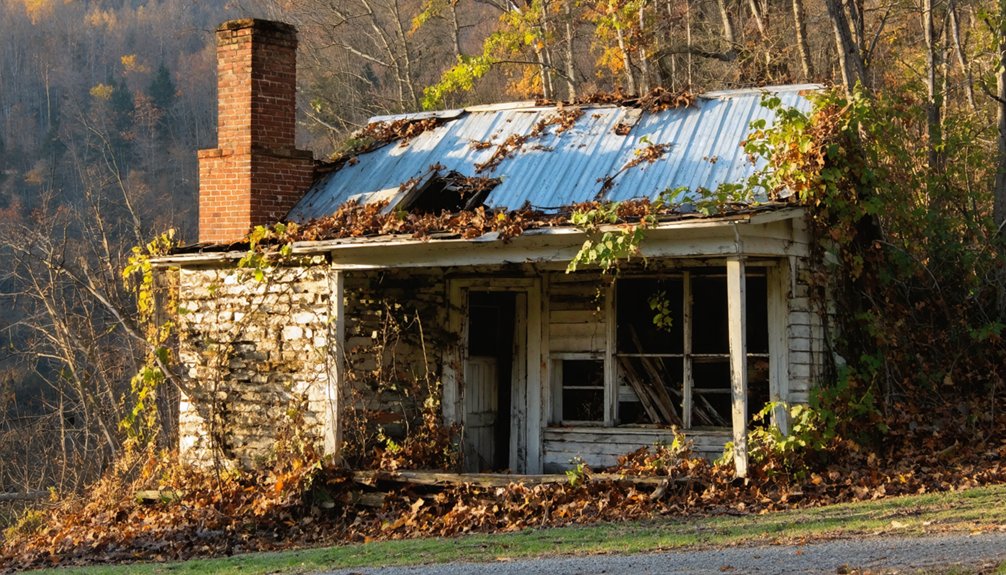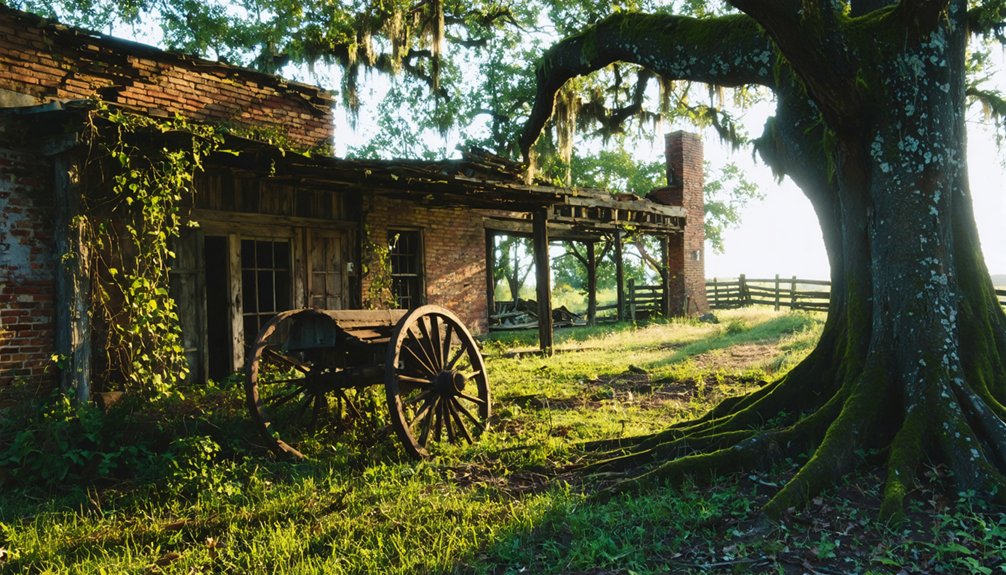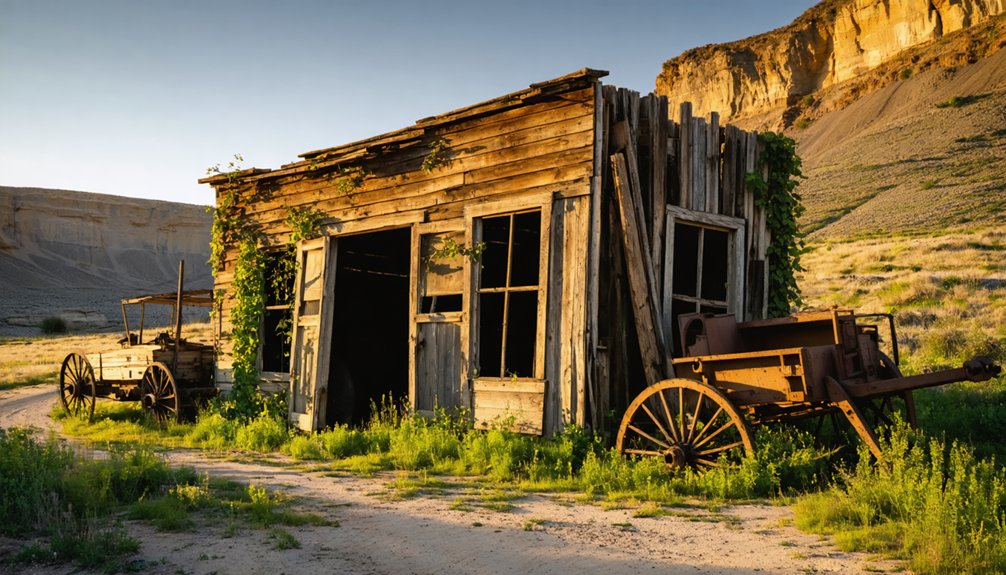
You’ll find Arkansas’s most famous ghost towns scattered across the Ozark Mountains, where boom-and-bust cycles left fascinating ruins. Rush became the state’s largest zinc mining center before post-WWI price crashes ended operations by 1919. Monte Ne’s luxury resort now lies submerged beneath Beaver Lake, visible only during droughts. Old Davidsonville served as Arkansas’s first county seat until floods forced abandonment in the 1830s. Graysonia vanished completely after its massive lumber mill closed, while Calico Rock contains America’s only ghost town within city limits. Each settlement tells a unique story of Arkansas’s industrial heritage.
Key Takeaways
- Rush was Arkansas’s largest zinc mining center, booming during WWI with up to 5,000 residents before collapsing in 1919.
- Monte Ne resort featured massive log hotels and gondolas before being submerged underwater by Beaver Lake in 1966.
- Old Davidsonville served as Arkansas’s first county seat and steamboat port before abandonment due to floods and economic collapse.
- Graysonia peaked at 1,000 residents with a massive sawmill producing 150,000 board feet daily before disappearing by 1930.
- Calico Rock contains America’s only ghost town within city limits, featuring six blocks with twenty-three original structures remaining.
Rush: Arkansas’s Largest Zinc Mining Center
While prospectors initially mistook the shiny metallic flakes for silver from Native American legends, John Wolfer’s 1880s discovery of a massive zinc deposit on Rush Creek in southern Marion County would transform this quiet Buffalo River valley into Arkansas’s most significant mining operation.
George Chase purchased Wolfer’s claim, establishing the Morning Star Mining Company and constructing a rock smelter in 1886. When green zinc oxide fumes emerged during the January 1887 test run, they confirmed the deposit’s true nature.
Green zinc oxide fumes billowing from Chase’s Morning Star smelter in January 1887 revealed the true metallic treasure beneath Arkansas soil.
World War I ignited a zinc production boom from 1911 to 1918, drawing 2,000 to 5,000 residents. The mines produced substantial quantities of smithsonite, a zinc carbonate mineral that became the backbone of the district’s operations. A remarkable six-ton zinc nugget called ‘Jumbo’ was even displayed at the World’s Columbian Exposition in 1893.
Advanced mining technology enabled fourteen mines across ten companies to extract zinc for weapons and ammunition. The post-war oversupply crashed prices, ending operations by 1919.
Monte Ne: The Sunken Resort Dreams of Beaver Lake
You’ll find one of Arkansas’s most unusual ghost towns beneath the waters of Beaver Lake, where William Hope “Coin” Harvey’s ambitious Monte Ne resort once flourished from 1901 until the Great Depression ended operations in 1932.
Harvey envisioned this 320-acre development near Rogers as America’s premier health resort, complete with the world’s largest log hotels, Arkansas’s first golf course, and a Roman-style amphitheater. The resort featured Italian gondolas imported for elegant transportation across the lagoon, creating a unique European experience in the Arkansas Ozarks. Harvey also planned an ambitious pyramid-shaped monument to serve as a time capsule for future civilizations.
When Beaver Dam flooded the area in the 1960s, it created an underwater archaeological site where hotel foundations, staircases, and limestone structures emerge like Arkansas’s own Atlantis during low water periods.
Harvey’s Ambitious Resort Vision
Around 1900, William Hope “Coin” Harvey purchased 320 acres at Silver Springs near Rogers and launched one of Arkansas’s most ambitious resort ventures.
Harvey’s resort ambitions for Monte Ne extended far beyond typical vacation destinations. He envisioned a world-class health resort featuring spring-fed valleys that would attract wealthy and middle-class guests seeking extended retreats from urban life.
You’d find Harvey leveraging his national reputation as a monetary reform advocate to market this extraordinary destination. Architect A.O. Clarke designed what were promoted as the world’s largest log hotels, while Harvey planned amenities including Arkansas’s first golf course, indoor swimming pools, tennis courts, and a spring-fed lake with imported Italian gondolas. Harvey established the Bank of Botany to provide financial backing for his expanding resort operations.
His vision represented freedom from conventional hospitality—a transformative escape into luxury wilderness living. To enhance accessibility for guests, Harvey constructed a five-mile railroad spur connecting Monte Ne directly to the main railway line.
Underwater Ruins Today
Since Beaver Lake’s waters rose to full pool in June 1966, Monte Ne’s ambitious resort structures have remained largely submerged beneath the reservoir near Rogers in Benton County.
You can explore these underwater archaeology sites when drought conditions or lake drawdowns expose Harvey’s forgotten dreams.
During low-water events like 1977 and 2006, you’ll discover surviving remnants of this submerged history:
- Concrete amphitheater seating and stage elements emerging from the depths
- Pyramid foundation sections and retaining walls along exposed shorelines
- Hotel foundations from Missouri Row and Oklahoma Row near the water’s edge
- Scattered stone chimneys, fireplaces, and masonry from resort outbuildings
You’ll find artifacts at Rogers Historical Museum, including Harvey’s death mask and amphitheater chairs, while countless building materials remain buried beneath lake sediment. The community also donated land to preserve Harvey’s tomb from being submerged when the lake waters rose. Monte Ne was home to Arkansas’s first indoor swimming pool, showcasing the resort’s innovative recreational amenities.
Old Davidsonville: Arkansas’s First County Seat and River Port
You’ll discover Arkansas’s most historically significant ghost town when you visit Old Davidsonville, which served as the territory’s first county seat and pioneered numerous governmental firsts from 1817 to the 1830s.
As you explore the history of the area, you may also come across several abandoned sites in Arkansas that provide insight into the region’s past. These remnants often tell stories of once-thriving communities that have since faded into obscurity. Each site has its own unique history, offering a glimpse into the early days of settlement and development in the state.
This bustling river port on the Black River became an essential steamboat stop and melting pot of cultures, attracting hundreds of residents and visitors during court sessions. The town was built on a Native American village site that had been occupied during the Archaic Period, adding layers of ancient history beneath the frontier settlement. Among the town’s notable residents was Stephen Austin, who served as circuit court judge in 1820 before becoming known as the “father of Texas.”
Yet within fifteen years, floods, economic collapse, and shifting trade routes mysteriously transformed this thriving settlement into complete abandonment.
Arkansas’s First County Seat
When Arkansas was still part of the Missouri Territory, settlers established Davidsonville in 1815 as Lawrence County’s planned seat of government, making it the first formally platted community in what would become the state.
You’ll find this town’s historical significance extends far beyond its founding, as it housed Arkansas Territory’s earliest governmental institutions.
Davidsonville’s community legacy includes these pioneering achievements:
- First courthouse – A two-story brick building completed in 1822
- First post office – Established June 28, 1817, with Adam Ritchey as postmaster
- First federal land office – Opened in 1820 before relocating to Batesville
- First planned community – Laid out with public square and organized blocks
The town peaked around 1820 with 200 residents, swelling to 600 during court sessions, before declining when governmental functions moved elsewhere by 1829.
Thriving Steamboat River Port
The town’s economic significance stemmed from its strategic position connecting the Ozark Plateau to Mississippi Delta trade routes.
You’d find the wharf buzzing with activity as migrants heading west utilized this essential transportation hub. Supporting businesses—taverns, trading posts, and mercantile stores—served river crews and travelers.
Archaeological evidence reveals imported wine bottles and fine ceramics, proof of Davidsonville’s prosperity during the 1820s frontier boom.
Mysterious Decline and Abandonment
Despite Davidsonville’s initial prosperity, a series of interconnected challenges led to its rapid abandonment by the 1830s.
You’ll discover that flooding impacts devastated this once-thriving settlement, as constant Black River floods isolated the community for much of each year. The town’s location made it unsuitable for essential governmental functions.
Four significant factors sealed Davidsonville’s fate:
- County seat relocation – Lawrence County moved its seat to Jackson in 1829, following the Southwest Trail.
- Transportation disruption – The Southwest Trail rerouted away from town, eliminating vital trade traffic.
- Federal office departure – The U.S. Land Office relocated to Batesville after just two years.
- Environmental challenges – Persistent flooding drove settlers toward drier western lands.
Calico Rock: Colorful Bluffs and Steamboat Memories
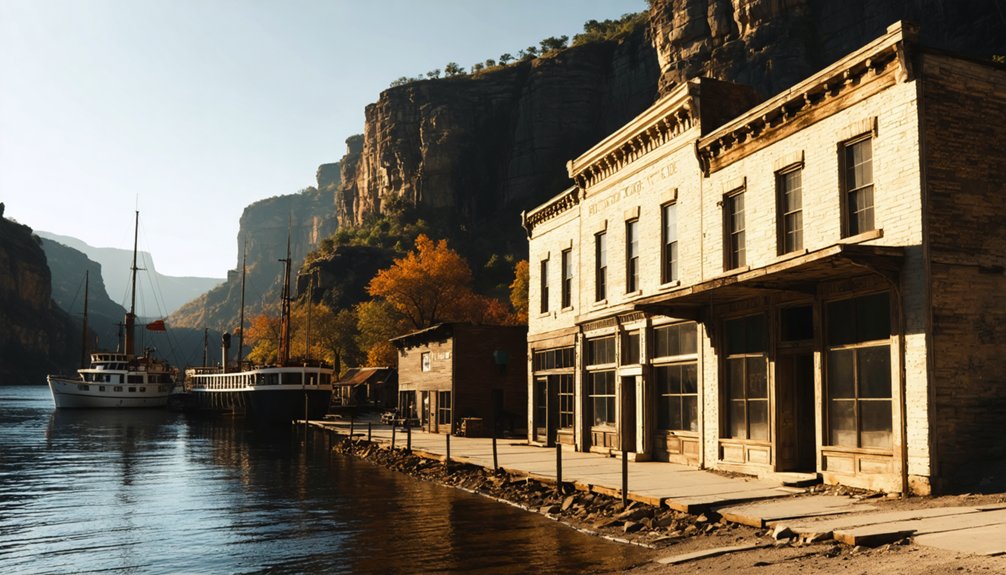
By 1903, you’d witness the railroad’s arrival transforming this frontier town into a zinc mining and timber hub.
Steamboats carried goods along the river while the commercial district bustled with activity.
Today, you can explore ghostly remnants within six blocks near Calico Creek, where twenty-three original structures stand as America’s only ghost town within city limits.
Graysonia: Timber Empire That Vanished Without a Trace
You’ll find one of Arkansas’s most ambitious industrial ventures in the ruins of Graysonia, where lumber baron William Grayson established a complete company town in 1907 to harvest Clark County’s virgin timber forests.
His vision created a thriving community of up to 1,000 residents with modern utilities, entertainment facilities, and a sawmill producing 150,000 board feet daily by the 1910s.
What makes Graysonia particularly haunting isn’t just its rapid rise and fall, but how thoroughly it vanished—leaving behind only concrete foundations and scattered ruins where a bustling municipality once stood.
William Grayson’s Industrial Vision
William Grayson transformed Arkansas’s timber industry through sheer ambition and calculated risk-taking when he established Graysonia in 1907.
After depleting Daleville’s timber resources as majority shareholder of Arkadelphia Lumber Company, you’d witness his strategic partnership with Nelson McLeod to create the Grayson-McLeod Lumber Company.
His industrial growth blueprint revolutionized Southern timber operations:
- Built sawmill producing 150,000 board feet daily among region’s largest
- Constructed company-owned town with 200 houses supporting 1,000 residents
- Established extensive infrastructure including hotels, utilities, and entertainment
- Created integrated railroad system for efficient timber transport
The Grayson legacy embodied entrepreneurial freedom—transforming virgin forests into thriving communities.
Though he died in 1910, his vision created Arkansas’s most ambitious lumber enterprise.
Complete Disappearance Mystery
Within two decades of William Grayson’s death, his timber empire had vanished so completely that you’d struggle to find Graysonia on modern maps.
The mill closed in 1931 when Depression economics met timber depletion, marking the beginning of one of Arkansas’s most dramatic ghost town mysteries.
You’ll discover that most buildings didn’t simply decay—Dougal McMillian systematically moved them to Arkadelphia for rental properties, leaving behind only concrete foundations and two kilns.
Today, you can barely access the remote site via dirt roads, where gated private property protects scattered remnants.
This vanished community represents how quickly industrial empires disappear when economic forces shift, transforming bustling towns into archaeological puzzles hidden within Arkansas’s wilderness.
Agnos: Railroad Lumber Town of Izard County
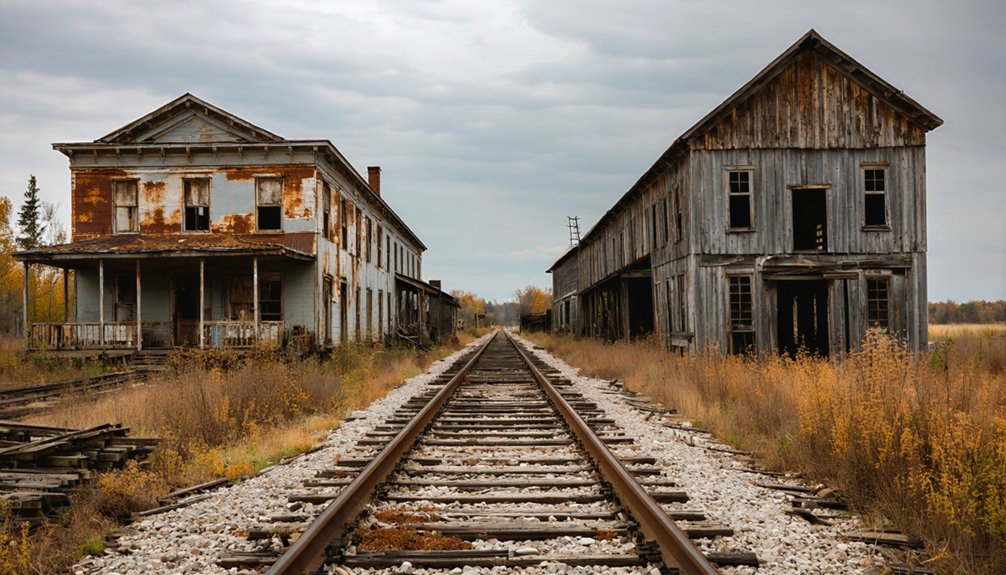
Deep in Izard County’s timber-rich hills, Agnos emerged in the early 20th century as a bustling railroad lumber town that promised prosperity to the families who flocked there seeking opportunity.
Deep in Arkansas’s forgotten hills, Agnos once thrived as a railroad lumber town before economic collapse left only weathered remnants behind.
The community’s Agnos history reflects Arkansas’s boom-bust cycles, where timber legacy sustained entire settlements until resources vanished.
Railroad access enabled lumber transport while families built essential infrastructure:
- Homes and businesses constructed from local timber
- Post office serving as the community’s social hub
- School educating settler children
- Commercial operations supporting daily commerce
When timber resources depleted and trains stopped arriving, economic collapse followed swiftly.
Today, you’ll discover weathered wooden structures leaning precariously, with saplings growing through floorboards where families once lived.
The old post office‘s faded paint whispers stories of a community that couldn’t adapt beyond its founding purpose.
Rush Creek Silver Dreams That Became Zinc Reality
While timber towns like Agnos rose and fell with Arkansas’s logging cycles, mineral discoveries sparked different dreams in Marion County’s rugged terrain.
You’ll find Rush Creek‘s story began in the early 1880s when prospectors John Wolfer, Bob Setzer, and J.H. McDabe discovered shiny metallic flakes they believed were silver. Their misconception sparked a mining boom that wouldn’t reveal zinc’s true identity until 1887’s smelter tests produced telltale green oxide fumes.
World War I transformed Rush into Arkansas’s largest zinc mining operation, with thirteen mines serving 5,000 residents.
George Chase’s Morning Star Mining Company produced massive smithsonite specimens, including one that won recognition at Chicago’s 1892 World’s Fair.
When post-war zinc prices collapsed in 1919, this once-thriving zinc mining community rapidly became another Arkansas ghost town.
East Calico: The Lost Trade Town Counterpart
The settlement’s transformation followed distinct phases:
Calico Rock’s evolution unfolded through four dramatic eras, each leaving its mark on this remarkable American ghost town.
- Trading Post Era (1800s) – Taverns served thieves, vagabonds, and prostitutes.
- Boomtown Period (1900s) – Railroad and zinc mining brought prosperity.
- Industrial Hub – Cotton gin, mills, and steamboat landing created commerce.
- Decline and Abandonment – Fires, floods, and economic shifts emptied the town.
Today, you’ll discover 20 abandoned buildings within Calico Rock’s limits, now operating as America’s only authentic ghost town inside municipal boundaries.
William Hope Harvey’s Pyramid Tomb and Gondola Vision
From abandoned settlements to ambitious visions, Arkansas’s ghost town legacy includes one man’s extraordinary attempt to preserve civilization itself.
William Hope “Coin” Harvey built Monte Ne resort in the Arkansas Ozarks, featuring an Italian gondola that ferried guests across spring-fed lagoons and multiple hotels with Arkansas’s first indoor swimming pool.
After losing his son in 1903, Harvey intensified development while planning a 140-foot concrete pyramid as a time capsule for future civilizations.
His Pyramid Tomb, a 40-ton concrete monument encasing his and his son’s bodies, was relocated to high ground when Beaver Lake flooded Monte Ne in the 1960s.
The ambitious Gondola Vision remains partially submerged, occasionally visible during low water.
White River Steamboat Stops and Abandoned Communities
Before railroads transformed Arkansas transportation, steamboats churned up the White River, creating a network of bustling landings that connected isolated Ozark communities to broader commerce.
You’ll find remnants of these abandoned settlements scattered along the riverbank, each telling stories of America’s westward expansion and economic freedom.
Key steamboat landings included:
- McBee Landing – Located near Cotter, served as Yellville’s commercial gateway
- Calico Rock – Functioned as postal drop point and freight hub
- Buffalo City – Hosted regular trade arrivals along the route
- Norfork – Key settlement stop for passengers and merchandise
Frequently Asked Questions
Are There Any Ghost Towns in Arkansas That Are Completely Accessible to Visitors?
Yes, you’ll find completely accessible ghost towns like Rush with paved roads and interpretive trails, Bruno with unrestricted remnant viewing, and Eros featuring preserved buildings—all following standard visitor guidelines without entry barriers.
What Safety Precautions Should I Take When Exploring Abandoned Arkansas Mining Sites?
Don’t explore abandoned mining sites—they’re deadly traps waiting to claim lives. Instead, you’ll need proper safety gear, knowledge of local regulations, and guided tours through officially sanctioned historical sites for safe exploration.
Can You Legally Metal Detect or Collect Artifacts From These Ghost Towns?
You can’t legally metal detect Arkansas ghost towns without written landowner permission on private property. Metal detecting laws require federal permits on public lands, and artifact preservation rules prohibit removing items over 100 years old.
Which Arkansas Ghost Towns Have the Best Preserved Original Buildings Still Standing?
Rush offers outstanding historic preservation with over twenty original structures standing, while Calico Rock’s mixed architectural significance balances active businesses against decaying buildings. You’ll find Rush provides the most authentic, intact mining-era experience.
Are There Guided Tours Available for Any of These Abandoned Arkansas Communities?
You won’t find guided ghost tours specifically for Arkansas’s abandoned communities. However, you can explore guided ghost tours in Little Rock, Eureka Springs, and Hot Springs that highlight each area’s historical significance and paranormal activity.
References
- https://www.axios.com/local/nw-arkansas/2024/01/02/arkansas-ghost-towns-mapped
- https://everafterinthewoods.com/forgotten-ghost-towns-in-arkansas-that-are-eerially-scenic/
- https://www.youtube.com/watch?v=U4kJjjbcnMM
- https://kkyr.com/arkansas-top-5-ghost-towns/
- https://aymag.com/arkansas-backstories-ghost-towns/
- https://metaldetectingforum.com/index.php?threads/arkansas-ghost-towns.80591/
- https://www.uaex.uada.edu/environment-nature/musings-on-nature-blog/posts/ghost-towns.aspx
- https://en.wikipedia.org/wiki/List_of_ghost_towns_in_Arkansas
- https://en.wikipedia.org/wiki/Rush_Creek_mining_district
- https://www.nps.gov/articles/rush-historic-district-500856.htm