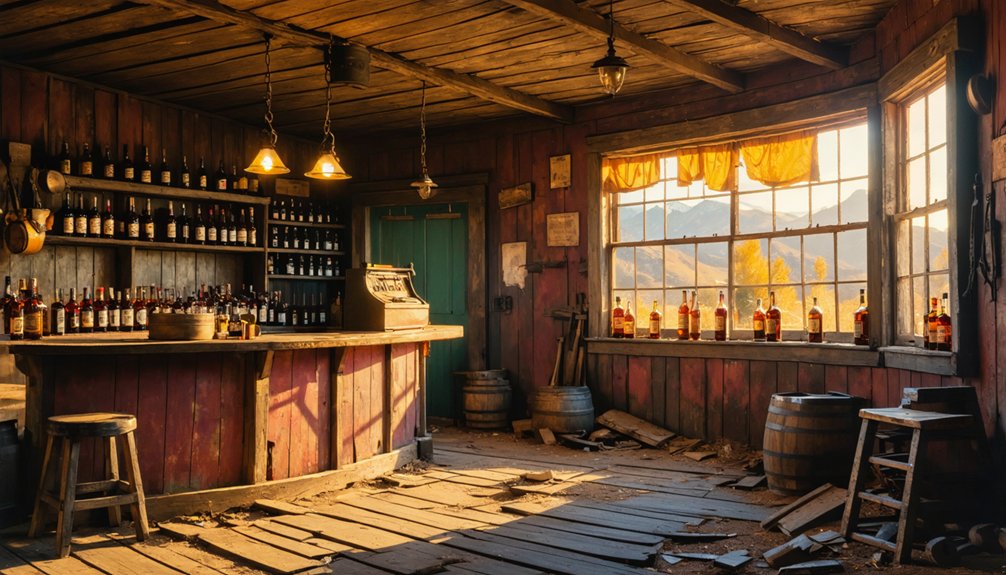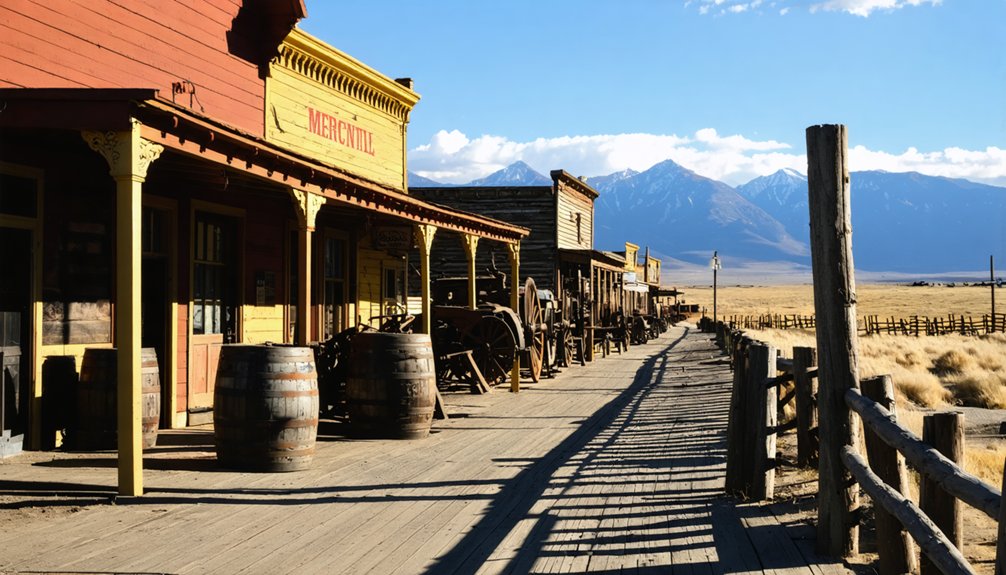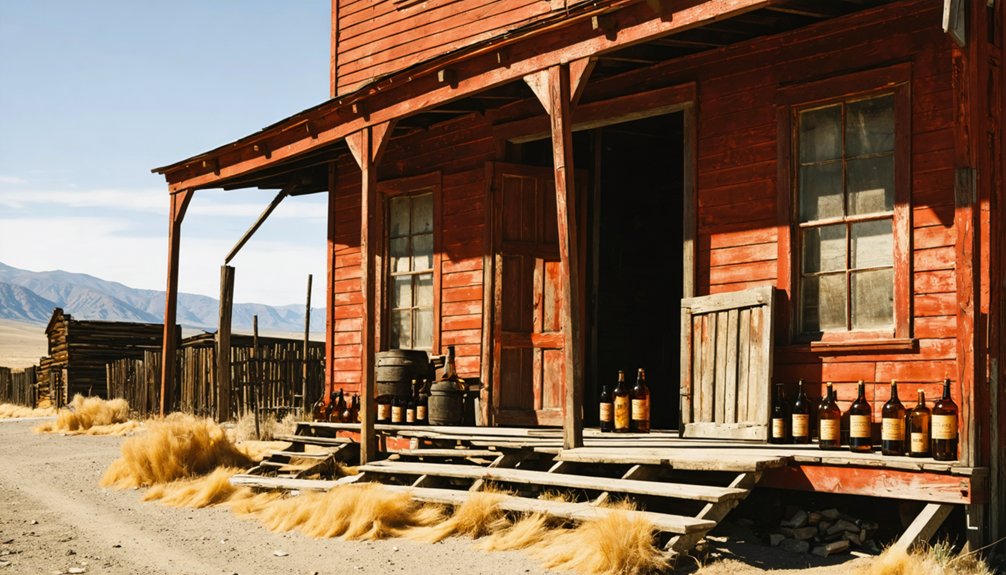
You’ll find California’s most famous ghost towns scattered across the state’s mining regions, each preserving unique stories from the Gold Rush and silver boom eras. Bodie State Historic Park maintains 170 original buildings with untouched interiors from its 1880s peak, while Calico showcases restored silver mining heritage after Walter Knott’s $700,000 investment in 1951. Randsburg’s General Store has operated continuously since 1896, and remote Ballarat features adobe ruins in Death Valley’s shadow, with high-altitude Cerro Gordo offering industrial mining remnants that reveal deeper historical layers.
Key Takeaways
- Bodie State Historic Park preserves 170 original buildings from a once-thriving mining town of 10,000 residents in 1879.
- Calico Ghost Town features five original buildings and was restored by Walter Knott after silver mining peaked at 3,000 residents.
- Cerro Gordo sits at 8,500 feet elevation and produced over $500 million in precious metals from 30 miles of underground tunnels.
- Shasta State Historic Park showcases Gold Rush heritage with a courthouse museum and preserved ruins from its 20,000-person peak population.
- Ballarat contains surviving adobe ruins in the Panamint Mountains, once housing 400-500 residents during its 1897-1905 mining boom.
Bodie State Historic Park: Preserved in Time
When W.S. Bodey discovered gold near Bodie Bluff in 1859, he couldn’t have imagined you’d one day walk through America’s most authentic ghost town.
After Bodey died in a blizzard, the Standard Company’s 1876 discovery sparked a boom that created a lawless frontier city of 10,000 people by 1879.
You’ll find 65 saloons once lined Main Street alongside banks, schools, and newspapers.
When gold depleted by the 1880s, residents abandoned their dreams, leaving behind a perfect time capsule.
California established Bodie State Historic Park in 1962, implementing “arrested decay” – no restoration, just stabilization.
This ghost town preservation approach maintains 170 original buildings with untouched interiors, protecting invaluable mining heritage.
You’re experiencing authentic Wild West history, frozen exactly as miners left it. The town featured the first long-distance hydroelectric transmission line to power the stamp mill, showcasing advanced technology for its era. Rangers and volunteers are available throughout the park to answer your historical inquiries about this remarkable preserved community.
Calico Ghost Town: California’s Restored Silver Mining Capital
Silver ore transformed a barren desert landscape into California’s most famous restored ghost town when prospectors discovered rich deposits in the surrounding mountains on April 6, 1881.
You’ll find Calico peaked around 1885 with 3,000 residents and 500 mines producing over $20 million in silver ore across twelve years. When silver prices collapsed in the mid-1890s, the town became abandoned by the early 1900s.
Ghost town preservation began when Walter Knott purchased Calico in 1951, investing $700,000 to rebuild structures using 1880s photographs. He donated it to San Bernardino County in 1966, creating today’s Regional Park.
Walter Knott’s $700,000 investment in 1951 transformed abandoned Calico into a meticulously restored ghost town using historical photographs as blueprints.
You can explore five original buildings, including Lil’s Saloon, and tour Maggie Mine tunnels while experiencing authentic mining heritage in this officially designated California Historical Landmark. The town’s unique Bottle House was constructed from excess bottles due to a scarcity of traditional building materials during the mining boom. Governor Arnold Schwarzenegger officially recognized Calico’s legacy by declaring it California’s silver mining town in 2005.
Randsburg and Johannesburg: Living Remnants of the Mojave Mining Era
Three prospectors struck gold on Rand Mountain’s slope in 1895, launching another chapter in California’s mining legacy that continues today. John Singleton, F.M. Mooers, and Charlie Burcham discovered what became the Yellow Aster Mine, producing $25 million in gold by 1933.
Randsburg history reveals a town that peaked at 3,500 residents by 1899, complete with opera house, saloons, and vigilante justice.
When gold declined, miners shifted to silver and tungsten. Johannesburg significance lies in its role within the broader Rand Mining District, serving alongside Randsburg as a Mojave mining hub.
Today, you’ll find these living ghost towns housing 69-77 residents, featuring original buildings, antique shops, and weekend museums—authentic remnants where small-scale mining operations still function. The historic General Store has operated continuously since 1896, originally serving as a drug store with a soda fountain. The area attracts off-road enthusiasts year-round who come to explore the desert terrain on dirt bikes and other vehicles.
The history of Lexington and Alma reveals fascinating stories of pioneers who shaped the region’s mining heritage. Visitors often stumble upon remnants of old equipment and abandoned structures that tell the tale of a once-thriving community. This rich past adds an intriguing layer to the exploration of the area’s rugged landscape.
Ballarat: Adobe Ruins in the Death Valley Region
You’ll find Ballarat’s haunting adobe ruins nestled at the base of the Panamint Mountains in Death Valley’s remote wilderness, where founder George Riggins established this mining supply town in 1896.
The settlement’s distinctive adobe structures—including the post office, morgue, and jail—have survived the harsh desert climate better than wooden buildings, creating an authentic snapshot of 1890s frontier life. Despite its remote location, Ballarat featured seven saloons that served the hundreds of miners and prospectors who called this desert outpost home.
These crumbling walls tell the story of a once-thriving community that housed 400-500 residents during its heyday from 1897 to 1905, sustained by the profitable Radcliffe Mine’s gold ore production. The town’s rapid decline after the mine closed demonstrates how the verification process of ore quality and quantity was crucial for sustaining remote mining communities in the unforgiving desert environment.
Remote Desert Location
Deep within California’s Mojave Desert, Ballarat sits at the base of the Panamint Mountain Range in remote Panamint Valley, positioned at 1,079 feet above sea level in Inyo County.
You’ll find yourself approximately 150 miles northeast of Bakersfield, surrounded by complete desert isolation that defined this mining settlement‘s character from its 1896 founding.
The town’s strategic location near Post Office Springs provided reliable water since the 1850s, making it viable for supporting Panamint Range mining operations.
Today, you’ll encounter abandoned buildings scattered across the stark landscape—remnants of Shorty’s cabin foundation, a weathered miner’s shack, and old post office ruins. The ruins also include the town’s former jail and morgue, which stands as one of the most notable surviving structures from Ballarat’s boom period. Rocky Novak operates a general store that welcomes tourists on afternoons and weekends, serving as one of the few signs of ongoing life in this desolate location.
This harsh desert environment that once sustained 500 residents now hosts only one full-time resident, emphasizing the unforgiving remoteness that both created and ultimately claimed Ballarat.
Adobe Structure Preservation
Ballarat’s founders constructed their settlement primarily from adobe bricks, creating a bustling community that housed seven saloons, three hotels, a Wells Fargo station, post office, school, jail, and morgue—but importantly no church among its structures.
You’ll find that adobe deterioration has claimed most buildings since the post office’s 1917 closure, with crumbling walls and foundations scattered throughout the site. The jail remains one of the few intact structures, while the post office has been reduced to ruins.
Preservation efforts face significant challenges since the site’s privately owned, limiting formal conservation initiatives. Natural decay continues as adobe structures return to desert earth, creating an authentic but fragile reminder of California’s mining heritage that you can explore off Panamint Valley road.
Mining History Legacy
When Australian immigrant George Riggins established Ballarat in 1897, he strategically positioned this desert settlement as an essential supply point for the booming Panamint Mountain Range mines and named it after Australia’s famous gold hub.
The mining impact transformed this remote location into a thriving community of 400-500 residents by 1905, complete with seven saloons, three hotels, and vital services.
The Radcliffe Mine’s 15,000 tons of gold ore from 1898-1903 sustained the town’s prosperity, contributing to the region’s million-dollar gold production.
When operations ceased in 1903, Ballarat’s decline began immediately.
- Post office closure in 1917 marked the official end
- Legendary prospectors like “Shorty” Harris remained until 1934
- Area mines collectively produced $1 million in gold
Today, this ghost town stands as evidence of California’s mining legacy.
Cerro Gordo: Mountain Mining Camp With Industrial Heritage
Perched high in the Inyo Mountains at 8,500 feet elevation, Cerro Gordo stands as California’s most productive silver mining camp, where over $500 million worth of precious metals emerged from thirty miles of underground tunnels during the late 1800s.
You’ll find this remote outpost became the state’s largest silver producer after Pablo Flores discovered ore near Buena Vista Peak in 1865. By the early 1880s, Cerro Gordo’s silver production supplied the majority of Los Angeles’s precious metals, with 340 tons of bullion passing through the city by 1869’s end.
The camp housed over 4,000 miners at its peak, operating massive smelters and a 300-foot vertical shaft.
Today, you can explore preserved buildings including the Belshaw House and bunkhouse rentals.
Shasta State Historic Park: Northern California’s Gold Rush Legacy
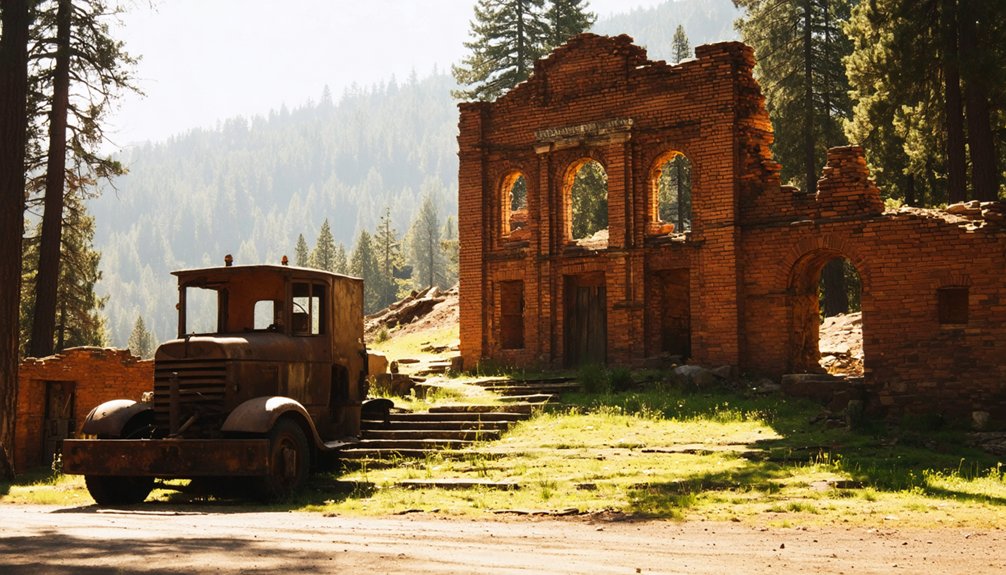
You’ll discover Shasta’s transformation from a bustling Gold Rush supply center serving thousands of Forty-Niners in the 1850s to a preserved historic park showcasing northern California’s mining heritage.
The town’s courthouse museum houses period mining equipment and California artwork that illustrate how technological advances shaped the region’s extractive industries.
Today’s cultural landscape preserves brick ruins, restored buildings, and interpretive trails that document how railroad bypasses and declining ore deposits transformed this once-thriving commercial hub into a ghost town by the early 1900s.
Gold Rush Commerce Hub
While thousands flocked to California’s Mother Lode region in 1848, a second gold rush erupted near what would become Shasta in spring 1849.
You’ll discover how Reading’s Springs transformed into a tent city of 500 miners within months, then evolved into Shasta City by 1850. This gateway to Trinity Diggins became northern California’s primary supply center.
During peak years 1852-1857, you’d witness extraordinary commerce:
- Over $100,000 in gold dust passed through weekly
- 100 freight teams traveled through daily
- Population exceeded 20,000 residents at its height
The robust gold rush infrastructure supported furniture stores, hardware shops, bakeries, and bookstores.
However, commercial decline began when railroads bypassed Shasta in 1872. Businesses relocated to Redding for railroad access, and owners dismantled buildings to rebuild elsewhere, ending the “Queen City’s” dominance.
Mining Technology Exhibits
Today’s Shasta State Historic Park preserves the mining legacy through carefully curated exhibits that demonstrate the technological evolution of California’s gold extraction methods.
You’ll discover how miners shifted from simple placer techniques to complex hard-rock operations through authentic displays in the Pioneer Barn. The restored courthouse explains both processes while showcasing mining machinery that powered northern California’s extraction industry.
Historical artifacts throughout the complex reveal the sophisticated support systems miners required.
You’ll witness live blacksmith demonstrations showing how essential tools were forged, while the barn’s equipment displays illustrate the evolution from basic panning to industrial-scale operations.
These exhibits demonstrate how technological advancement transformed California’s mining landscape, providing the infrastructure that sustained entire communities during the Gold Rush era.
Cultural Landscape Preservation
Since California acquired the site in 1946, Shasta State Historic Park has maintained one of the state’s most extensive cultural landscapes from the Gold Rush era.
You’ll discover how historical conservation efforts preserve this authentic 19th-century settlement that once housed 3,500 residents before railroad expansion bypassed it in the 1880s.
The park’s cultural heritage extends beyond restored buildings to encompass the complete pioneer experience:
- Historic trails wind through cottage ruins, orchards, and cemeteries where prominent citizens rest
- Pioneer Barn area displays original farming and mining implements under ancient oak trees
- Ruins trail offers elevated views of brick buildings and surrounding landscape
You can explore Catholic Cemetery’s historic graves, examine the original stagecoach in the hay barn, and walk paths that once connected this thriving commercial center’s gardens and residential areas.
Frequently Asked Questions
What Should I Bring for Visiting Remote Ghost Towns in Desert Conditions?
Desert temperatures exceed 100°F for 100+ days annually, so you’ll need one gallon water supply per person daily, GPS navigation tools for remote access roads, sun protection, emergency gear, and extra fuel for your adventures.
Are Pets Allowed at California’s Ghost Town Historic Sites and Parks?
Yes, you’ll find pet policies at most California ghost towns welcome leashed dogs. Ghost town regulations typically allow pets in outdoor areas but restrict access to museums, tours, and some indoor attractions.
Which Ghost Towns Offer Overnight Camping or Nearby Accommodation Options?
Calico offers full-service ghost town camping with RV hookups and cabins sleeping four. You’ll find nearby lodging at Benton Hot Springs with thermal pools, while Ballarat provides primitive desert camping options.
Can I Use Metal Detectors or Collect Artifacts at These Sites?
You can’t use metal detectors at most California ghost towns due to strict metal detecting regulations protecting state historic parks. Artifact preservation ethics and federal laws prohibit collecting without permits, even on private land.
What Are the Best Months to Visit Ghost Towns for Weather?
Though you’ll face crowds, October through May offers ideal seasonal weather patterns for exploring freely. Fall delivers perfect Halloween atmosphere, while winter and spring provide comfortable temperatures. Summer’s desert heat restricts your best visiting times considerably.
References
- https://whimsysoul.com/must-see-california-ghost-towns-explore-forgotten-histories/
- https://www.visitcalifornia.com/road-trips/ghost-towns/
- https://www.tripadvisor.com/Attractions-g28926-Activities-c47-t14-California.html
- https://californiahighsierra.com/trips/explore-ghost-towns-of-the-high-sierra/
- https://dornsife.usc.edu/magazine/echoes-in-the-dust/
- https://www.youtube.com/watch?v=cr3jaq8nR3o
- https://nvtami.com/ghost-towns-nevada-california/
- https://modernhiker.com/bodie-state-historic-park/
- https://junelakeloop.com/bodie_state_historic_park
- https://www.nps.gov/places/bodie-historic-district.htm