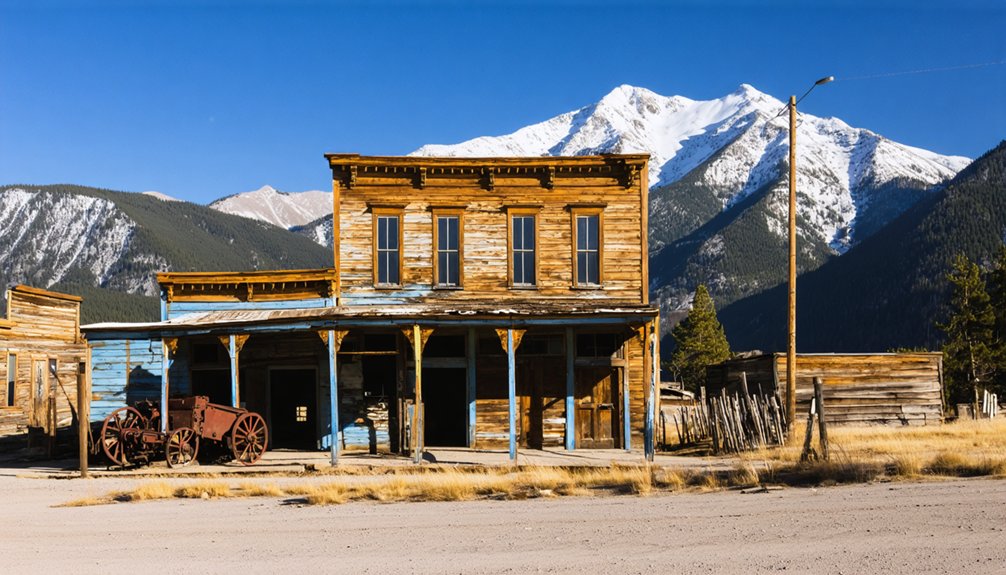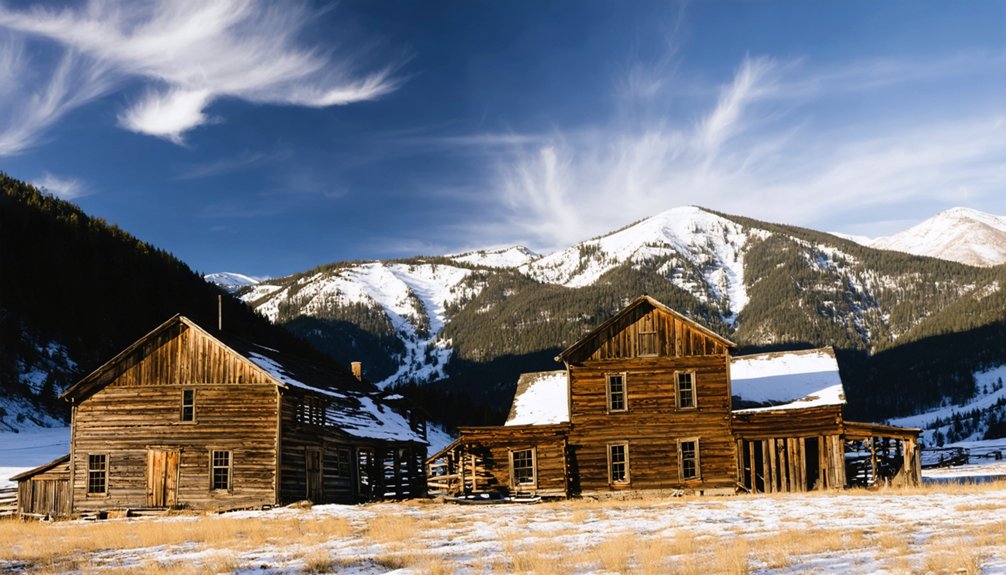
You’ll find Colorado’s most famous ghost towns perched at extreme elevations, with St. Elmo at 10,000 feet showcasing over 43 original 1880s structures as the state’s best-preserved mining camp. Animas Forks sits even higher at 11,200 feet in the San Juan Mountains, while Independence along Highway 82 and Capitol City near the Animas River reveal remnants of the 1870s-1890s silver boom. These abandoned communities once supported thousands of miners before economic collapse left behind fascinating historical sites that reveal the dramatic stories of Colorado’s mining frontier.
Key Takeaways
- St. Elmo is Colorado’s best-preserved mining town with over 43 original 1880s structures at nearly 10,000 feet elevation.
- Animas Forks sits at 11,200 feet in the San Juan Mountains and attracts over 100,000 annual visitors.
- Independence was once home to 1,500 residents and produced over $190,000 in ore from 1880-1882.
- Capitol City was founded in 1877 with dreams of becoming Colorado’s state capital before the 1893 silver crash.
- Tin Cup earned notoriety for its lawlessness, with multiple town marshals killed and outlaws buried in Boot Hill Cemetery.
St. Elmo: Colorado’s Best-Preserved Mining Town
Perched at nearly 10,000 feet in Colorado’s Sawatch Range, St. Elmo stands as the state’s best-preserved mining town.
You’ll discover over 43 original structures from its 1880s boom days when 2,000 residents worked 150 patented mine claims.
St. Elmo’s history began as Forest City in 1878 before adopting its literary name from Augusta Jane Evans’ novel. The town thrived with five hotels, saloons, and a bustling general store until mining declined in the 1920s. The Denver, South Park & Pacific Railroad reached St. Elmo in 1881, serving as a primary supply source for surrounding settlements. The nearby Mary Murphy Mine produced over $60 million worth of gold during its operation, fueling the town’s prosperity.
Originally named Forest City, this literary-inspired town flourished with hotels and saloons before mining’s decline ended the boom.
The Stark family’s contributions proved essential to preservation. They remained as sole year-round residents after others departed, purchasing abandoned properties and maintaining the town through the 20th century.
Their dedication earned St. Elmo its 1979 National Historic District designation, preserving this remarkable window into Colorado’s mining heritage.
Animas Forks: High-Altitude Remnants in the San Juan Mountains
While St. Elmo showcases Colorado’s mining past, Animas Forks takes you even higher into the San Juan Mountains at 11,200 feet.
You’ll discover this ghost town‘s remarkable mining heritage when you navigate the challenging Alpine Loop’s 65 miles of unpaved roads requiring high-clearance 4WD vehicles.
Founded in 1873 after gold and silver discoveries, Animas Forks quickly grew to house 450 residents by 1883.
The town claimed to be America’s largest settlement at that altitude, supporting mines like Big Giant and Gold Prince.
However, an 1891 fire and the 1893 silver crash triggered its decline.
The Silverton Northern Railroad reached Animas Forks in 1904, providing crucial transportation for mining operations.
The town even had its own local newspaper called the Animas Forks Pioneer during its bustling heyday.
Today’s Alpine accessibility brings over 100,000 annual visitors to witness dozen preserved structures.
You’ll experience authentic frontier history in one of Colorado’s most remote yet accessible ghost towns.
Exploring these authentic ghost towns in Colorado provides a unique glimpse into the past, with well-preserved structures and fascinating stories to uncover. Each town has its own distinct character, often showcasing remnants of the mining boom that once thrived in the region. Visitors can wander through dilapidated buildings and learn about the lives of those who once called these places home.
Among the most intriguing ghost towns to explore in Colorado are the abandoned remnants of once-bustling mining communities. As you traverse these historic sites, you’ll encounter not only breathtaking vistas but also artifacts that tell the story of the hardships faced by early settlers. Each visit is an opportunity to connect with the past and appreciate the rich history that shapes Colorado’s identity.
Independence: Historic Homesteads on Independence Pass
At 11,000 feet elevation along Highway 82, Independence stands as one of Colorado’s most accessible high-altitude ghost towns, though seasonal road closures isolate this former mining camp each winter just as brutal storms once drove out its last residents.
Founded as Beldon in 1879, Independence’s mining impact generated over $190,000 in documented ore production during its 1880-1882 boom. The town supported 1,500 residents, multiple businesses, and the Farwell Stamp Mill before ore yields collapsed in 1883.
Today you’ll find preserved log cabins, building foundations, and interpretive trails managed by the Aspen Historical Society:
- Seasonal access limits visits to spring through fall when Independence Pass opens
- Multiple building ruins including the general store and stamp mill remain
- Artifact removal is prohibited on this archaeological preserve
- The easy trail requires only a 1-mile round trip from the trailhead
- Lee hauled bricks from Pueblo at $1 each to build his mansion with ballroom and theater
- The town processed 900,000 pounds of merchandise and 360 tons of ore in one season
- Mining operations included Lee’s smelter that processed 70 tons of ore daily
- Groves of aspens and evergreen trees now surround remaining structures
- Mountain willows and forest vegetation cover old brick kilns and outbuildings
- Scenic trails wind through the former townsite revealing mining remnants
- The first town marshal died in an 1882 gunfight
- His replacement was shot and killed just one year later in 1883
- Mining disputes and saloon brawls created constant danger
- https://coloradoinfo.com/blog_post/explore-ghost-towns-in-colorado/
- https://en.wikipedia.org/wiki/List_of_ghost_towns_in_Colorado
- https://www.longmontleader.com/colorado/explore/20-must-visit-ghost-towns-in-colorado-for-an-eerie-adventure-10192944
- https://www.colorado.com/articles/colorado-ghost-towns
- https://www.americansky.co.uk/colorado-holidays/exploring-colorados-ghost-towns
- https://www.uncovercolorado.com/ghost-towns/
- https://www.atlasobscura.com/things-to-do/colorado/ghost-towns
- https://www.tripadvisor.com/Attractions-g28927-Activities-c47-t14-Colorado.html
- https://www.legendsofamerica.com/co-stelmo/
- https://www.islands.com/1828318/saint-st-elmo-colorado-abandoned-town-american-west-best-preserved-enchanting-gem/
The 1899 blizzards finally forced out Independence’s last holdouts. By 1912, the town was completely abandoned with only one resident having remained until that final year.
Capitol City: Silver Rush Ruins Near the Animas River
You’ll discover Capitol City’s ambitious origins when founder George S. Lee envisioned transforming this remote silver mining camp into Colorado’s state capital in 1877.
The town’s rapid rise to 800 residents and equally swift collapse following the 1893 silver crash left behind significant ruins including the restored post office, Lee’s smelter stack, and foundations of his would-be governor’s mansion. The original townsite sprawled across 200 acres and included essential frontier amenities like hotels, restaurants, bars, and even a schoolhouse to serve the growing community.
At its peak, Lee’s operations employed over 115 men, making him one of the county’s largest employers through his smelter, sawmills, lumber yards, and brick kiln operations.
Today you can explore these weathered remnants while enjoying the dramatic alpine scenery of the San Juan Mountains at nearly 9,500 feet elevation.
Silver Rush History
Capitol City emerged from the Colorado silver rush as one of the most ambitious yet short-lived mining settlements in the state’s history.
You’ll find this remarkable ghost town’s story begins in 1871 when prospectors discovered the Ute and Ule silver mines at 9,480 feet altitude. George S. Lee‘s mining techniques and aggressive development transformed these early silver discoveries into a thriving community by 1877.
The silver boom created extraordinary wealth that attracted 800 residents during Capitol City‘s peak year:
However, the 1893 silver crash devastated Capitol City, ending this ambitious experiment in mountain capitalism. Lee originally envisioned the remote settlement as Colorado’s new state capitol, demonstrating the extraordinary optimism that characterized the silver boom era. The town’s post office closed in 1920, officially marking the end of Capitol City’s significance as a functioning community.
Remaining Town Structures
Today, only two primary structures survive from Capitol City’s silver boom era: the old U.S. Post Office and Lee’s Smelter Stack.
You’ll also find George Lee’s Rose Lime Kiln among the remaining structures, along with ghostly remnants of outbuildings scattered through the surrounding forest and detectable brick kilns hidden beneath vegetation.
The magnificent Lee Mansion that once dominated this townsite has completely vanished.
This two-story brick home, completed in 1879 with its veranda, formal parlor, library wing, and small ballroom, gradually deteriorated through the mid-20th century.
By 1972, only brick piles marked where the mansion stood.
Today, aspens, mountain willows, and evergreens reclaim the townsite.
You’ll discover a few private homes and restored cabins among the ghostly remnants of this once-thriving 800-person community.
Natural Scenery Highlights
While Capitol City’s buildings have largely vanished, the surrounding natural landscape creates a stunning backdrop that enhances the ghost town’s haunting appeal. At 9,480 feet elevation, you’ll discover breathtaking high-altitude mountain scenery along the Alpine Loop Backcountry Byway.
The Engineer Pass Road offers panoramic vistas of remote peaks and valleys that once witnessed Colorado’s silver rush fever.
Nature has reclaimed this historic mining camp through stunning transformation:
You’ll experience true wilderness solitude in this quaint valley setting within Hinsdale County’s rugged ranges, where natural regrowth tells the story of time’s relentless march over human ambition.
Vicksburg & Winfield: Twin Mining Camps With Audio History
Deep within Clear Creek Canyon, the twin mining camps of Vicksburg and Winfield stand as remarkable evidence to Colorado’s silver boom era, offering visitors an extraordinary audio-guided journey through their intertwined histories.
Vicksburg history begins in 1867 as a mining camp near Granite, while Winfield legends trace back to Governor John Evans and William Byers’ 1867 mining ventures.
You’ll discover Winfield’s 1890 heyday supported 1,500 residents with three saloons, hotels, and essential services across its 120-acre townsite. The 1893 silver crash devastated both camps, ending continuous habitation.
Today, you can explore restored museums, including Winfield’s schoolhouse and Ball cabin, plus Vicksburg’s outdoor mine equipment displays.
The haunting cemetery reveals 26 burials from fires, snowslides, and frontier violence.
Tin Cup: The Rowdy Town Where Sheriffs Didn’t Last Long
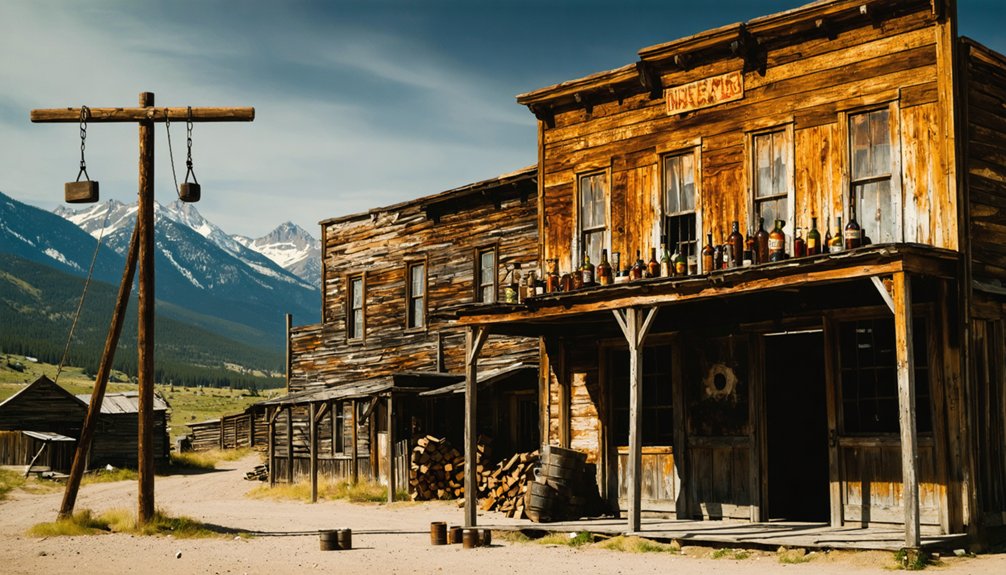
High atop the Continental Divide at 10,157 feet, Tin Cup stands as Colorado’s most notorious example of a mining camp where violence ruled and lawmen met swift, deadly ends.
Named after prospector Jim Taylor’s 1859 gold discovery carried home in a tin cup, this remote Gunnison County settlement quickly earned its lawlessness legacy.
During its 1880s boom with 1,400 residents, Tin Cup’s marshals faced impossible odds:
Boot Hill in Tincup Cemetery tells the violent story, where outlaws like “Black Jack” Cameron rest alongside their victims.
Today’s visitors can explore preserved cabins and structures from this wild frontier era.
Frequently Asked Questions
What Permits or Fees Are Required to Visit Colorado’s Ghost Towns?
You’ll find permit requirements vary by location—Ashcroft charges $5 per adult while Animas Forks has no fees. Fee structures depend on managing agencies like USFS or BLM controlling access.
Are Camping and Overnight Stays Allowed Near These Ghost Town Sites?
You’ll find camping regulations hilariously complex—overnight accommodations depend on land ownership. You can’t camp in prohibited BLM areas, but dispersed camping’s allowed in national forests with permits and fourteen-day limits.
What Safety Precautions Should Visitors Take When Exploring Abandoned Mining Structures?
You’ll need proper safety gear including gas detectors and hard hats before approaching any structures. Never enter abandoned mines—assess structural integrity from distance only, avoiding loose timbers and unstable ground.
Which Ghost Towns Are Accessible During Winter Months and Snow Conditions?
You’ll find St. Elmo offers the best winter accessibility among Colorado’s ghost towns, featuring snow-covered streets perfect for scenic snow activities. Independence, Carson, and Animas Forks remain largely inaccessible due to harsh conditions.
In addition to St. Elmo, various ghost towns in Colorado events throughout the year attract adventure enthusiasts looking to explore the state’s rich history. Activities such as guided tours and local festivals celebrate the culture of these abandoned places, allowing visitors to experience their haunting beauty. Each town tells its own unique story, providing a captivating glimpse into Colorado’s past.
Can Visitors Legally Remove Artifacts or Souvenirs From Ghost Town Sites?
No, you can’t legally remove artifacts from ghost towns. Legal regulations protect these sites through federal, state, and local laws. Artifact preservation requirements apply regardless of ownership, with violations resulting in fines and criminal charges.