You’ll find Connecticut’s most famous ghost towns scattered across the state, each with unique stories of decline and abandonment. Dudleytown in Cornwall gained legendary status for its supposed curse, while Bara-Hack in Pomfret earned the nickname “Village of Voices” for reported paranormal activity. Johnsonville Village showcases Victorian-era mill town ruins, Gay City transformed into a state park with accessible trails, and Pleasure Beach represents urban decay turned renewal. These haunting sites reveal deeper histories of colonial settlements, industrial rise and fall, and nature’s reclamation.
Key Takeaways
- Bara-Hack in Pomfret features stone foundations and cemetery ruins, earning the nickname “Village of Voices” from reported paranormal activity.
- Dudleytown in Cornwall’s Dark Entry Forest is Connecticut’s most legendary cursed village, though historians debunk the supernatural claims as fabrications.
- Johnsonville Village showcases Victorian mill town ruins with reported ghost sightings, but remains off-limits since 2017 under private ownership.
- Gay City transformed from a 19th-century religious community into a state park with ten miles of trails through abandoned ruins.
- Pleasure Beach evolved from a popular amusement destination to urban ruins before reopening as a public park in 2014.
Bara-Hack: The Welsh Settlement Lost to Time
Deep in the forests of Pomfret, Connecticut, the ghost town of Bara-Hack stands as a haunting reminder of America’s forgotten settlements.
You’ll discover this Welsh community was established in the late 18th century by Obadiah Higginbotham and Jonathan Randall, who named it “breaking of bread” to honor their shared heritage. The settlement thrived with waterwheel mills, linen wheels, and family farms until mid-19th century decline claimed it.
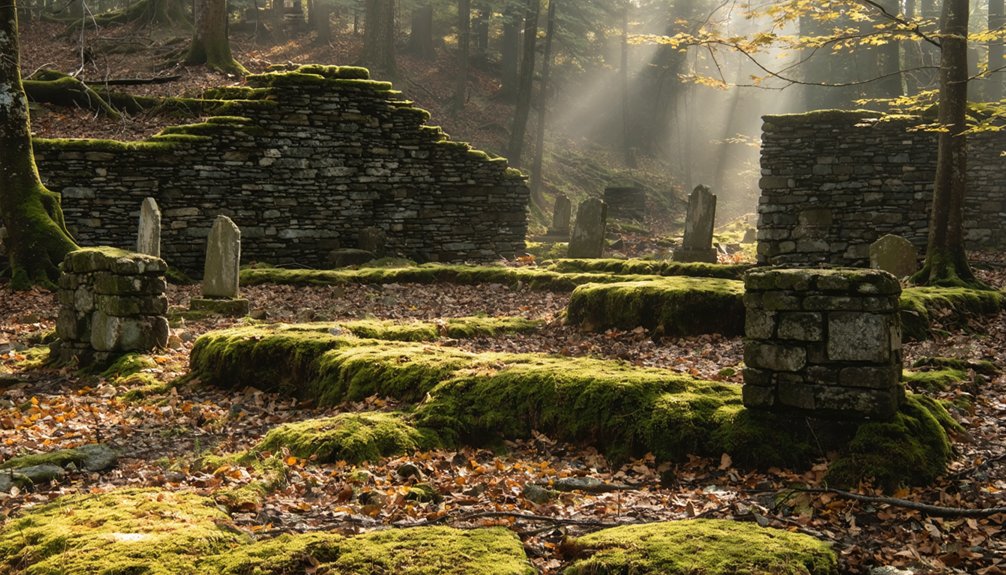
Today, you can explore stone foundations, cellar holes, and the mysterious Randall-Botham Cemetery where enslaved individuals rest alongside founding families. The Randall family reportedly brought many slaves to Connecticut as part of their considerable wealth. Visitors often report streaking lights and mysterious orbs throughout the abandoned grounds.
The haunted history includes disembodied voices earning it the nickname “Village of Voices.” This site’s cultural significance extends beyond ghostly legends—it represents the complex narratives of Welsh settlers, enslaved people, and displaced Nipmuc tribes in early America.
Dudleytown: Cornwall’s Legendary Cursed Village
You’ll find Dudleytown nestled in Dark Entry Forest between Cornwall’s hills, where British colonists established a mining community in the mid-18th century before abandoning it by the early 1900s.
The settlement’s reputation stems from alleged supernatural events tied to a supposed family curse, though historians trace these stories to fictional accounts published in 1926 rather than documented evidence. The curse legend claims origins from Edmund Dudley, a nobleman executed by Henry VIII for treason in the 16th century.
Today, you can’t legally access the privately owned site due to repeated trespassing by ghost hunters, though the area remains a popular subject for paranormal investigators and media coverage. Current residents report no supernatural occurrences and descendants of original settlers continue to live in the area.
Origins and Early Settlement
While most Connecticut settlements grew into thriving towns, Dudleytown’s story began with promise but was destined for abandonment.
Thomas Griffis started this chapter in the early 1740s, purchasing land from Yale College that locals called Mast Swamp. He harvested timber for ship masts, sending logs down the Housatonic River.
The early settlers arrived steadily—Gideon Dudley bought nearby land in 1747, followed by Barzillai and Abiel Dudley by 1753.
Three to five Dudley brothers eventually settled there, giving the area its nickname. Other families joined them, including the Tanners and Carters, clearing Cornwall’s forests for agriculture. The Dudley family carried a dark reputation, as they were believed to be descendants of Edmund Dudley, who was executed for treason. The settlement would later become known by the ominous name Dark Entry, reflecting the tragic events that would unfold there.
However, agricultural challenges plagued the community from the start.
The steep, high elevation created poor growing conditions and difficult access, making sustainable farming nearly impossible.
The Curse Legend
Although Dudleytown’s agricultural struggles and isolation provide logical explanations for its abandonment, a supernatural legend has overshadowed the settlement’s actual history. The curse origins allegedly trace back to Edmund Dudley’s 1510 execution for plotting against King Henry VIII, when a curse supposedly condemned his descendants to horror and death.
However, historians find no connection between Cornwall’s Dudley family and English nobility.
You’ll discover that supernatural accounts didn’t emerge until 1926, appearing in Edward C. Starr’s History of Cornwall—over a century after the settlement’s decline. The Cornwall Historical Society confirms these legends are fanciful fabrications. Despite surviving for over 100 years, environmental factors including the settlement’s challenging high elevation ultimately led to its abandonment. Today, the Dark Entry Forest Association owns most of the former village land and has banned hikers due to vandalism and ecological damage.
While the Dudley family did experience hardships like Abiel’s senility, contemporary records show no supernatural elements, only ordinary struggles of frontier life.
Modern Access Restrictions
Despite the debunking of supernatural claims, Dudleytown remains completely inaccessible to the public today.
The Dark Entry Forest Association, established after 1900’s abandonment, owns this land as a private nature preserve. You’ll face serious trespassing consequences if you attempt entry—hefty fines, arrest, and prosecution await violators. Cornwall police actively patrol the area, responding to frequent incidents involving amateur explorers and paranormal seekers.
The association’s preservation efforts stem from decades of vandalism problems. Mid-1990s waves of intruders overwhelmed authorities, while earlier 1970s keg parties and ritual activities prompted full lockdown. The village’s dark reputation grew significantly after Ed and Lorraine Warren investigated the area and declared it demonically possessed during that same decade.
You can’t obtain permission regardless of your reason for visiting. Wealthy residents maintain constant surveillance, and police issue on-site tickets. The association controls 800-900 acres of land, extending their property rights far beyond the original village boundaries. No-trespassing signs mark the perimeter, warning tour companies to avoid including Dudleytown in their itineraries.
Johnsonville Village: Victorian Mill Town on the Salmon River
You’ll find Johnsonville Village nestled along the Salmon River in East Haddam, where a once-thriving 19th-century twine mill community now stands as Connecticut’s most well-preserved ghost town.
The 62-acre site contains eight restored Victorian buildings that powered New England’s fishing industry until zoning disputes shuttered public access in 1994.
You can’t visit this private property today, but paranormal investigators have documented unexplained activity throughout the abandoned mill structures that once employed hundreds of workers.
Industrial Heritage and Decline
When the Neptune Twine Company established operations along the Moodus River in 1832, it transformed a remote stretch of Connecticut wilderness into one of the state’s most complete industrial villages. The river’s 300-foot drop over three miles powered multiple mills producing twine and cordage for fisheries and wartime needs. By the late 1800s, Neptune Twine employed thirty workers with monthly payrolls reaching $1,000, showcasing remarkable industrial innovation.
- Multi-story mills specialized production across floors—carding, spinning, twisting, packing.
- Worker housing, chapel, library, and post office created self-sufficient community infrastructure.
- Devastating fires destroyed Triton Mill (1924) and Neptune Mill (1972).
- Industrial centralization eliminated small-mill competitiveness throughout the twentieth century.
- Population outmigration followed employment losses, testing community resilience.
Warren Paranormal Connection
Along the Salmon River near Moodus, Johnsonville Village carries a supernatural reputation that extends far beyond its status as an abandoned Victorian mill town.
You’ll find this 62-acre site steeped in ghostly lore, with reported apparitions in the 1846 Colonial house and spectral mill workers near the Johnson Millpond overlook office built in 1899.
Ghost sightings include phantom children in the relocated New England schoolhouse and shadowy figures throughout the village’s transplanted buildings.
The devastating 1972 Neptune Twine Mill fire sparked poltergeist rumors that persist today.
Paranormal investigations have documented EVPs in village structures, while urban explorers report K-II meter spikes near the livery stable.
You’ll discover that Moodus’s historic seismic activity, known as the “Moodus noises,” amplifies the area’s supernatural mystique.
Private Property Restrictions
Since Iglesia ni Cristo acquired Johnsonville Village for $1.85 million in July 2017, the 62-acre Victorian mill town remains strictly off-limits to public access.
You’ll find that private ownership has effectively sealed this historic site from exploration, continuing restrictions that began in 1994 when zoning disputes forced closure of Raymond Schmitt’s Victorian tourist attraction.
Current access limitations include:
- Trespassing prohibitions enforced across the entire 62-acre property
- No public tours or guided visits permitted since 2017
- Private security measures protecting ongoing renovation projects
- Restricted entry to historic buildings like the 1862 schoolhouse and general store
- Complete prohibition on photography or documentation by outsiders
While renovations continue on structures including the main home and Emory Johnson’s 1842 homestead, you can’t legally visit this preserved slice of Connecticut’s industrial heritage.
Gay City: From Abandoned Village to State Park
Religious disputes over alcohol consumption drove Elijah Andrus and his followers from Hartford to establish a new settlement in 1796, choosing an isolated hollow along the Blackledge River that they initially called Factory Hollow.
Fleeing Hartford’s religious alcohol controversies, Elijah Andrus led his devoted followers to establish Factory Hollow along Connecticut’s remote Blackledge River in 1796.
You’ll find this community’s village history marked by ironic contradictions—founded to escape alcohol disputes, yet rum was served at twice-weekly services, causing arguments and fistfights that eventually fractured families.
The settlement prospered through sawmills, wool mills, and paper mills until repeated fires destroyed their economic foundation in the 1880s.
Civil War losses and urban opportunities drew remaining residents away, leaving empty homes to nature’s reclamation.
Today, you can explore the ruins through Gay City State Park’s ten miles of trails, where persistent ghostly sightings continue among crumbling foundations and the haunting cemetery.
Pleasure Beach and Stamford’s Urban Ruins
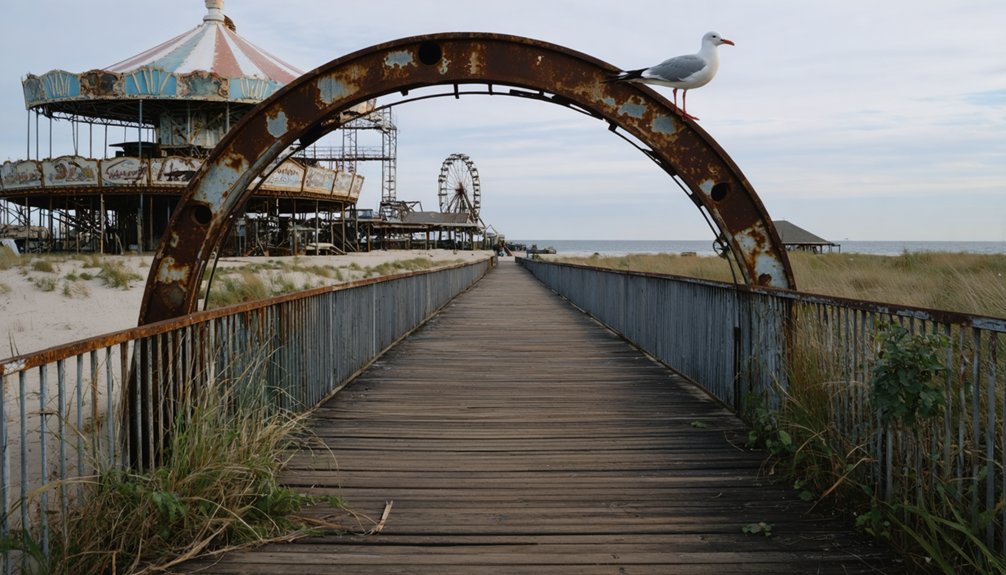
While Gay City’s abandonment stemmed from internal religious conflicts, Connecticut’s largest ghost town emerged from economic collapse and geographic isolation. Pleasure Beach transformed from a thriving late 19th-century amusement destination into complete desolation by the 1990s.
You’ll find this peninsula’s dramatic decline began when:
- The 1953 fire damaged key rides and attractions
- Economic collapse hit Bridgeport by 1959, eliminating the industrial base
- A 1996 arson fire destroyed the only bridge to mainland
- Drug use and looting plagued the abandoned structures throughout the 1980s
- Systematic demolitions removed the carousel and remaining buildings by 2011
Though Stamford Ruins aren’t directly connected, both locations demonstrate how Connecticut’s urban decay creates unexpected ghost towns.
Today, you can visit via water taxi—Pleasure Beach reopened as a public park in 2014.
Hidden Remnants: Lesser-Known Abandoned Sites Across the State
Beyond Connecticut’s well-documented ghost towns lie dozens of forgotten settlements scattered across the state’s forests and valleys.
As you explore these abandoned villages in Connecticut, you’ll stumble upon remnants of history, with crumbling foundations and overgrown pathways telling tales of their former inhabitants. Each site offers a unique glimpse into the past, inviting adventurers to uncover the stories hidden within the trees. The serene landscapes juxtaposed with the whisper of history make these locations a fascinating contrast to the bustling towns nearby.
You’ll discover hidden histories in places like Bara-Hack, where Welsh settlers’ stone foundations crumble beneath overgrown vegetation on private land that paranormal investigators can’t legally access.
Gay City State Park preserves forgotten landmarks from John Gay’s 1796 Methodist community, offering ten miles of trails past textile mill ruins and weathered tombstones.
Ten miles of hiking trails wind through the remnants of John Gay’s 1796 Methodist settlement in Gay City State Park.
Dudleytown’s cursed reputation overshadows its simple reality—poor soil and economic hardship drove families away by the 1920s.
Valley Forge and Little Egypt vanished entirely beneath reservoir waters during the Great Depression, leaving only relocated cemeteries as proof these communities ever existed.
Frequently Asked Questions
Are Any Connecticut Ghost Towns Completely Safe for Families to Visit?
You’ll find Gay City State Park and Johnsonville Village completely safe for families. Connecticut’s 50% preserved ghost towns offer family friendly attractions with maintained trails and stable structures, requiring minimal safety precautions for your exploration adventures.
What’s the Best Time of Year to Explore Abandoned Sites?
You’ll find autumn exploration offers ideal conditions with 40-60°F temperatures, clear visibility through fallen leaves, and 40% fewer crowds. Avoid summer adventures due to humidity, overgrowth obscuring 60% of sites, and increased poison ivy coverage.
Do You Need Special Permits to Photograph Ruins on Private Property?
Like trespassing on sacred ground, you’ll need explicit owner permission for photographing ruins on private property. Connecticut’s property rights laws trump photography ethics—historical abandonment doesn’t grant you legal access to capture images.
Which Ghost Town Has the Most Preserved Original Buildings Still Standing?
Johnsonville Village has the most preserved original buildings with eight intact 19th-century structures including a schoolhouse, general store, and chapel. You’ll find the best-preserved architecture showcasing significant historical significance among Connecticut’s ghost towns.
Are There Guided Tours Available for Any of These Locations?
While these haunting ruins whisper tales of the past, you won’t find guided tour options available. Private ownership, legal restrictions, and preservation efforts limit access, though their historical significance draws curious explorers seeking freedom through self-discovery.
References
- https://newenglandwithlove.com/ghost-towns-in-connecticut/
- https://patch.com/connecticut/brookfield/abandoned-not-forgotten-4-connecticut-ghost-towns
- https://en.wikipedia.org/wiki/List_of_ghost_towns_in_Connecticut
- https://i95rock.com/mystery-of-dudleytown-ct/
- https://www.atlasobscura.com/things-to-do/connecticut/ghost-towns
- https://ctvisit.com/articles/ghost-hunting-in-connecticut
- https://ermakvagus.com/North America/usa/Northeast/bara-hack/bara-hack.html
- https://digging-history.com/2013/12/04/ghost-town-wednesday-bara-hack-connecticut/
- https://www.atlasobscura.com/places/the-abandoned-village-of-barahack-pomfret-connecticut
- https://www.damnedct.com/bara-hack-pomfret/